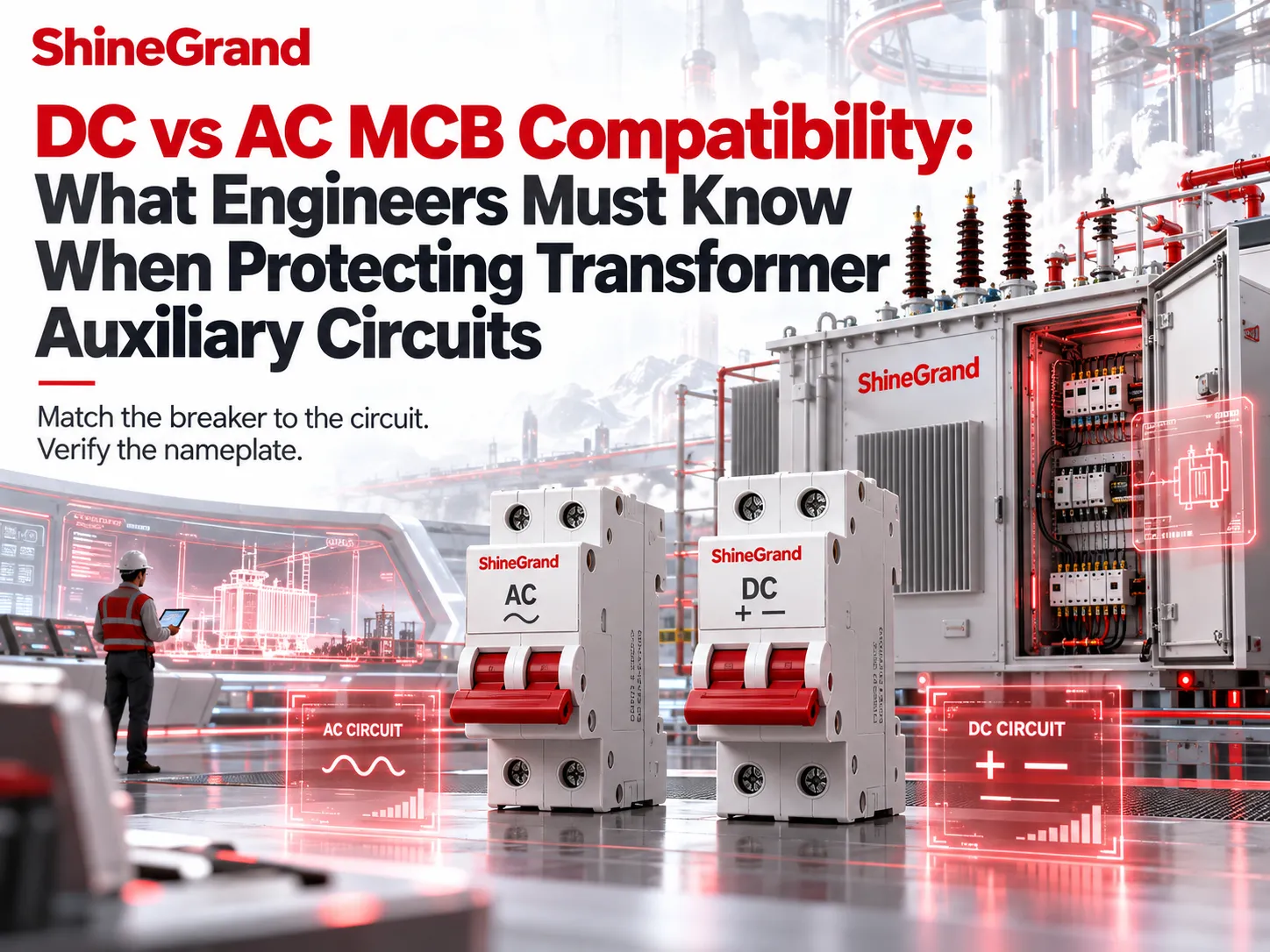
In the design phase, during bidding, and also during certification for transformer control cabinets, PV and energy storage systems, we keep getting asked the same question: can a DC MCB be used in an AC circuit, and can an AC MCB be used in a DC circuit? Although this seems straightforward, the damage caused by a mistake is crucial: the breaker wouldn’t work efficiently and safely during fault conditions, so electrical engineers and workers in the solar energy installation field should be informed about the compatibility of DC MCBs with AC technology along with the science of it, the implications for transformers and their installation.
Is it permissible to use DC MCB in AC circuits? Generally, the answer is no. This is because the MCB should be marked on the nameplate that it is certified for both applications. Thus, a DC MCB is made having in mind the peculiarities of extinguishing the arc in DC, and a lot of MCBs for DC circuits are arranged in such a way that they are polarity sensitive (using an electromagnet to extinguish arc in one of the directions). In an AC circuit, such device does not guarantee reliability of the arc shutting down due to the reverse current. Furthermore, the other way around, using an AC MCB in a DC circuit is even more dangerous since it will rely on the process of zero cross which is absent in DC. Thus, the arc cannot be extinguished. Therefore, the best option is to choose MCBs according to the way of their application, the appropriate standards available, i.e., AC type MCB according to IEC 60898-1, DC type MCB according to IEC 60947-2 and IEC 60898-3 and only true dual rated devices corresponding to both standards in mixed circuits.
The Direct Answer, and the One Exception
As we’ve just seen, the brief answer is what most people want. Hence, my duty is to shed light on this matter without making it too complicated. MCBs can be tested and identified with both AC and DC ratings. In that case, aside from the voltage rating, breaking capacity and maybe the number of poles are provided separate for each down below rated voltage both for AC and DC applications. Devices with both ratings can be used in both modes within the limits defined on their labels. Everything else is single mode application. If a certain breaker has a DC rating on its sticker, it should be used in DC circuits only while breakers with AC rating should go to AC applications only. This is not mean to be careful, it rather indicates important thing in arc behavior which will be explained in the following section of the article.
Why AC and DC Interruption Are Fundamentally Different
The main concern is regarding how the current breaker manages to stop the formation of the electric arc which appears when its terminals open due to a fault or live load.
For AC current, the flow will alternate at about 100-120 times a second with transactions going through zero on every cycle. During zero transition the arc tries to put itself out and this is where an AC breaker is supposed to block the arc from being formed again, so the problem is pretty straightforward.
For DC current (there are no zero transitions), the arc flows continuously without getting extinguished until the breaker stretches, cools, and divides the arc. Therefore, the design of a DC breaker is quite complicated; it uses permanent magnets installed with the purpose of blowing the arc out towards the splitter plates. It is worth noting that because the magnetic field is formed depending on the way the current flows the breakers are polarity-dependent and elements should have + and – markings indicated; it is impossible to connect them incorrectly.
Now the compatibility issue is obvious. If you put a polarity-sensitive DC breaker into an AC circuit the current will help during one part of the cycle and then will be working against during the second half. If you put an AC device into a DC circuit it simply won’t function because there is no zero point. Furthermore, if you need to operate the equipment at higher voltage, you will need several switches with conducting elements arranged in series.
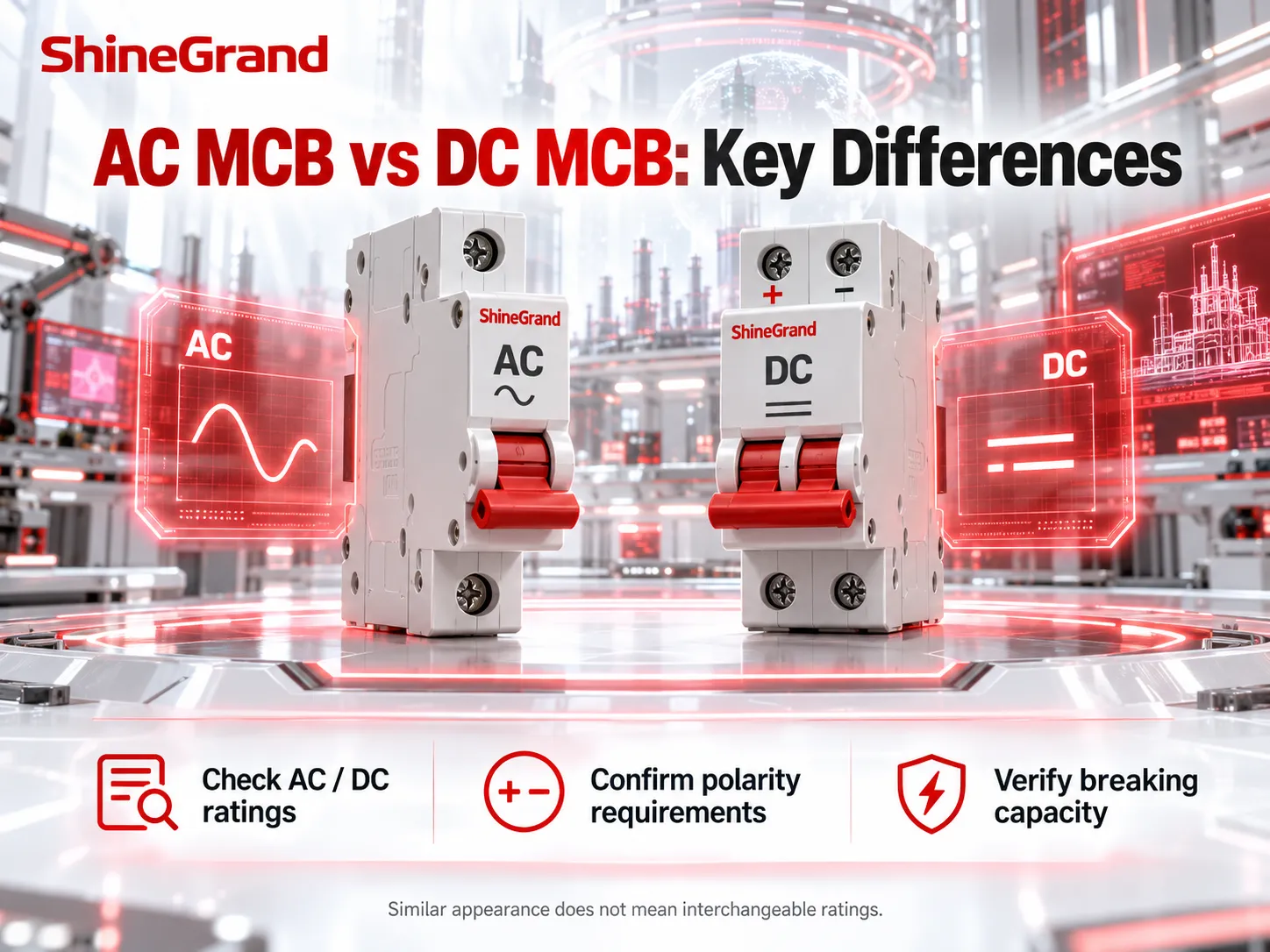
AC MCB vs DC MCB: Key Differences
The practical differences that decide DC MCB AC circuit compatibility line up as follows.
-
Arc extinguishing: The AC MCB use the natural phenomenon called zero crossing of the current while the DC MCB relies on the extended arc, forced cooling of the arc, as well as magnetic blowout.
Polarity: The AC MCB is not sensitive to polarity, whereas many DC MCBs are polarity-sensitive with + and – terminals.
Rated voltage: AC MCB is rated in terms of AC voltage like 230/400 V AC, while DC MCB is rated in terms of DC voltage. The voltage rating of a DC MCB can only be achievable through the series circuit of several poles.
Breaking capacity: the capacity of this device should be tested separately for AC and DC. The breaking capacity for the AC devices could not be used for the DC ones.
Magnetic tripping: The threshold for a magnetic trip is likely to be different for AC-based MCBs compared to DC-based systems during their operation.
Applicable standard: The AC MCB devices have compliance with IEC 60898-1, while the ones designed for DC use the standard IEC 60898-3 or IEC 60947-2 applicable for industrial devices.
Marking: The dual mode rated devices display both AC and DC ratings, while the single mode devices indicate only one rated voltage.The essential point from this findings is that AC and DC MCBs could be identical in many aspects yet tested under different standards due to drastically different behaviour of devices.
Why This Matters in PV, Storage, and Transformer Skids
At this point, we are entering territory that is not just of academic interest. A modern photovoltaic (PV) or battery storage installation built around a transformer or pad-mounted unit consists of three completely different electrical worlds paired side by side, in many cases within the same cabinet. These three electrical worlds are the AC electrical circuit (for instance, the 400 VAC electrical grid and transformer LV connections), the DC electrical circuit (the PV strings or battery bus that may have hundreds of volts of DC voltage), and auxiliary control circuits used in operation of the equipment (which may be AC 230 V or DC 24, 48, or 110 V control supplies). Each of those circuits requires protection in accordance with its mode of operation.
In this type of installation, the risk of making a mistake in the compatibility of a DC MCB and AC circuit is significant and specific. For instance, using an MCB only meant for AC operations in the DC PV or battery circuit can set a bad fire during a fault due to the inability of the circuit breaker to operate, i.e. to trip, during fault conditions. On the other hand, if a polarity-sensitive DC MCB is used in an auxiliary AC circuit, it may fail to work and, therefore, fail the type test. Even when nothing catches fire, a badly chosen device can still fail to trip, violating the coordination of the entire system, and it may also fail the type test and technical review as it should meet all requirements. In a nutshell, the fact of making the choice of the circuit breaker based on its appearance or the fact that it is available on the shelf rather than based on the mode of operating of the circuit significantly reduces safety of the entire installation.

How ShineGrand Approaches Auxiliary-Circuit Protection
ShineGrand Electric constructs transformers and patio-mounted devices featuring an AC-to-DC discipline in the design of their auxiliary circuits as well as their secondary circuits. The major idea is simple: all protective devices in the cabinet are chosen according to the circuits in which they function, and all AC devices are chosen according to the standard IEC 60898-1 and all DC devices are selected according to the standard IEC 60947-2 or IEC 60898-3. In addition, dual-rated devices are only used when it is evident and confirmed that mixed function is actually needed.
As a manufacturer, ShineGrand supplies the transformer and distribution equipment at the heart of these systems, including the Three Phase Pad Mounted Transformer Series used widely in PV and storage skids, the 6-10KV Oil-Immersed Distribution Transformer, and the indoor 20-35kV Epoxy Dry-Type Transformer, together with the switching and protection components used around them, such as disconnect switches, high-voltage fuses, and surge arresters. For the low-voltage MCB selection inside the auxiliary circuits, the ShineGrand engineering team works to the customer’s tender specification and the governing IEC standards so that every device matches its circuit’s mode, rating, and coordination requirements.
Frequently Asked Questions
Can we use an AC MCB in a DC circuit?
Generally speaking, the answer is no. An AC miniature circuit breaker operates using the zero-crossing of AC current to extinguish an arc, while there is no zero-crossing in DC circuits, and hence, the arc may not extinguish, leading to overheating, welding, or even a fire in the breaker itself. Only devices that are intended and marked for DC use should be implemented in DC circuits. Never assume that an AC miniature circuit breaker can be used in a DC application.
Can I use a DC circuit breaker for AC?
You can only usebrakethe breaker that is dual rated and labeled for AC and DC. A breaker made only for DC is designed to extinguish arcs in DC and has polarity sensitivity in magnetic blowouts that is based on the current flow. The mechanism in AC circuits will not work since the current is constantly reversing, so it may not provide reliable interruption and may not pass AC type approval. Always check the nameplate for the AC rating first.
What is the difference between an AC MCB and a DC MCB?
The AC MCB is dependent on the natural crossing of the current for quenching the arc and hence it is non-polarized and rated in AC volts per IEC 60898-1. However, DC MCB requires forcible quenching of the arc, which is why it has to employ magnetic blow-outs sensitive to the direction of current and use more than one pole in series for a higher voltage system. The breaking capacity and the tripping mechanism of the MCBs are different, and thus, their ratings can’t be equated.
Are AC and DC circuit breakers different?
Yes. Though they may appear the same, they have been designed and tested with different interruption characteristics in mind. The safest option is to choose the circuit breaker according to the function of the circuit and to only use it in a mode where it has been specifically rated to perform.
References
- IEC 60898-1 — Circuit-Breakers for AC Operation. The standard for AC MCBs in household and similar installations.
- IEC 60898-3 — Circuit-Breakers for DC Operation. The standard covering MCBs rated for DC.
- IEC 60947-2 — Low-Voltage Switchgear: Circuit-Breakers. The industrial circuit-breaker standard used for AC and DC devices.
- IEC 62109 / IEC 62477 — Safety of Power Conversion Equipment for PV and Storage. Reference for protection in PV and energy-storage systems.
- Electrical Engineering Portal. Neutral educational resource on breaker selection, arc interruption, and DC protection.
Get the Right Auxiliary-Circuit Protection From ShineGrand Electric
Correct DC MCB AC circuit compatibility is not a detail to leave to whatever breaker is on hand; it is a safety and type-approval requirement in every transformer, PV, and storage skid that mixes AC and DC. ShineGrand Electric Co., Ltd. designs and manufactures power and distribution transformers, pad-mounted units, and the switching and protection components around them, and supports customers in specifying auxiliary-circuit protection to the correct IEC standards. To discuss a project or request engineering support, explore our full transformer product range or contact the ShineGrand team through the contact form at www.shinegrand.com.
For a deeper technical reference on selecting circuit breakers for DC applications, you can download the DC circuit breaker application guide (PDF).