In case you are planning the construction or the replacement of medium voltage switch gear, motor control center, or remote substation, the usage of medium voltage control power transformer is most likely. These devices, commonly abbreviated as MV CPT are used for converting medium voltage (mainly between 2.4 kV to 15 kV) into stable low voltage control supply, which is usually 120/240 V, required for operation of different relays and contactors, measuring devices, and other auxiliary circuits. Although relatively small in size compared to distribution transformers, a wrong selection of medium voltage transformer can lead to nuisance tripping, unstable operation of control power or, in a worst-case scenario, immediate failure of insulation. This document serves as an overall source of information covering everything an engineer wishes to know about medium voltage control power transformer, including differences from the ordinary control transformer, main characteristics, sizing process, applications and the leading manufacturers, as well as common questions.
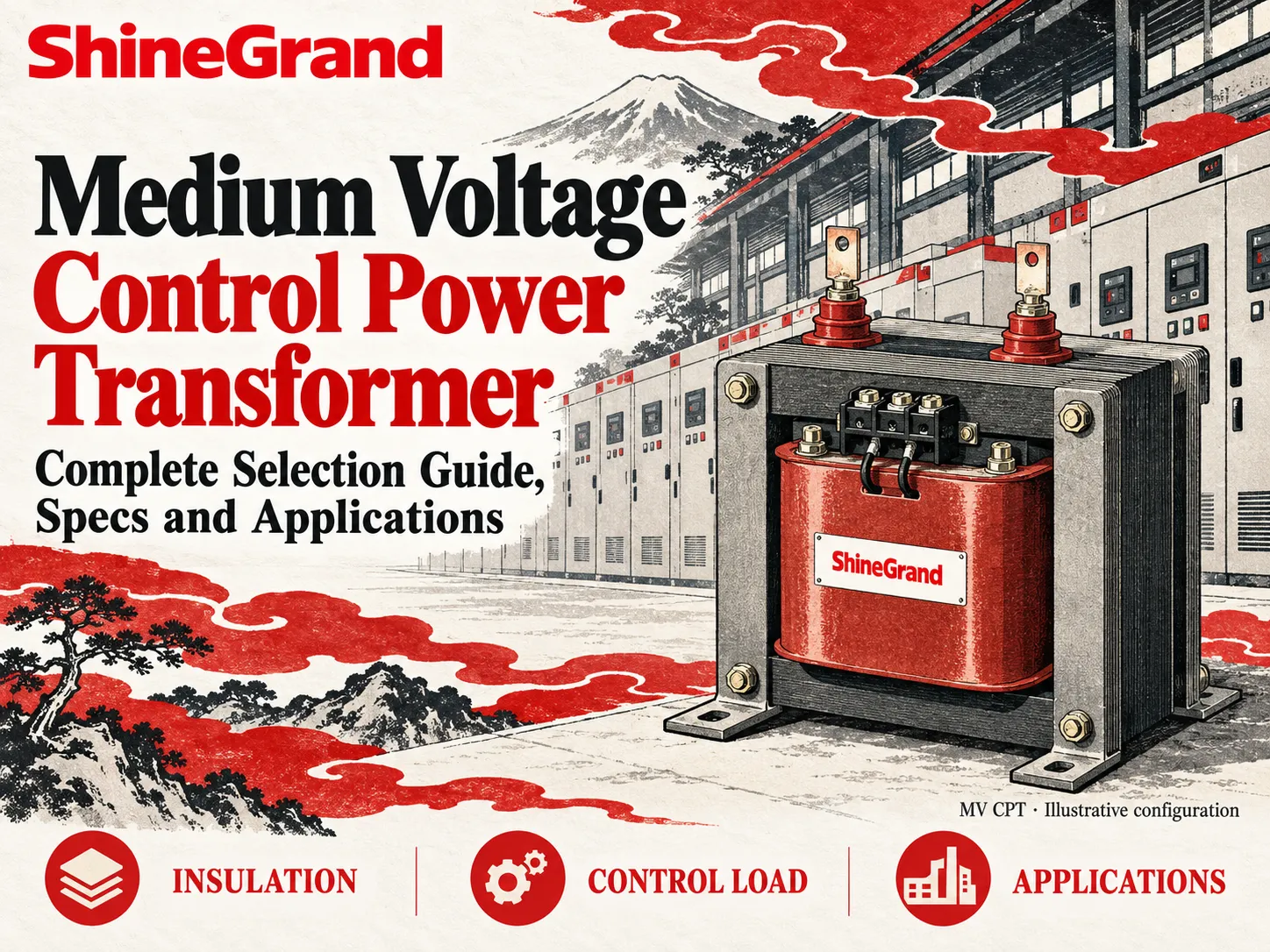
A medium voltage control power transformer is a type of transformer that delivers low voltage control power to control devices and switchgear from a medium voltage bus (with voltages usually between 2.4 and 15 kV). It is essentially characterized as having a high primary voltage and the right level of insulation (commonly having a BIL of either 60 kV or 95 kV). The kVA rating is not the only characteristic associated with the medium voltage control transformer. Having the correct combination of BIL, primary voltage, continuous rating, and inrush capability in accordance with the control load is the key factor for successful operation of control devices and protective relays.
What Is a Medium Voltage Control Power Transformer?
A control power transformer (CPT) functioning at the medium voltage refers to a single-phase dry transformer, with the coil encapsulated in epoxy, placed inside or next to medium voltage switchgear to supply the power needed for operations in the event that a different low-voltage power source is not available or cannot be adapted. It gets the electrical supply directly from the MV bus and separates a clean 120/240 V supplier needed for the control system. Such transformers can be rated between 0.5 kVA and 15 kVA and would have the primary voltages from 2.4 kV to 15 kV and a secondary of 120/240 V to facilitate series-parallel operation. Most devices of this type are meant for being used indoors and exhibit self-cooling abilities and can be supplied with primary taps of ±2.5 or 5% so that the bus voltage is adjustable.
How It Differs From a Standard Control Transformer
The term “control transformer” usually means a low-voltage piece of equipment that has a power supply ranging from 120 volts to 600 volts. Meanwhile, a medium-voltage control power transformer (or MV CPT) implies the existence of several important distinctions between this type of device and the previous one when it comes to safety.
Primary voltage: while the regular control transformer operates within the range of 120 volts to 600 volts, the medium-voltage control power transformer works with the voltage of 2,400 volts up to 15,000 volts.
Insulation / BIL: while the regular control transformer has low insulation levels, the MV CPT is rated at either 60 kV BIL (5 KV range) or 95 kV BIL (15 kV range).
Model: the normal control transformers come as dry-type either in open or enclosed form, while the MV CPT has a more robust epoxy-encapsulated design for compatibility with higher voltage levels.
Application: low-voltage control transformers are mainly used for machine tools and MCCs, while the MV CPT can be utilized for mid-voltage switchgear and MV motor starters.
Typical size: while the regular control transformers have a span of 50VA and 5 kVA, the MV CPT is normally used in the range of 500VA to 15kVA.
The main distinguishing factor between the two types of transformers is the primary voltage and BIL. If an ordinary control transformer is put on a medium voltage bus, it will lead to immediate failure of the insulation. This is the reason why MV CPT is manufactured as a separate entity.
Key Specifications to Review
Manufacturer data sheets for control power transformers should be compared on the basis of the parameters stated above, which determine the application and safety factors associated with the transformer.
Capacity: Common continuous ratings include 500 VA, 1 kVA, 2 kVA, 5 kVA, 10 kVA, and 15 kVA; the most used ratings in switchgear are the 5 kVA and 10 kVA.
Primary winding voltage: generally standard values are 2400V, 4160V, 4800V, 7200V, 12470V, 13200V, 13800V, and 14400V.
Secondary winding voltage: 120/240V enabling 120V control circuits and 240V load.
BIL: BIL is equal to 60 kV for 5 kV class and 95 kV for 15 kV class.
Temperature rise: typically 115 ° C rise at 180 ° C insulations.
Taps: ± 2.5 % or ± 5 % in primary winding.
Frequency: 60 Hz standard frequency, with 50/60 Hz available on request.
Mounting: open frame with mounting holes, horizontal or vertical.
Most medium voltage control power transformers are supplied without fuses, since the switchgear manufacturer chooses and installs the primary overcurrent limiting fuse taking into account the characteristics of both transformer and secondary circuits.
How to Size a Medium Voltage Control Power Transformer
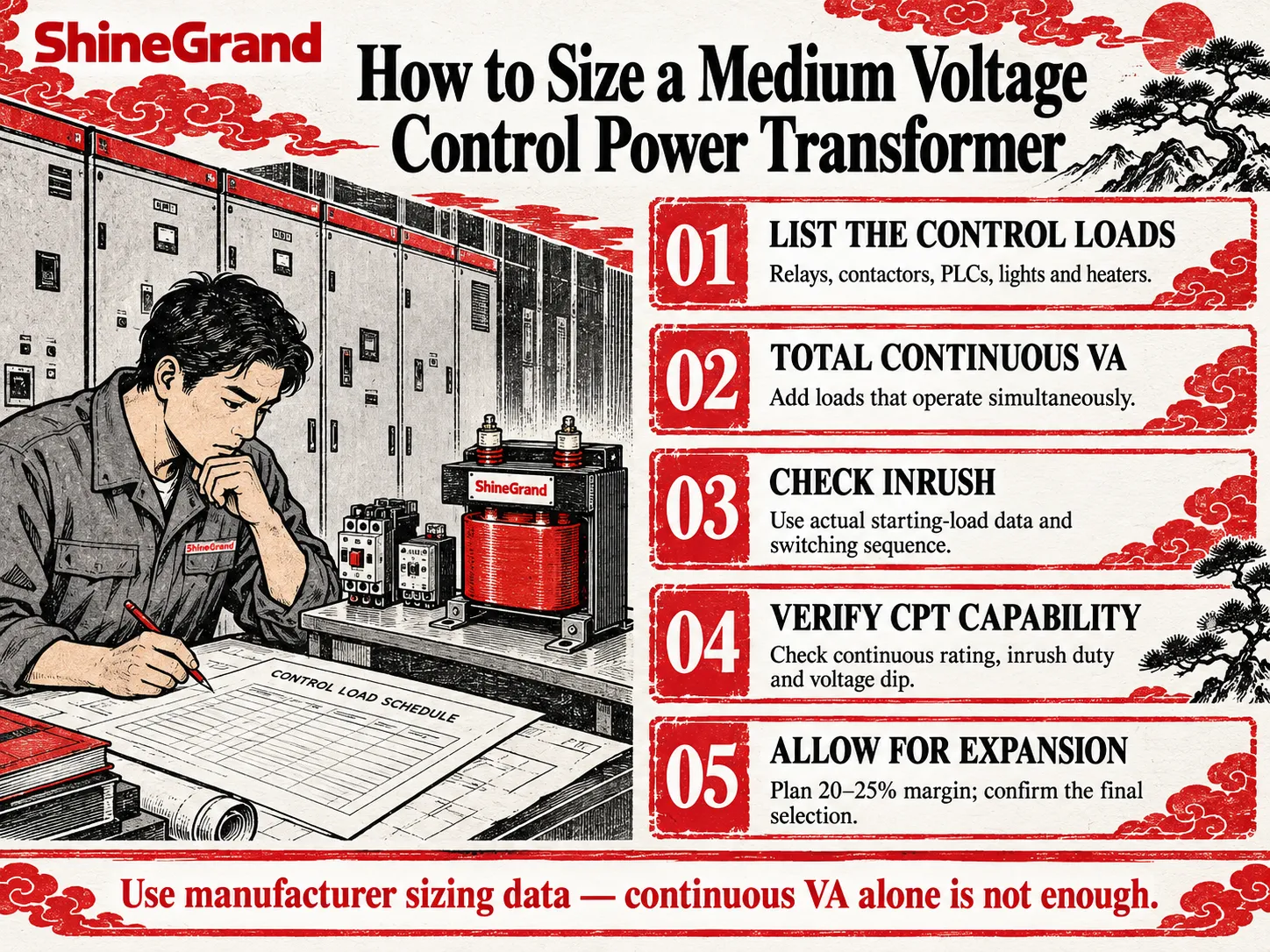
Proper sizing helps in avoiding the issues related to voltage drop, which otherwise proves to be a financial burden. The MV CPT sizing technique is easy to implement.
1.Record all control devices that the transformers must energize, such as the solenoids, contactors, relays, PLCs, the indicator lights, and space heaters.
2.Calculate the total power consumed by all devices that can operate together at once.
3.Find out the highest inrush load, which is usually the biggest contactor, and multiply by the inrush ratio (3-10 times).
4.Select a CPT for which the continuous rating is higher than the total continuous rating and the inrush rating is above the inrush level, with no or little voltage drop.
5.Consider the need for future use expansion.
For example, the switchgear cabinet takes 800 VA of continuous load and sees 2500 VA inrush for its biggest circuit breaker.
Typical Applications
Control power transformers often feature in many different mediums of installation requiring local control power. For example, they can be found in:
1- Metal-clad or metal-enclosed switchgear
2- Medium-voltage motor control centers (MCC)
3- Generator controlling panels
4- Transformer neutral grounding systems
5- Remote or unmanned substations
6- Capacitor bank and reactor controls
In any of the above, it is very rare that CPT operates in isolation. Instead, it forms part of a wider medium voltage package including the main distribution transformers, disconnect switches, and surge protection. This also forms a practical bridge to buyers as it becomes very efficient to order power transformers, switching equipment, and control power requirements from a manufacturer while ordering the entire MV distribution scheme.
Leading Brands for Reference
Engineers who choose MV CPTs and refer to well-known vendors to identify acceptable ranges and groups of models. For reference, common suppliers of control power transformers and related MV equipment include Eaton, ABB, Schneider Electric, and Hammond Power Solutions, alongside specialist makers such as Rex Power Magnetics, SNC Manufacturing, and GE/ITI. Their catalogs will help you check for standard primary voltage, BIL rating, and kVA ratios with regard to your requirements. Keep in mind that these are companies dealing with transformer manufacturing, so it’s better to deal with one partner who offers services not only for transformers.
Installation and Maintenance Notes
A number of important aspects will ensure reliability of MV CPTs in operation. First of all, check whether the unit you have is suitable for indoor use unless otherwise specified, as most of them are for indoor use only and must be housed in weatherproof enclosures for outdoor applications. Make sure that the necessary primary current limiting fuses are installed and properly rated, since the transformer is usually delivered unfused. Check if the core and the enclosure are properly grounded, and make sure that there is enough free space for ventilation of epoxy-encapsulated coils and that the coils can dissipate their heat. If required by the project, obtain certified routine test reports. With proper loading and usage in a clean dry environment, high-quality MV CPT can serve for 25 to 30 years.
Common Selection Mistakes to Avoid
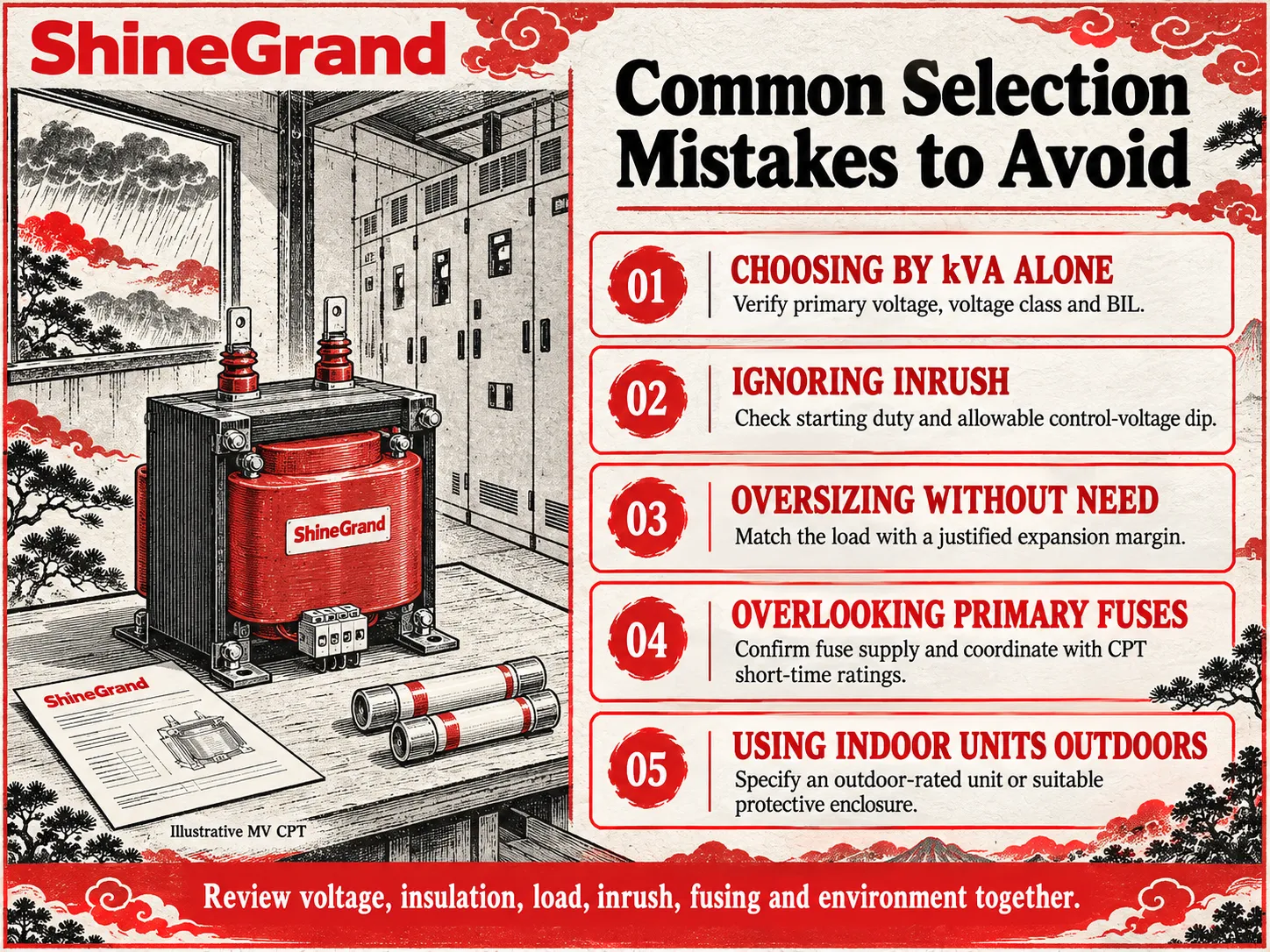
Only a few errors recur on a frequent basis in CPT applications, and all are avoidable. The biggest mistake is to choose the voltage rating in kVA alone, neglecting the BIL and the voltage classes, which leads to inadequate insulation of the bus. Another mistake is to choose a transformer that can take care of the continuous load but cannot handle the inrush current necessary to power the biggest contactors or chargers because the control voltage drops at the crucial moment. Another mistake is the opposite—namely, to oversize the transformer in a way that is inefficient cost-wise. There are also cases when the teams forget that the CPT is sold without fuses and forget to size the fuses according to its specifications, or fail to take into account the fact that the primary current-limiting fuses should be chosen according to the CPT’s short-time ratings. Finally, the last typical error is the installation of the indoor CPT outdoors without the adequate housing that would guarantee its lifespan. The way to avoid all of these mistakes is to check the voltages, BIL, continuous load, inrush current, fusing, and environment holistically.
Frequently Asked Questions
What is a medium voltage transformer?
A medium voltage transformer is a transformer functioning in the medium-voltage range, which may generally be termed as between the range of 1 kV and 36 kV. This has transformers used in distribution systems that deliver power to the electric load and special units such as the medium voltage control power transformer that provides the low-voltage control power to switchgear and other minor circuits. The term indicates the voltage level of the system rather than a particular device.
What is the difference between a power transformer and a control transformer?
A transformer used for power distribution is made to transmit bulk electrical energy to consumers. The rating of the large transformer can be from kVA to MVA. Control transformers are smaller converters and are built to have a constant voltage output, even in the face of high currents from relay and contactor coils, so efficiency is secondary. A medium voltage control transformer is a control transformer that receives its input power directly from a medium voltage bus.
What is the difference between a control power transformer and a potential transformer?
A control power transformer is responsible for supplying actual power (VA) necessary for the functioning of various devices including relays and contactors. The potential transformer (PT or VT) is the type of instrument transformer that has the higher accuracy level and operates only in measuring voltage for metering and protection; it has low burden and cannot be used for control.
What is the difference between CT and CVT?
The current transformer, or CT, reduces a high current to a value that is easy to measure. The CT performs its function of measuring and ensuring safety. The capacitor voltage transformer, or CVT, reduces the high voltage signals from the transmission line through the use of a voltage divider. Both the CT and CVT are instrument transformers, but neither of them is a control power transformer that can provide power for controlling purposes, rather than measuring.
Can I use an AVR as a transformer?
No. An automatic voltage regulator (AVR) stabilizes or corrects voltage often by using electronic regulation or tapping, while a transformer modifies voltage levels through electromagnetic induction. They have separate functions, and as such an AVR cannot substitute for a medium voltage control power transformer that provides isolated control power at the right voltage and BIL from the MV bus.
Can a medium voltage control power transformer be used outdoors?
The majority of conventional units are outdoor-rated exclusively. In order to use them outdoors, weather-resistant enclosure or specially designed outdoor CPT is necessary. Nonetheless, it is important to verify the environmental rating in accordance with the installation location.
Do I need primary fuses on the CPT?
Definitely, in nearly all instances. The CPT is typically given without any fuses, and the manufacturer of the switchgear or whoever installs it installs fuses limiting the current so as to provide proper protection for the transformer as well as the second control circuits.
What size MV CPT do I need, 5 kVA or 10 kVA?
As the total of continuous VA on your connected devices goes up, so too should your control load capacity calculations. The key in this case is monitoring for the highest inrush. Switchgear setups typically fall in the 5 kVA range or can go as high as 10 kVA plus to accommodate heavier loads.
Is a medium voltage control power transformer the same as a distribution transformer?
No. A distribution transformer supplies power to loads. A medium voltage control power transformer only supplies low-voltage control circuits inside switchgear or similar equipment, at much smaller ratings.
References
- IEEE C57.13 — Standard Requirements for Instrument Transformers.
- IEEE C57.12.01 — General Requirements for Dry-Type Distribution and Power Transformers.
- NFPA 70 — National Electrical Code, Article 450 (Transformers). General installation considerations.
- IEC 60076-11 — Dry-Type Power Transformers. International standard for dry-type transformers.
- Electrical Engineering Portal. Neutral educational resource on control power transformers and switchgear.
Conclusion and Next Steps
A properly selected medium voltage control power transformer is a small but critical part of any reliable medium-voltage system. By matching primary voltage, BIL, continuous rating, and inrush capability to the real control load, engineers avoid nuisance trips and keep protective and control devices operating stably. When your project also needs the main power transformers, pad-mounted units, disconnect switches, or a complete medium-voltage distribution package that works alongside the CPT, it pays to work with a manufacturer experienced across the full range of MV distribution equipment. ShineGrand Electric supplies medium-voltage distribution transformers, including the 6-10KV Oil-Immersed Distribution Transformer and the Three Phase Pad Mounted Transformer Series, along with disconnect switches, high-voltage fuses, and surge arresters designed for the same environments in which control power transformers operate. For coordinated technical support and factory-direct options on the MV distribution equipment around your CPT, explore the full transformer product range or contact the ShineGrand team with your system voltage, control load data, and delivery requirements.