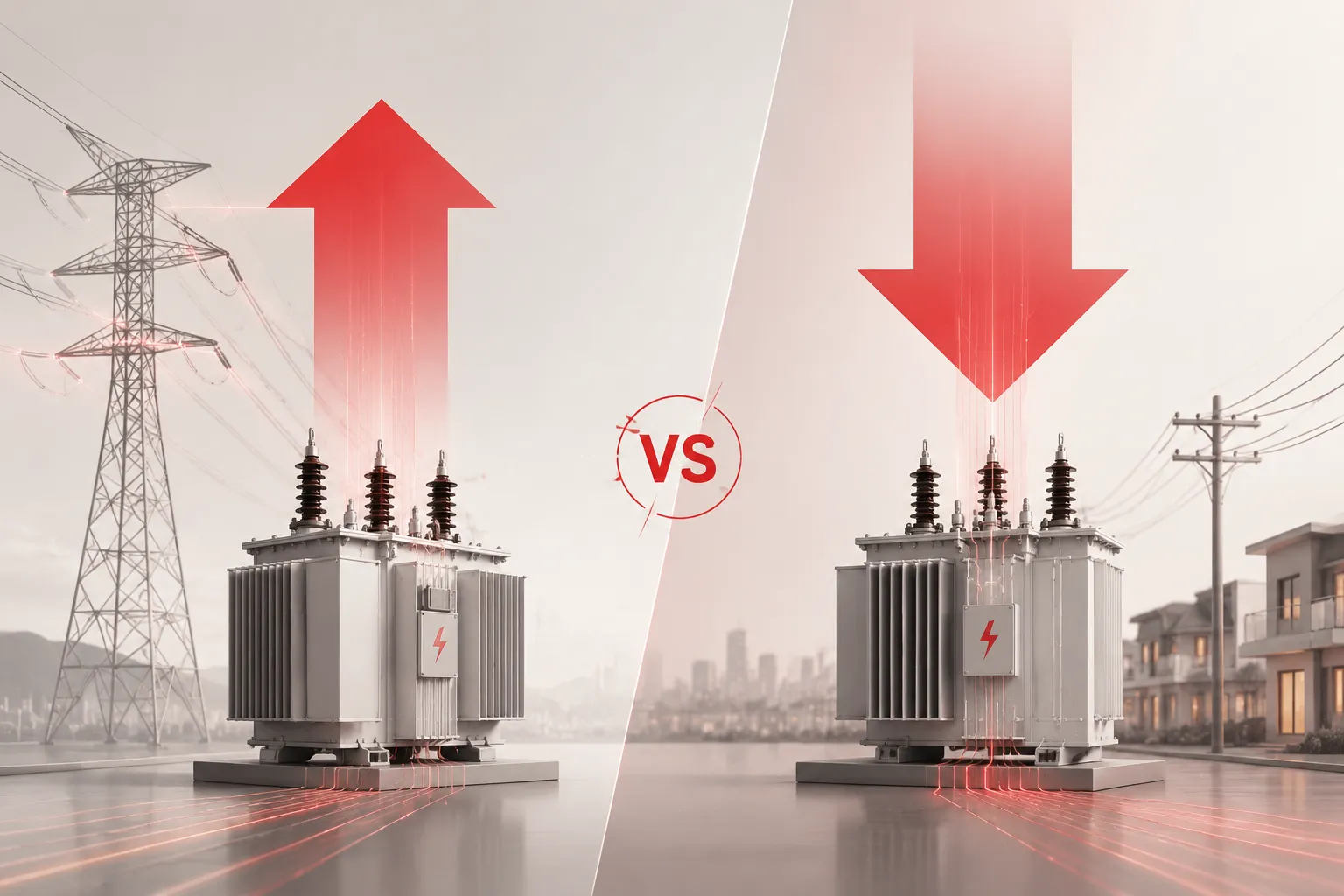
Transformers are the heroes of the electrical world silently converting one voltage or power type to another at home, at work, and in utility (national) or regional electrical grids. The two transformer types that underlie the transformer business are called and understood as the Step-Up Transformer and the Step-Down Transformer. This article will help you understand the basic differences between the two; what are some effective uses for each; and, how to select the correct transformer to meet your specific needs.
The Major Differences Between a Step-Up and Step-Down Transformer
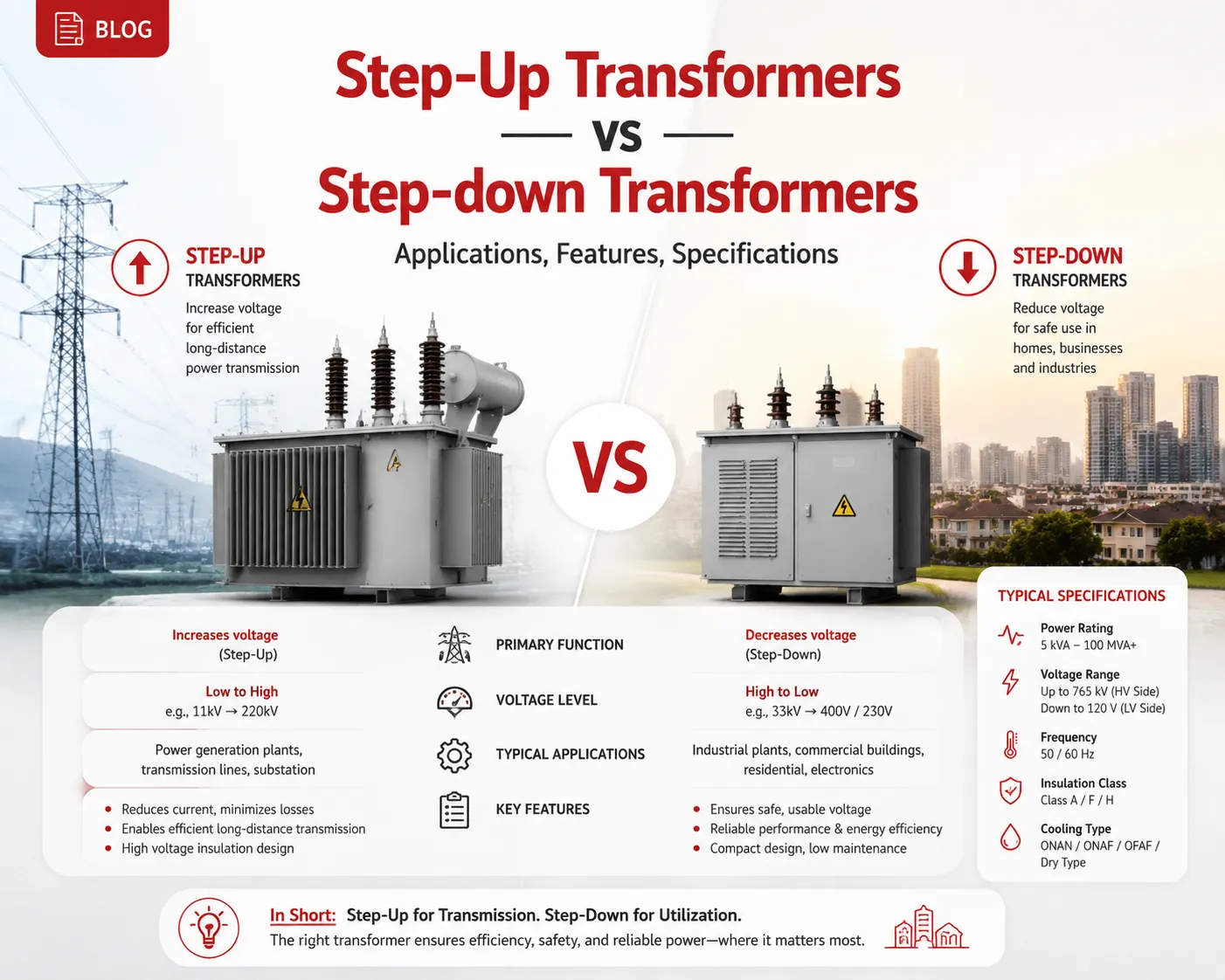
There is a major difference in how the two types of transformers work; the voltage conversion direction and how the windings are configured.
| Feature | Step-Up Transformer | Step-Down Transformer |
|---|---|---|
| Voltage Transformation Direction | Increase input voltage (e.g. 110V → 220V) | Decrease the input voltage (e.g. 220V → 110V) |
| Winding Ratio | More turns of wire on the secondary than on the primary | Fewer turns of wire on the secondary than on the primary |
| Common Applications | Transmission of power, renewable energy (solar or wind), industrial machinery | Appliances, consumer electronics, low voltage products |
| Common Current Flow | Low Input Current, High Output Current (from long distance transmission) | High Input Current, Low Output Current (for the safe use of devices) |
Step-Up Transformers: Applications, Features, Specifications
Step-up transformers are designed to increase voltage levels, thus becoming a critical part of long-distance power transmission grids and high-amp, high-watt applications. By increasing voltage and lowering current used to transmit power, you will lose less power as you transmit electricity across long distances.
Common Specifications and Models
- Step-Up Transformer (110V to 220V) – This is the most popular model that consumers buy and use in order to operate appliances from other countries, such as (but not limited to) European kitchen appliances, in the U.S. The price of step-up transformers begins at $20 for 500W models and may go as high as $200 for an industrial model rated at 5000W.
- 3-Phase Step-Up Transformer – Used primarily within industry to provide power for large machinery such as motors and compressors. Most common configurations include an input voltage of 208V and an output voltage of 480V. These units can range in power capability from 10kVA to 1000kVA. Prices vary from $500 to over $10,000.
- Small Step-Up Transformer – Compact units (50W–500W) used for hobby projects, electronics repair, or powering small electrical devices (e.g., LED strips). Prices range from $10 and up.
- DC Step-Up Transformer (Boost Converter) – Converts low DC voltage (e.g., a 12V car battery) into higher DC voltage (e.g., 24V for RV appliances). Note: Traditional transformers work only with AC; DC models use electronic circuitry.
Top Manufacturers and Pricing
- Hammond Manufacturing: Industrial grade three-phase step-up transformers starting at $800.
- Voltage Converter Transformers: Consumer 110V to 220V models from $25 to $150.
Step-Down Transformers: Applications, Features, Specifications
Step-down transformers reduce high voltage down to safe, usable levels of voltage for use within households, offices, and electronics. They are by far the most commonly used type of transformer in everyday life as they provide power to everything from your cellphone charger to the industrial control systems found in many factories.
Important Technical Specifications and Models
- 220V to 110V Step-Down Transformers – Provide the ability to operate North American appliances such as coffee makers, hair dryers, etc., while located in Europe, Asia, or Australia. Prices range from $15 for a 300W model to over $300 for a 10,000W model.
- Low Voltage Step-Down Transformers – Converts either 120V or 220V to 12V or 24V for use with LED lighting, security cameras, or doorbells. Prices range from $10 to $50.
- Isolation Transformer – Provides a barrier between the power source and the load, protecting sensitive electronic devices from surge currents or ground loops. Common in labs and medical environments, starting at $50.
Top Brands and Pricing
- Toroid Corporation: High-efficiency step-down transformers for commercial and industrial use, starting at $100.
- Amazon Basics: Affordable consumer 220V to 110V transformers from $20.
Deciding on a Step-Up or a Step-Down Transformer
Follow these guidelines when selecting your transformer:
Determine Your Voltage Needs: Read your device’s specifications to figure out the required voltage. For example, a 220V European blender in the U.S. (110V) needs a step-up transformer, whereas a 110V U.S. laptop in Europe (220V) needs a step-down transformer.
Calculate Power Rating: Choose a transformer with a power rating 20–50% higher than your device’s maximum draw to avoid overheating. For a 1000W microwave, select a 1200W–1500W transformer.
Consider the Phase and Frequency: Industrial machinery typically requires 3-phase transformers, while consumer devices use single-phase systems. Ensure the transformer matches your local frequency (50Hz or 60Hz).
Check Safety Certifications: Look for UL, CE, or RoHS certifications to ensure compliance with safety standards. Isolation transformers are recommended for sensitive equipment.
Frequently Asked Questions about Transformers
Can you use a step-up transformer to make a step-down transformer?
You can theoretically use a step-up transformer as a step-down transformer, as they are bidirectional by design. However, this is not recommended as the insulation and cooling systems are specifically designed for their intended operation, and reversing the usage could cause damage or overheating.
How can you tell if a transformer is step-up or step-down?
Check the label for input/output voltage ratings. If the output voltage is higher than the input, it’s a step-up transformer (e.g., 110V in → 220V out). Conversely, if the output is lower, it’s a step-down transformer (e.g., 220V in → 110V out). Additionally, the winding with more turns indicates whether it’s a step-up transformer.
What are the 4 types of transformers?
The 4 basic types of transformers are: 1. Power Transformers: Convert electrical power in transmission lines to consumer voltage levels. 2. Distribution Transformers: Step down voltage for homes and business use. 3. Isolation Transformers: Provide electrical separation for safety purposes. 4. Instrument Transformers: Measure voltage or current in high-power systems, such as current or voltage transformers.
Is a step-down transformer different from a step-up transformer?
Yes, they serve different purposes. Step-down transformers reduce voltage to make it safer for devices, while step-up transformers raise voltage for long-distance power transfer or industrial use. Their winding ratios and current flow directions are opposite, making them suitable for different applications.
In modern electrical systems, step-up transformers and step-down transformers play vital roles, from powering international appliances to transmitting electricity over great distances. Step-up transformers enable efficient power distribution across long distances and power heavy machinery, while step-down transformers reduce high voltage to safe, usable levels for homes and electronic devices. It is essential to carefully assess your power and safety requirements before choosing a transformer and purchase from trusted brands like Hammond Manufacturing or Toroid Corporation. Understanding the core differences and applications of these two transformer types will help ensure reliable and efficient power conversion for your specific needs.