Isolation Transformers provide protection for electronic devices against vibration, shock, electromagnetic interference (EMI), etc. An Isolation Transformer operates as a barrier between devices and electrical sources to prevent leakage of voltage between devices and sources of power. This barrier allows sensitive electronic equipment to be safely operated without fear of damage caused by electrical current passing through the device’s components. This article will discuss the operation, application, and choice of Isolation Transformer for electrical application.
How Does an Isolation Transformer Work?
An Isolation Transformer consists of two windings (primary and secondary) that are not directly connected electrically but are magnetically coupled through an iron core. When the primary winding (the input) gets powered, this energy is coupled through the iron core to the secondary winding (the output), thereby providing galvanic isolation of the two windings. The energy flows from input to output via magnetic induction (the principle of transferring energy through magnetism). Most Isolation Transformers have a 1:1 turn ratio, which means the voltage at the input equals the output; however, some models are also available to provide stepped-up or stepped-down voltages while maintaining electrical isolation.
The components of an Isolation Transformer include:
Primary Winding: Connects to a power source (e.g., 120 volts or 240 volts AC).
Secondary Winding: Connects to a load (e.g., medical equipment or audio).
Iron Core: Directs the magnetic field, thereby efficiently transferring energy (via magnetic induction) from primary to secondary windings.
This design eliminates ground loops, reduces electrical noise, and protects users from electric shock by breaking the connection with ground.
What Are the Applications of an Isolation Transformer?
Isolation Transformers are primarily used to increase safety and ensure performance in sensitive electronic equipment. Here are some commonly recognized uses for Isolation Transformers:
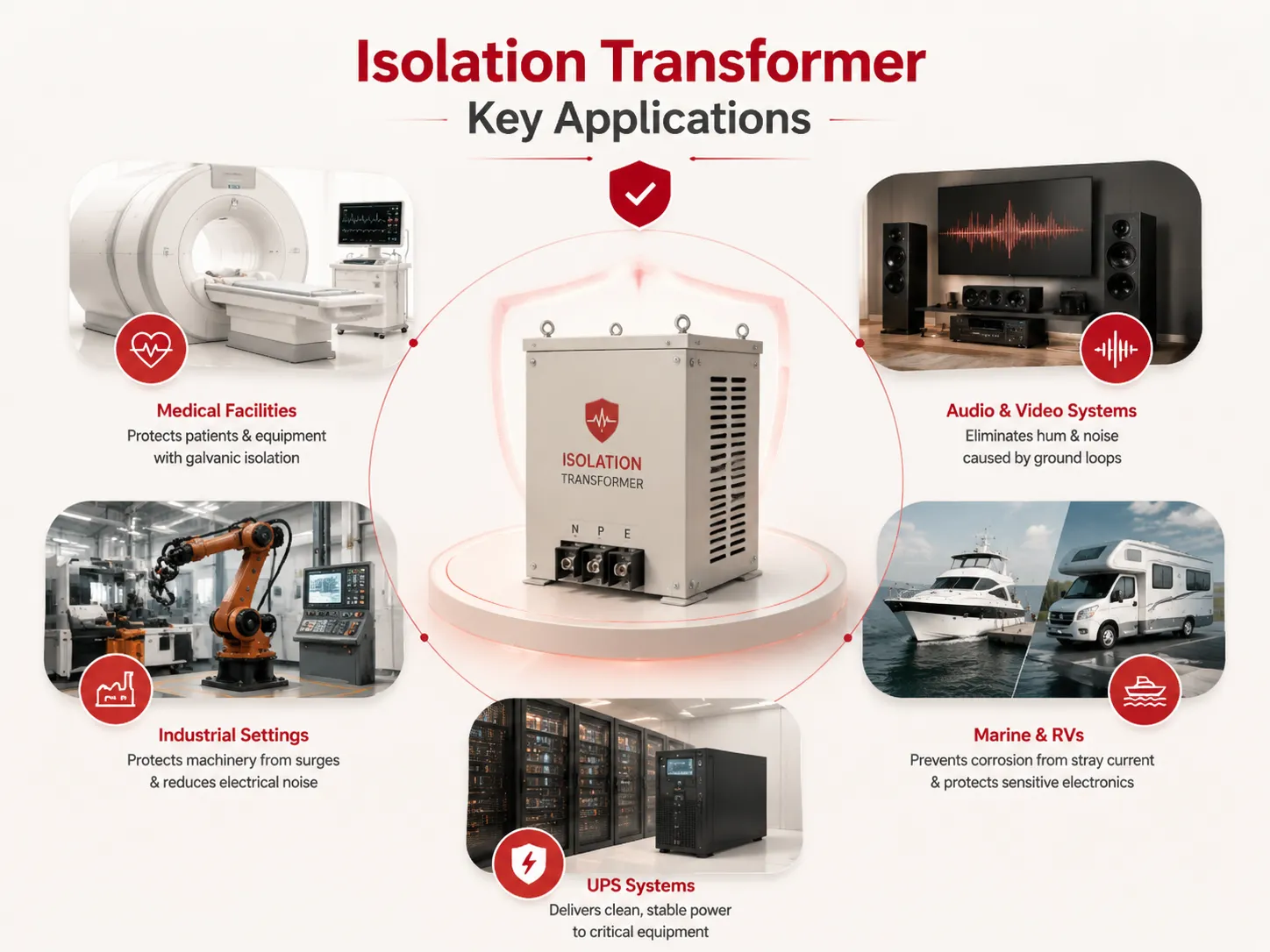
Medical Facilities: Hospitals utilize isolation transformers to ensure safety when powering patient care machines through galvanic isolation. This ensures no electrical shock occurs from equipment like MRI machines or patient monitoring systems.
Audio & Video Applications: Isolation transformers eliminate ground loops, reducing noise in audio and video systems such as home theater setups, live sound systems, and recording studios.
Industrial Settings: Isolation transformers help protect machinery against voltage spikes in factories, while also reducing electrical noise critical for the optimal operation of CNC or robotic machines.
Marine & RV Usage: Marine isolation transformers ensure electronic equipment on vessels is not affected by stray currents, mitigating problems such as corrosion. Similarly, RV-grade transformers protect sensitive electronics from unstable power sources at campgrounds.
UPS Systems: Many UPS systems incorporate isolation transformers to provide stable and clean power to critical infrastructure such as data centers and servers during power outages.
Isolation Transformer vs. Normal Transformer: Key Differences
Isolation and normal transformers are both inductive devices that use magnetic force to transfer electrical energy; however, there are crucial differences between the two types:
| Feature | Isolation Transformer | Normal Transformer |
|---|---|---|
| Electrical Connection | No direct connection between primary and secondary windings (galvanic isolation). | Primary and secondary windings share a common ground. |
| Primary Purpose | To provide safety from electric shock, reduce electrical noise, and eliminate ground loop issues. | To step voltage up or down for power distribution purposes. |
| Turns Ratio | Typically 1:1 (same input/output voltage). | Varied (e.g., 240V to 120V). |
| Key Applications | Medical equipment, audio systems, industrial machinery. | Power grids, household appliances, lighting. |
Types of Isolation Transformers
Isolation transformers come in various types to meet specific application requirements:
- 1:1 Isolation Transformers: The most common type, with equal input and output voltage (e.g., 120V in, 120V out). Ideal for noise reduction and safety.
- 3-Phase Isolation Transformers: Designed to power three-phase industrial equipment while isolating high-voltage systems.
- Drive Isolation Transformers: Used with variable frequency drives (VFDs) to reduce harmonic distortion and protect industrial motors from voltage spikes.
- UPS Isolation Transformers: Integrated into UPS systems to ensure stable, clean power for critical devices during outages.
Top Brands of Isolation Transformers & Price Ranges
The price of isolation transformers depends on factors like capacity, type, and manufacturer. Below are some popular brands and their price ranges:
- Tripp Lite: Offers consumer and industrial models. Prices range from $50–$200 for home-use 1:1 transformers, and $500–$5,000 for industrial-grade 3-phase transformers.
- Victron Energy: Specializes in marine and RV-use transformers, with corrosion-resistant models ranging from $300–$2,000.
- Siemens: Offers high-capacity industrial transformers, priced between $1,000–$10,000 depending on size and capacity.
- HUYU: A budget-friendly Chinese brand, offering models starting at $30—typically 20–30% cheaper than premium brands.
Most residential users will suffice with an isolation transformer offering a 500–1,000 VA capacity, priced around $50–$150.
How to Choose the Right Isolation Transformer
When selecting an isolation transformer, consider these factors:
Voltage & Capacity: Ensure the isolation transformer’s input matches your system’s voltage requirements (120V, 240V, or 3-phase), and select a VA rating 20% higher than the total load you aim to support.
Application: Choose a model suited to your specific use case (e.g., medical-grade for hospital needs, marine-grade for boats).
Certifications: Look for products certified by organizations such as UL, CE, or IEC.
Noise Reduction: If integrating into an audio or video system, select a transformer with a shielded core to minimize noise.
FAQ: Common Questions About Isolation Transformers
What is the isolation transformer used for?
The isolation transformer is primarily used to improve electrical safety, reduce electrical noise, and eliminate potential issues like ground loops. These transformers serve essential roles in medical facilities, audio systems, industrial environments, and marine or RV applications. They protect against electric shock and enable sensitive electronics to perform efficiently.
What is the difference between isolation transformers and normal transformers?
The main distinction lies in galvanic isolation. Isolation transformers have no direct electrical connection between primary and secondary windings and prioritize safety, noise reduction, and ground loop prevention. In contrast, normal transformers connect both windings to a common ground and are optimized for stepping voltage up or down.
What is an isolation type transformer?
An isolation transformer utilizes magnetic induction to transfer electrical energy between separate windings without any direct electrical connection. It achieves galvanic isolation, which prevents current leakage and enhances both safety and performance for sensitive electronic devices.
Why do hospitals use isolation transformers?
Hospitals use isolation transformers to protect patients and medical professionals from electric shock. Galvanic isolation ensures there is no direct electrical connection with ground, significantly reducing the risk of current flowing through a patient’s body even if medical equipment malfunctions. This feature is critical for patient safety during the use of life-supporting medical devices.
An isolation transformer is a valuable tool for enhancing safety, reducing electrical noise, and boosting the functionality of sensitive electronic systems. By enabling magnetic induction and galvanic isolation, these transformers protect against ground loops and electrical shocks. They are used in diverse environments, including hospitals, audio-visual setups, industrial workplaces, and marine/RV applications. To select an appropriate isolation transformer, ensure you match voltage capacities with your requirements, prioritize safety certifications, and look to trusted manufacturers like Tripp Lite and Victron. For private consumers and businesses, investing in an isolation transformer ensures both safety and optimized performance for your essential devices and systems.