A step-up transformer is a type of electrical device designed to increase the voltage from its input (primary winding) to provide a higher output voltage at its secondary winding while reducing current proportionally. This process adheres to the principles of electromagnetic induction, making step-up transformers essential for power transmission, industrial applications, and voltage conversion during international travel. This guide explores how these transformers function, their various types, and key factors to consider when purchasing one.
How Does a Step-Up Transformer Work?
Step-up transformers operate based on Faraday’s Law of Electromagnetic Induction, which states that a varying magnetic flux induces an electromotive force in a conductor. A step-up transformer typically comprises two wire coils wrapped around an iron core:
- Primary Winding: This coil is connected to the power source. When current flows through it, a magnetic field is generated in the core.
- Secondary Winding: This coil has more turns of wire than the primary winding. The changing magnetic field generated by the primary winding induces a higher voltage in the secondary winding.
The voltage increase is determined by the turns ratio: V₂ / V₁ = N₂ / N₁, where V represents voltage and N represents the number of turns in the winding. For instance, if the primary winding has 100 turns and the secondary winding has 200 turns, the voltage will double (e.g., 110V to 220V).
As a transformer’s voltage increases, its current will decrease proportionally, maintaining the same power assuming negligible losses. This characteristic makes step-up transformers ideal for transmitting electricity over long distances, as high voltage minimizes energy loss in power lines.

Key Types of Step-Up Transformers
Step-up transformers are categorized into several types based on their applications:
Single-Phase Step-Up Transformers
These transformers are typically used in residential or small commercial settings to convert voltages such as 110V to 220V or 120V to 240V. Common applications include powering large appliances such as air conditioners and electric stoves or serving as travel adapters.
Price Range: $50–$300.
Top Brands: Tripp Lite, Leviton.
Three-Phase Step-Up Transformers
Primarily used in industrial environments, three-phase transformers convert voltages such as 208V to 480V or 240V to 480V to power heavy machinery, motors, and manufacturing equipment. These are more efficient for high-power applications.
Price Range: $500–$5,000+.
Generator Step-Up Transformers
Used in conjunction with power generators, these transformers step up the generator output voltage (e.g., 480V) to transmission line voltage (e.g., 138kV) for long-distance power distribution.
Top Brands: General Electric, ABB.
Small Step-Up Transformers
Compact models designed for low-power devices, such as audio equipment, guitar amplifiers, and other electronic gadgets, often converting 12V DC into higher AC voltages.
Price Range: $20–$100.
Top Brands: Mouser Electronics, Digi-Key.
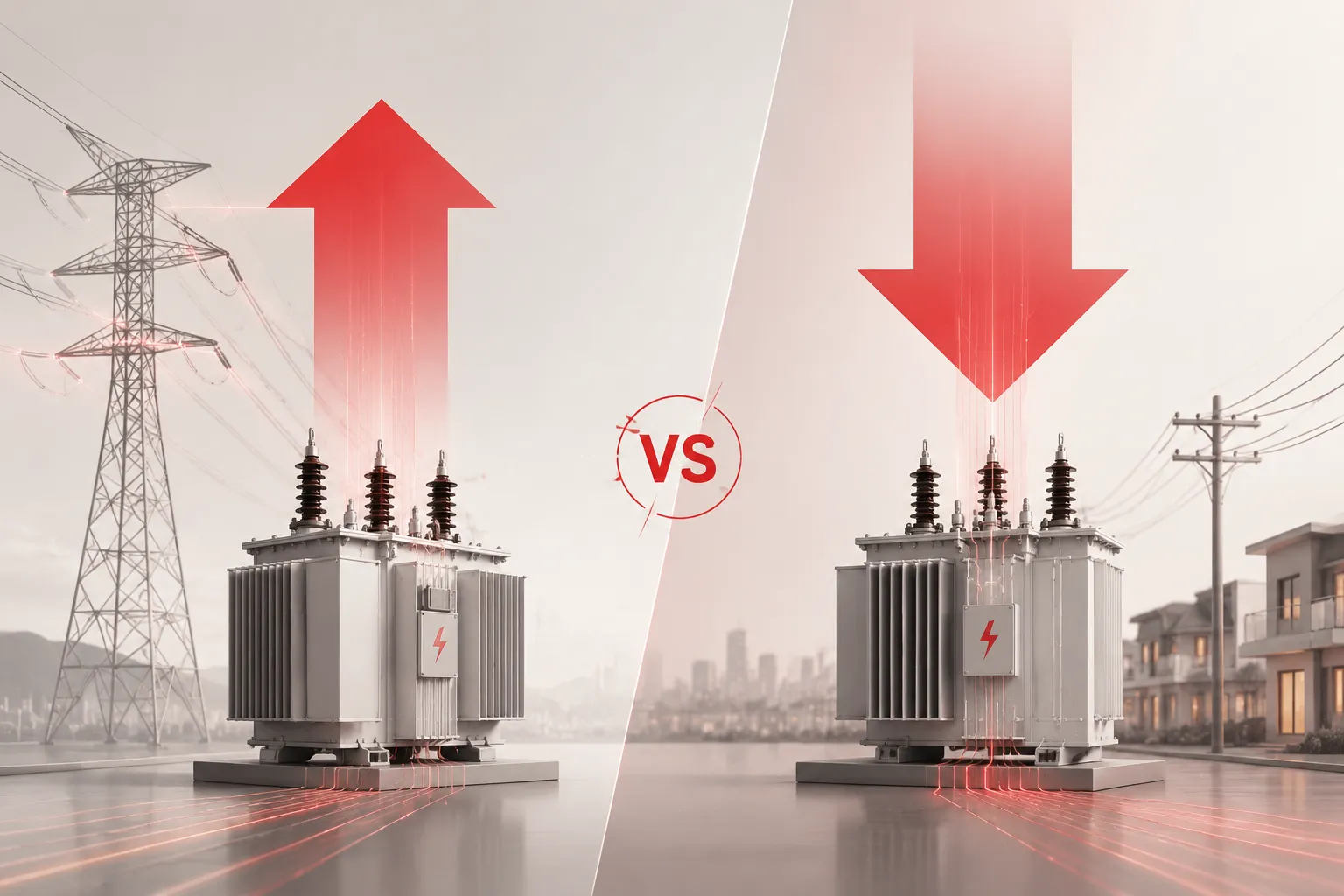
Step-Up vs. Step-Down Transformers: Key Differences
| Feature | Step-Up Transformer | Step-Down Transformer |
|---|---|---|
| Voltage Change | Increases input voltage to a higher output voltage | Decreases input voltage to a lower output voltage |
| Turns Ratio | Secondary winding has more turns than primary | Primary winding has more turns than secondary |
| Current Change | Output current is lower than input current | Output current is higher than input current |
| Common Applications | Power transmission, industrial machinery, travel adapters | Residential power distribution, electronic device charging, low-voltage devices |
How to Choose the Right Step-Up Transformer
Here are key factors to consider when selecting a step-up transformer:
- Voltage Requirements: Ensure the transformer can handle your input voltage and produce the desired output (e.g., 110V to 220V, 208V to 480V).
- Power Rating (kVA): Choose a transformer with a power rating exceeding the total wattage of your devices. Use this formula: kVA = (Watts × 1.25) / 1000 to account for safety margins.
- Phase Type: Use single-phase transformers for residential needs and three-phase ones for industrial applications.
- Efficiency: Opt for transformers with at least 95% efficiency to minimize energy loss.
FAQ: Common Questions About Step-Up Transformers
What do step-up transformers do and why?
Step-up transformers increase voltage from the primary winding to the secondary one while reducing current. They significantly improve the efficiency of power transmission and are crucial for industrial machinery, large appliances, and international voltage conversions.
How do step-up transformers differ from step-down transformers?
Step-up transformers raise voltage while reducing current, with more turns on the secondary winding, whereas step-down transformers lower voltage while increasing current, with more turns on the primary winding. Step-up transformers are ideal for power grids and industrial systems, while step-down models are suitable for home appliances and low-voltage devices.
What are potential drawbacks of step-up transformers?
While advantageous for long-distance transmission and industrial use, step-up transformers pose safety risks due to higher voltage, which requires rigorous insulation and safety protocols. They are also bulkier and more expensive than equivalent step-down transformers.
What is the 80% rule for transformers?
The 80% rule states that transformers should not operate at more than 80% of their rated capacity to avoid overheating and increase longevity. For example, a 10 kVA transformer should handle no more than 8 kVA of load to ensure safety and efficiency.
Step-up transformers are indispensable components in electrical systems, designed to enhance voltage and enable efficient power transmission. From residential to industrial applications, their versatility makes them a cornerstone of global energy infrastructure. By understanding their functionality and selecting the right model with proper safety considerations, you can effectively harness their transformative power for varied applications.