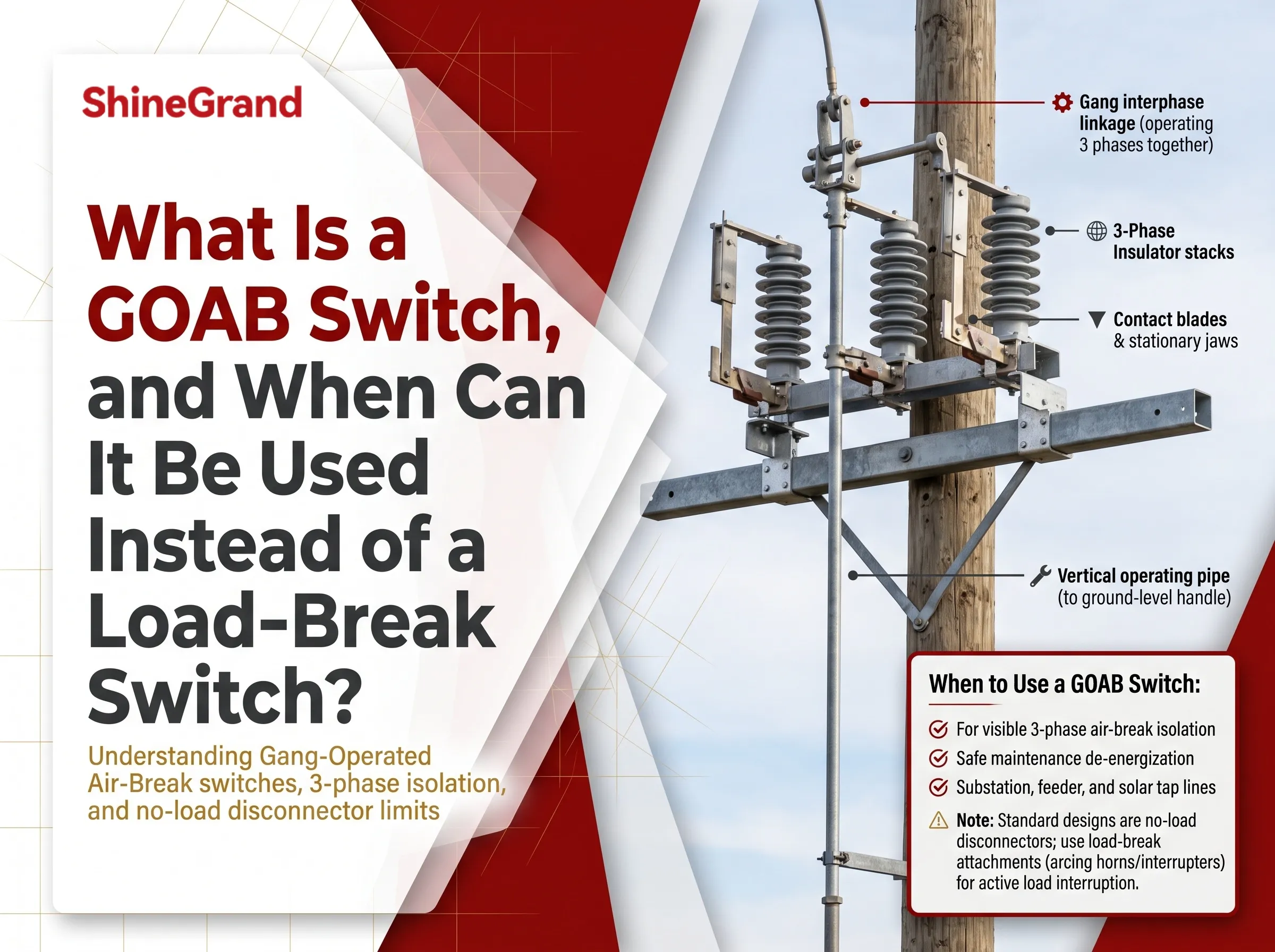
You’ve seen them either on distribution substations or along medium-voltage feeders. It’s a bunch of three insulators sitting side by side on a steel frame with a long vertical pipe going down the pole that leads to a handle somewhere at ground level. That is a GOAB switch, and it is one of the most common ways utilities, industrial plants, and renewable energy sites create a safe, visible break in an overhead circuit. It’s a simple name, yet GOAB switches are not often well understood-for one very critical point: whether they can be opened when current is flowing. This guide explains what GOAB is, how it works, the main configurations, how it differs from a load-break switch and a circuit breaker, and what to specify when you are buying one.
What is a GOAB switch? A Gang Operated Air Break Switch is an outdoor, high-voltage switch that opens and closes all three phases using one common operating mechanism with the circuit breaking done across an open air gap visible from the ground. A GOAB is a designed disconnector or isolator to isolate de-energized equipment or an insignificant current load, so they’re not designed to interrupt either load or fault current. Load-interrupting GOABs are special designs fitted with arcing horns or interrupt attachments that must have a verified load-break rating.
Meaning of GOAB
Let’s dissect the various indivisible parts of GOAB indicating all features involved:
Gang-operated: The phases of circuits are mechanically coupled together, meaning that they are operating altogether. One person working on the switches (operating handle or motor) can affect all phases. Group-operated appears to have a similar meaning as that of gang-operated.
Air-break: In this case the opening of circuit is achieved through separating the contacts in free air, thus making the open contact visible. There is nothing like liquid, gaseous or vacuum environments around the contact.
Switch: This is a simple device for switching, not meant for protection.
Consequently, the gang-operated air-break switch may be described as a three-phase power switch operating outdoors, separating power circuit in free air. The term GOAB, air-break, disconnector is frequently used in practice as synonyms, however not all disconnectors mean GOAB switches as it is covered further.
GOAB and outdoor disconnector: the need to distinguish
Outdoor disconnector or outdoor isolator appears to be more generic expressions, whereas GOAB is a specific type of outdoor disconnector. An outdoor disconnector can only be referred to as GOAB if all three phases are operating through an automatic operation mechanism. In case of single-phase outdoor disconnectors where each phase is opened separately with hot sticks, it does mean overcoming the disconnector meaning, however no reference to GOAB switches. When a disconnector is ordered, it is always crucial to check out the mode of operation rather than the voltage and current.
How Does a GOAB Switch Work?
The operation of a GOAB switch is fundamentally a mechanical process. To comprehend the operation of a GOAB one needs to know its elements.
Key components
- Base or frame: a frame (or channel) made of galvanized steel. It supports all three poles and is mounted on a substation or a pole crossarm.
Insulators: porcelain or polymer insulators which suspend the live part of the switch. In most designs one of the insulators with every pole moves.
Blade and contacts: the current-carrying arm (blade) and the stationary contact (jaw) it closes on. The contacts are made of either silver copper or aluminum to make them more conductive.
Interphase linkage: rods or tubes which connect the rotating insulators of all three poles and allow them to move together.
Vertical operating pipe: a long steel pipe connecting the switch to the operator.
Operating mechanism: a manual crank, worm-gear operator or a motor operator for remotely opened switches.
Locking and toggle devices: a toggle (over-toggle) or locking device to keep the blades securely closed against the influences of a fault, and a device for padlocking the switch in open or closed position.
Grounding devices: grounded operating handle and, in most of the cases, a device which allows for connecting the operator to the ground. Some switches are fitted with earthing knife which is interlocked with the main blade.
Opening process sequence
①.The operator starts to turn the manual crank or runs the electrical motor.
②.The vertical operating pipe rotates and moves the linkage.
③.The interphase linkage transfers the movements to three poles simultaneously.
④.The blades are freed from their locking position and opened providing the gap for every phase.
⑤.In the open position the system locks, and the operator can visually confirm if all phases have been disconnected from the circuit.
Closure process is the same as opening but in reverse order.
Popular GOAB Switch Configurations
GOAB switches have various configurations of blades. The configuration affects space between the phases, space needed for the switch and also mechanical impact on the structure.
Vertical break: blade is hinged at one end and raises vertically. This type requires less horizontal space and can be used for narrow structures and layouts with obstacles above the switch.
Side break: blade swings to the side horizontally. It needs less height but more space between phases.
Center break: each pole has two rotating insulators which support one-half of a blade and meet in the middle part. When insulators rotate both parts of the blade swing open creating space in the middle.
Double side break is used when a center insulator rotates a blade thereby separating it at both ends with two consecutive gaps.
V-type and other compact designs are created to save space as blades are in “V” position.
Moreover, switch can be installed in various locations: upright on a horizontal crossarm, vertical on a pole with phases vertical or hanging under it. Each position needs a switch that is properly tested because gravity and load of ice work differently on the blade.
Can a GOAB Switch Break Load?
This is the most important question about any GOAB switch, and the answer depends entirely on the design.
Standard GOAB switches are no-load disconnects
A gang-operated air break switch is considered a disconnector of the standard variety. By international definition (IEC 62271-102), a disconnector only needs to make or break low current; for instance, charging current for short run bus sections, or to make or break without any significant change of voltage at open terminals. It’s not made for switching on loaded circuits, nor is it meant to interrupt fault current. The proper order of action is to first open the circuit breaker, recloser or load break first making sure of isolation afterwards.
Opening a GOAB under load will result in a long arc across the contacts when a circuit is opened under load. At medium and high voltage this arc may burn the contacts, skip to adjacent phases or even to the ground, creating danger for the operator and putting the operator at risk of getting injured no matter that he is standing on the ground mat.
Load-break GOAB switches are special designs
Several GOAB switches are designed to have a certain interrupting ability:
Arcing horns (whips or quick-break horns) are additional sets of horns that make contact after the main contacts disconnect and then separate quickly. This type of horns creates an arc away from the contact areas and allows for the interruption of small current such as magnetizing current of the transformer or charging current of the line. Its capabilities are limited and the manufacturer must define them.
Here are interrupter attachments: vacuum or SF6 interrupters mounted on the poles and breaking current internally during process of the opening. The switches equipped with these machines can interrupt the rated load current, charging or loop-splitting current depending on the value of the test.
The main rule is that if the switch doesn’t possess the dedicated rating for the interruption, it will not break the load during operation. It is a common mistake to think that the switch can perform the interruption because it looks like a load-break switch or has horns or because some other switch produced by the same manufacturer is rated as load-break one.
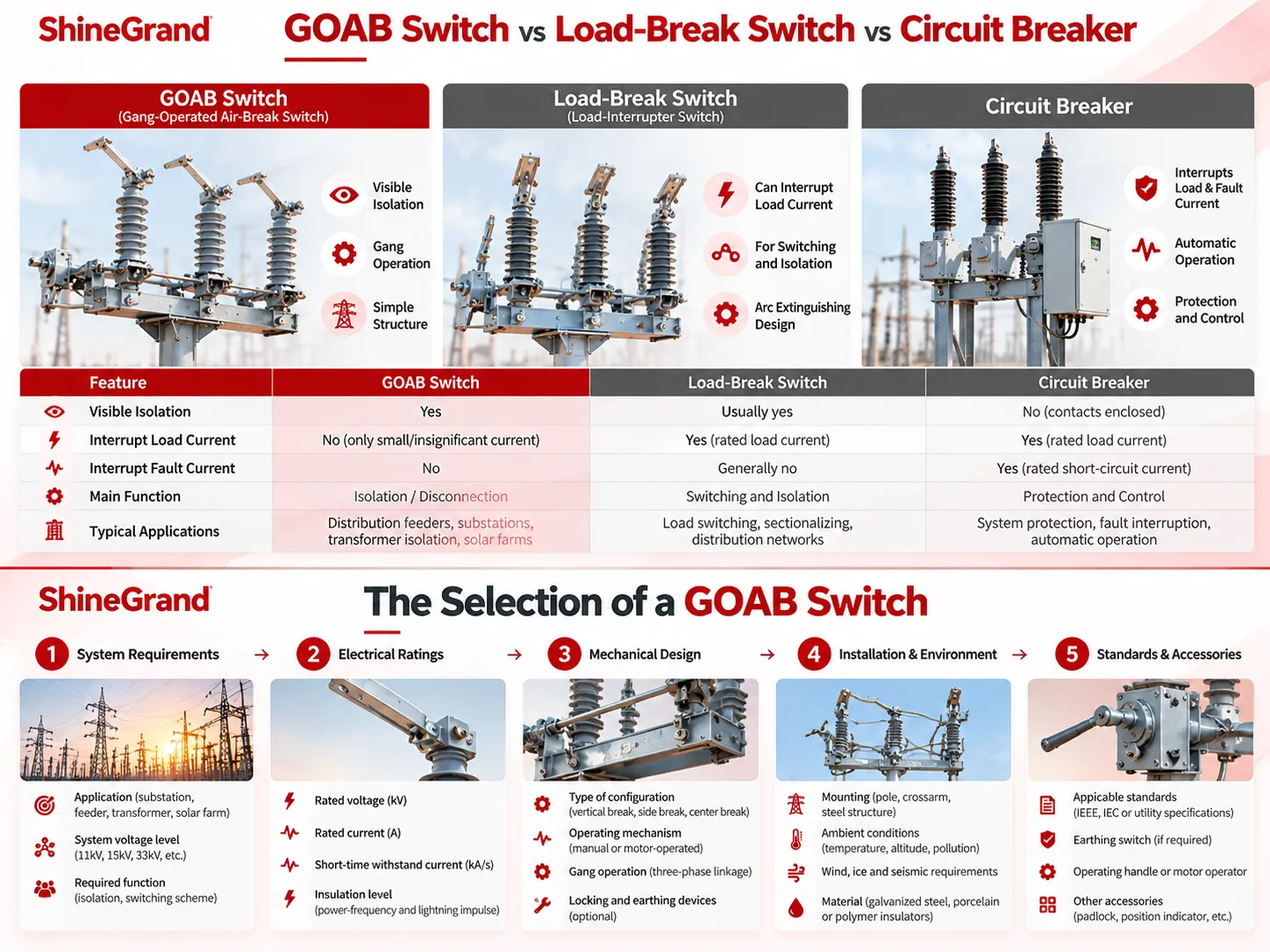
GOAB Switch vs Load-Break Switch vs Circuit Breaker
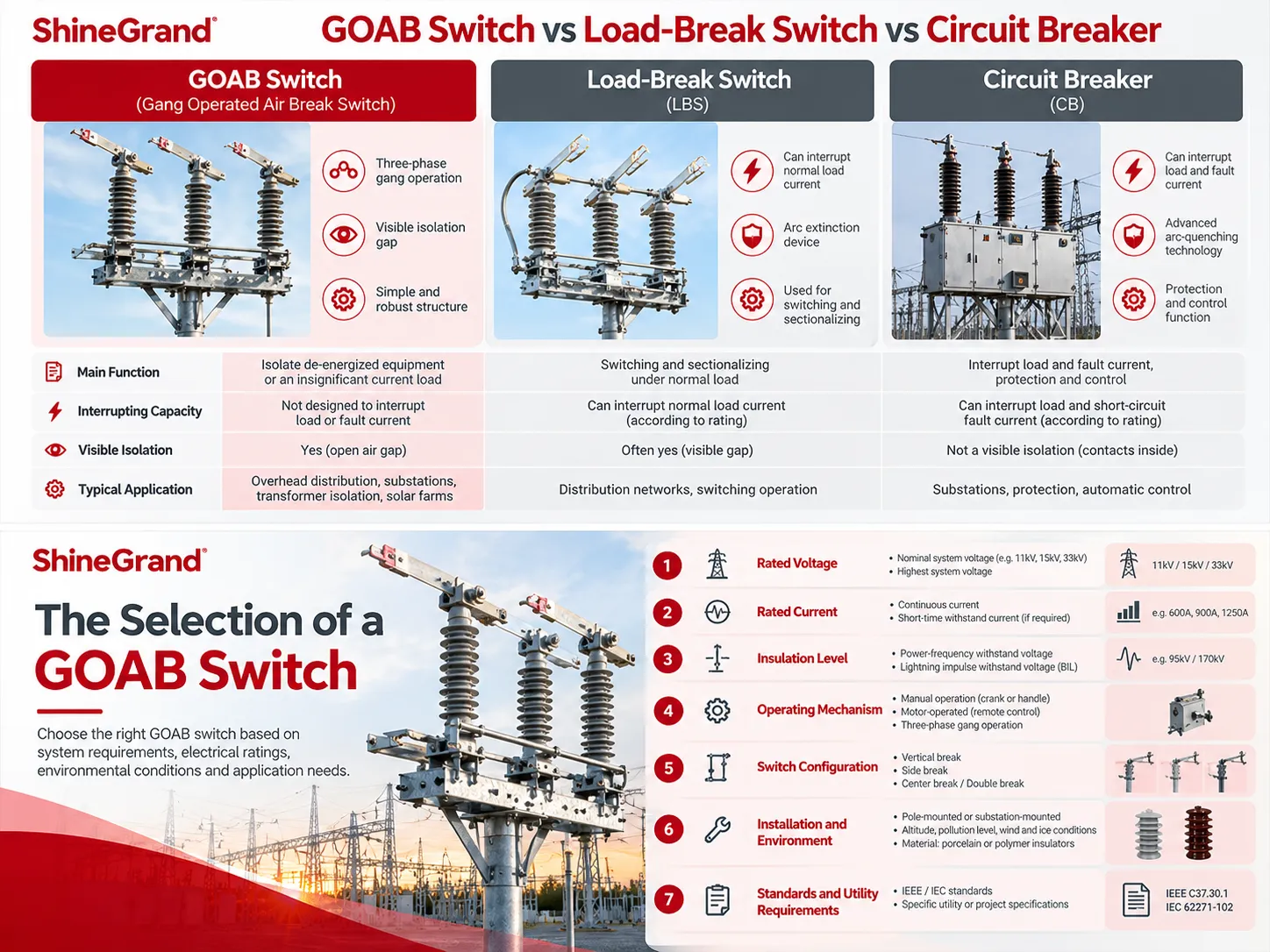
All three items are usually located one next to each other, and each serves a different function:
Standard GOAB switch (with disconnection function) provides visible isolation. The switch carries an active current load or was capable of withstanding a fault current when in position closed, but it can be opened only when there is no load present or negligible load current.
The load break switch enables the interruption of the normal load current within the capacity of the load-break switch itself, while it cannot interrupt the fault current. Depending on the design of the device, it may or may not provide visible isolation.
A circuit breaker is capable of interrupting both active current load and fault current with the relay control, but it usually has no visible air break. Thus, circuit breakers are installed together with disconnection devices.
Usually, circuit breakers on the distribution feeder interrupt the electric current and disconnecting devices provide isolation from the current in order to carry out maintenance.
Gang-Operated vs Single-Pole Operated Switches
Not every outdoor isolator is gang-operated. Single-pole isolators, sometimes called hook stick switches or single-phase disconnects, do not have interphase connection. Every phase is opened and closed by a lineman with the help of an insulated hot stick.
On the contrary, gang-operated switches operate all phases simultaneously on the ground, providing reliable three-phase disconnection. However, they are more expensive and require a frame structure and arm.
Single-pole disconnects are less sophisticated and cheaper than gang-operated disconnectors; they can be used in places where switching is done not frequently, or there is a need to isolate certain phases at a time. However, a lineman has to operate phase by phase, being closer to live parts.
he ShineGrand’s SGG3 10 kV outdoor single-phase isolator is an example of such an approach, since each phase is equipped with its independent operating mechanism and needs an insulated rod to operate.
Where GOAB Switches Are Used
- Substations: circuit breakers, transformers, capacitor banks, and buses should be taken out of service for maintenance work.
Distribution feeders: should be divided into portions, connected to each other, and tapped into different lines.
Recloser and regulator cutout: allowing the system to be interrupted for protective or voltage control purposes.
Industrial facilities: need adaptation of incoming power supply and taking large transformers out of service.
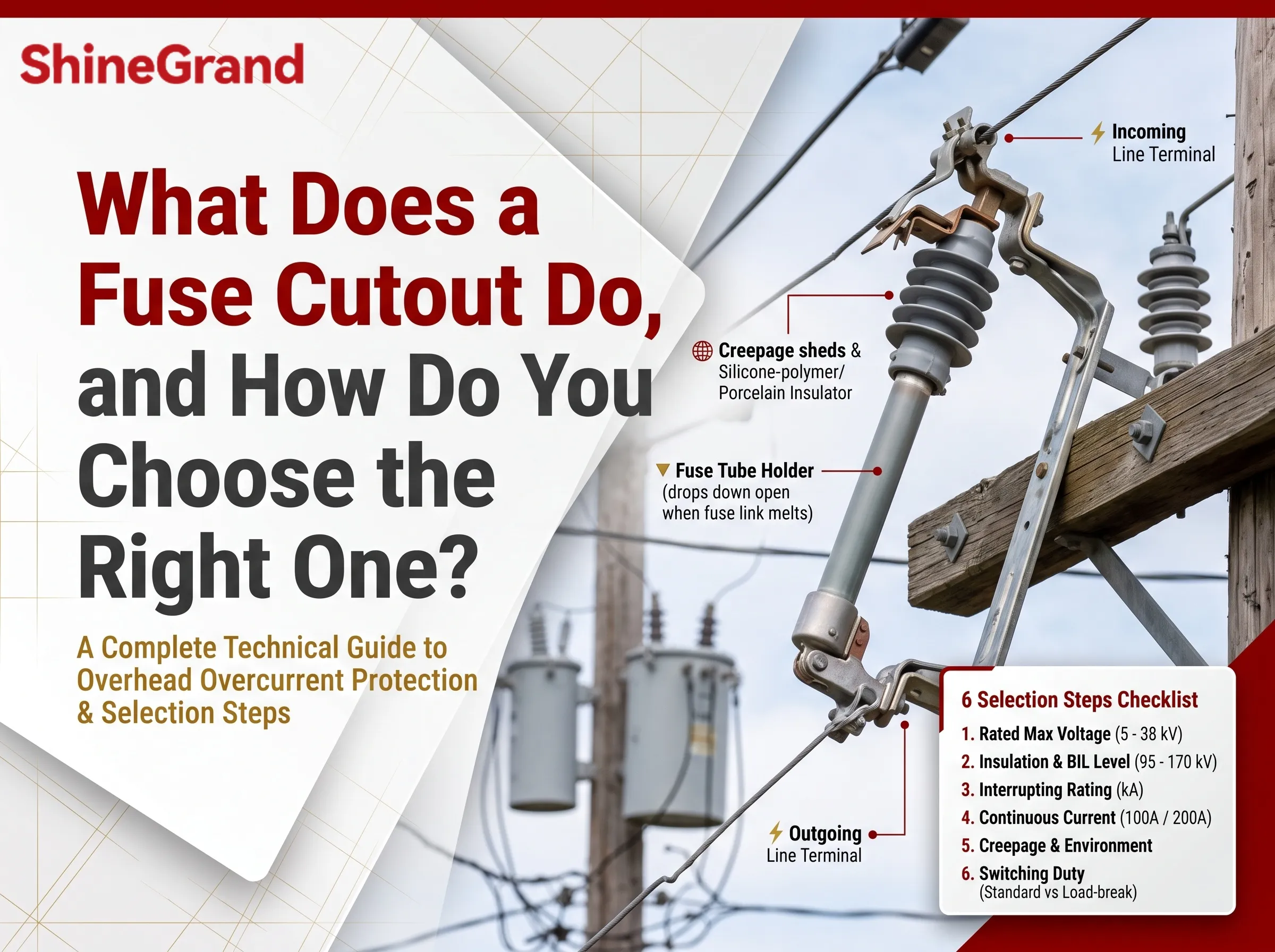
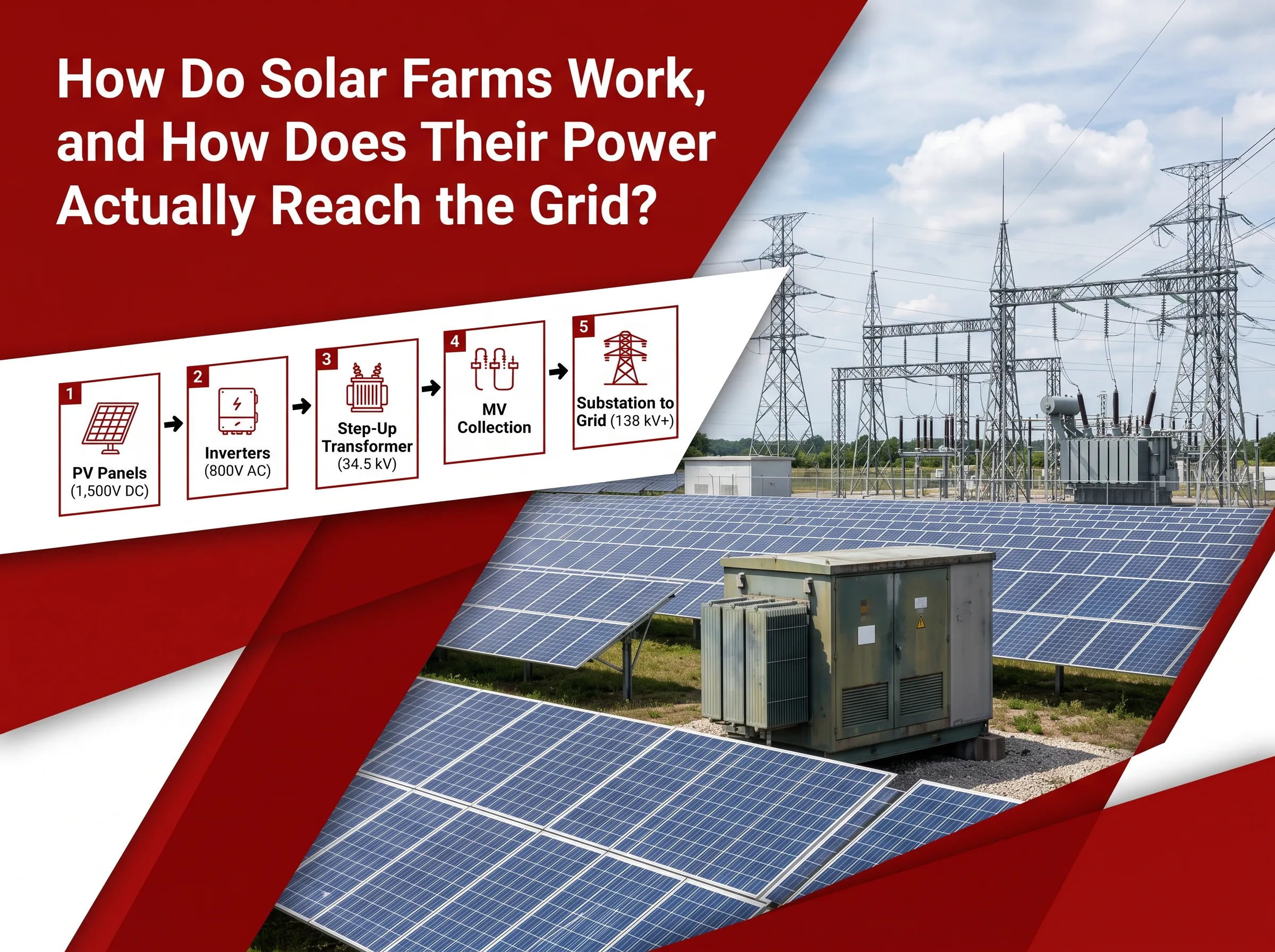
Solar and wind energy plants: need to consider the following components for the electrical system design: ShineGrand’s guides on how solar farms work and how to start a solar farm explain where these switches sit in a solar plant’s electrical system.
The Selection of a GOAB Switch
The specification of a quality GOAB switch takes into account electrical, mechanical and functional characteristics. In our case, the following should be taken into consideration:
①.The maximum voltage level as well as insulation class. The switch should correspond to the maximum voltage of the system, the BIL (Basic insulation level) and the withstand voltage, both in the case of working against the ground and with an opened gap (normally, the withstand voltage should be higher).
②.The continuous current. The rating should be higher than the maximum continuous current load, letting some allowance for further increase. Commonly used values lie within 600-1200 A, and above.
③.The short-time and peak withstand current values. The closed switch – which should be able to withstand fault currents in the system without merging or opening. It is necessary to take into consideration the short-time (thermal) value and the short duration, and the peak respectably.
④.The switching purpose. It is necessary to indicate whether the switch is needed for isolation purposes only or it should be able to interrupt line charging, magnetizing or load continuous operation. In case of necessity for interruption, it is essential to signify the load-breaking capacity of the switch.
⑤.The break type, mounting and space between phases. This point includes breaking types such as vertical, side-walk, central break and double break, as well as mounting position
⑥.The type of switch actuation device. Depending on this aspect, the switch should be either manually operated or electric action device.
⑦.The ground switch and locking device. The interlock should not allow the grounding switch to be either opened when the circuit is still closed.
⑧.The switch insulators and switching environment. One of the questions which should be asked includes insulation type (porcelain or polymer), the length of the creepage distance concerning the pollution of the station site.
⑨.The standards applied. In this case it means asking for the type test results according to a given standard.
Keeping the GOAB Switch in Good Condition
Since a GOAB switch might have to stay shut for long periods of time and then be called upon to operate, upkeep of that switch becomes important. The majority of problems that GCC switches experience relate to mechanical issues:
– Corrosion, dirt or hardened lubricant leads to seized-up bearings and pivots, resulting in difficult or impossible operation of the switch.
– Poor alignment of the blades and contacts causes an inability to close completely, and thus:
– The contact resists and generates heat together with the contact wear.
– Poor linkage connection may not allow one of the phases to go open or shut even though the operator has performed the appropriate action.
A standard maintenance program will include infrared thermographic scanning, visual inspections, cleaning and lubricating the pivots and contacts during outages, checking the alignment and toggle adjustments, measuring the contact resistance and running several rounds of operations of the switch.
How to Understand the Chinese Disconnector Model Number Code
Many disconnector types manufactured in China have a very complicated model number code but there is some good news: the code is very easy to understand. Let’s take for instance the model code of GW4-40.5/630:
G = disconnector (isolating switch);
W = outdoor use;
4 = series;
40.5 = maximum voltage level in kV (suitable for the 35kV class system);
630 = maximum current capacity in amps.
This information allows users to compare various brands but does not provide any information about the switch operation (operated on its own, mounted or able to interrupt the current).
ShineGrand Outdoor Disconnectors
ShineGrand Electric manufactures outdoor high-voltage disconnectors for distribution lines, substations and renewable energy projects. Key models include:
- GW4-40.5/630 40.5 kV outdoor disconnector: rated 40.5 kV and 630 A, with 185 kV lightning impulse withstand to ground and 215 kV across the open gap, short-time withstand up to 31.5 kA, silver-plated copper contacts and creepage distance of 1,025 to 1,250 mm. It suits 33–35 kV substations and collection systems, and includes a ground knife rating for grounding.
- GW1-10/1250 10 kV outdoor disconnector: rated 10 kV (12 kV maximum) and 1,250 A, with 31.5 kA for 4 s thermal withstand and 80 kA peak withstand. It can be supplied with a manual rain-proof operating mechanism (CS8 series) or a CX6 electric motor operator.
- GW5-40.5/1250 high-current outdoor disconnector for 40.5 kV applications needing higher continuous current.
- SGG3 10 kV outdoor single-phase isolator for locations where individual, hot-stick operated isolation is preferred.
When the three poles are supplied on a common frame or linked to a single operating mechanism, these disconnectors operate as gang-operated switches. Please confirm the required pole configuration, operating mechanism and any load-switching duty when requesting a quotation. You can view the complete disconnect switch range, along with fuse cutouts and surge arresters for the same overhead and substation applications.
Frequently Asked Questions
What does GOAB stand for?
GOAB stands for Gang-Operated Air-Break. It describes an outdoor switch whose three phases are opened and closed together by a common mechanism, with the circuit broken across a visible air gap.
Is a GOAB switch the same as a disconnect switch?
Standard GOAB switches are referred to as outdoor three-phase gang-operated disconnect switches; however, a disconnect switch does not always mean it is a GOAB since there are exceptions such as a single pole hook stick disconnect or indoor disconnectors, which are noticed more in indoor applications.
Can you open a GOAB switch under load?
This is not a standard one. A standard GOAB is only intended for no-load isolation or negligible current. Opening the circuit while it is energized creates a dangerous arc. Only those GOABs which have undergone testing for load-breaking ability using arcing horns or interrupting fittings can break away the load, and that too, only within the specified limits of the load-break ratings.
What is the difference between a GOAB switch and a hook stick switch?
A GOAB switch activates all three phases simultaneously from a ground-level switch or motor. A hook stick switch is a single-pole disconnect that line staff operates one phase at a time with an insulated hot stick. Hook stick switches are easier and cheaper; GOAB switches are quicker, safer for three-phase disconnection, and can be motorized.
What is a motor-operated air break switch?
An electric air break switch, or MOAB, is defined as a GOAB containing a motor operator fitted either instead of a manual handle or at least alongside it. The switch can be operated through SCADA or local control panel, providing it with the feature of automatic sectionalization and eliminating its dependence on remote manual operation.
Why is the operating handle of a GOAB switch grounded?
When an insulator breaks down or flashes, the pipe and handle under operation may become energized. However, grounding both the operator and the handle (with the operator standing on a grounded surface) helps keep the operator at the same voltage level as the handle so that he is not subjected to touch or step voltages.
Where are GOAB switches used in a solar farm?
In solar farms, GOAB switches are usually used to isolate medium-voltage collection feeders, the high-voltage side of the main transformer, and the line to the point of interconnection, so parts of the facility can be safely de-energized for maintenance purposes.
How often should a GOAB switch be maintained?
Intervals are determined by the utility’s practice, environment and operation frequency of the switch. Many owners of the switches conduct annual or periodic infrared scanning and visual inspections together with complete mechanical maintenance, lubrication and contact resistance tests once every few years or during scheduled outages. If the switches are installed in a coastal, dusty or very cold area, they will require inspection more frequently.
References
- IEEE C37.30.1 — Standard Requirements for AC High-Voltage Air Switches Rated Above 1000 V. North American ratings and tests for outdoor air switches.
- IEC 62271-102 — High-voltage switchgear and controlgear, Part 102: Alternating current disconnectors and earthing switches. International standard for disconnectors.
- Eaton — Overhead Switches and Sectionalizers. Three-phase overhead switches and bypass switches for distribution systems.
- Hubbell Power Systems — Air Break Distribution Switches. Manufacturer category for distribution air break switches.
- Southern Switch — What Is a GOAB Switch?. Field perspective on GOAB configurations and maintenance.
- Wikipedia — Disconnector. General background on disconnectors and isolators.
Need a Gang-Operated Disconnect for Your Project?
A GOAB switch is only as safe as its specification: the right voltage and insulation level, enough current and short-time withstand, the correct break type and mechanism, and a clear understanding of whether it is a no-load disconnect or a tested load-break design. If you are planning a substation, distribution line or solar farm connection, send ShineGrand your system voltage, current, fault level, mounting and operating requirements. Contact ShineGrand for a quotation or technical support.