Most explanations of how solar farms work stop at the panels: sunlight strikes a silicon surface, electrons move and electricity is generated. This is correct but also just the beginning. The electricity produced from the solar panel is power in the form of low-voltage direct current. In contrast, the power grid operates on high-voltage alternating current. To connect the two, there must be a stream of inverters, transformers, wires and protections that everyone ignores, yet without this there is no way to deliver power to the consumers. This guide describes how electricity travels from the solar panel until it is delivered to the consumer.
How do solar farms work? The solar farm consists of a number of photovoltaic panels that turn sunlight into electricity in the form of direct current. In the next step, the process to convert the electric current into alternating current begins. Then, there is another step where the current voltage is increased thus allowing the electricity to travel across several kilometers of wires. Finally, the electricity is delivered to the consumers.
Definition of Solar Farm
Solar farm refers to the type of solar power system located on the ground with the aim of producing power to either feed the local grid or satisfy a major energy consumer instead of powering the building where its line of solar panels is situated. The terms solar park, solar farm and utility scale solar power plant are often used interchangeably.
Types of Solar Farms
Solar farms can be classified into different types depending on their capacity:
Community solar farms which may be anywhere from 1 to 5MW of capacity are usually linked to the local distribution power network and can supply power to multiple subscribers.
Commercial and industrial solar farms are designed to power a specific business or facility by supplying reliable electricity through long term PPA contract.
Utility solar farms are those with a capacity of tens and hundreds of megawatts that supply power to the grid and retail electricity to utility companies.
The difference between solar farms and rooftop solar installations extends beyond size. Rooftop systems typically supply low voltage electricity to buildings using voltage matching technology but the key aspect of the solar farm is that solar farms feed power to the higher voltage systems.
How Do Solar Farms Work? The Path from Sunlight to the Grid
An effortless way to conceptualize what occurs at a solar farm is to look at it in terms of the various stages involved in the transformation of electrical energy from one form into another during the energy flow process.
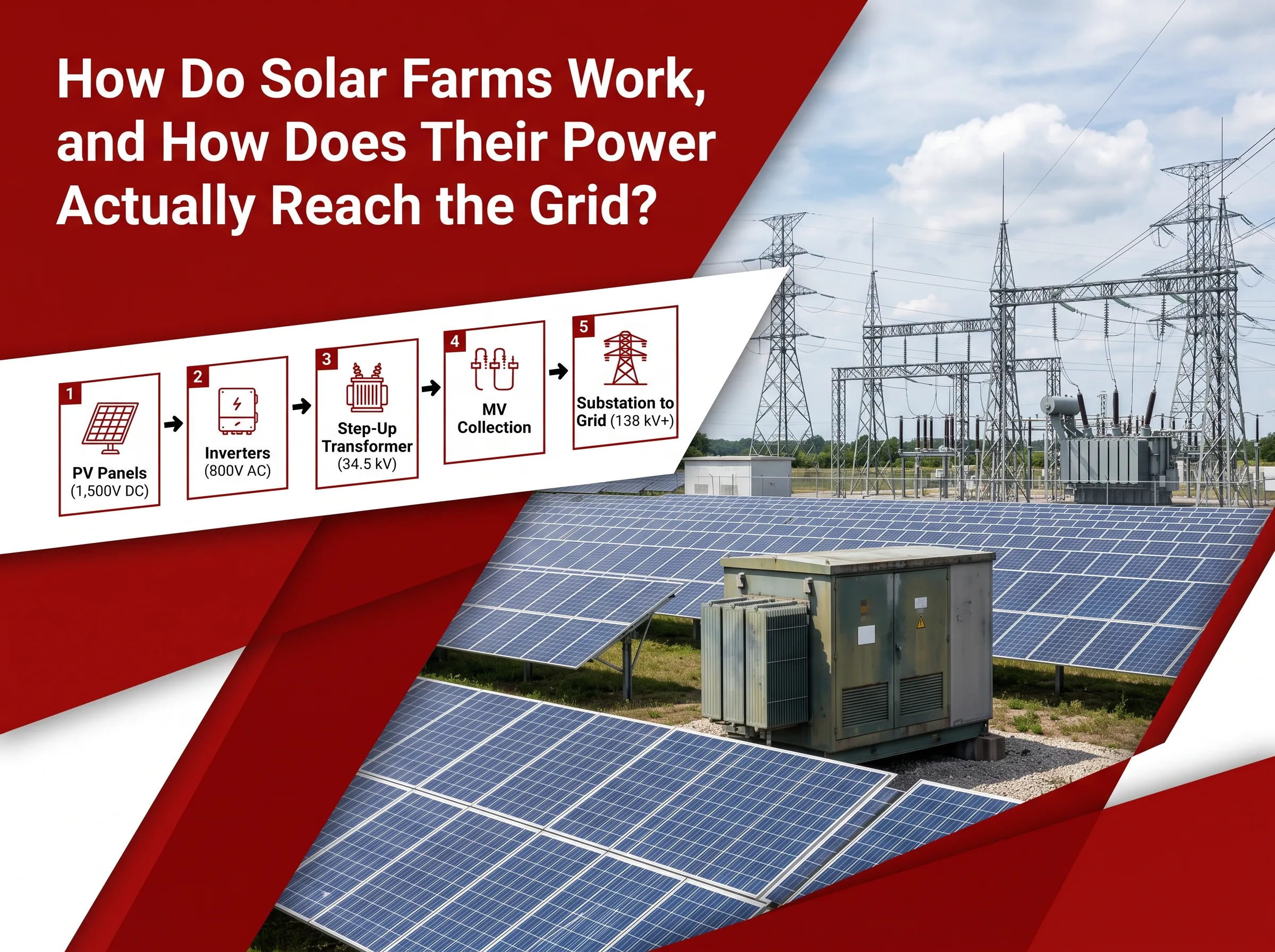
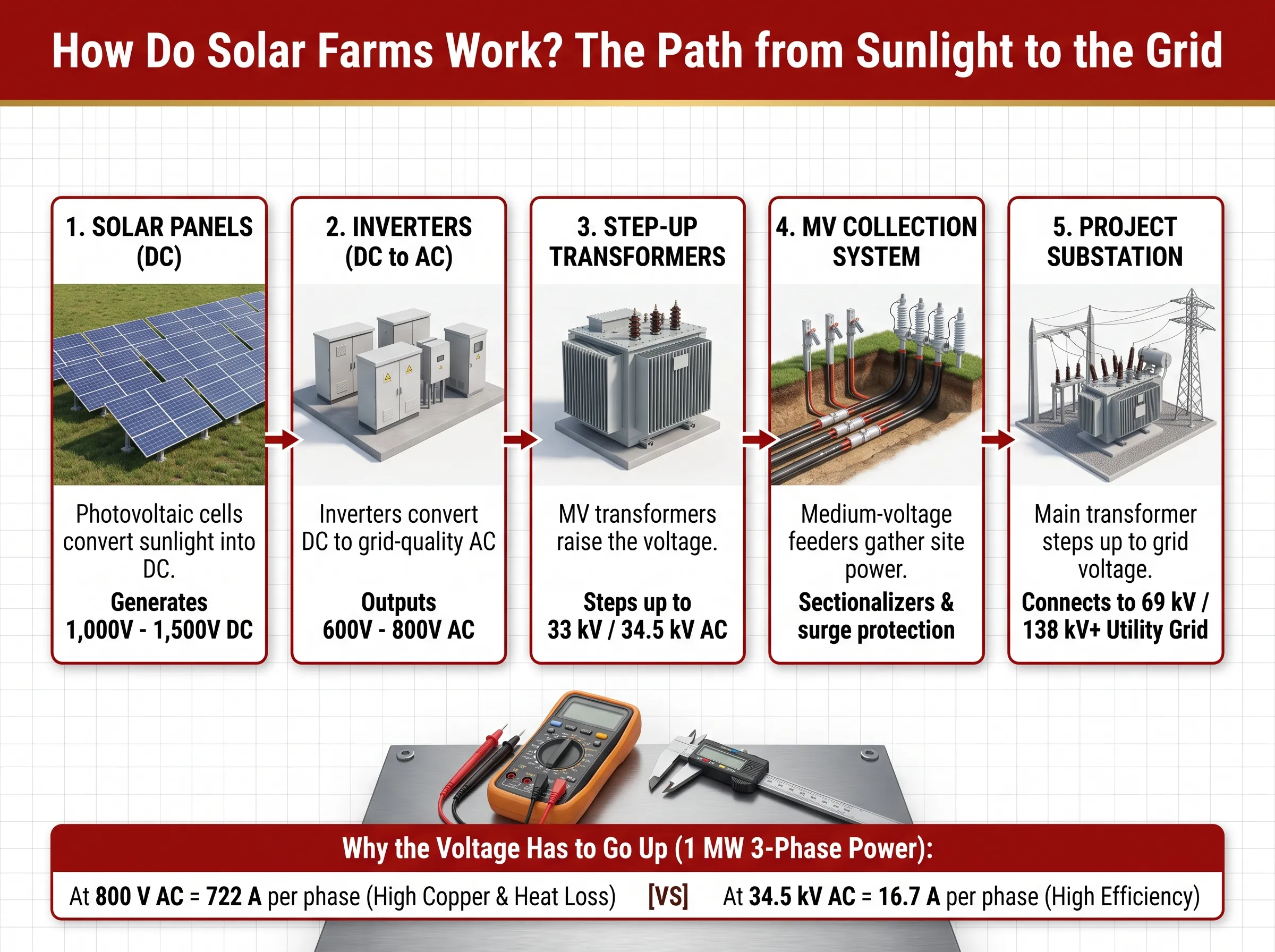
1. Solar panels convert sunlight to electricity in the form of DC. PV cells in each panel convert sunlight into direct current. Each panel is linked to wires in series, with strings increasing DC voltage in modern utility-scale facilities to values of 1,000 V to 1,500 V.
2. There is a conversion of DC to AC by the inverter. The inverter converts the direct current to the grid-compatible form of electricity, as several strings are connected to the inverter to obtain low voltage level electricity. This is a voltage of several hundred volts, for example, it could be 600 V to 800 V.
3. The transformer raises the voltage to medium voltage levels. The inverter or group of inverters is connected to a step-up transformer that converts the voltage to the levels of medium voltage. It is around 34.5 kV in North America and it could be 33 kV in some IEC markets and related values. For example, it is possible for the transformer to convert about 800 volts of AC electricity to 33 kV of AC electricity.
4. The medium-voltage collection system helps in the collection of the electricity generated. Some underground or aboveground electrical cables connect the transformers across the solar park. They are connected via feeders. In the process, disconnect switches, fuses and surge arresters help in ensuring the safety of the electricity generated.
5. The substation connects electricity to the utility grid. In the substation of a solar generation facility, an electric transformer will increase the voltage further to levels of transmission or sub-transmission, which may be 69 kV, 138 kV and others. The connection is managed via certain devices such as breakers, relays and different transformers.
The voltages listed above may vary in certain cases. In this regard, the voltage levels will be defined according to the design of the system and connection requirements.
Why the voltage has to go up
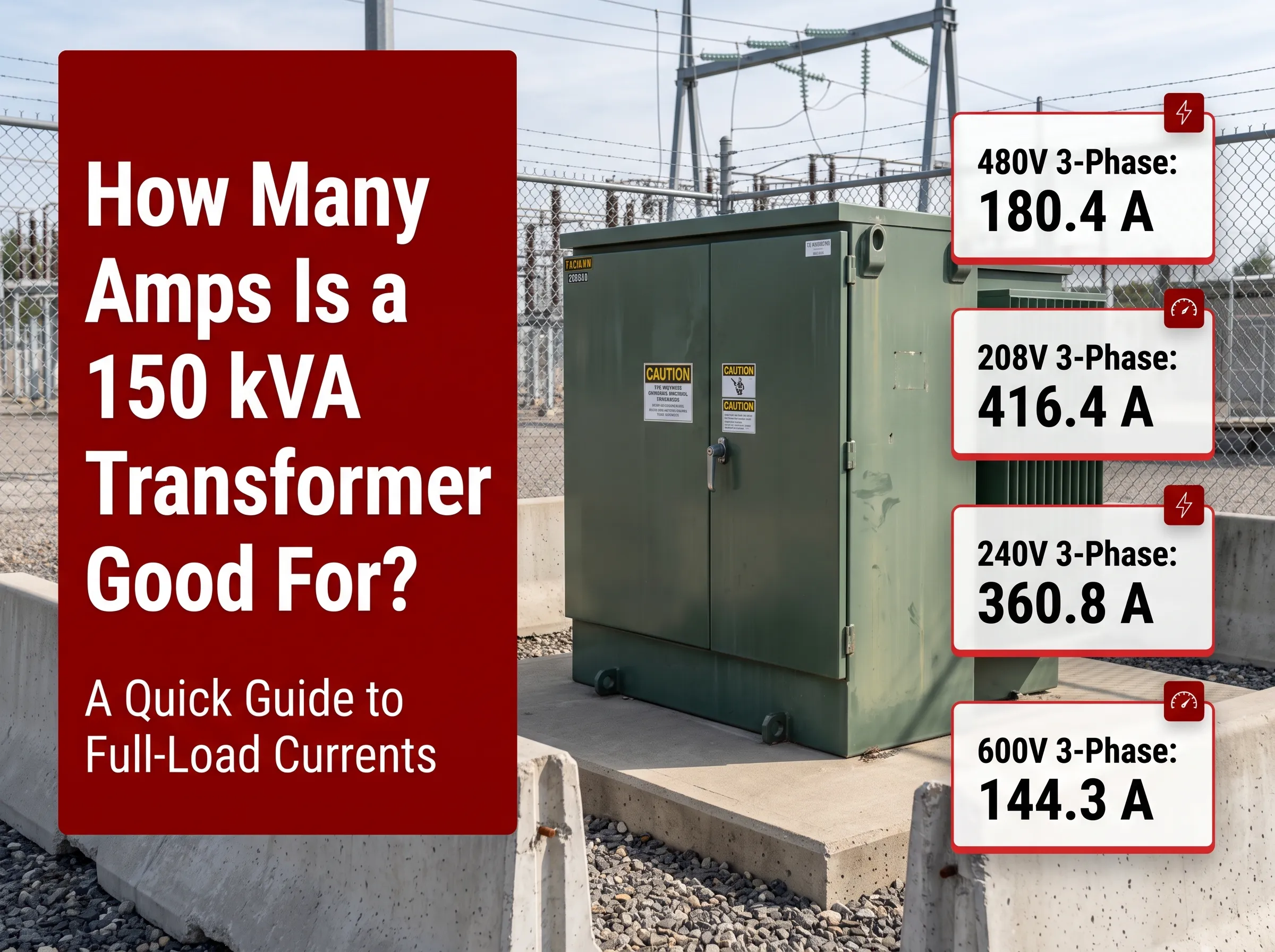
Increasing the voltage is essential. It allows transmitting vast amounts of energy. Current decreases according to voltage, reducing losses in cables with the square of current. The image below illustrates the consumption of 1 MW, which is 722 A for three-phase layout at 800 V AC usage while the same 1 MW only needs about 16.7 A for the same three-phase power at 34.5 kV level.
Transporting hundreds of megawatts across the huge area at 800 V would require a lot of copper and would result in serious energy losses. That is why electric energy is passed in the beginning as a medium voltage and transferred to the high voltage at a substation, thus ensuring efficiency of a solar farm. In fact, the same logic applies to every electricity supplier. ShineGrand’s transformer calculation table shows the same kVA-to-amps relationship for other ratings.
Solar Farm Components
The different components of a solar farm can be classified into different groups. Though the panels are the most prominent feature, a large share of a solar farm’s investments is made into the technologies that are able to produce and deliver power.
Solar panels (PV modules)
A majority of solar power plants are using crystalline modules, but recently more and more bifacial models started to be incorporated. Each module can produce a few hundred watt-hours of energy and as many as several hundred thousand solar panels can be constructed at a large power plant.
Mounting structures and trackers
The solar panels are placed in fixed-tilt racking systems, however, nowadays, such large power stations can take use of single-axis trackers, which allow the panels to be turned from east to west and follow the sun. Single-axis trackers are generally found in utility-scale power plants where land and weather conditions permit their installation.
DC wiring and combiner boxes
Solar panels are connected in a string, and a number of strings can be taken into a combiner box; however, before any of them can reach the central inverter, they need to pass through the combiner box. The combiner box includes string fuses and DC disconnect switches. In those plants that are equipped with string inverters, the inversion happens outside of the combiner box.
Inverters
Inverters are connections that link DC and AC. The US Department of Energy says they convert DC to AC power, and prepare the output in a clean form so that it can be accepted by the grid. In addition, currently, inverters provide grid services like handling disturbances, controlling voltage with reactive power and reacting to frequency changes. Utility plants can either rely on, or use multiple string inverters at a time.
Step-up transformers
Inverter step-up transformers are known as medium-voltage (MV) transformers and they serve to convert the output of an inverter to the collection one. Most of them are either liquid-filled pad-mounted units which are placed next to the inverter or skid-mounted units. Various designs of central inverters make use of transformers with two low-voltage windings.
Medium-voltage collection system
The collection system connects all step-up transformers with the substation, through the use of cables, switches, and protection equipment. Underground cables are used for collection within most solar farms, along with sectionalizing switches that help isolate certain parts of the plant.
Project substation and main power transformer
The substation houses the major transformer employed to elevate the collected power to the level suitable for the grid along with circuit breakers, protection devices, prescales, and frequently reactive power system. Bigger projects may replace the substation with the one used by the adjacent plants or connected to the distribution network of a utility.
Protection, monitoring and storage
Surge arresters, fuses, the disconnect switch, and grounding minimize injuries to persons as well as damage to equipment. A SCADA and monitoring system helps a supervisory control that manages operation from remote locations. Nowadays, growing number of solar farms has batteries allowing to store energy during the day and to use it later during the day time.
The Solar Farm Electrical System, Section by Section
It helps to think of the solar farm electrical system as three distinct zones, each with its own voltage level, equipment and risks.
The DC side
All components from the solar panels and up to the inverter input are powered with direct current that is usually up to 1,500 volts DC in the latest solar plants. Direct current has higher difficulty in being interrupted as it has no natural zero-crossing and therefore requires the use of specific DC fuses, combiner boxes and disconnects. Ground fault and arc fault detection are the vital safety devices in this regard.
The low-voltage AC side
Between the inverter output and the step-up transformer, the plant runs on low-voltage AC with high currents. This section is usually kept as short as possible, which is why inverters and transformers are typically placed together on a skid or pad.
The medium-voltage and high-voltage AC side
After the step-up transformer, the machinery has to work under both medium and high voltage electricity, and this is when it begins to resemble a typical utility grid, as it contains transformers, outdoor switches, fuses, surge protectors, cables, circuit breakers and relays. Moreover, the design of the photovoltaic farm has to comply with the safety, reliability and power quality standards set by utilities.
What Kind of Transformer Does a Solar Farm Use?
The solar farm transformer performs functions similar to those of a conventional distribution transformer or power transformer, but their working conditions differ in ways that have significance for the design.
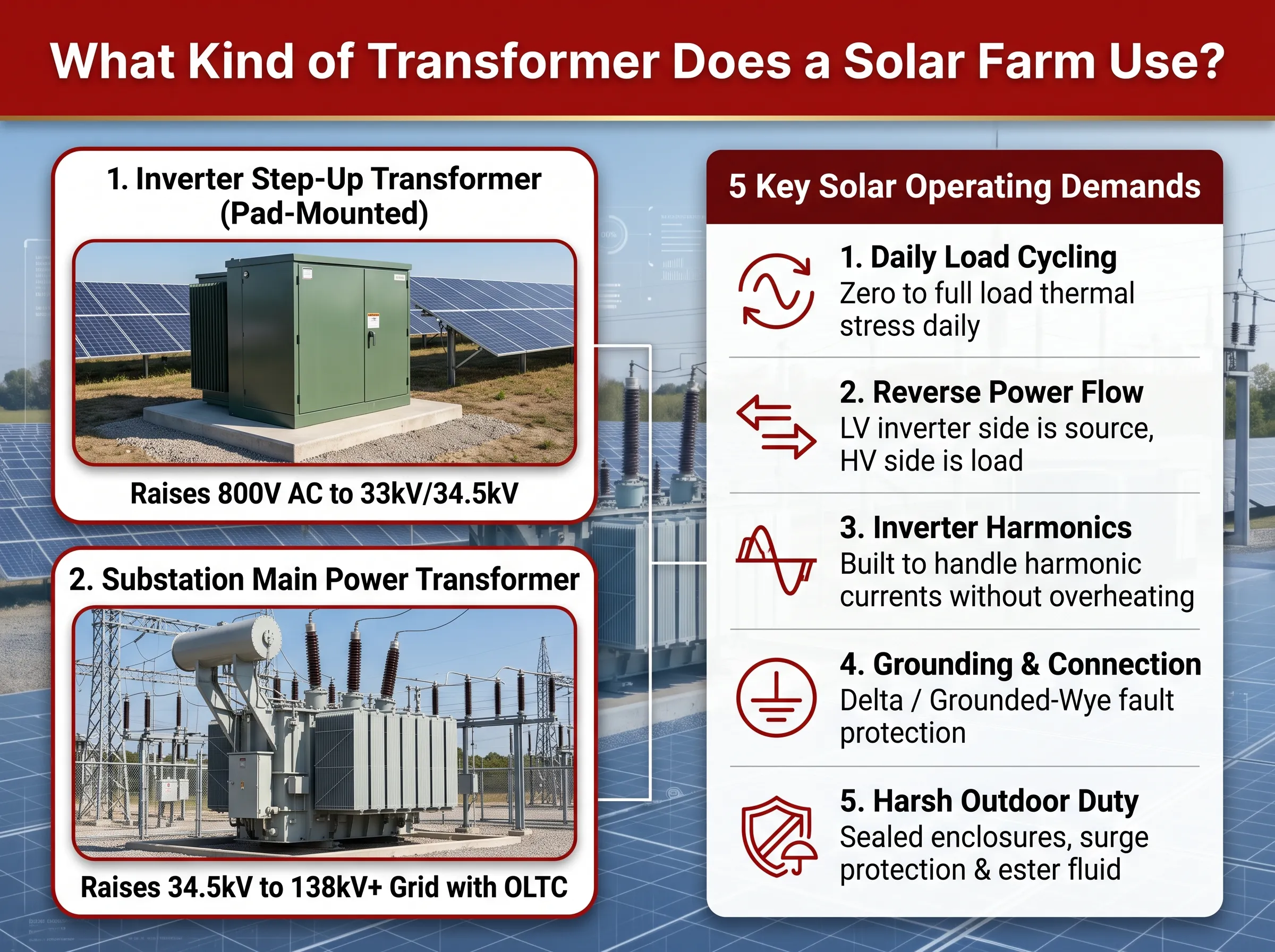
• Daily load cycling: The solar transformer is characterized by daily thermal cycling from zero load to full load and back every day. This involves repeated thermal cycling that stresses the insulation and seals differently as compared to conventional applications (which have more constant loads).
• Reverse power flow: The solar transformer’s “low voltage” side acts as a source while the “high voltage” side acts as a load, which is the opposite of a conventional distribution transformer. Therefore, winding configuration, grounding and protective measures should be designed accordingly.
• Harmonics: Although modern inverters output clean power, the transformer must be able to handle the harmonics in the output of the inverter without overheating.
• Grounding and connection: The choice of winding configuration (for example, delta on the inverter side and grounded Wye on the collection side) can greatly affect the ground fault detection function. This issue is usually determined by the grounding study of the plant and the requirements of the utility.
• Outdoor and remote locations: The transformers are typically located in open fields exposed to heat, dust, wind and lightning and therefore designed with robust enclosures, surge protection and reliable fluid systems. Most of the solar projects use natural ester fluids because they have low flammability and are biodegradable.
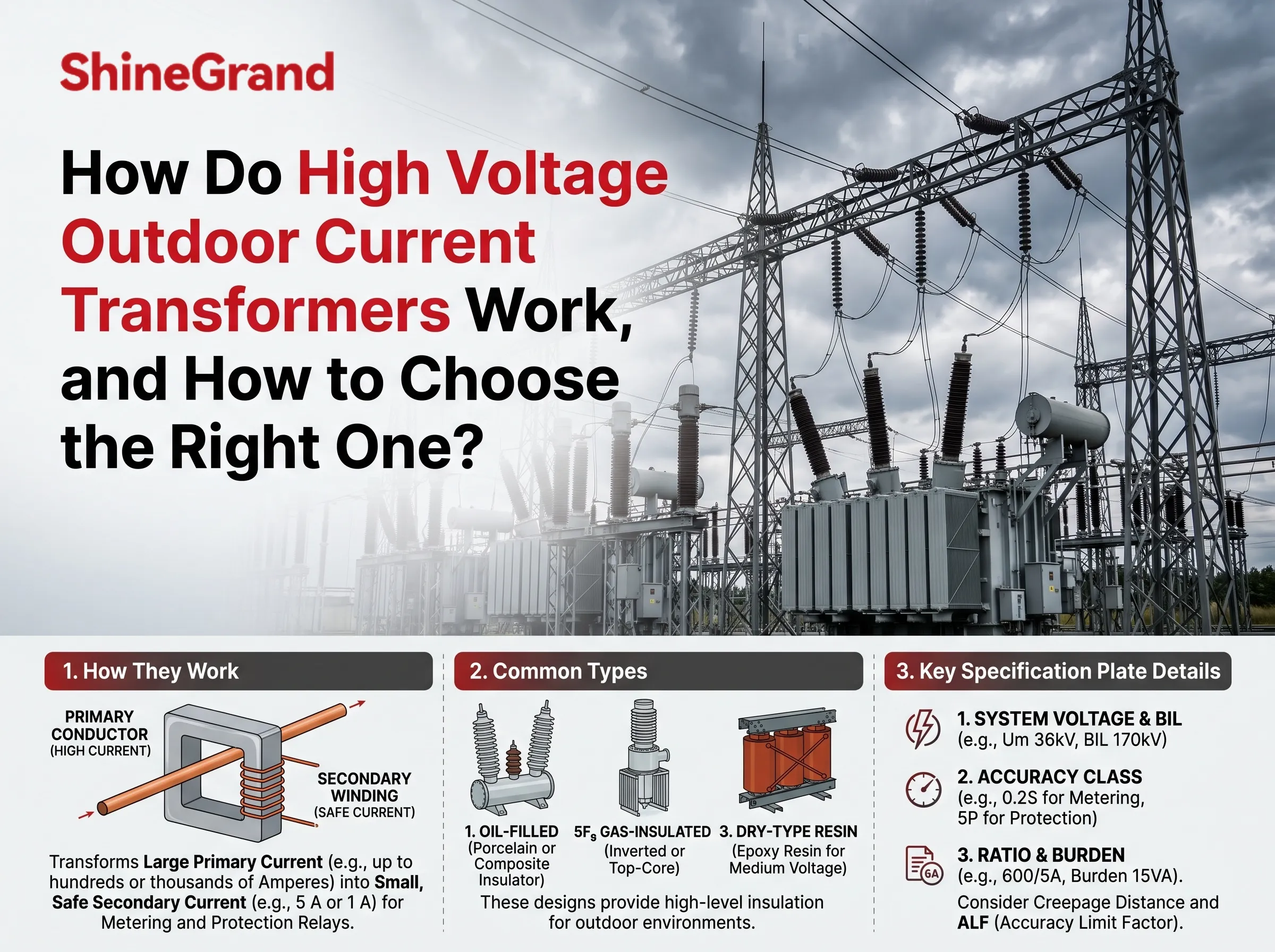
There are two types of transformer that one can find in most solar farms. Inverter step-up transformers are usually pad-mounted and used in large quantities across the whole facility. The main power transformer is located at the substation and raises the collection voltage to the grid voltage.
Solar Farm Grid Connection: What Happens at the Point of Interconnection
The connection of a solar facility to the grid is the area of the project that is subject to the most regulation and is tended to be the one that takes the longest time. Before it produces electricity, a solar installation must go through interconnection steps defined by the grid operator. This process assesses whether the grid is capable of receiving the output of the installation and which upgrades should be made.
Once the connection is made, the solar facility will be expected to act as a reasonable player on the grid. Regardless of its size or connection voltage, the facility is normally supposed to meet the standards dictated by IEEE 1547 for distributed power transfer, and IEEE 2800 for large inverter-based sources, as well as local grid codes. Some of the common requirements include:
Ride through means keeping connected despite minor voltage and frequency disruptions instead of being disconnected (tripping).
Reactive power and voltage regulation includes supplying or absorbing reactive power needed for the regulation of voltage at the grid.
Frequency response means adjusting generation when grid frequency is not stable.
Power quality means keeping harmonic and voltage deviations under control.
Protection coordination means that the protection systems of the solar plant should work in accordance with utility protection systems.
As noted by the DOE, various inverters are grid-following, which means that they rely on the timing coming from the grid. There is an increasing interest in grid-forming inverters capable of generating voltage reference on their own and ensuring the stability of the grid with a limited number of traditional generators.
How Solar Farms Are Protected
A solar farm refers to an extensive solar power generation plant. A solar farm is a large installation that generates solar power on a large land mass, generally in a region characterized by high rates of thunder and lightning. It is necessary to incorporate safety in every step of the design process in every stage of development.
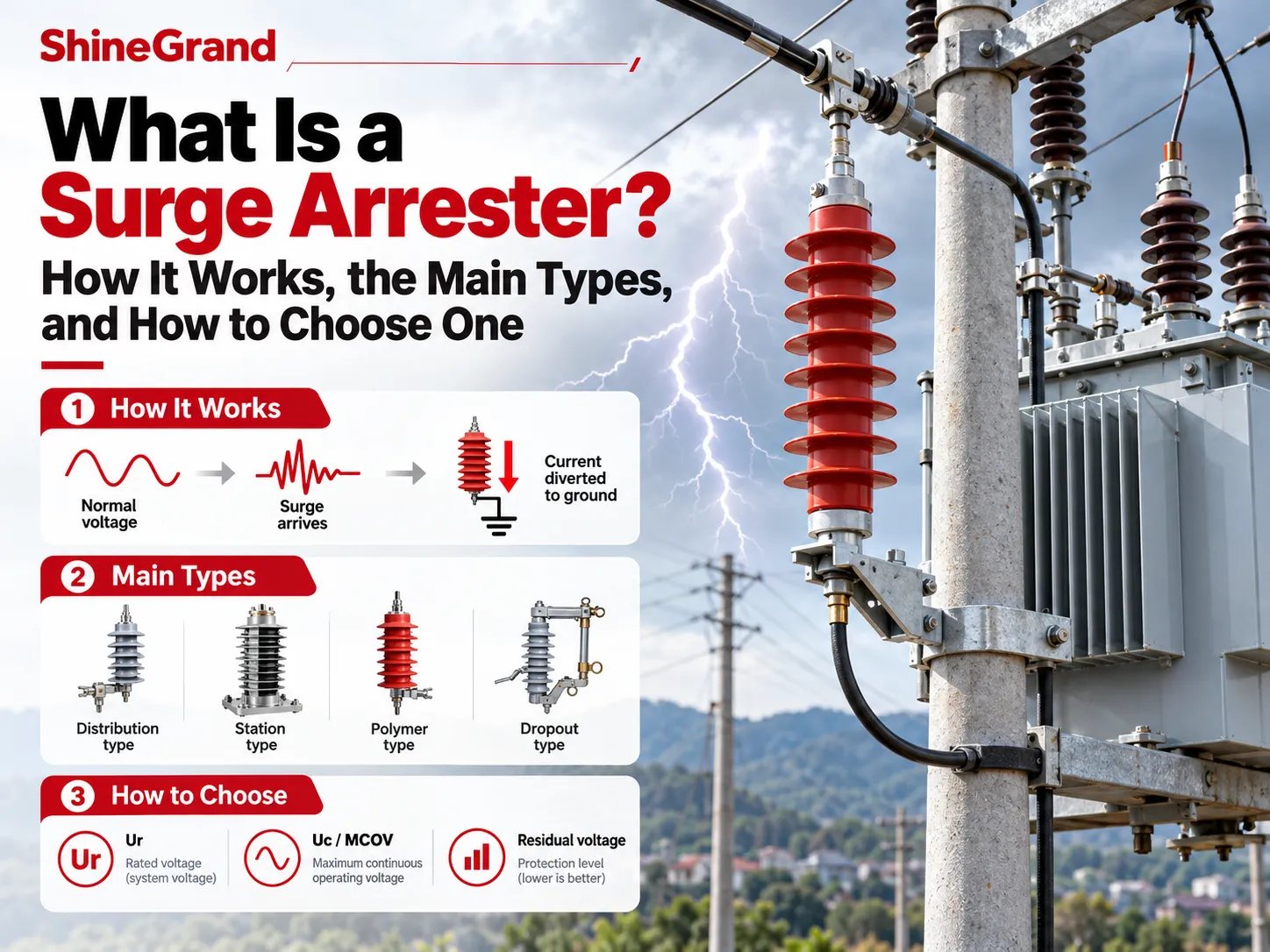
One of the devices used in solar farms is the lightning arrestor that regulates the overvoltage that may occur due to lightning and operations performed on the transformers, ground wire connectors, and substation devices. The specifications of the lightning arrestors should correspond to the voltage of the plant and the grounding system.
Fuses are another type of safety equipment used in a solar farm and are aimed at the protection of the transformers and branches of energy supply. High-voltage transformers are usually equipped with a combination of different types of fuses such as expulsion and current-limiting ones. The solar plant also makes use of fuse cutout devices on high-voltage lines.
A disconnecting device can also be found in a solar power plant. This device has a visible break point that allows the workers to perform their work in a safe way. The disconnecting devices are situated on the difficult-to-access parts of the plant, on the open line or at the substation.
The circuit breakers and relays located in the substations play a crucial role in timely reaction to electrical fault occurrence in the solar power plant.
The grounding system is aimed at connecting the electrical devices and electric structures.
How Much Power Does a Solar Farm Produce?
The capacity of a solar farm (e.g. 100 MW) refers to its highest output at ideal conditions. Since the sun does not shine all through the night and output varies with seasons, weather and position of the sun, the average output is much less. It is calculated based on the capacity factor that determines the ratio of produced power to hypothetical output of power at maximum output all year round.
Utility-scale solar farms in the US have capacity factors from about 20% to 30% depending on the location and use of trackers for the solar plant. For example, 1 MW of solar at a capacity factor of 22% can provide approximately 1 MW × 8,760 hours × 0.22 ≈ 1,900 MWh per year. More sunshine with trackers results in higher production than in cloudy places closer to the poles.
The land use for solar energy production will depend on the type of the solar plant but we can say that a utility solar plant would use on average about 5 to 10 acres per megawatt including the spacing between rows and the area needed for roads and machinery.
Are Solar Farms Profitable?
The profitability of the solar farms is influenced by a number of factors apart from just sunlight. Earnings from a solar project depend on many issues such as electricity pricing, costs for the construction and equipment, financing cost, value of incentives, land price, cost of interconnection and the amount of energy not used because of grid curtailment. Such issues like interconnection costs have become one of the biggest challenges because upgrades on the grid located at the point of connection influence the economics of the project quite strongly.
How to Start a Solar Farm
A typical process of establishing a solar energy facility begins with determining an appropriate site. Initially, it entails finding the location with favorable conditions of sunlight and grid access. After that the solar energy farm will apply for interconnection and obtain environmental and land use permits. Then the farm will sign an offtake agreement and arrange for financing of the project. Once everything is settled, the selection of the EPC contractor and the procurement of essential equipment will be undertaken. After that, the construction and commissioning of the facility will take place. The most important determining condition is the grid access. The guides on starting the solar farm will be provided in this section of the book.
Where ShineGrand Fits in a Solar Farm
ShineGrand Electric works on the part of a solar farm that most explanations skip: the medium-voltage equipment that carries power from the inverters to the grid. ShineGrand lists renewable energy as a core application area and supplies:
- Three-phase pad-mounted transformers for inverter step-up and power collection, with primary voltages up to 35 kV.
- Oil-immersed distribution and power transformers, including higher-voltage units such as 110–132 kV oil-immersed transformers.
- Outdoor disconnect switches, such as the GW4-40.5/630 40.5 kV outdoor disconnector suited to 33–35 kV collection systems.
- Surge arresters for overvoltage protection of transformers, cable terminations and overhead lines.
- Fuses and fuse cutouts for transformer and branch protection.
Equipment can be adapted to local grid voltages and frequency. Final selection always depends on the plant design, inverter specifications and the utility’s interconnection requirements.
Frequently Asked Questions
What is a solar farm?
A solar farm is a large, ground-mounted solar power plant that generates electricity for the grid or for a large customer. It consists of many PV panels, inverters, transformers, a collection system and usually a substation that connects it to the utility network.
Do solar farms produce AC or DC electricity?
Solar panels produce DC electricity. Inverters at the solar farm convert it to AC before it is stepped up in voltage and delivered to the grid, because the grid runs on AC.
How do solar farms connect to the grid?
The output from the inverter is raised to medium voltage level using transformers, collected over the site, and sent to the substation where the main transformer increases it to the grid voltage level, and at that point, the plant is connected to the grid after fulfilling interconnection studies and technical specifications required by the grid operator.
What voltage does a solar farm produce?
Various sections of the solar facility function where voltages vary. The modules operate with voltages not exceeding 1,000 V or 1,500 V, the inverter works with several hundreds volts AC, the constant current collection system functions at around 33 kV or 34.5 kV and the grid connection may operate with distribution level voltage or 138 kV.
What transformer is used in a solar farm?
Two types of step-up transformers – pad-mounted or skid-mounted – are used in most solar farms. The smaller transformers lift the output produced by the inverter to the collection voltage, while the more powerful substation transformers increase the collection voltage to grid voltage level.
Do solar farms work at night or on cloudy days?
Solar farms produce nothing at night. On cloudy days they still generate electricity, but at reduced output depending on how thick the cloud cover is. Solar farms paired with battery storage can store daytime energy and deliver it after sunset.
How much land does a solar farm need?
Utility-scale solar farms commonly need roughly 5 to 10 acres per megawatt, including space between panel rows, roads and equipment areas. The exact figure depends on panel technology, tracker use and site layout.
How long do solar farms last?
Performance guarantees on solar panels usually range from 25 to 30 years, while most solar farms are built for an operational life cycle of at least 30 years. Inverters will generally need to be repaired or replaced once during that time, while transformers and other pieces of substation apparatus will last for many years if well maintained.
References
- US Department of Energy — Solar Integration: Inverters and Grid Services Basics. How inverters convert DC to AC and provide grid services.
- NRECA — PV Field Manual and Reference Designs. Utility PV engineering guidance including inverters, transformers and AC collection.
- National Renewable Energy Laboratory (NREL). Research on PV performance, land use and grid integration.
- US Energy Information Administration (EIA). Data on solar generation and capacity factors.
- IEEE 1547 and IEEE 2800. Interconnection and interoperability requirements for distributed and inverter-based resources.
- Wikipedia — Photovoltaic power station. General background on solar farm design and history.
Planning a Solar Farm Connection?
Understanding how solar farms work means looking beyond the panels to the inverters, transformers, switches and protective devices that carry the power safely to the grid. If you are designing or building a solar project, ShineGrand can supply step-up transformers, outdoor disconnect switches, surge arresters and fuses for the medium-voltage side of the plant. Contact ShineGrand to discuss your project requirements.