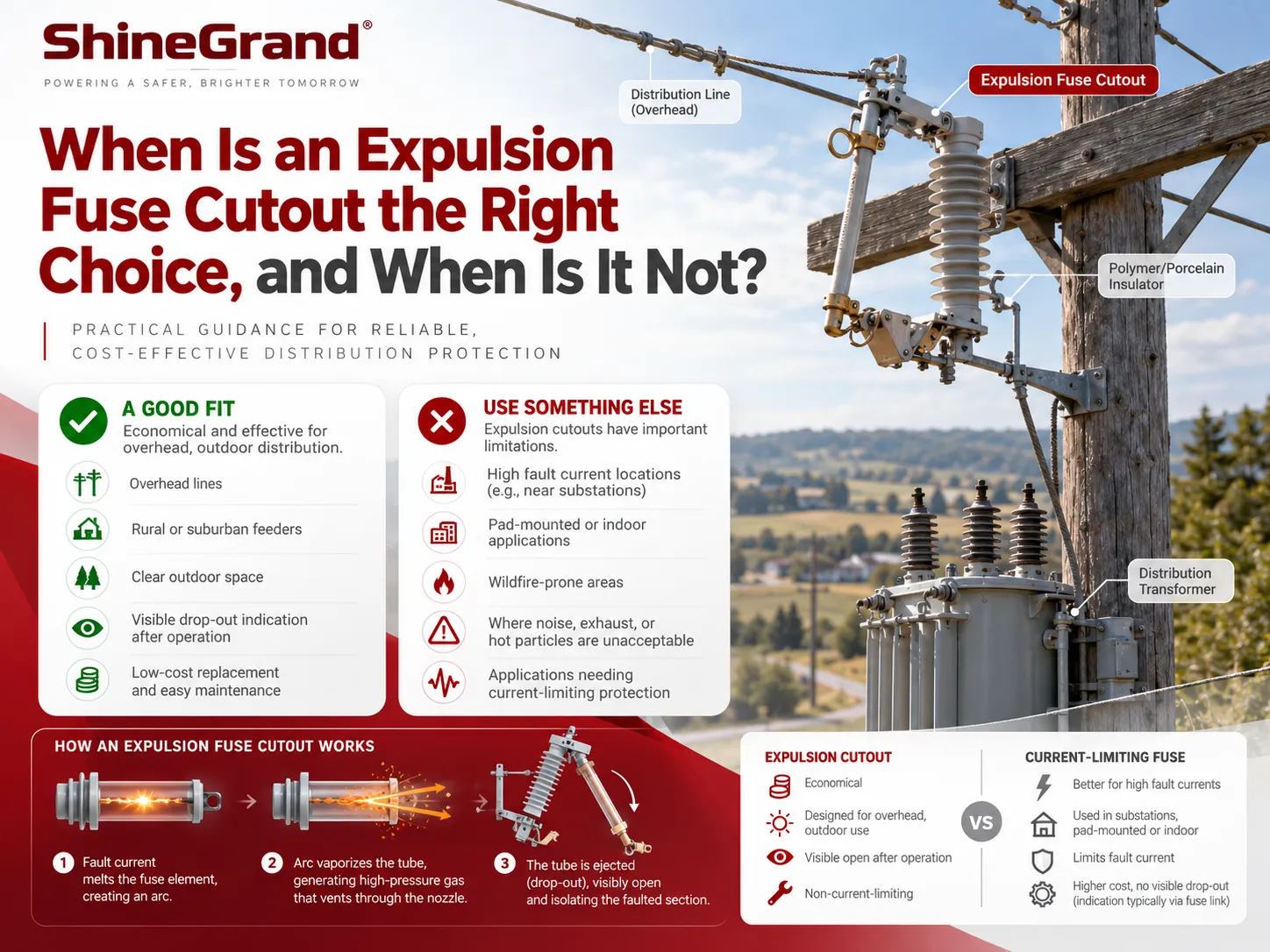
A majority of the overhead distribution lines installed worldwide utilize an inexpensive but very effective device called an expulsion fuse cutout which is placed on the crossarm above the transformer or at the very beginning of the lateral cable. The camera is simply designed, reliable, and easy to use by field crews. Unfortunately, the process of interrupting is such that the expulsion fuse cutout makes some noise and generates exhaust. It causes many inconveniences including passing the peak of the fault current, limiting its interrupting capabilities, and becoming a fire hazard in the areas at risk of fires. The guide provides the definition of an expulsion fuse cutout and describes its operation.
What is an expulsion fuse cutout? An expulsion fuse cutout refers to an outdoor distribution fuse that consists of a fuse link melted down due to overcurrent inside an insulating tube and the electricity created as a result of the arc is stopped with the help of gas which is produced as a result of the reaction. The gas is discharged from the tube, thus stopping the electric flux at its peak point. The process concludes with tube swinging open in order to show a break. An expulsion fuse cutout is one of the cheapest options that still provide visible evidence of efficiency.
For an overview of the cutout itself, including its parts, the drop-out sequence and solid blade cutouts, see ShineGrand’s guide What Does a Fuse Cutout Do. This article concentrates on the expulsion interruption principle and how it shapes application decisions.
What Is the Difference Between a Fuse and a Cutout?
Although the meanings of the two terms often seem to overlap, we should realize that they illustrate various components of the unity:
A fuse, or more exactly, a fuse link is the replaceable item that blows when the current goes beyond its time-current characteristics. This is the element that detects the overcurrent.
The cutout is the entire unit that contains the fuse: the insulating part, the bracket for mounting the apparatus, the upper and lower contacts, the fuse holder tube, and the dropping mechanism. It gives insulation, a point for operation, which the service staff can open without risking their safety when working with hot sticks, and in drop-out designs, it gives a visible open indication.
Thus, we can conclude that a fuse can be used without a cutout, as in the case of the current limiting fuse in a pad-mounted transformer, for example, or a bay-o-net fuse in an oil tank. A cutout can also be used without a fuse, for example, a solid blade cutout – it uses the same base of the cutout with a solid blade instead of a fuse plug, and should simply act as a disconnecting unit. The term “fuse cutout” refers to a cutout with a fuse and fuse link.
How the Expulsion Mechanism Interrupts a Fault
In expulsion fuse cutouts, “expulsion” refers to the process of extinguishing the arc, not to the mechanical drop-out. In fact, the entire process from the moment the fuse link melts until the arc extinguishes takes from less than one cycle to several cycles depending on the fault current level. The process is presented in four stages, which are indicated in the below diagram.
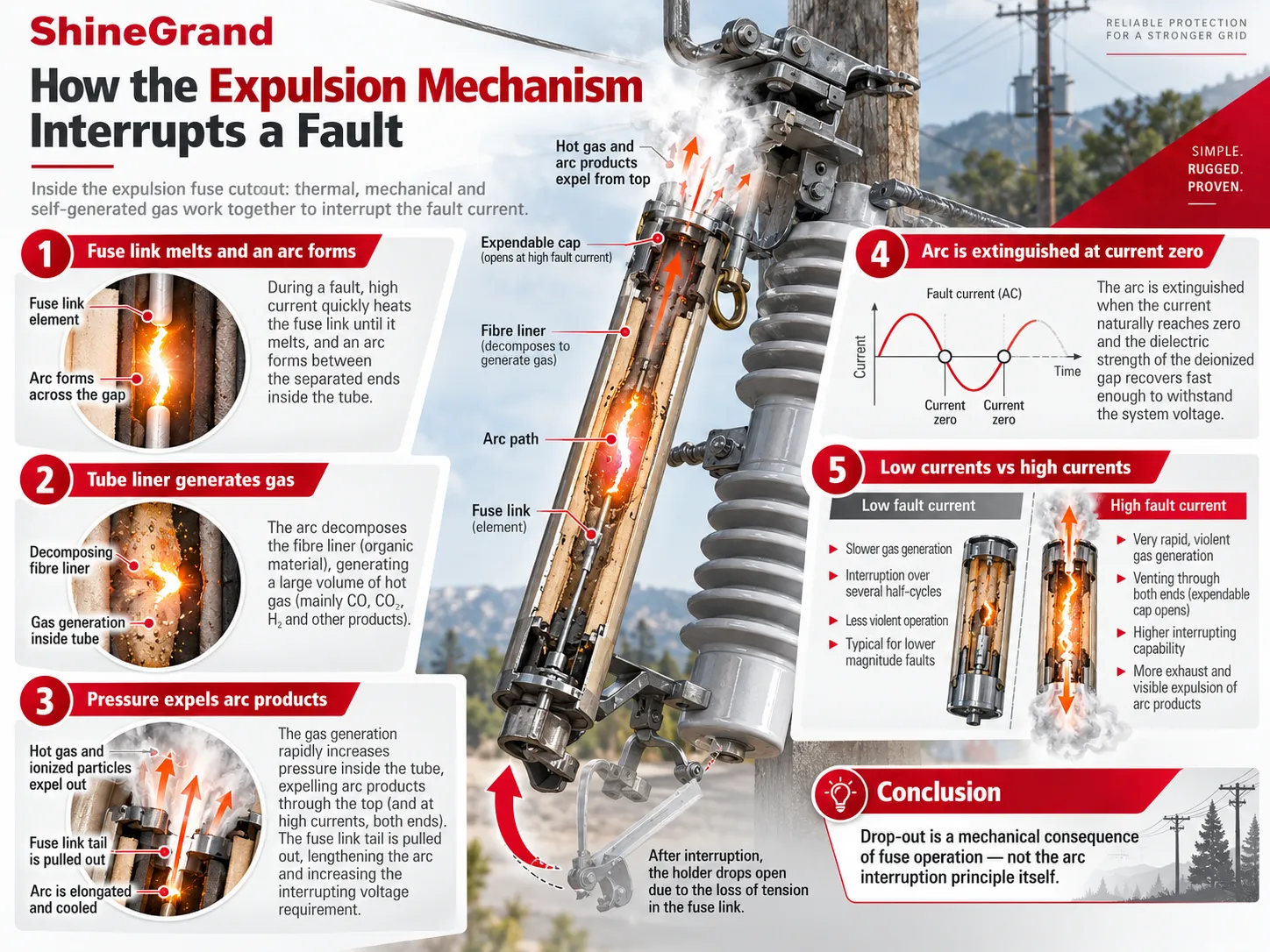
The fuse link melts and an arc forms
As soon as the flowing current becomes more powerful than the melting values of the fuse, the fuse element melts, disconnecting by melting the circuit by melting the wire. As the circuits are connected to the medium voltage, soon after the electric wire melts, the arc is formed across the width of the disconnecting jump wire.
The tube liner generates gas
Fuses consist of tubes covered with gas-absorbing materials, which are usually made of fiber, widely known as horn fiber. The gases and gases produced after the melting of the end of the fuses significantly contribute to the gas production. The high amount of gases makes it possible to use other materials for fuse production, particularly boric acid.
Pressure expels the arc products
Moreover, due to the hasty gas raising pressure, gases are expelled via the open ends of the fuse tubes. At the same time, the fuse wire, which is free in movement, is pulled out of the fuse tube, causing the length of the arc to be increased.
The arc is extinguished at current zero
As soon as the current goes to ZERO during its cyclical movement, the arc goes out for a short while. In case there is sufficient coolness in the tube for the electricity passing through the air gaps considerably, the electric field recovery occurs faster than the raising of the cycled voltage.
Low currents versus high currents
- The problem of low current or overvoltage arc interruption is less complex than with high stranded currents, as interruptions take place over just several half-cycles of electricity. In this regard, for interruptions to occur more safely, many fuse designs use extra tubes.
In contrast, due to the pressure buildup, for more current interruption purposes, many fuses are produced with two tubes.When the current is interrupted, the current flow is transferred from the electric circuit to the physical process of wires opening, which is also an essential concept to comprehend the idea of arc extinguishing.
The expulsion principle’s implication in practice
The complete first peak of fault current passes through
An expulsion fuse can stop current only on a natural current zero point, and thus doesn’t limit the value of the first fault current peak. The transformer, cable, or line that is being protected experiences at least a half-cycle (and usually for a longer period) of the complete prospective fault current. This is acceptable for moderate faults. However, at high faults, the energy released via an internal fault in a transformer can be enough to rupture the tank or even destroy it before the fuse has fired.
Interrupting rating indicates a maximum limit
As per every expulsion cutout, there is a value of maximum interrupting rating. If the current exceeds this limit, the pressure of gas and energy of the arc may be too strong for the tube to withstand, which can result in interrupting failure or tube explosion. The maximum ratings may have different configurations – symmetrical or asymmetrical RMS current, and this difference may be very important because the currents near substation are usually very asymmetrical due to the X/R ratio of the grid. It is advisable to compare the rating of a cutout and the available fault current at the installation point, while not relying on the average one for the whole system.
Noise and exhausts and clearances
The expulsion cutout that works in conditions of high current fault emits a loud noise, as well as a jet of gases and particle that goes predominantly down and outwards from the tube. Hence, the place of installation should have clearance between the path of emission and other phases and constructions that may be grounded and flammable products. Therefore, cutouts are mounted outside the building and at an angle preventing any issues during their operation.
Visible indication and easy restoration
The plus side is that the design of a drop-out allows the operating crews to understand exactly which cutout has worked. The restoration of the operation is done through replacing the fuse link, which does not require any expenses. There is no need for voltage, batteries or relays.
Expulsion Fuse Cutout vs Current-Limiting Fuse
These two methods for protecting medium-voltage circuits operate using different principles.
In the interruption principle, the Switch uses gas from an enclosure to interrupt the circuit at zero current point, and the current-limiting fuse uses silver in sand to lower the current before the first peak.
Regarding let-through energy, the first method allows all energy through, while the current-limiting fuse minimizes the peak current and let-through energy.
In terms of noise and venting, the expulsion cutout is loud and vents hot gas and particles while the current-limiting fuse is attentive.
In terms of interruption capabilities, the expulsion cutouts are rated in the range of kAs and capable for interrupting loads of up to 10-20 kAs, while the current-limiting fuses interrupt 40-50 kAs or more.
Low current performance is another factor determining the performance of the expulsion fuse, which works well in case of overload, while the back-up fuses are useless in this case and required to share the job with the other devices.
For indication and restoration aspect, the expulsion cutout simply drops open after operation and can be restored with the use of a cheap fuse, whereas the current-limiting fuse should be fully changed and is quite costly.
Finally, the last parameter is what distinguishes the two devices according to their location. The expulsion cutout is an outdoor device designed to be mounted above ground, while the current-limiting fuse is an indoor piece of equipment inside any box or transformer.
ShineGrand’s high voltage fuse guide covers the full range of medium-voltage fuse types and transformer fusing in more detail.
Combining the Two: Backup Current-Limiting Fuses
In many cases, utilities have no choice but to use both. When fault current levels surpass the capability of an expulsion cutout in such a way as to pose a threat, a backup current-limiting fuse will be positioned in series with the expulsion cutout. The following is true as far as the process is concerned:
– the expulsion fuse link in the cutout will work only for lower and medium fault currents
– the backup current-limiting fuse will operate only for large faults thus limiting both the current and the energy
– the backup fuse is chosen in such a way that it will allow enough current to go through to cause melting of the fuse in the cutout making sure that the cutout falls out giving the operators an opportunity to determine the location of operation.
This solution allows low-cost use of the expulsion cutout and provides with the possibility of indicating the location of an incident happening near substations.
Expulsion Cutouts and Wildfire Risk
Expulsion fuses can ignite dry vegetation underneath a pole as they disperse hot gases and particles when operating. Wildfire regulations are aware of this fact and take it into consideration. In California, for example, Public Resources Code section 4292 requires that there is a firebreak of minimum 10 feet from any pole containing expulsion fuses, switches, and other specified devices in any area that is fire-prone. Regulations state that poles containing devices of exempt types are excluded and current-limiting fuses fall within this category.
As such, in regions prone to wildfires, utilities started replacing traditional expulsion fuses with either non-expulsion fuses or current-limiting ones on overhead lines or combining expulsion cutouts with other fire mitigation techniques. Therefore, if you are planning to undertake a project in fire-prone regions, please check with the local regulatory agency and the utility requirements before using expulsion cutouts.
When an Expulsion Fuse Cutout is the Fit Solution
However, expulsion fuse cutout is usually a good solution when:
The installation site is an overhead line, outdoors with open space above and below the cutout
Available fault current at the selected location is within the interrupting capacity of the cutout with a margin in reserve, which is often the case for rural/suburban feeders far from substations
The equipment being protected can withstand the let-through energy
There is a necessity for visible indication and easy replacement of the equipment, for example, on long rural electric lines that are inspected after storms.
The area is free from wildfire regulation restrictions.
When it is Better to Employ Other Types of Equipment
Consider the use of current-limiting fuses, backup current-limiting fusible elements, and any other protection solutions when:
The fault current exceeds the interrupting capacity of the cutout or is very close to it.
Concerns related to transformer tank rupture because of high-energy internal faults exist, particularly in large power transformers located close to substations.
The fuse must be installed indoors or inside an enclosure or a pad-mounted transformer.
Noise or vapor is unacceptable, for example, near buildings and public places.
Choosing an Expulsion Fuse Cutout
When an expulsion fuse cutout is the right solution, the following factors affect the reliable operation:
1.Rated voltage and BIL matched to the upper voltage of the installation.
2.Holder continuous current rating, which is usually either 100 A or 200 A.
Interrupting capacity compared with available fault current at the installation site and indicated as symmetrical/asymmetrical.
3.Number and rating of the fuse link (K, T or H) that are chosen according to the current, inrush, and coordination requirements of the protected facilities.
4.Vent arrangement and exhaust clearances (is there a use of a replaceable tube cap?)
5.Insulator material and creepage distance for that pollution level of the site (1).
6.Load-break capability if the crews are supposed to open the cutout under load.
7.Applicable standards.
ShineGrand Expulsion Fuse Cutouts
ShineGrand Electric manufactures expulsion fuse cutouts of the drop-out type for overhead distribution:
- SGFCO124 drop-out fuse cutout: 12 kV rated, 100 A with 6.3 kA breaking current or 200 A with 8.0 kA breaking current, 125 kV lightning impulse withstand and 320 mm creepage.
- SGFCO123-33/100 33 kV ceramic fuse cutout: 33 kV, 100 A, 6.3 kA breaking current, 170 kV BIL and 660 mm creepage.
- Load-break fuse cutout: models for 12, 15, 24, 33 and 36 kV systems where crews need to open the cutout under load.
These ratings suit typical overhead distribution feeders. For locations where the available fault current exceeds the cutout’s breaking current, please share the fault level so that a suitable protection arrangement can be discussed. ShineGrand also supplies surge arresters, disconnect switches and distribution transformers for complete overhead installations. Browse the full fuse product range.
Frequently Asked Questions
What is an expulsion fuse?
An expulsion fuse is a type of fuse that uses the gas produced by the arc extinguishing material of the fuse tube to put out the arc after the fuse element has melted. The gas produced passes through the tube, thereby cooling the arc down and neutralizing allowing the circuit to break at natural current zero.
What is the difference between a fuse and a cutout?
A fuse is a device that melts when too much power is passed through. A fuse cutout is the entire structure that makes use of the fuse; it is made up of components like an insulator, contacts, fuse holder, and a frame. A cutout is one that contains a fuse while a solid blade cutout lacks a fuse totally.
What are the different types of cutout fuses?
Depending on the structure of operation, cutouts can be open type, open link type, or completely closed. Functionally, cutouts can be classified into standard drop-out, load-break, solid blade, and heavy-duty cutouts. By the choice of the insulator, cutouts can be classified into porcelain and polymer cutouts. The effective fuse links used in these cutouts can be K (quick), T (slow), or H (high-surge). ShineGrand’s fuse cutout guide explains each type.
What is the difference between a current limiting fuse and an expulsion fuse?
An expulsion fuse operates by halting a natural current zero through gas expelled by the tube’s liner, enabling a complete primary spike of fault current and expelling heat with a loud noise. On the other hand, a current-limiting fuse operates by means of an element embedded in silica sand to reduce the current before the primary spike, allowing a limitation of the let-through energy and making noises, encasing the fuse.
Why does an expulsion fuse cutout make a loud noise when it operates?
The processes of the arc quickly turns the tube liner into a gas that produces considerable pressure, which then exits the tube at high speed. Maximum noise and large exhaust take place at high current faults, because the generation of the gas is very strong.
Can expulsion fuse cutouts be used in high fault-current areas?
Provided that the fault current is under the cutout’s interrupting capacity with allowance. If fails otherwise, a heavy-duty fuse or a current-limiting fuse in series or in place of a fuse cutout should be employed.
Are expulsion fuses a wildfire risk?
They may be operated in such a manner that they produce waste products which consist in both hydrocarbons and solids. In order to counteract the risk of starting fires, certain states have developed specific information on safety regulations which includes such requirements as cutting vegetation around power lines which have fuses capable of creating spark discharges in fire-prone environments.
Does the expulsion fuse tube need to be replaced after it operates?
Typically, just the fuse link will be replaced. The fuse holder can be reused if it is intact; the liner wears away every time it is used, however, and tubes must be checked and replaced in case of any major faults or when wear limits have been reached. Replaceable caps, where applicable, must be replaced as soon as they vent.
References
- IEC 60282-2 — High-voltage fuses, Part 2: Expulsion fuses. International standard for expulsion fuses and distribution cutouts.
- IEEE C37.42 — Specifications for High-Voltage Expulsion-Type Distribution-Class Fuses, Cutouts and Fuse Links. North American cutout standard.
- T&D World — Current-Limiting Backup Fuse Enhances Overhead Distribution Protection. How backup current-limiting fuses coordinate with expulsion cutouts.
- California Public Resources Code Section 4292. Vegetation clearance around poles carrying fuses and other equipment.
- 14 CCR 1255 — Exemptions from PRC 4292. Includes current-limiting non-expulsion fuses as exempt equipment.
- ShineGrand — What Does a Fuse Cutout Do?. Cutout parts, operation and types.
Choosing Protection for Your Overhead Lines?
An expulsion fuse cutout is, still, the cheapest and the easiest way of protecting the most overhead distribution circuits if the device is applied within its interrupting capacity, has the appropriate clearances, and adheres to local fire related regulations. If you are ordering cut outs for new or existing line, send your system voltage, attainable fault current, holders rating and site.. Contact ShineGrand for a quotation or technical support.