A pole mounted transformer is the small, gray tank that you spot high on a utility pole. This device reduces medium voltage carried by the overhead network to the voltage used by households, farms, and businesses, such as 120/240 volts or 240/480 volts. Generally, homeowners simply know that these transformers exist, but utilities, contractors, developers, and purchasing specialists must be able to determine kVA rating of the transformers to be ordered, decide whether standard or self-protected design is required, know how single-phase transformer works, under what circumstances it is possible to connect three-phase transformer to the pole, and specify all characteristics in the RFQ. This guide presents the answers to these questions.
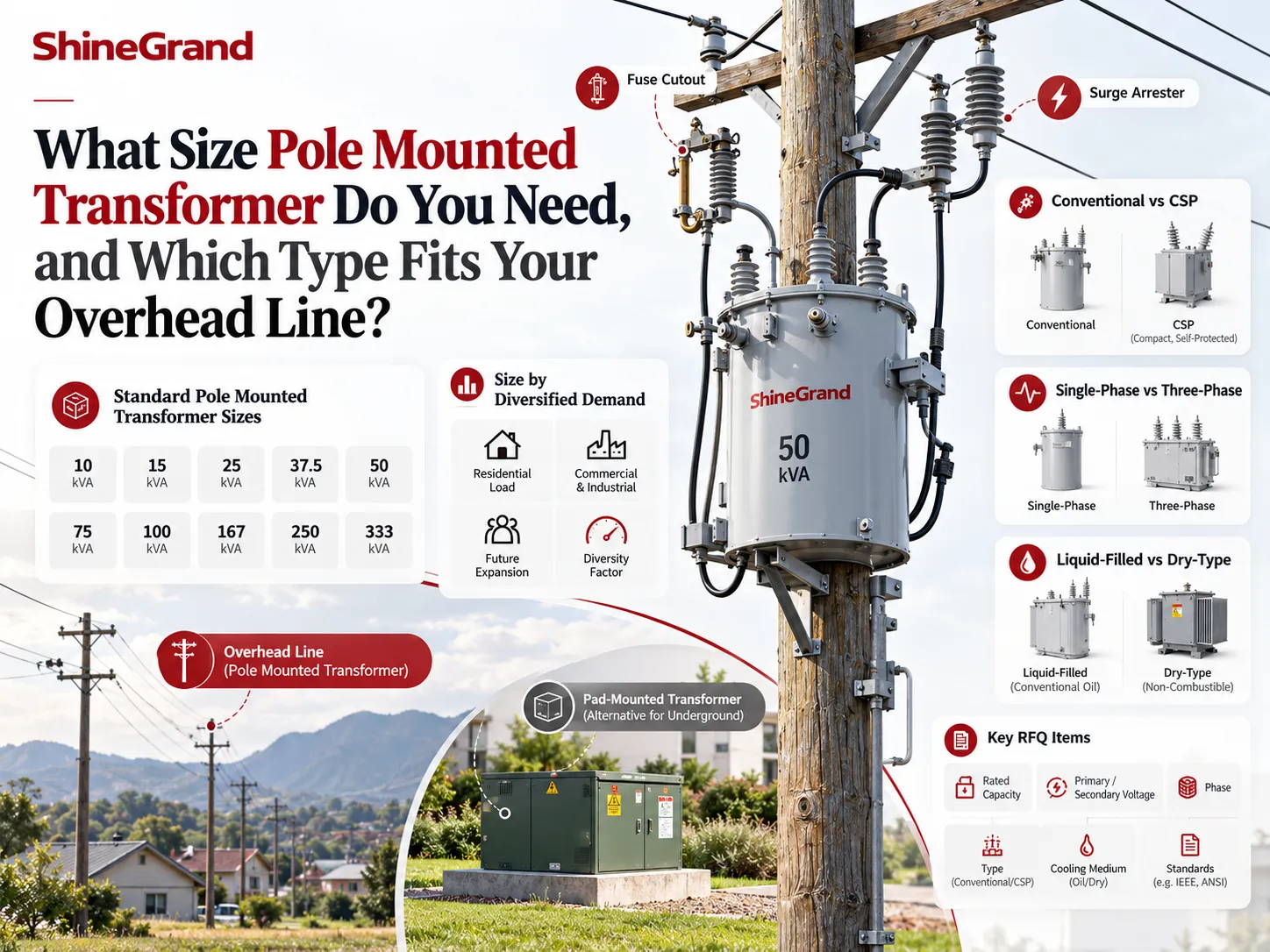
So what does a pole mounted transformer look like and what are the available types? A pole mounted transformer is a distribution transformer filled with oil (sometimes dry) mounted on the utility pole to reduce medium voltage (which is usually between 2.4 kV and 34.5 kV) to service voltage. The most common sizes of single-phase pole mounted transformers in North America are 5, 10, 15, 25, 37.5, 50, 75, 100 and 167 kW, with bigger transformers of 250 and 333 kW also manufactured for higher loads. Three-phase transformer installations usually consist of two or three single-phase transformers combined into a set or just one larger three-phase transformer. The correct power rating is determined by the degree of diversity of the connected load, increase in demand for service, like EV charging etc.
If you are looking for a basic explanation of what these units are and how they work, see ShineGrand’s guide to what an electric pole transformer is. This article covers sizing, types and specification.
Standard Pole Mounted Transformer Sizes
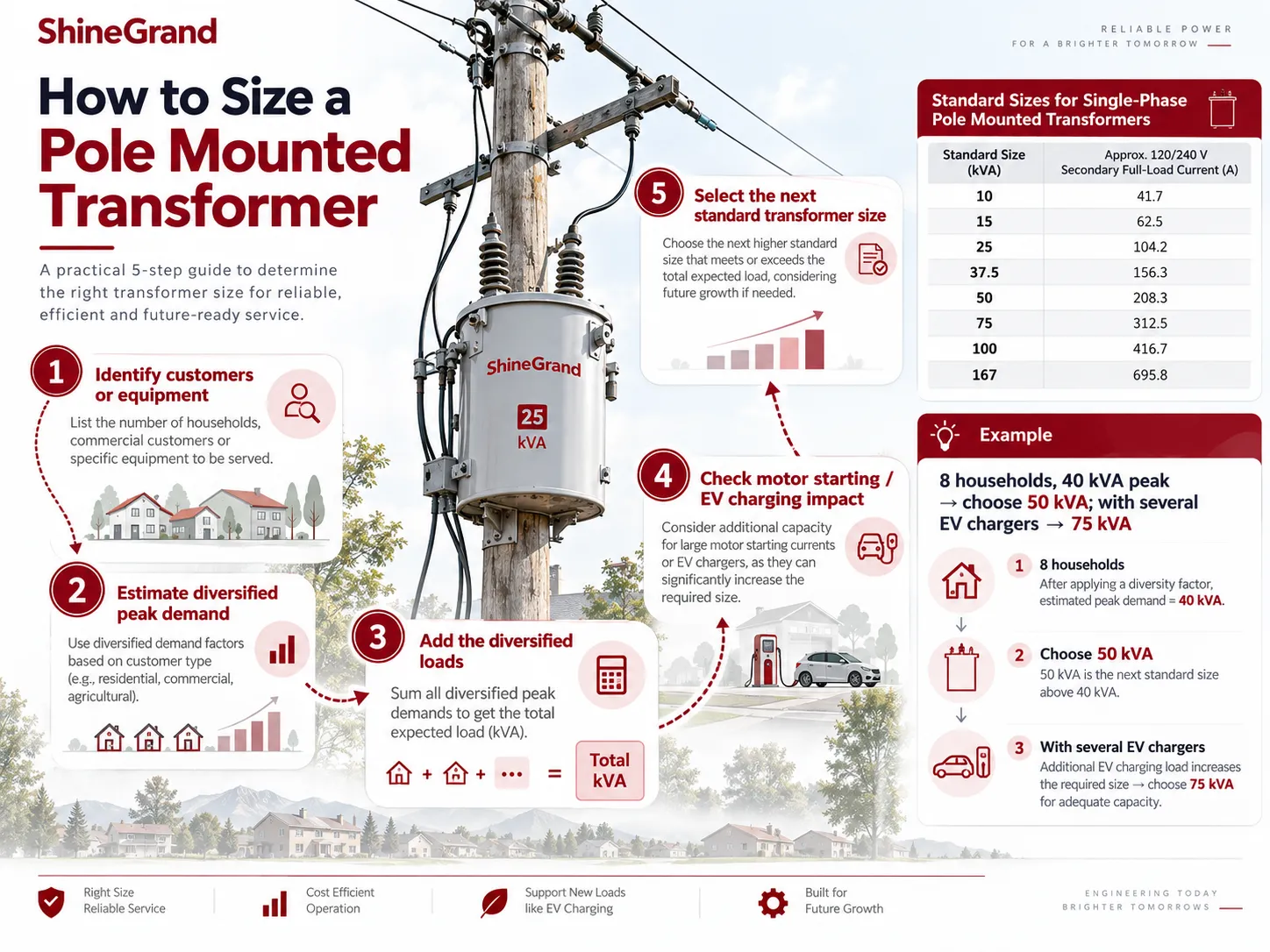
Single phase transformers that are positioned on poles are produced according to regular sizes of kVA power. It is helpful to know the full load current for each size of transformer in order to verify all service conductors, secondary fuses, mounting devices and breakers. To find out the full load current on the secondary side of a transformer operating at the voltage of 120/240 V one needs to use the following data:
10 kVA: around 41.7 A
15 kVA: around 62.5 A
25 kVA: around 104.2 A
37.5 kVA: around 156.3 A
50 kVA: around 208.3 A
75 kVA: around 312.5 A
100 kVA: around 416.7 A
167 kVA: around 695.8 A
Such output is achieved by using the single-phase formula I = kVA × 1,000 ÷ V. On the input side the output is less with the 50 kVA performing at 7200 V only drawing around 6.9 A, thus the input fuses are quite small.
In reality, there are many transformers with the rating from 25 kVA and up to 75 kVA, which comply with the requirements of more than half of the residential streets. The transformers rated at 100 and 167 kVA are installed to operate certain big houses, small businesses and even farm equipment that requires considerable resources, while the transformers with the capacity of the 250 kVA and 333 kVA help to fulfill heavy loads if the utility approves their positioning.
How to Size a Pole Mounted Transformer
The process of transformer sizing is not only about summing the ratings of each device. Not all households receive their peak load simultaneously, so utilities employ differential demand approach instead. The steps for practical transformer sizing are as follows:
1. Select the customers or the devices to be connected to the future transformer and their type: customers having gas heating, electric heating, companies having heat pumps, etc.
2. Estimate the differential peak demand per household. Utilities collect their own information on customers’ and household needs: for example, a household of four or more people with gas heating would contribute hardly a kilowatt to the peak of any transformer, while a household having electric heating, heat pumps and EV chargers would be very different.
3. Add the calculated numbers of the clients you plan to connect. The type of the client must be taken into consideration.
4. Check the starting moment for the electric engine. A transformer may be appropriate for planned use of 30 kW of energy, but this energy consumption may be dangerous while starting a huge electric engine.
5. Take the next size of a transformer according to your calculation.
As an example only: if we have eight households having peak power consumption of 40 kVA we would need a 50 kVA transformer, however, if we install several EV-chargers in these households, we will need a 75 kVA transformer.
Types of Pole Mounted Transformers
Conventional vs completely self-protected (CSP)
This is the second crucial decision in the design after kVA capacity definition.
Traditional transformers do not possess any inner protection; the latter is provided by means of an external fuse cutout used for primary over-current protection as well as a separate surge arrester used for lightning protection, both installed on the pole or crossarm.
Betting on a completely self-protected transformer allows to design transformers with the required protection features integrated in the transformer design itself. In the majority of cases, it is represented by the presence of an internal primary protection link inside the tank and a secondary circuit breaker to trip when overload occurs or secondary circuit fails. A lot of CSP designs include would-clue up indicator informing when the transformer is close to overloading.
CSP transformers decrease the amount of the equipment on the pole as it allows restoring service with the help of resetting the secondary breaker rather than having to change a fuse. However, traditional transformers are more simple and protect can be changed without replacing the transformer altogether. If you use conventional units, ShineGrand’s guide to fuse cutouts covers the external protection.
Single-phase vs three-phase
Among the various types of transformers used across different regions, this type of transformer happens to be the most frequently used in North America. This is because there is mainly single-phase electricity supply in domestic areas with voltages such as 120V and 240V. Following are the different ways in which three-phase load in overhead lines is being catered to:
– Employing a transformer bank comprising three single-phase transformers on a single pole connected in wye or delta for achieving three-phase operation (e.g. 208Y/120 V or 480Y/277 V).
– Use of open-delta or open-wye transformer banks of just two single-phase transformers to provide power catered to small three-phase loads.
– A three-phase pole-mounted transformer to be used in alignment with IEC standards.
In cases of very high requirements for using three-phase power, a pad-mounted transformer powered by underground cable becomes more suitable.
Liquid-filled vs dry-type
Virtually all overhead transformers contain a liquid, typically mineral oil, which acts both as insulator and coolant in a compact lightweight tank, although alternatives are becoming more popular:
Natural ester fluids, derived from vegetable oils, have a higher fire point compared to mineral oil, and can be easily broken down in nature. They are usually used near water bodies, in fire-prone areas, and where there is a need to minimize environmental hazards caused by leakage.
There exist dry-type overhead transformers, which do not contain liquid at all. Amongst such transformers is Siemens Energy’s CAREPOLE, a single-phase overhead transformer with rating of 25 kVA to 50 kVA operating in a circuit of up to 25 kV and windings coated with resin based on IEEE standards.
How Single-Phase Pole Mounted Transformers Are Connected
For a single phase pole mounted transformer, many specification errors come from misunderstanding the primary and secondary connections, so it is worth going through them.
Primary connection
- In the case of multi-grounded wye systems (such as 12.47Y/7.2 kV), a transformer is usually installed in a line-to-neutral position. The plate details the required voltage levels as the winding being rated 7,200 V and the winding is compatible with a system of 12,470Y. These transformers have single high voltage bushing although one end of the winding is connected to a tank.
In the case of delta or ungrounded systems when the transformer is used in the line-to-line connection, two insulated bushings are necessary in order to maintain safety and efficiency of the entire process.
The dual voltage primary allows the utility company to install one transformer now and take advantage of increased voltage in the future.
Secondary connection
- The regular North American residential service has a voltage of 120/240 V three-wire, having a center tapped secondary, which provides a voltage of 120 V for lighting and sockets and a voltage of 240 V for high capacity equipment.
Secondaries with a voltage of 240/480 volts are used in irrigation pumps and farms and for some commercial loads.
In the IEC markets, single-phase secondaries, depending on the network, will usually be either 230 V or 230/460 V.
Taps, polarity and impedance
- Taps which are generally ±2 x 2.5% at the primary enable the necessary adjustment of the secondary voltage according to the correct line voltage at the pole.
Polarity is important in case of paralleling units or banked transformers. IEEE discusses the polarity of units ≤ 200 kVA and having high-voltage winding of 8,660 – additive polarity; larger ones or with higher voltages have subtractive polarity.
Impedance influences the voltage drop, the start of a motor and the amount of the fault current fed to the customer panels. Specify the impedance if your utility has a standard range of the value specified. 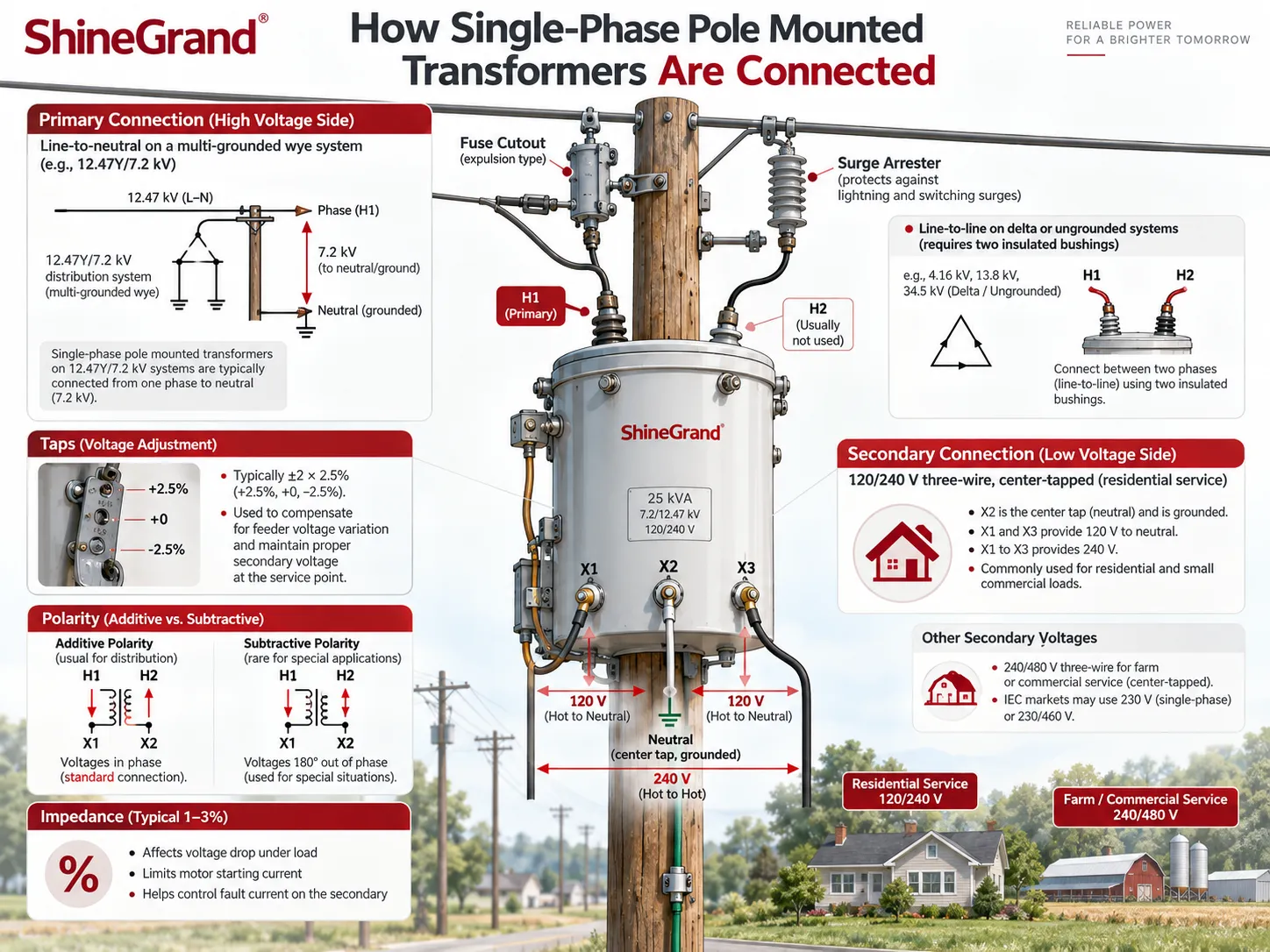
Pole Mounted Transformer vs Pad Mounted Transformer
The selection actually occurs more according to how distribution is made than by reference to the transformer itself:
Distribution systems: poles with pole-mounted transformers can supply overhead lines, while pad mounted transformers works with underground cables.
Capacity: single-phase pole transformer can supply the upper limit of its use.
Installation cost: pole-mounted units have less installation cost than the other types due to it not requiring any trenching and concrete pads to be used at the first stage of distribution installation.
Installation and maintenance: Pole-mounted transformers work with a bucket truck while pad mounted units are safe for underground work.
Accessibility: pole mounted units have to be reached for repairs using the pole; pad mounted systems are at reached for repairs.
For new underground developments, ShineGrand’s three-phase pad-mounted transformers are the alternative.
What to Put in a Pole Mounted Transformer Specification
The comprehensive request for quotation (RFQ) for pole-mounted transformers should include the following information:
·kVA ratings and quantities.
·Number of phases.
·Input voltage brackets and connectivity including i.e. 7200/12470Y or dual voltage
·Number of HV bushings
·Output voltage brackets, for example, 120/240 or 240/480
·Frequency: 50 Hz or 60 Hz
·BIL.
·Taps range.
·Impedance range if specified by Utility.
·Type of construction: conventional or CSP while mentioning any different rating of the arrester, breaker, or fuses.
·Dielectric Medium – mineral/oils /natural ester
·Core and winding materials – grain oriented silicon steel/amorphous core and copper/aluminum windings.
·Efficiency or loss parameters such as US DOE efficiency or loss evaluation factors for total cost calculation.
·Tank material and wrapping for environment, i.e. stainless steel, or use of extra protection against coastal environment.
·Mounting hardware required i.e. pole suspender brackets for pole construction or cluster construction and ground provision.
·Key standards to be followed such as IEEE C57.12.00 and C57.12.20 (North America). CSA C227.4 (Canada) or IEC 60076 (Rest of the world).
·Test and Documents Requirements – routine test reports and type test evidence where applicable.
Installation and Protection Considerations
The reliability of a transformer that is fixed on a pole is de-dependent on its installation. The significant factors are listed below:
The pole strength and classification must be suitable according to the weight of transformer, which varies between less than 200 kg for small transformers to over a ton for bigger ones.
The mounting height and clearances must comply with the safety code guidelines such as NESC.
The tank, arrester ground, and secondary neutral must be bonded to a low resistance ground.
The surge arresters must be fixed as near to the transformer bushing as possible, and the length of leads should be short enough to give maximum protection to winding.
- Primary fuse links must be sized for the transformer’s inrush current and coordinated with upstream protection. ShineGrand’s high voltage fuse guide explains transformer fusing in detail.
- Wildlife guards on bushings help prevent outages caused by animals.
ShineGrand Pole Mounted Transformers
ShineGrand Electric manufactures single-phase pole mounted transformers for North American and international overhead networks:
- Ratings from 10 kVA to 333 kVA, covering the standard residential and rural sizes.
- Primary voltages from 4,160 V to 24,940 V, including 7,200, 7,620, 12,470, 13,200, 13,800 and 19,920 V.
- Secondary voltages of 120/240 V and 240/480 V, with other voltages such as 277, 346 and 600 V available.
- 50 Hz or 60 Hz, oil-immersed, with a 65°C temperature rise.
- Grain-oriented silicon steel or amorphous metal cores, and copper or aluminum windings.
- Efficiency in line with DOE 2016 and NEMA TP-1 requirements, and design references to IEC 60076 and CSA C227.4.
- Conventional and CSP configurations available.
ShineGrand also supplies surge arresters, fuse cutouts and disconnect switches, so the complete pole-top package can be sourced together. See the full transformer range for other ratings.
Frequently Asked Questions
Is a pole mounted transformer the same as a pole mount transformer?
Yes. Pole mounted transformer, pole mount transformer and pole-top transformer all describe a distribution transformer installed on a utility pole. They are the same type of equipment.
What size is a typical single phase pole mounted transformer?
Most residential single-phase pole transformers in North America are 25 kVA, 37.5 kVA, 50 kVA or 75 kVA. Standard sizes run from 5 kVA to 167 kVA, with 250 and 333 kVA available for heavier single-phase loads.
How many houses can a pole mounted transformer serve?
The transformer size and power consumption of the homes have an impact on the number of homes served by the transformer. A small 25 to 50 kVA sized transformer has the capacity to serve between four to ten houses only in areas with light loading, that is, light appliances load homes. However, electric homes, heat pumps, vehicles with electric chargers impact the number of homes served. Power supply utilities have their own standard and based on loaded information.
What is a CSP pole mounted transformer?
The CSP transformer self-sufficiently protects itself with its own protective features, including an internal protective fuse, a secondary switch and a surge protector which is installed on the tank of the transformer. It thus requires less external equipment than the conventional transformer whose operation is dependent on a different fuse cutout or surge protector.
Can a pole mounted transformer supply three-phase power?
Affirmative. Three-phase power may either be obtained from a trio of single-phase pole transformers arranged in a bank formation or may occur by combining two transformers positioned in an open delta or open-wye configuration for small loads. However, large three-phase power loads are always served through pad-mounted transformers.
Can a pole mounted transformer be dry-type?
Dry-type pole transformers, including Siemens Energy’s CAREPOLE, which has a capacity of 25 to 50 kVA and operates in a single phase, use cast resin as insulation rather than oil, and are meant to take the place of oil-insulated transformers of a similar rating in applications involving the risk of fire or leakage from the transformers.
How long does a pole mounted transformer last?
Liquid-filled pole transformers are commonly expected to last 25 to 40 years under normal loading. Sustained overloads, lightning damage, corrosion and moisture ingress shorten that life.
References
- IEEE C57.12.20 — Standard for Overhead-Type Distribution Transformers 500 kVA and Smaller. Ratings, construction and accessories for pole mounted transformers.
- IEEE C57.12.00 — General Requirements for Liquid-Immersed Distribution, Power and Regulating Transformers. Including polarity and general ratings.
- IEC 60076 — Power transformers. International transformer standard series.
- US Department of Energy. Energy conservation standards for distribution transformers.
- Siemens Energy — CAREPOLE Dry-Type Pole Mounted Transformers. Example of a dry-type alternative to liquid-filled pole transformers.
- ShineGrand — What Is an Electric Pole Transformer?. Basic function, symptoms of failure, cost and maintenance.
Ordering Pole Mounted Transformers for Your Project?
Choosing the right pole mounted transformer comes down to the right kVA size, primary connection, secondary voltage, protection approach and efficiency requirement for your network. Send ShineGrand your primary voltage, kVA ratings, secondary voltage, quantity and standards, and the team will confirm a suitable configuration. Contact ShineGrand for a quotation.