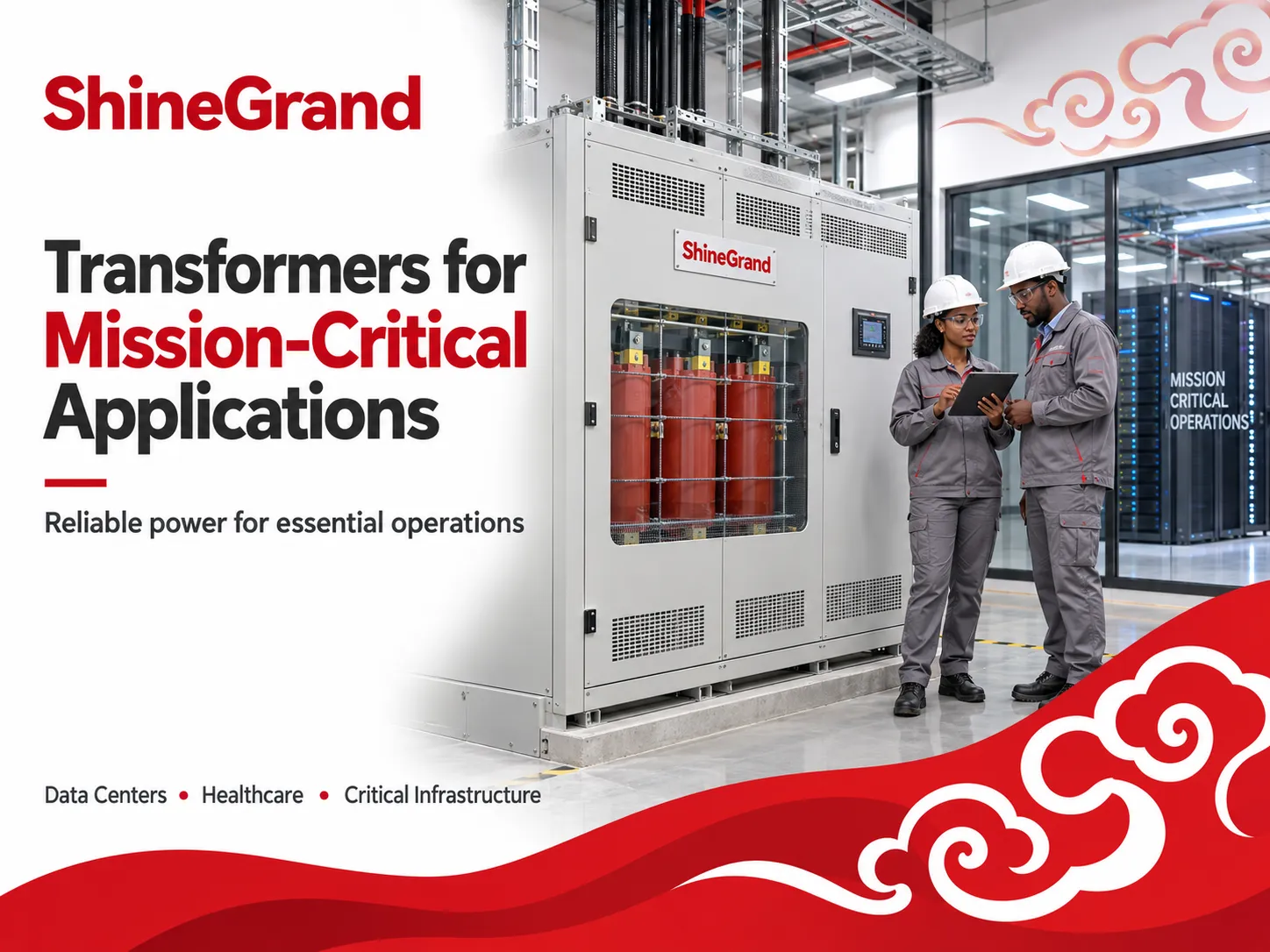
For typical buildings, a brief interruption in its power supply may be annoying and result in some inconvenience. In more critical environments like that of data centers, hospital operating theaters, or production cleanrooms, such an interruption may mean losing data, interrupting surgical procedures, or ruining production runs costing millions of dollars. In such locations, failures have to be avoided completely, and the transformer installed between the grid supply and e.g. critical devices becomes one of the most critical devices needed for such facilities to operate correctly. Selecting the right type of transformer for such an operation is a completely different exercise than the one of picking a standard transformer, and this article tries to explain the features making the transformers for mission-critical applications different and provides guidance on how to select such a transformer.
On the performance side, a transformer is the device that converts the grid electricity into the voltage required by critical devices. Its reliability, its response to difficult situations, and the ability to work properly in case of any fault have a direct influence on the performance of other devices connected downstream.
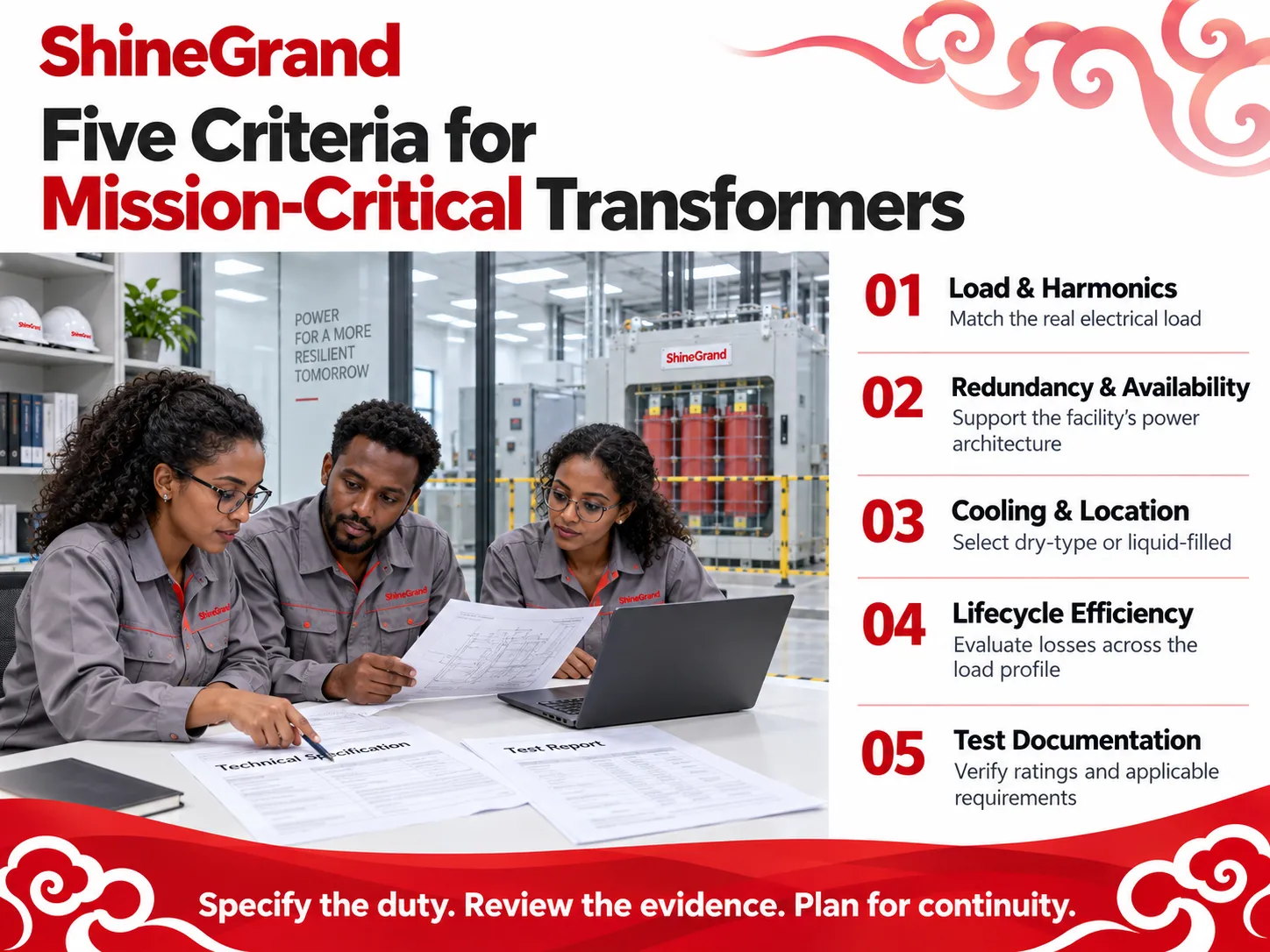
In summary, transformers for mission-critical applications must do far more than convert voltage. Transformers must deal with non-linear, harmonics-laden loads, usually requiring them to have a K-factor rating, cope with inrush current and overload scenarios while working efficiently at low loads resulting from redundancy, and first serve the purpose of maintaining operation during faults by high withstand levels offered in short-circuit and cooling redundancy. Five factors are critical for choosing a transformer: load patterns, redundancy and availability; type of cooling agent used (dry-type or liquid-filled); energy efficiency over the whole lifespan; and compliance with standards set by IEC, IEEE, or UL. That is the reason the power supply of mission-critical installations such as hospitals or data centers relies on that combination in order to use transformers as the basis of dependable uninterrupted operation.
What Makes an Application “Mission-Critical”?
A mission-critical application is characterized by any operation where loss of power brings series of consequences that are significantly higher than the consequences from the outage itself, in regard to money, safety, or data. The key point that remains the same in all cases is that continuity of operations is something far beyond just a convenience. This can be illustrated by data centers, as a small interruption of power may lead to failure of numerous servers and data corruption; hospitals, where life-support equipment cannot be turned off even for a moment; semiconductor cleanrooms and precision fabrication, where the voltage drop can result in a need for disposing of the whole batch of production; and essential buildings like telecom systems facilities, airports, military establishments, etc. In each of the stated cases, the power supply has been arranged to ensure maximum possible availability, and the transformer should ensure it no matter what happens.
Why Mission-Critical Applications Demand More From a Transformer
The transformer constitutes the primary power distribution point that is instrumental in making the entire distribution setup effective. Under normal circumstances, the transformer must only perform its role of supplying the required power, however, in cases of mission-critical applications, it must withstand harsh load conditions, remain functional and yet achieve this under continuous operation over long periods of time. The slightest interruptions of the system or limited voltage drop can be sufficient to disable the critical system equipment meaning a transformer has to be picked based on its performance in the time of crisis rather than just normal operation conditions. Thus, the importance of the change in the attitude that makes us speak of mission-critical transformers.
Key Selection Criteria for Mission-Critical Transformers
Selecting a transformer for critical duty means evaluating it across several dimensions at once, rather than focusing on capacity alone. The following five criteria capture what matters most.
Load Profile and Harmonics
Critical facility loads are rarely straightforward. Various electronic devices, which consume electric energy in non-linear manner, make load levels far from innocent, since loads such as server power supply, uninterruptible power supply, and medical imaging equipment contribute to increased level of harmonics consumption due to their functionality characteristics. Such harmonic vegetative both core and windings of the transformer heat excessively, which can lead to transformer malfunctioning if it is not specially designed for such loads. As a result, transformer must have K-factor rating, which will indicate that the model developed is able to serve harmonic loads. Moreover, transformer should be capable of accepting inrush current and providing for overload constant supervision, which indicates that it should withstand temporary overloading during operation. Finally, due to redundant design, such transformers usually work at only 30-50% of their capacity and have low operating losses in non-load conditions.
Redundancy and High Availability
Critical infrastructure is usually subject to redundancies like N+1 or 2N which correspond to the different levels of data centers so that failure of one part is not enough to bring down the site. The transformers that make use of such networks need to meet those principles. They need to go through very tough short circuit tests, so that they can remain in good condition during a fault, provide interfaces for the partial discharge and temperature monitoring so that the issues can be detected in time and make use of redundant cooling systems, which do not feature points of failure.
Cooling: Dry-Type vs Liquid-Filled
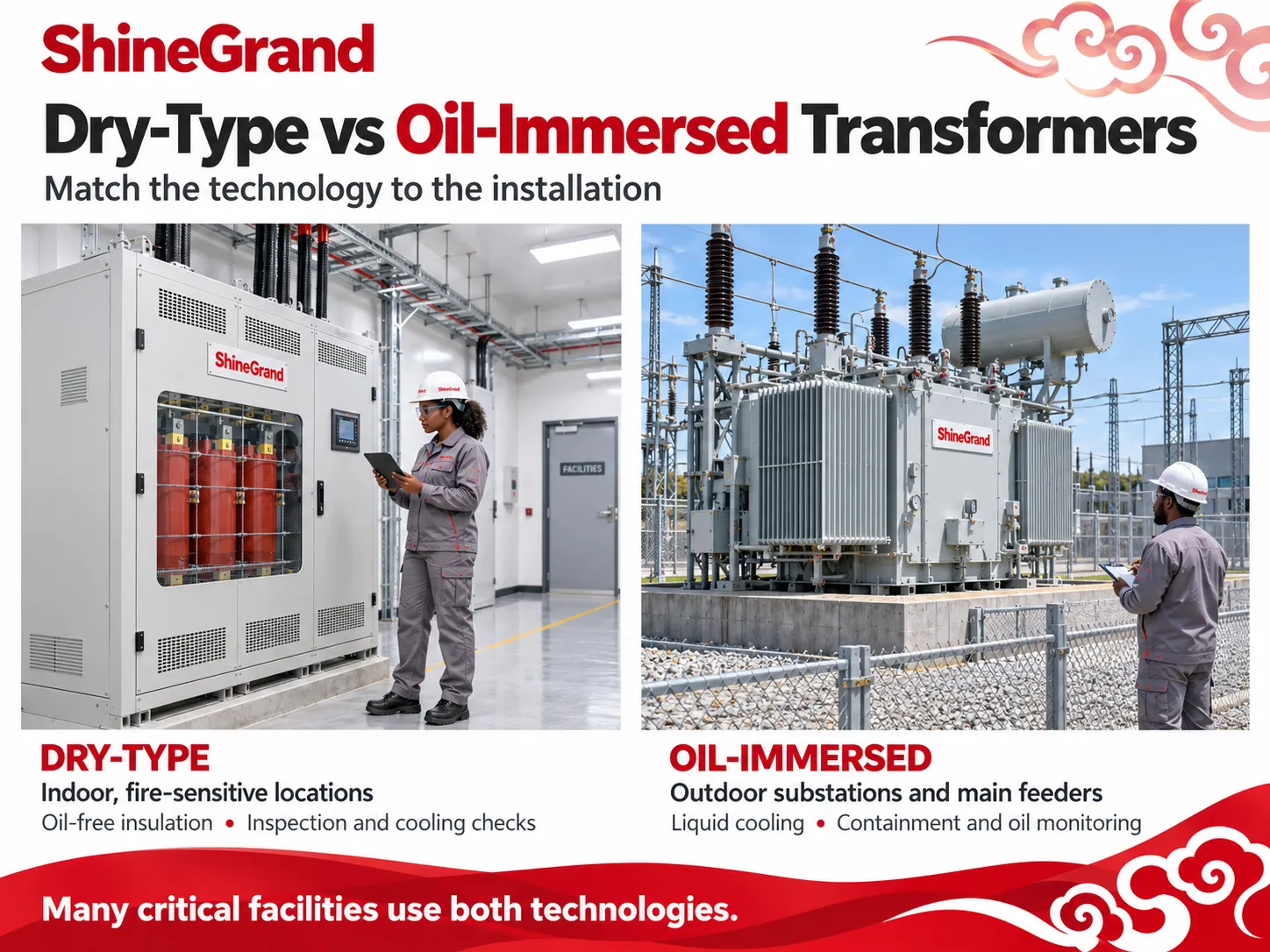
Deciding between a dry-type transformer and a liquid-filled transformer is one of the most significant decisions in this regard, as it depends mainly on the location of the transformer and fire safety. Dry-type transformers are made of cast-resin or air insulation, have no oil present inside, and their self-burning capability clearly identifies them as the best option to use indoors, for instance, in data centers, hospitals, and cleanrooms which should not pose any fire hazard or be hard to maintain. Liquid-filled transformers are good at cooling and provide good performance at large capacities, thus being good for outdoor sites; however, they require additional measures to be implemented and the liquid inside to be monitored regularly. Some important facilities utilize both types of the transformers in their operations, allowing for liquid-filled transformers to be utilized on the incoming supply and dry-type devices near the sensitive equipment.
Energy Efficiency and Total Cost of Ownership
Over the lifespan of a transformer, which is typically between twenty and thirty years, the purchase cost is only a small percentage of the cost of ownership, as the losses incurred during the operation of the transformer are by far the more substantial figure. When the transformer is not switched off, even a slight increase in efficiency makes a huge difference in savings. That is the reason the purchasing process for mission-critical transformer equipment takes into account efficiency requirements, such as those set by the US Department of Energy as well as the European eco-design requirements for no-load and load losses. While initially spending somewhat more on high-efficiency transformers is more than compensated for by the savings made over the lifetime of the unit.
Standards and Certifications
In sectors with a high degree of risk, obtaining third-party certifications is considered a minimum requirement, rather than something that could be classified as additive in nature. Compliance with standards such as IEC and IEEE sets the tone for the requirements for rating and testing of the transformer, even under the toughest of conditions, while certifications of this type (UL, for example) serve as external confirmations that the tested insulation system, the temperature rise limits, and the fire resistance of materials are in compliance with the conducted tests. For mission-critical applications, insisting on properly certified equipment removes a whole category of risk from the project.
Reliability by Design: Features That Prevent Downtime
However, the method of construction of transformers like those included in the Technics series is a prominent determining factor for their quality, short circuit withstand capability, and quiet performance. Indeed, the reliability of the transformer assembly implies that the windings remain intact during a short circuit current. The transformer is equipped with various monitoring devices, including temperature monitors or partial discharge interfaces, which can transform the device from a silent device to the one capable of providing warning to its owner of potential failures long before they emerge. At the same time, both solid insulation and the fact that partial discharge and raw materials as well as assembly process are properly adjusted bring a big guarantee of the transformer assembly performance. In a mission-critical setting, these are not luxuries; they are the features that keep the lights on.
Matching the Transformer to the Application
Various critical environments utilize different types of transformers. In data center applications, it usually combines either liquid or dry type transformers in the incoming medium-voltage supply with K-factor dry-type transformers located near the IT load in an N+1 or 2N design configuration. Whereas for hospitals, dry type transformers would be placed inside the building for safety concerns and used in the operating theatres as well as in the imaging departments. In other cases, for facilities such as semiconductor manufacturing plants where clean and stable power with close to non-harmonic adjustment is required, transformers should operate in such a manner that they provide clean and stable power. Finally, for large sites and critical infrastructure points including military and telecom sites, appropriate transformers are recommended which will provide reliable transformers feeding the load.
Beyond the Data Center: Demanding and Harsh Environments
Not every mission-critical site sits in a climate-controlled building. Facilities functioning in a tough environment such as defense installations, telecom hubs, train stations, and outdoor industries require constant power supply that operates under conditions that pose major problem to standard equipment. When determining the equipment for the transformers meant to ensure power supply to these facilities, one must take into consideration such factors as extreme temperature, high altitude, seismic resistance, and protection from dirt, moisture, and rust. The international standards specify many requirements for testing and rating of transformers that are supposed to work in adverse conditions, so the units should be carefully tested and chosen instead of simply published. The underlying goal never changes: the transformer must remain a dependable foundation of the power system no matter where it is installed, because in a mission-critical application the environment is simply one more thing the equipment has to survive.
How ShineGrand Supports Mission-Critical Power
Reliable critical power starts with dependable equipment, and that is where a capable manufacturer matters. ShineGrand Electric designs and manufactures a complete range of power and distribution transformers suited to mission-critical applications, in both oil-immersed and dry-type designs. For indoor, fire-sensitive spaces such as data center and hospital distribution, the 20-35kV Epoxy Dry-Type Transformer offers an oil-free, low-maintenance solution. For medium-voltage feeders there is the 6-10KV Oil-Immersed Distribution Transformer, and for substation and incoming-supply duty the high-voltage 110-132kV Oil-Immersed Distribution Transformer and the ground-level Three Phase Pad Mounted Transformer Series. Backed by high-voltage fuses, surge arresters, and disconnect switches, these units give facility engineers a coordinated, reliable foundation for critical power systems.
Frequently Asked Questions
What is a mission-critical transformer?
This type of transformer is a very special one, designed for situations where any power loss can have far-reaching effects, such as in case of data centers, hospitals, and clean rooms. Western OR or similar types of transformers focus more on reliability, even while operating under harmonic loads, on good short circuit withstand ability, redundancy support, control options, and certification of safety.
Should I use a dry-type or oil-immersed transformer for a data center?
This is reliant on where the transmission units are located. Dry-type come equipped with a self-extinguishing feature that makes them perfect for use indoors next to the IT equipment. Equipped with a technology allowing for optimal cooling and great price, oil-immersed are utilized where large capacities are needed such as for outdoor substations and main incoming feeders. Multiple facilities combine the use of oil-immersed on the supply and dry-type units next to the load that is crucial.
What is a K-factor transformer and why does it matter?
A K-factor transformer is designed to serve non-linear, harmonic-rich loads, like those from servers, UPS systems, and drives, without overheating. In mission-critical applications full of such loads, a properly rated K-factor unit maintains efficiency and service life where a standard transformer would run hot and degrade.
What does N+1 redundancy mean for transformers?
N+1 means the system has one extra part compared to the necessary minimal equipment for handling the load, thus if there is a faulty equipment part or the unit is underservice, there will be no power failure. But this makes it possible for transformers to work in non-full load regime and this is why no-load losses and light-load efficiency are of primary importance in critical designs.
What certifications should a mission-critical transformer have?
Check to see if IEC and IEEE standards are followed in specific ratings or tests and whether third-party certifications (for example, UL) are available because they prove that insulation, allowable temperature rises, and fire safety testing have been conducted independently.
Can transformers for mission-critical use handle harsh outdoor conditions?
Indeed, it is necessary to specify the exact requirements in all relevant specifications. Transformers used in harsh environments must be suitable for extreme temperature variations, altitudes, earthquakes, dust, and moisture, in accordance with international requirements. The point is that it is necessary to describe the environmental factors factors at the beginning, rather than to rely on the traditional design capabilities.
References
- IEC 60076 — Power Transformers. The international standard series defining performance, insulation, and testing requirements for power transformers.
- IEEE C57.110 — Recommended Practice for Establishing Transformer Capability When Supplying Nonsinusoidal Load Currents. The basis for handling harmonic loads and K-factor sizing.
- Uptime Institute — Tier Standard. The widely used framework defining data center redundancy tiers such as Tier III and Tier IV.
- U.S. Department of Energy — Distribution Transformer Efficiency Standards. Reference for the efficiency requirements that drive total-cost-of-ownership decisions.
- Electrical Engineering Portal. Neutral educational resource on transformer selection, cooling, and power systems.
Power Your Critical Operations With ShineGrand Electric
When downtime is not an option, the equipment behind your power system has to be dependable by design. ShineGrand Electric Co., Ltd. manufactures a complete range of power and distribution transformers for mission-critical applications, in both oil-immersed and dry-type designs, along with high-voltage fuses, surge arresters, and disconnect switches. Whether you are building a data center, a hospital, a precision manufacturing facility, or any site where continuous power is essential, explore our full transformer product range or contact the ShineGrand team for expert guidance tailored to your project.