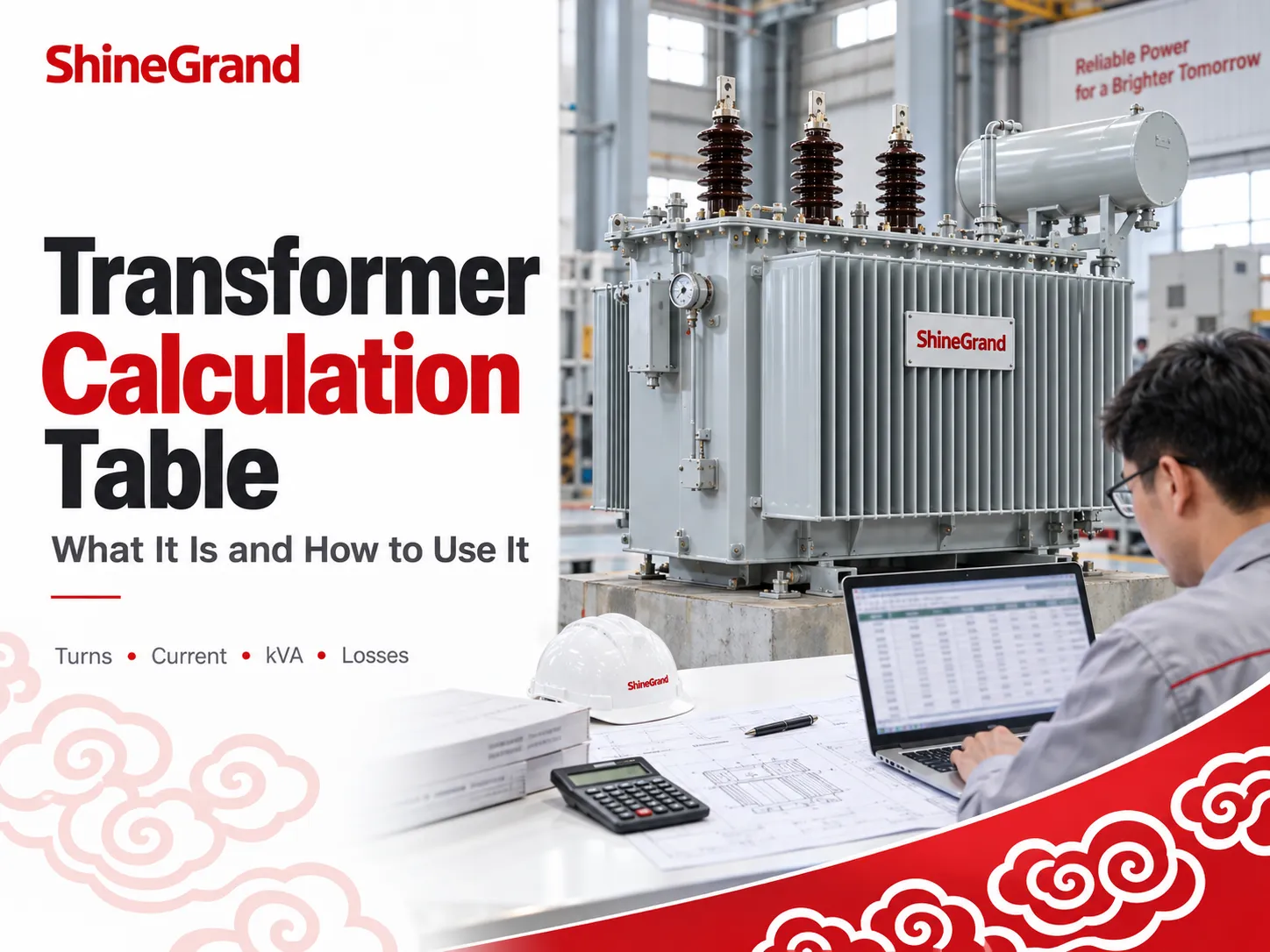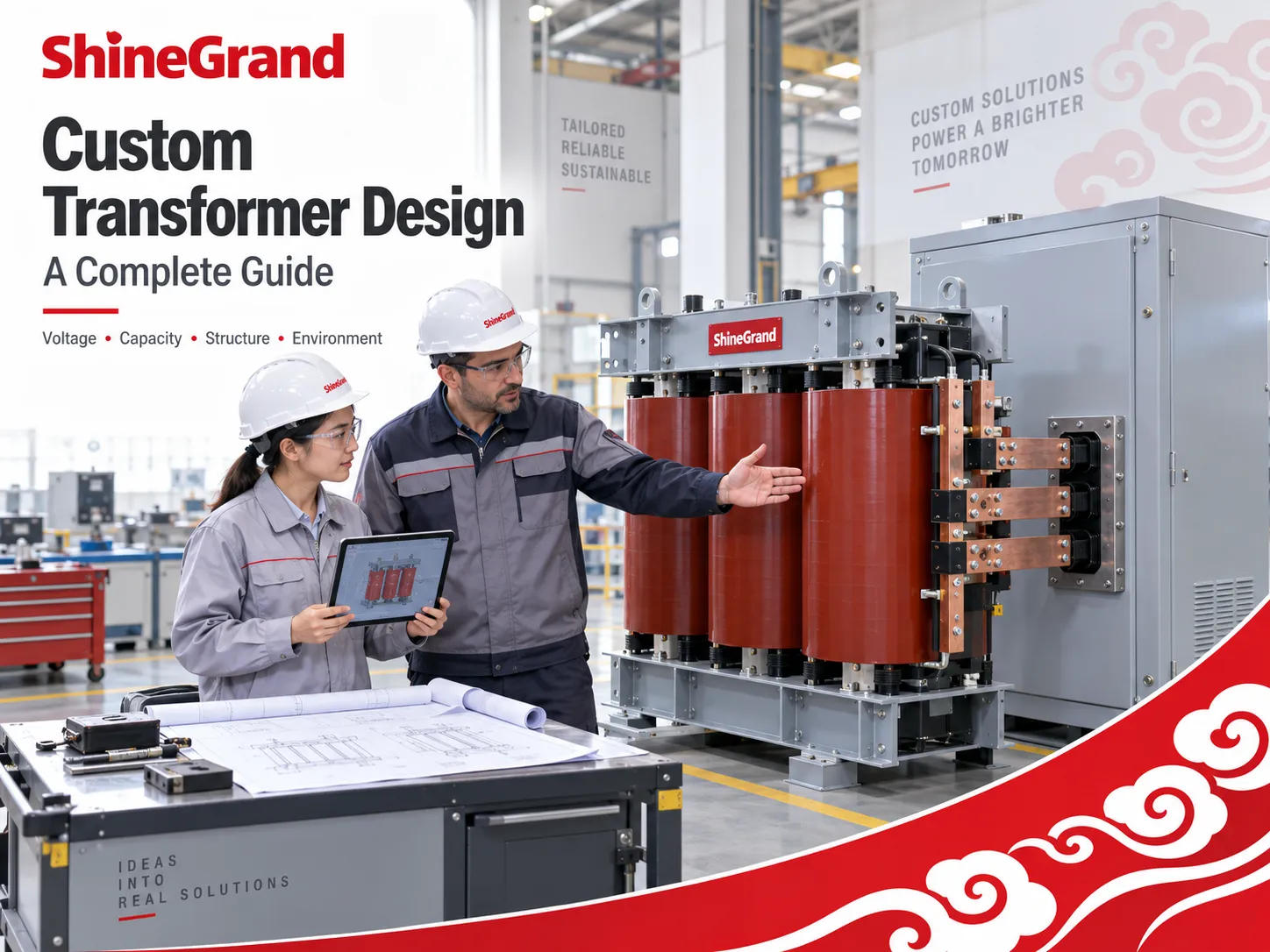
While common transformers can cater to many standard requirements, you will eventually come across a project where a stock item will not suffice. Whether it is an uncommon voltage, a load with harmonious distortions, a compact fit, a hostile environment, or a machine imported from abroad with an exotic power system, the final conclusion remains the same – custom transformer design. This article describes the essence of what custom design is all about, the parameters that should be checked prior to the plotting of any design, the core equation of every transformer, the detailed design process, and the situations which would imply that a custom transformer is required.
The correct custom transformer can be achieved thanks to engineering and communication. The manufacturer should obtain a full and comprehensive understanding of what the transformer needs to provide and conditions for its installation while the customer should be well aware of trade-offs in this endeavor.
Custom transformer design is the technique used to modify a certain transformer to work according to the needs of the user in terms of energy consumption, variations of voltage, construction and dropping conditions. The main goal of the custom design consists in making the transformer meet the non-standard requirements that cannot be satisfied with the standard version, so that the operation of the unit would be secure and stable in the course of time. Instead of adjusting an application for a product already existing, custom design begins with load, site, and interface.
What Is Custom Transformer Design?
Good knowledge leads to custom design.
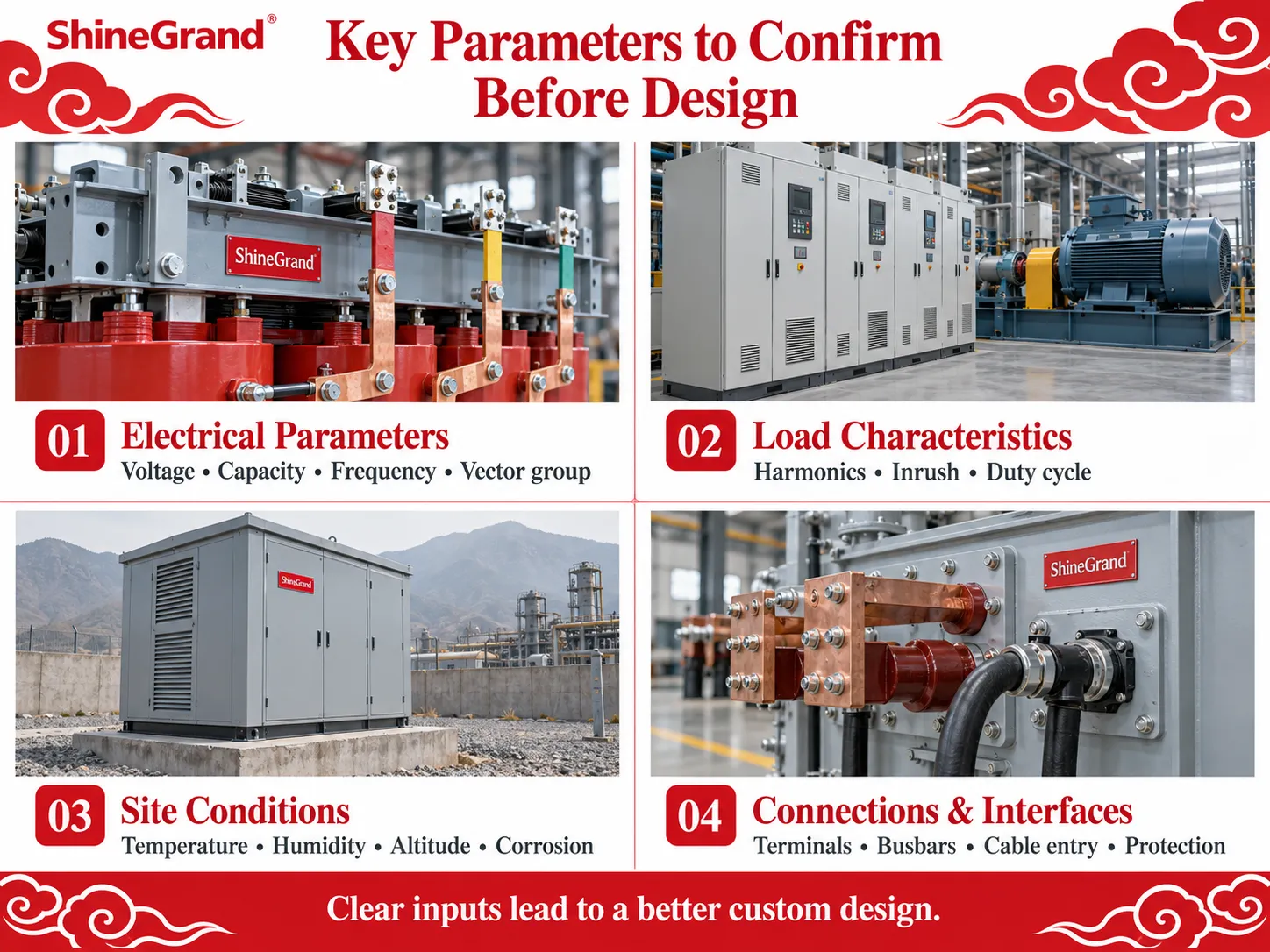
Before calculations and graphic works start, it is necessary to determine electrical parameters, load characteristics, environmental conditions, and interface form.
Electrical parameters. The voltage at the output and input side of the transformer (for example 380 to 200 Volt), the rated capacity (in kW or kVA), the frequency (50 or 60 Hertz), and connection type including the vector group (e.g. Dyn11). These factors define the electrical parameters and functions of the transformer.
Load parameters. The type of load (resistive, inductive, or rectifying and chopping device) and whether there is a high inrush current. This is also essential for the thermal design and harmonics design.
Environmental conditions. This includes humidity and temperature at the location site of the transformer as well as the presence of dust, high altitude, or corrosive atmosphere that necessitates better insulation and higher protection level.
Interface form. This includes how the inputs and outputs of the transformer are designed, their connection types (e.g. terminals, busbar or cable) along with additional features (such as display of current and voltage, protection system, automatic tap changer).
Key Parameters to Confirm Before Design
When it comes to a successful custom design, the importance of information cannot be overstated. The following aspects must be established before moving on to developing a design and doing calculations, as they have a significant influence on the design process.
Electrical characteristics. The input and output voltage levels (380 V and 200 V, for example), the output capacity expressed in kVA or kW, frequency (50 or 60 Hz), and connection type (for instance, Dyn11). These determining electrical characteristics define the electrical essence of the transformer.
Load specifics. This refers to whether the load is resistive, inductive, or is a type of rectifier and drive producing harmonics; whether there is a possibility of large inrush current; whether the duty cycle is continuous or intermittent.
Environmental requirements. It refers to all the climate conditions (temperature, humidity, dustiness), as well as any special conditions, such as installation at high elevations or in a corrosive environment where improved insulation and protection ratings are needed.
Interface design. This refers to the design of connections at the input and output (terminals, busbar, cabling), whether any special features are needed (for example, indication of voltage or current, thermal protection, tap changing).
The Core Design Equation
Every transformer must adhere to one basic equation that governs the relationship of all parameters. In the case of a line frequency transformer, the voltage across the winding depends on the frequency, number of turns, peak magnetic flux density and cross-section of the transformer’s core. The classic form of this equation tells us that the induced voltage is approximately equal to 4.44 times a function of frequency, number of turns, flux density and core area. This means that for a particular voltage and core, there is a minimum number of turns required to keep the magnetic flux lower than the saturation point of the core. Saturation causes damage and therefore has to be avoided, and this specific equation is the foundation for the whole design process.
What makes this powerful for custom transformer design is that it turns an intimidating subject into a starting point. Once the equation sets the correlation between the number of turns and the core size, the designer can proceed to work with any other aspects of the design, like doing the calculations for the winding material and winding method, cooling arrangements, etc. A transformer differs from an inductor in that it practically does not store energy, and therefore the same core size may be applied in different transformer designs for varying power ratings. Therefore, it is enough for an engineer to learn only this formula in order to be able to employ this knowledge efficiently.
The Custom Transformer Design Process, Step by Step
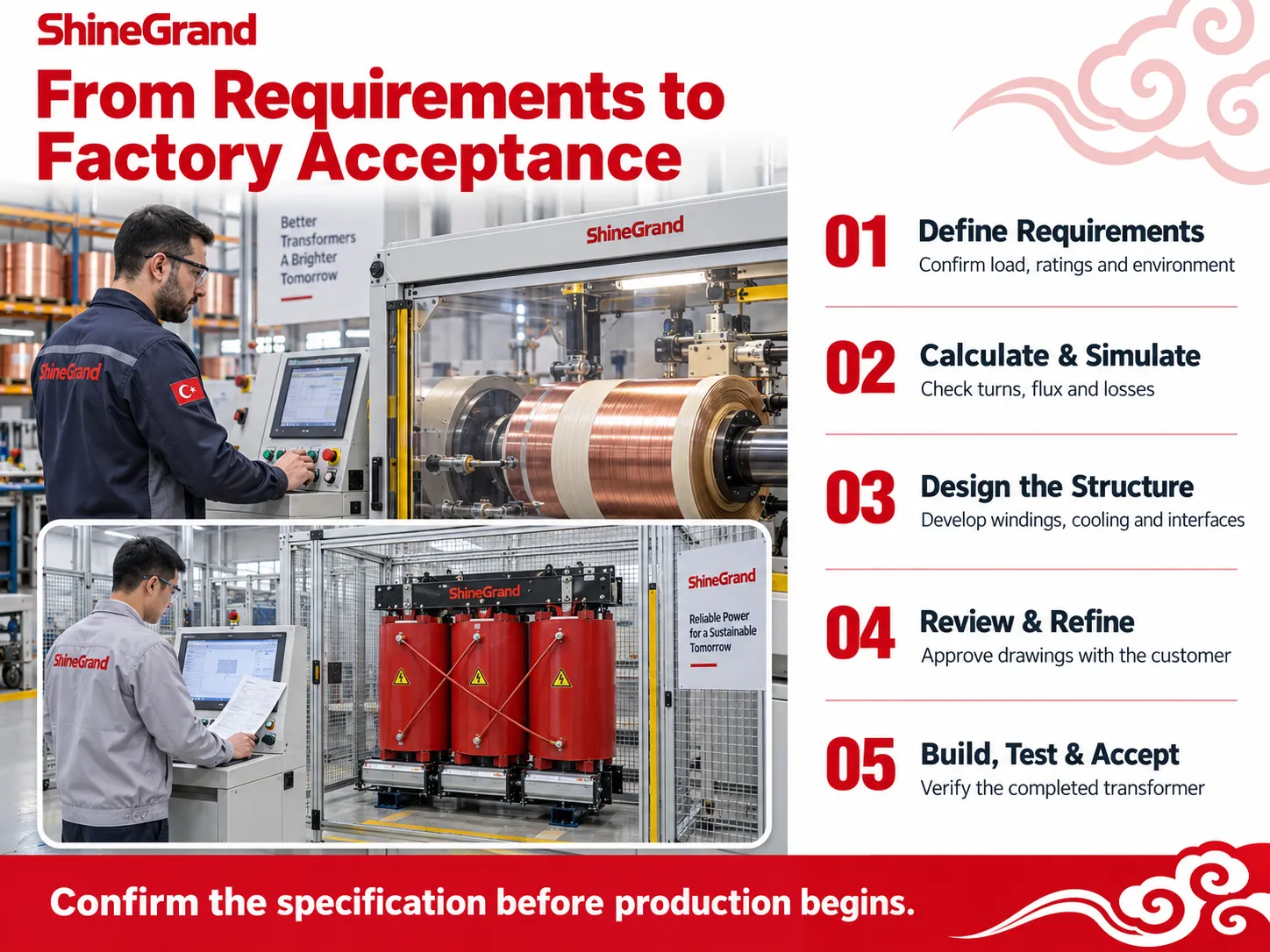
The key stages of a custom project take place in a straightforward manner with the purpose of keeping the client in the picture throughout the entire process.
Requirements gathering and design. Here, information about the client’s power consumption requirements is collected, and the designer identifies the total needed power accounting for an extra 10-15% margin, and prepares a summary design scheme.
Electromagnetic calculations. The calculations carried out by the designer in an engineering software package ensure that the optimal turns ratio, magnetic flux density, and loss parameters are set, while the core does not saturate and the efficiency requirement is satisfied.
Design of the mechanical structure. At the stage highlighted by mechanical design, the overall structure and components of the transformer indicated in the design scheme and drawing, including the stacking approach, the winding scheme, and the cooling design (including both oil ducts and air ducts).
Review and modification of the design. At this stage of the process, the drawing is submitted for client confirmation, and modifications initiated by either of the parties may be performed until the design of the system is approved.
Production, tests, and acceptance of products. Important stages include various factory tests or no-load, load, insulation, and temperature-rise testing. Following the completion of the tests, the device would meet manufacturing requirements, meaning plus or minus 0.5 percent in terms of ratio error accompanied by acceptable level of temperature rise as well.
Special Scenarios That Call for a Custom Transformer
Certain conditions necessitate custom transformer design since standard transformers would not suffice. If these conditions are identified in advance, time and funds can be saved.
Multi-voltage input applications. In the case when voltage varies dramatically (for instance, from 360 to 400 V), certain transformers would need a broader range of input voltage or tapping, in order to maintain the output voltage at about 200 V.
Low-voltage, high-current applications. In the cases where the voltage is significantly reduced, while the output current is equal to thousands of amps, transformers will require large cross-section busbars or foil windings to minimize resistive losses and enhanced cooling.
Special environmental protection systems. The sites with high elevation will need an upgraded insulation type while any corrosive medium will need anti-corrosion treatment, and maritime applications will need to ensure that they meet maritime certification requirements.
Power supply of smart and automatic equipment. In cases when machines with controllers and servos are applied, a custom-made transformer is required in order to load different devices at the same time and match the voltage system for the equipment that was imported.
Custom vs Standard: When Is Bespoke Worth It?
Although custom transformers have a higher price and take more time to obtain than off the shelf products, it is important to identify exactly when the higher investment will pay off. A standard transformer is the best way to go when its configuration, connection and enclosure are already compatible with the intended application because the standard equipment is less expensive, gets delivered faster and is easier to replace later. On the other hand, custom transformer design comes into play in instances when using a standard product would compel the customer to incur expensive alternative solutions, such as deploying some add-on equipment to adjust voltage, oversizing the transformer for the sake of measuring harmonics it was never built for, or placing the standard product into an unsuitable environment. Thus, in this case custom transformer production becomes a less expensive solution over its lifespan because it eliminates losses, heat and reliability issues common for mandatory adjustments. Therefore, the issue at hand is all about how much the desired specifications differ from the catalog solutions and the running time of the transformer.
Lead Time, Cost, and What Drives Them
The custom transformer is designed and made to order, meaning that its lead times and costs depend on exact specifications provided at the beginning. Increasing the voltage class, capacity, and introducing exotic materials lengthens both the lead time and price. Also, specific testing processes, such as partial discharge tests or impulse tests, increases the lead time, while the same apply to any certification required by the application. Also, some winding types are more time-consuming to implement than others – the foil and large busbars used in the designs that handle large current loads take more time than ordinary round wires. Nonetheless, understanding that custom design is possible is only fine if all specifications are set and defined at once because any changes in voltage, capacity, or interface will mean that the project goes back to the start. Good manufacturers will explain how each specification influences timing, so that any project can be planned realistically.
How to Choose a Custom Transformer Manufacturer
The choice of the right manufacturer is a significant part of a successful custom transformer project, as a custom transformer can only match the quality of the manufacturer that engineers and constructs it. Therefore, look for genuine designing capabilities rather than just an assembly, so that the supplier will be able to take the requirements and provide an efficient electromagnetism and mechanics design. Look for real testing including factory acceptance tests against recognized standards, so that what you receive will be confirmed performance, not promises. Also search for relevant certificates and experience in similar applications, and willingness to iterate your drawings and interfaces until the product fits correctly. Good manufacturer will start asking the questions formulated in the previous part of this material, as such questions are a good starting point of a custom transformer creation process.
Frequently Asked Questions
How do I design my own transformer?
Begin with what is necessary: input and output voltage, power, frequency, and load category. After that, utilize the relevant equations interrelating voltage, turns, flux density, and core area to select the core and the minimal number of turns in order to avoid saturation. After that windings and cooling must be developed. Professional design and testing should be considered in case of anything more than low power device.
How do I design a transformer?
The process of professional custom transformer design is step-by-step; it includes requirements analysis and capacity design, electromagnetical calculations and simulations on turns, fluxes, and losses, mechanical and cooling designs, review of the drawings by clients, and – finally – production with comprehensive factory tests performed. It is software tools and expert engineers that allow reaching the required efficiency, temperature rise levels, and accuracy.
Is it possible to build a real transformer?
Yes. Transformers are manufactured on a daily basis, from small bespoke units to huge power transformers. Once the correct specifications are provided, a good transformer manufacturer will create, wind, assemble and test an actual transformers that works for a specific application. The crucial point is that an accurate specification is available at the start and testing is conducted before putting the transformer in operation.
Who is a reputable custom transformer manufacturer?
A well-known custom manufacturing company uses genuine design capabilities along with production that meets global standards, factory testing along with acquired experience in several applications. ShineGrand Electric is one of such manufacturers, providing custom power transformers and distribution transformers available as oil-immersed and dry designs as well, which were professionally manufactured and tested.
References
- EE Power — Designing Custom Transformers With One Design Equation. A technical article on the single governing equation behind transformer design.
- IEC 60076 — Power Transformers. The international standard series defining performance, insulation, and testing requirements for power transformers.
- IEEE C57.12.00 — General Requirements for Liquid-Immersed Distribution, Power, and Regulating Transformers. Reference standard for transformer ratings and construction.
- Electrical Engineering Portal. Neutral educational resource on transformer design, calculation, and testing.
- Transformer — Wikipedia. General reference on transformer construction, the turns ratio, and the governing EMF equation.
Custom Transformers Built to Your Specification by ShineGrand Electric
If a regular transformer will not work, a specially designed transformer would be the solution. ShineGrand Electric Co., Ltd. can create and make custom power transformers, including oil-immersed and dry-type transformers, according to your specifications, voltage, capacity, design, and environment. From medium-voltage units such as the 6-10KV Oil-Immersed Distribution Transformer and the indoor 20-35kV Epoxy Dry-Type Transformer, to the ground-level Three Phase Pad Mounted Transformer Series and the high-voltage 110-132kV Oil-Immersed Distribution Transformer, every unit is engineered and tested for reliable service. To discuss a custom transformer design for your project, explore our full transformer product range or contact the ShineGrand team.