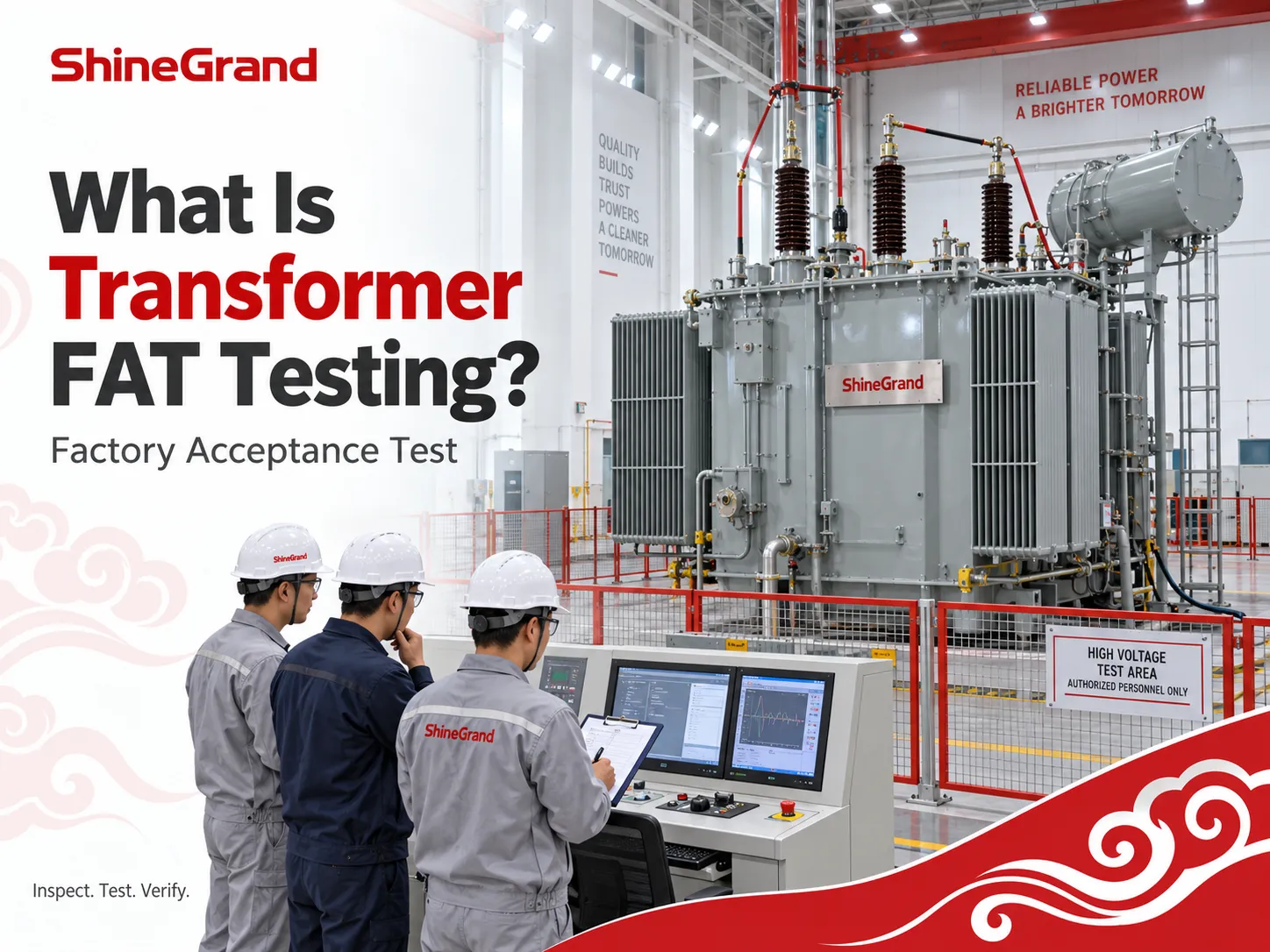
Before a transformer ever leaves the factory floor, it has to prove itself. That proving ground is called transformer FAT testing, short for Factory Acceptance Test, and it is the moment where a freshly built unit is put through a battery of checks to confirm it actually does what the drawings promised. If you have ever wondered what really happens between the end of assembly and the day a transformer is loaded onto a truck, this is it. This guide walks through what transformer FAT testing involves, who takes part, which tests are run, and why the whole process matters so much.
Think of it as a final exam. A transformer can look perfect on the outside but still hide a winding fault, a wiring mistake, or oil that is not quite up to standard. FAT is how a manufacturer catches those problems while the unit is still in the shop, where they are cheap and easy to fix, rather than months later out in the field, where they are expensive and dangerous.
This means that when it comes to the process of transformer FAT testing, inspection, and electrical tests are performed at the factory of the manufacturer after the assembly process but before the shipment, in order to assure that the transformer meet applicable specifications describing the design of the transformer and requirements of the client to some specific model of transformer as well as to the general international standards such as IEC 60076 or IEEE C57.12.90. The testing process involves participation of the quality manager from the manufacturing company, client and if necessary independent third party. Actual tests can vary from ordinary electrical measurements of electrical resistances such as winding resistance, ratio or insulation resistance and withstand and temperature-rise tests and special checks to partial discharge and oil analysis.
What Is Transformer FAT Testing?
FAT Testing (Factory Acceptance Testing) of transformers can be defined as a series of defined tests, measurements, and inspection processes done on a finished transformer to assure that it is manufactured correctly. The idea is easy to convey but critical to accomplish: to ensure that the equipment is built in accordance with the design calculations of the manufacturer, the standards imposed by law, and the requirements ordered by the customer. The practical meaning of FAT testing includes taking a look at the transformer starting from its painting and size and up to examining the electrical characteristics of its windings and insulation.
The reason for FAT testing of transformers to be done in a factory is quite simple: these tests are commonly easier done when the transformer is still at the manufacturer’s plant, surrounded by testing devices and specialists involved into its manufacturing process. After the transformer is shipped, there are no more chances to perform all these tests. Therefore, transformer FAT testing is considered to perform the last and the most rigorous check before the unit is sent away.
When Does FAT Testing Happen and Who Is There?
FAT testing occurs at the final step of construction, i.e., before the transformer is packed and shipped. At this stage, design work has already been finalized, the unit is ready, and the main issue is if it will operate according to what has been indicated in the design specifications. This is usually done in front of witnesses, as three groups of people are usually present at the FAT testing stage.
Manufacturing quality control team. The senior engineers oversee the FAT, carry out all the tests in the necessary order, and take the measurements according to the specifications. They are responsible for the testing.
Client’s representative. It can be either an engineer of the purchasing company or an inspector who comes to observe the test and make sure that the measures were taken in full compliance with the requirements set in the contract. Presence of this person guarantees that nothing was done behind the curtain.
Independent inspector. Third-party inspection agencies (like SGS, UL and CSA) can be present at the testing process to guarantee the credibility of procedures and results.
Why FAT Is Important?
Transformer FAT testing is a very time-consuming and labor-consuming process, so it is good to think why it is done. It helps to catch the problems as early as possible because many times it is high-cost to investigate faults that emerge after installation. Thereafter, it helps to determine the level of conformance with the technical specifications and makes sure the company adheres to such standards as IEC, ANSI or IEEE. The biggest advantage, however, is that it helps to detect issues during manufacturing process, while it is still cheap to fix mistakes.
The Main Tests in Transformer FAT Testing
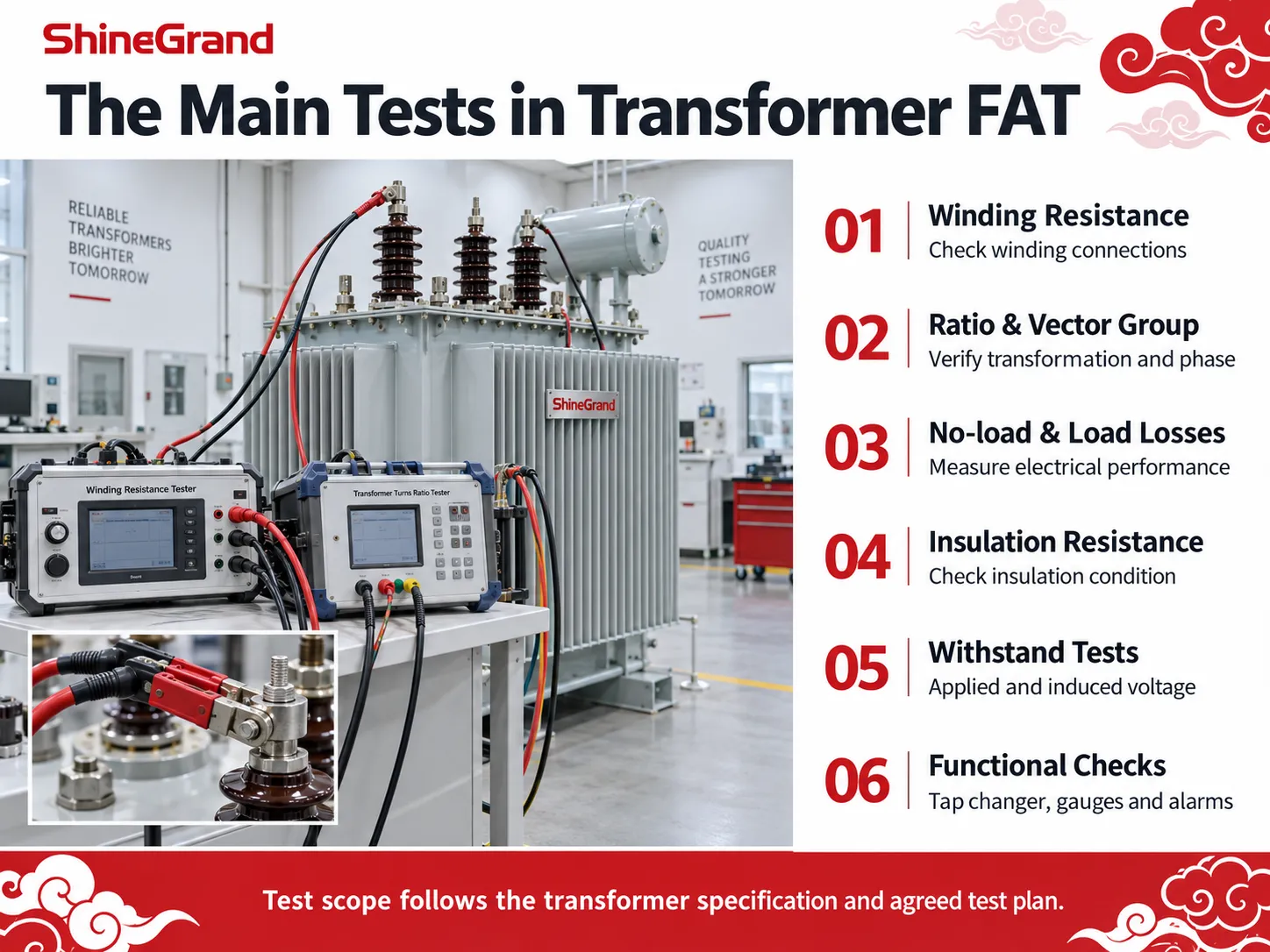
There is no simple test that can determine whether a transformer passes or fails. Transformer FAT testing involves a number of steps of about a dozen tests – not all tests listed are necessarily performed. The combination of tests depends on transformer properties such as voltage class and type as well as customer specification. Some of the basic tests are presented below.
Visual and dimensional control is the first test we have to carry out to check coating, fittings, name plate, the location of accessories and dimensions against gird design since some places have strict requirements with respect to its dimensions.
Winding resistance test is a test which involves measuring of each winding using DC either by means of voltage drop method or using a bridge in order to check for any open circuits, bad joints or hidden faults.
Voltage ratio and polarity test verifies all the turns ratios at every tap and checks for the proper polarity of the transformer ensuring correct voltage transformation and phase relationship.
Vector group confirmation indicates whether the internal windings connection corresponds to the symbol ordered by the customer, so it determines whether the transformer is compatible with the grid it is connected to.
No-load loss and current test is carried out at rated voltage and frequency which shows the quality of the core and core losses while the transformer is energized but not loaded.
Short circuit impedance and load loss test is performed with shorted winding while other winding is powered up.
Insulation resistance test is carried out with the help of megohmmeter in order to measure insulation resistance either between windings or from windings to ground in order to prove that insulation is good enough prior to performing high voltage tests.
Applied and induced withstand tests. The two tests include applied voltage test which checks the insulation with respect to the ground and the induced voltage test where increased voltage and frequency are applied to check insulation withstand.
Temperature rise test is carried out in order to load the cooling system and check the temperature of the windings and oil.
Functional testing is a test consisting in operating the tap changer, different indicators, coolers, alarms and relays to check that everything functions normally.
Specialized and Optional FAT Tests
In addition to the basic set of tests, various projects may include additional tests based on the configuration of the transformer, its usage or any regulatory requirement that requires them. Partially discharged testing detects the presence of small discharges occurring inside the transformer due to its deteriorated insulation system. Sweep frequency response analysis, or SFRA, helps check the physical structure of the transformer windings and core by examining the electrical response of the transformer for a variety of frequencies to assess its integrity. Dissolved gas analysis (DGA) tests the insulation and fluid used so as to check for previous abnormal conditions in the system. Lightning impulse testing generates an impulse that imitates the lightning strike on the transformer windings and noise and vibration measurements are noted in case where sound levels are an issue. None of these is needed on every unit, but for large power transformers they are often essential parts of transformer FAT testing.
Transformer Oil Tests During FAT
In oil-filled transformers, the insulation oil is rigorously tested as, like transformer structure itself, the oil provides insulation for the conductor windings which provides cooling as well. The most important test that is performed with oil is known as breakdown voltage or BDV which indicates oil’s dielectric strength of oil in the process raising the voltage across small electrodes until breakdown occurs. In addition to that, it is also common to test oil for such things as moisture content, acidity of oil, interfacial tension, dielectric dissipation factor, dissolved gases, etc. These tests give an idea of quality of the oil and one of the main tasks is to keep moisture out of the oil as it is the most common contaminant.
FAT vs SAT: What Is the Difference?
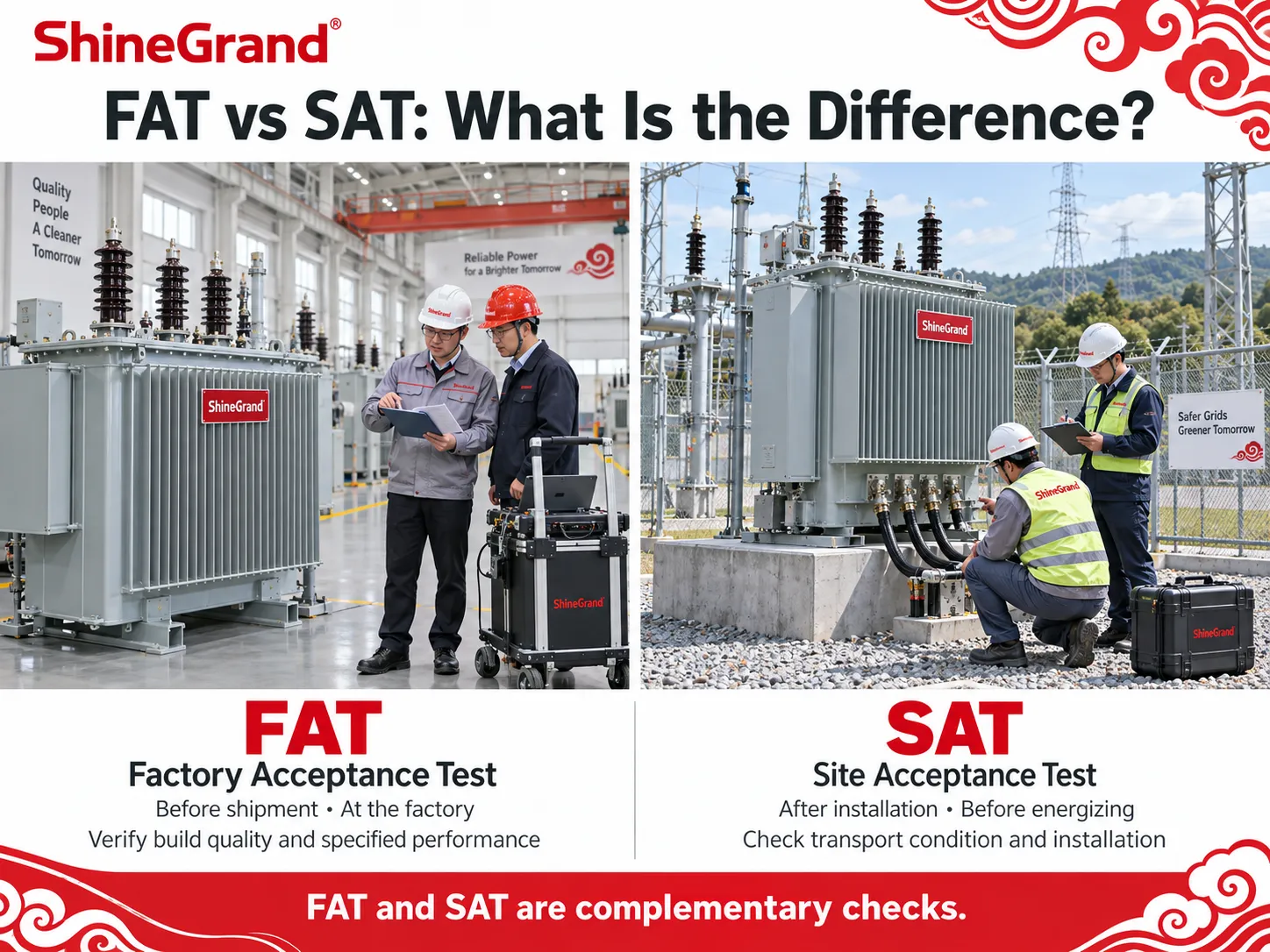
FAT and SAT are terms that are often used interchangeably while discussing the acceptance of equipment and while both tests serve the function of testing the equipment they serve different purposes and take place during different times. The FAT or the Factory Acceptance Test is conducted at the factory of the manufacturer just before shipping of the unit to check whether the unit is manufactured correctly. As opposed to that SAT or the Site Acceptance Test takes place later at the installation site as soon as the device reaches the site but it hasn’t been energized yet. FAT is an assurance of the correct manufacturing of the unit while SAT ensures that the device is delivered in good condition and installed in the right way. The peace of equipment might pass the FAT successfully but still needs to undergo the SAT in order to make sure that the previous operation of the equipment while transporting it did not cause any issues.
Stepwise Guide to the FAT Testing Procedure for Transformers
The flow of FAT testing varies from one institution to another, but the successful procedure guarantees a proper and logical flow through all processes so that nothing is overlooked and results are traceable.
Beginning with documentation, collect the approved drawings, technical specifications, and test plan, and check the serial numbers and calibrations of the instruments to be used in the test.
Start the process with inspections. In this way, one should perform visual and dimensional checks before electricity is supplied to the transformer.
The next step is to perform standard electrical tests. This includes winding resistance, ratio and polarity, vector group, no-load and load losses as well as insulation resistance tests.
Apply the withstand tests. Conduct the voltage testing procedure to show that the insulation is reliable.
Carry out other specialized tests. Depending on the specifications, the tests of temperature rise, partial discharge, and oil must be conducted.
Conduct the functional tests and finalize everything. It is important to conduct tests, analyze results, and issue the test report with the conclusion.
Standards that govern the FAT testing procedure
Transformer FAT testing is carried out in compliance with international standards that have been developed for that purpose. The IEC 60076 series establishes the requirements and test procedures for power transformers and is widely used internationally. In North America, ANSI C57 series has been developed, and IEEE C57.12.90 contains the instructions for the testing of liquid-immersed transformers.
What a FAT Checklist Looks Like
Successful FAT is achieved through planning, and experienced teams follow a checklist. Prior to the beginning of testing, they verify instrument identification and calibration and record the serial number, prepare pre-test documentation such as drawings, specifications, and a test plan, and agree on the sequence of tests. During testing, they take and record measurements according to an approved procedure, especially in sensitive cases where any uncertainties in the record could lead to problems in the future. After the completion of all the tests, post-test analysis and “sign-off” finalize the process.
Frequently Asked Questions
What is the difference between FAT and SAT testing?
FAT, or the Factory Acceptance Test, is conducted at the factory where the transformer was manufactured prior to it being sent out, demonstrating that the transformer was produced according to the specified requirements and standards, usually in the presence of the customer. On the other hand, SAT, or the Site Acceptance Test, is done after delivery and prior to energizing, that is at the point of installation, checking if the transformer has sustained any damage during transport or installation processes and ensuring that the unit operates properly on the site. Hence, while FAT demonstrates that transformer was built according to the given specifications, SAT is focused on the installation aspect.
What is the acceptable BDV value for transformer oil?
The current normal is that in-service mineral oil insulating fluid should maintain a breakdown voltage of at least approximately 30 kV according to the IEC 60156 test, with maintenance limits specified in IEC 60422. If it falls below this threshold, filtration or replacement is usually recommended. New and treated fluids give a much higher value, usually around 60 kV-70 kV or even higher, and transformers that operate at higher voltage may require higher minimums.
What is the procedure for transformer testing?
The following sequence of inspection is followed while testing: first performs visual and dimensional inspection, then laboratory tests such as winding resistance, transformer ratio or vector group tests, no-load and load losses tests, insulation tests are performed and then followed by applied and induced resistance tests and lastly special tests such as temperature rise, impulse test and partial discharge test.
What tests are performed on transformer oil?
The critical oil tests are BDV (breakdown voltage), moisture (water) content, DGA (dissolved gas analysis), acidity (or neutralization number), dielectric dissipation factor, and interfacial tension. Together, they provide information about oil insulation ability and signalize contamination and moisture presence or oil aging before it becomes dangerous for the transformer.
References
- IEC 60076 — Power Transformers. The international standard series defining the requirements and test procedures for power transformers.
- IEEE C57.12.90 — Test Code for Liquid-Immersed Distribution, Power, and Regulating Transformers. The detailed test code used for transformer acceptance testing.
- IEC 60156 — Determination of the Breakdown Voltage of Insulating Liquids. The standard method for measuring the breakdown voltage of transformer oil.
- IEC 60422 — Mineral Insulating Oils in Electrical Equipment: Supervision and Maintenance Guidance. Guidance and limits for in-service transformer oil condition.
- Inspection 4 Industry — Power Transformer Testing (FAT). Neutral third-party overview of the factory acceptance test sequence.
- Electrical Engineering Portal. Neutral educational resource on transformer testing and power systems.
Factory-Tested Transformers From ShineGrand Electric
A transformer is only as trustworthy as the testing behind it. As a manufacturer, ShineGrand Electric puts its transformers through factory acceptance testing to international standards before they ship, so that what arrives on site performs exactly as specified. ShineGrand designs and manufactures a complete range of power and distribution transformers, in both oil-immersed and dry-type designs, including the 6-10KV Oil-Immersed Distribution Transformer, the high-voltage 110-132kV Oil-Immersed Distribution Transformer, the Three Phase Pad Mounted Transformer Series, and the 20-35kV Epoxy Dry-Type Transformer, along with high-voltage fuses, surge arresters, and disconnect switches. To specify a unit or discuss testing and certification requirements, explore our full transformer product range or contact the ShineGrand team.