If you look closely at an overhead distribution line, you would see a gray porcelain or polymer insulator, which holds a tubular fuse cutout above the pole-mounted transformer. This is the simplest but most important element of the medium-voltage system. The functionality of the fuse cutout is very simple, easy and inexpensive, but it determines how many customers will be affected in case of a single faulty transformer. The following article will describe what a fuse cutout is, its construction, the cycle of the work process, a difference between it and a solid blade cutout, its types, and steps to be taken while choosing or replacing the cutout.
What does a fuse cutout do? A fuse cutout functions as a combination of a fuse and a switch used on mid-voltage overhead lines usually from 5 kV to 38 kV. Its operation is very simple. The element protects capacitor banks and transformers from overloaded current. In case of malfunction or overload, the fuse link inside the tube melts creating gas that extinguishes the arc and causes the tube to fall down on the pivot hinge. Thus, the circuit gets opened immediately providing crews with a signal about the problem. The solution also allows them to disconnect the equipment by pulling the fuse holder.
What Is the Purpose of a Fuse Cutout?
The fuse cutout performs three functions simultaneously, which is why power companies use millions of them.
• The first function of the fuse cutout is to provide overcurrent protection. The fuse element melts if the current exceeds the time-current characteristics of the fuse, thereby disconnecting faults at the transformer or line it protects.
• The second function of the fuse cutout is to perform fault isolation and sectionalizing. By disconnecting only the faulty section, the cutout keeps the rest of the line operational. The transformer failure that would otherwise cause a power disruption for thousands of customers is limited to only one transformer.
• The last function of the fuse cutout is to allow linesmen to perform a manual switching operation. Using an insulated hot stick, a linesman can open the fuse cutout to de-energize the transformer or tap line during repair work and close it after the work is completed.
Another practical benefit of the drop-out fuse is that a crew can easily see the drop-out fuse from the ground and find the faulty transformer.
It should be noted that the “cut-out” word in the UK and other countries means a sealed fuse which is used when the utility’s cable enters a house. It is a low-voltage device that belongs to the utility and is not identical to the fuse cutout discussed in this article.
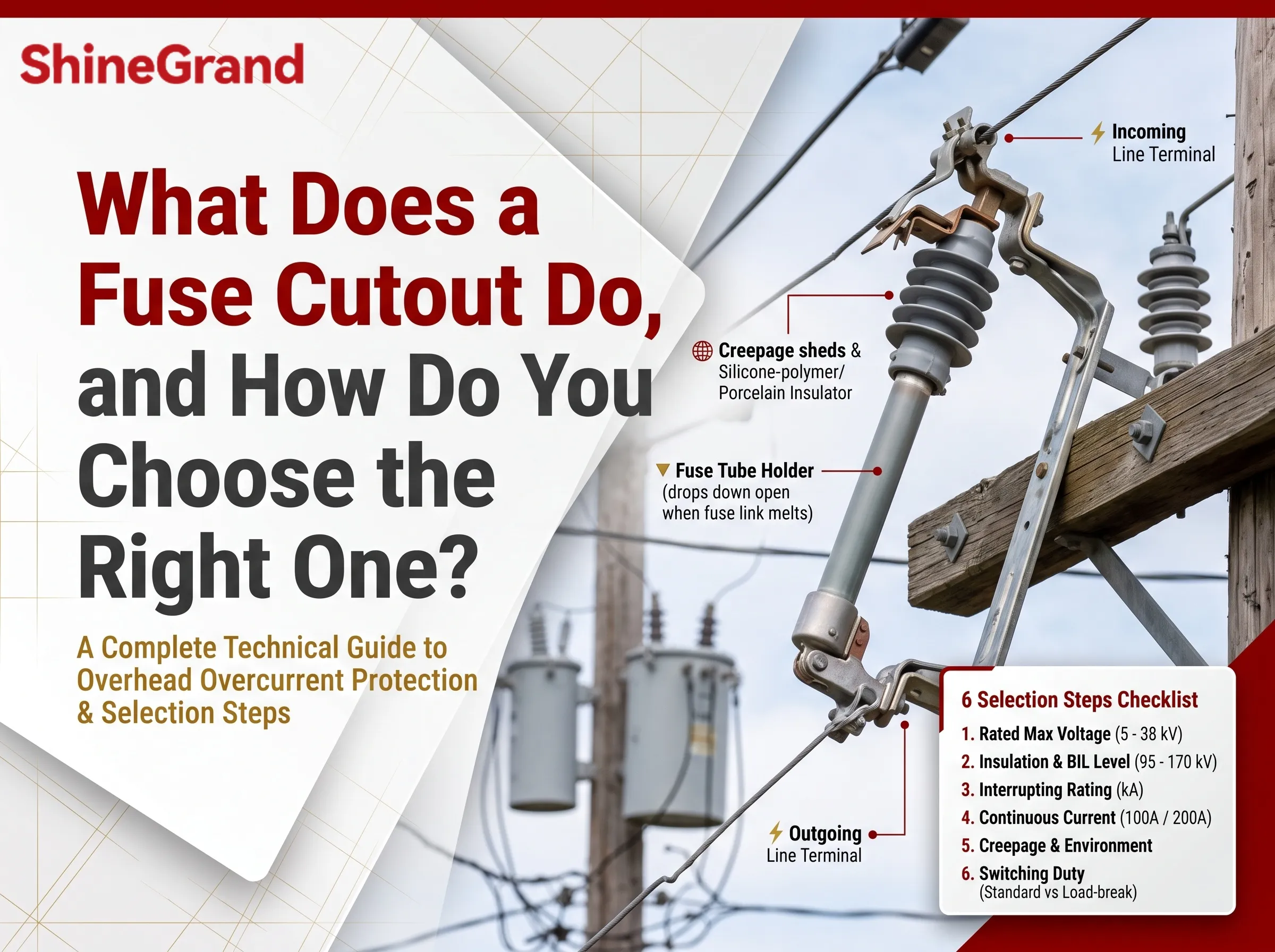
Main Parts of a Fuse Cutout
Companies might have separate designs, but, there are some aspects that can be found across all designs made by companies when it comes to the principal components of open type fuse cutouts.
Porcelain or synthetic polymer is used to produce the case of open type fuse cutouts which feature insulators designed to comply with dielectric strength requirements.
The case of the fuse cutout consists of important components which are held in the case due to insulation.
Metal structure used to hold the case of the fuse cutout to the cross-arm or pole.
Switching mechanism located on the top part of the fuse cutout which allows opening and closing of the cutout.
The joint between the fuse link and the main body of the cutout as well as the place where the current is transmitted to the body of the fuse cutout.
Main part of the cutout designed to put the fuse and create an arc when current flows through it.
A part of the cutout that may be exchanged when necessary and consists of a material that breaks the circuit by simply melting.
A ring made of the tube of the cutout that helps the line worker to open and close the fuse cutout.
A part of the cutout that is responsible for connection of the input and output lines of the cutout.
Moreover, it is worth to mention that despite the simplicity of the tail of the fuse link, it is kept tight for it is operated by a spring mechanism that can move the tail out of the fuse holder.
How Does a Fuse Cutout Work?
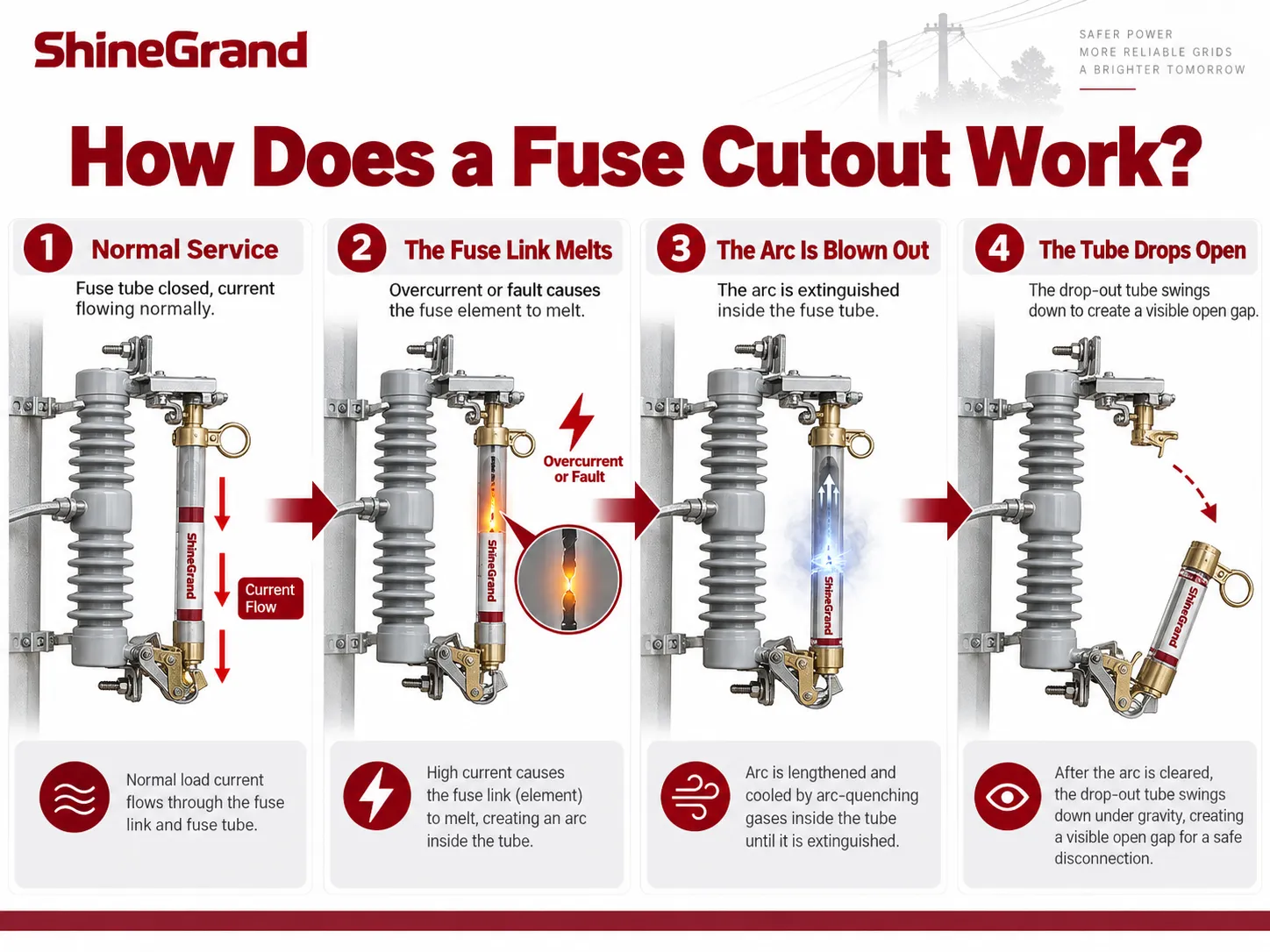
The process of switching from normally functional service to a dropped fuse takes less than a second in case of a heavy fault in the system. Four stages of operation are characteristic of fuse cutouts.
1. Normal service
At this stage, the load current flows from the line terminal through the upper contact down the fuse element in the pipe down through the lower contact to the transformer. The pressure is applied on the tail of the fuse link, which keeps the lower toggle of the key operable in its “set” location, allowing the fuse holder to be locked in the upper contact.
2. The fuse link melts
When a fault occurs, then the current rising through the fuse link rises up. When the magnitude and duration of the current exceeds the melting curve of the fuse, the fusible material melts. An arc appears through the gap, where the melted element was.
3. The arc is blown out
Next, the heat released by the arc decomposes the tube liner material, therefore, a spark of high pressure gas is produced. The gas leaves the lower part of the tube and, in some designs, through the upper part of the tube, taking the fragments of arc products and cooling down the arc. Hence, during the next cycle of alternating current, the arc is unable to rise again.
4. The tube drops open
When the fuse link is disconnected, the tension of the tail is released. The lower toggle due to spring action leads the fuse holder to open the upper component. The tube swings down on the hinge, making the visible arc. Therefore, the visible air gap becomes apparent, hence an operator can see the active cutout.
The safety issues need to be considered. First of all, that a dropped cutout means that the fuse worked, but does not indicate that the downstream equipment is safe to touch. The equipment may still be alive due to backfeed and other operating sources, thus crews need to test and protect themselves, before starting work. Second of all, it is important to mention that during the operation, a high-temperature gas is discharged from the cutout through.
What Is the Difference Between a Solid Blade Cutout and a Fuse?
This question often arises because people cannot distinguish between a solid blade cutout and a fuse cutout as they appear almost the same on ground view. Both of them come equipped with the same design of insulators, brackets and contacts, and often both have the same type of base. What differs them is the kind of equipment present in the holder position of these cutouts.
Unlike a fuse cutout which uses a fuse tube equipped with a replaceable fuse link to disconnect the circuit automatically during an overcurrent situation, a solid blade cutout eliminates the use of the fuse tube and offers no protection whatsoever. Thus, it acts merely as a manual switching device.
Utility companies install solid blade cutouts in places where there should be proper visibility of the switch point and lack of protection, e.g. at sectionalizing feeds points, in places for section isolation and in places for series protection provided by another device in the past.
Despite the fact that solid blade cutouts acquisition is cheaper, such cutouts usually have a greater continuous current capacity since there is no fuse tube limiting transfer. Nonetheless, these cutouts should also never be opened under voltage unless a load-break device is present with you.
Needless to say that a typical problem consists of confusing the two names so that in case of using a solid blade cutout instead of a fuse cutout protection provided becomes non-existent, whereas using a fuse cutout instead of liquids leads to unexpected situations.
What Are the Different Types of Cutout Fuses?
Fuse cutouts are classified in several overlapping ways. It helps to look at them by construction, by function and by insulator material.
By construction
- Open cutouts: The common type that features an exposed fuse tube that is located on an open insulator. This is the type that is used on most of the overhead lines of today.
Open-link cutouts: A simple cutout that does not have a fuse tube because a fuse link is between two contacts in the form of springs as opposed to being located in a glass tube. These are ideal for lower amounts of power and duties and thus are often found in different small transformers and capacitors.
Enclosed cutouts: A design that is very old that has been replaced by the open cutouts.
By function
- Standard cutout fuses: A utility used when there is a fault. The cutouts can only be opened with the use of a ‘hot stick’.
Load-break cutouts: A cutout that has special devices that enable the load-shedding process.
Solid blade cutouts: A device that works like a switch.
Heavy-duty and extra-heavy-duty cutouts: Cutouts that are used where there are very high power currents.
By insulator material
- Porcelain cutouts: made from porcelain which has been used around the world for a very long period of time.
Polymer cutouts: made from silicon rubber which is how they were able to combat different environmental challenges.
Fuse links themselves also come in different speeds, mainly K (fast), T (slow) and H (high-surge, for small transformers). ShineGrand’s guide to high voltage fuse types and ratings covers fuse link speeds and transformer fusing in detail.
Fuse Cutout vs Circuit Breaker vs Recloser
All three devices are designed to protect distribution circuits, but they serve different purposes.
Fuse cutouts work just once. Once the fuse link is melted, the crew must replace it to restore the power. This device is the cheapest, and it does not require auxiliary power or relay circuits.
Reclosers are fully automatic devices that operate on faults and then reset a specific number of times. Since most overhead faults are temporary, like fallen branches or animals, reclosers will restore power without the need of a crew in many cases.
Circuit breakers are usually located at substations and operated by protective relays. They can stop large fault currents, but they are the most capable and also the costliest devices.
On a typical feeder, the main line is usually protected by the substation breaker or recloser, while the fuse cutouts are used to operate individual laterals or transformers. The operations of the devices are synchronized in such a way that the device closest to the fault will start to operate first. In the case of “Fuse saving” scheme, recloser operates first, allowing transient faults to clear before the fuse melts and in the case of “Fuse blowing” scheme, fuse opens immediately to clear the lateral fault with minimum disruption to other customers.
Where Are Fuse Cutouts Installed?
-
In pole-mounted distribution transformers, cutouts are installed usually one per phase conductor.
Across the main feeder lines where lateral and tap lines are branched off.
Just before pole-mounted capacitors, voltage regulators, and wire riser.
On riser poles feeding underground wires to pad-mounted transformers.
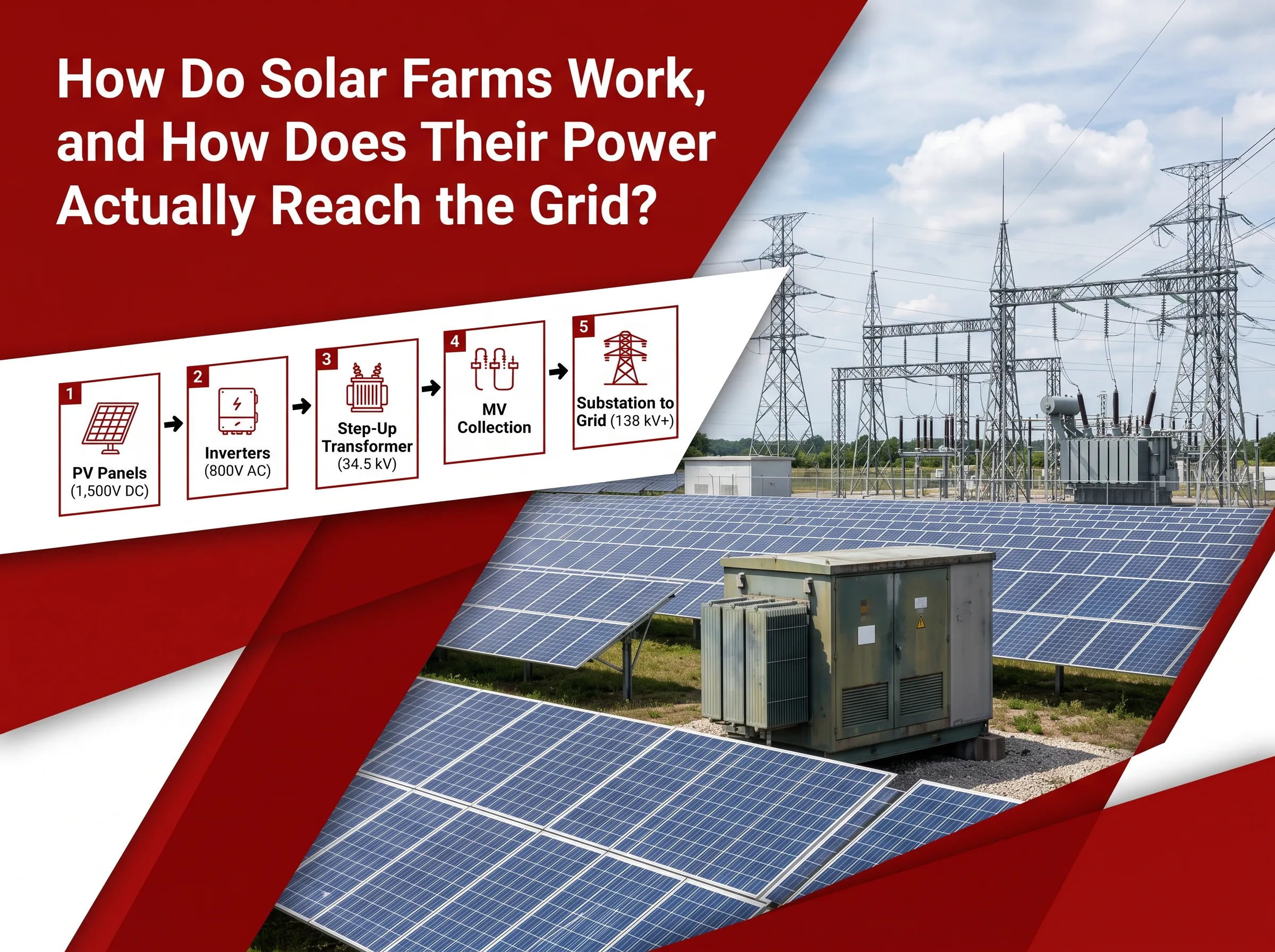
In the case of solar power plants and industrial overhead collection systems, cutouts are placed at principle fuse points.On pole-mounted transformers, cutouts are usually used along with surge protectors. The function of a cutout is to deal with overcurrents; the purpose of a surge protector is to fight lightning and switching overvoltages. None of them can be used instead of the other.For more on the transformers being protected, see ShineGrand’s guide to electric pole transformers.
How to Choose the Right Fuse Cutout
The specifications of the fuse cutout must comply with the system and equipment requirements. Verify the following parameters:
1. Rated maximum voltage. Rated voltage of the cutout should at least match the maximum operating voltage of the system. Cutouts with 12 kV or 15 kV rating are usually used for 11 kV systems. For 33 kV, 36 kV, or 38 kV cutouts are usually put in place since the line-to-line voltage needs to be verified.
2. Insulation level. Find out the full information on the power frequency withstand and impulse lightning withstand of the fuse cutout and compare it with what the utility uses. For instance, for a cutout with 15 kV rating, BIL can be 95 kV or 110 kV; for 33 kV to 36 kV cutouts, it is around 170 kV.
3. Continuous current rating. The fuse cutout holder normally has a current rating of 100 A or 200 A. This is the rated current of the holder, and not the fuse link itself. For instance, a fuse cutout with 100 A setting and 15K fuse link would provide current of 15 A.
4. Interrupting rating. The interrupting rating must be equal or higher than the fault current available at the installation place. Some locations, for instance, a butt joint close to substations may require extremely powerful equipment, and therefore rating must be checked.
5. Creepage and environment. Based on the pollution level of the site choose the creepage distance, since coastal, desert, and industrial areas require higher rating. Select porcelain or polymer depending on the two conditions.
6. Switching duty. If the teams plan to open the cutout while it is still engaged, then it should be either a load-break type or compatible with the utility’s portable load-break equipment.
7. Mechanical compatibility. When it comes to the replacement of a fuse cutout, the specified bracket, length of a fuse link, and the type of a fuse link should match the one already installed.
8. Standards and test evidence. In North America, distribution cutouts are found in IEEE C37.42, while internationally, in IEC 60282-2 with design tests described in IEEE C37.41. Make sure to ask for the test report and not just trust the data included in the specification sheet.
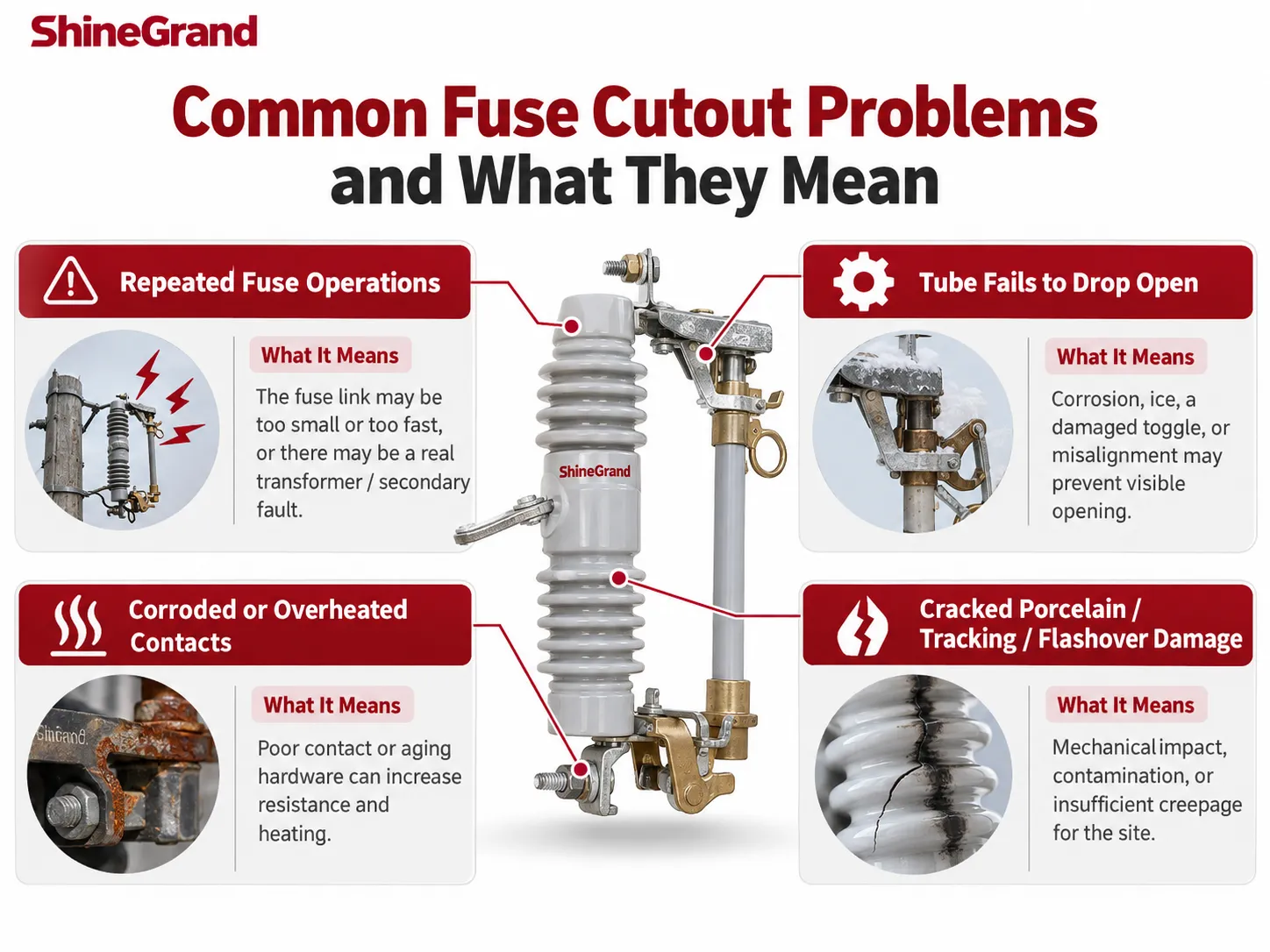
Common Fuse Cutout Problems and What They Mean
-
Repeated fuse operations on the same transformer often suggest that the fuse is either too small or too fast for the inrush and load of the transformer or there is an actual problem with the transformer or secondary.
A tube that does not drop after the operation of a fuse is generally because of corrosion, icing, some broken toggle or misalignment. The circuit is open, but there is no visual indication of it, which complicates finding the fault.
A tube that drops without the fuse operating can be caused by vibration, worn latching or incorrectly connected link without sufficient tail tension.
Burnt or pitted contacts mean overheating due to insufficient contact pressure or overload, and the cutout is at risk if it is not replaced after this event.
Crack porcelain, tracking or flashover damage means that the mechanical impact was caused or contamination or insufficient creepage at the site.
Broken or crushed tubes after the operation means that the fault was above the cutout interrupting capability.Any works on cutouts is high voltage work and should be done only by qualified personnel with respect to the operating, testing and grounding procedures of the utility.
Reference Designs from Leading Manufacturers
Well-documented manufacturer literature is a useful benchmark when writing a cutout specification. Two good examples:
- S&C Electric Type XS Fuse Cutout: an outdoor distribution cutout for 4.16 kV through 25 kV systems, with extra-heavy-duty and ultra-heavy-duty versions and a solid-blade disconnect style, compatible with a portable load-break tool.
- Eaton Types K and T fuse links: a clear explanation of fast and slow fuse link characteristics, with a nominal speed ratio of about 7 for K links and 12 for T links.
ShineGrand Fuse Cutouts
ShineGrand Electric manufactures outdoor drop-out fuse cutouts for overhead distribution networks and transformer protection:
- SGFCO124 drop-out fuse cutout: 12 kV rated, available as 100 A models with 6.3 kA breaking current and 200 A models with 8.0 kA breaking current, with 125 kV lightning impulse withstand and 320 mm creepage distance.
- SGFCO123-33/100 33 kV ceramic fuse cutout: 33 kV, 100 A, 6.3 kA breaking current, 170 kV BIL and 660 mm creepage for higher-voltage distribution lines.
- Load-break fuse cutout: models for 12, 15, 24, 33 and 36 kV systems, for lines where crews need to open the cutout under load.
Because ShineGrand also supplies distribution transformers and surge arresters, cutouts can be quoted as part of a complete pole-top protection package. Browse the full fuse product range.
Frequently Asked Questions
What does a fuse cutout do?
The role of a fuse cutout is to prevent excessive power from affecting overhead distribution apparatus, including transformers and branches. When a fault occurs, it melts the fuse wire, hence stopping the flow of electricity and the dropping of the fuse holder, making the apparatus disabled from the fault, while at the same time giving an indication. Furthermore, the cutout acts as a means of manual switching via hot stick operation.
What is the purpose of a cut out?
In overhead electricity lines, cutout refers to the device that is responsible for provide overcurrent protection and offering a coordinated disconnection point so that if there is a fault in any transformer or lateral, it can be isolated without switching off the whole feeder. In everyday terms, “cutout” in domestic electrical terminology in the UK refers to service fuse that the utility company seals when delivering electricity to premises, which is a totally different and low-voltage device.
What is the difference between a solid blade cutout and a fuse?
A fuse cutout has a fuse link which melts during any overcurrent thus making the holder drop open by itself. A solid blade cutout substitutes the fuse link with a solid metal blade which offers no protection and does not drop open by itself.
What are the different types of cutout fuses?
By definition, cut-outs can either be open type (the conventional cut-outs) or open-link cut-out, as well as enclosed. In respect of their action, the cut-outs can either operate as standard drop-outs, load-breaks, solid blade (disconnect) or heavy duty type. In terms of insulator, the cut-outs can be classified into porcelain-cut-outs or polymer-cut-outs. The fuse-links used in the cut-outs can be of K (fast), T (slow) and H (heavy surge) types.
Can you open a fuse cutout under load?
A standard cutout must not be opened while under the load since pulling on the tube will create an arc which may harm the operator and damage the machinery. It is only acceptable to interrupt a load by using a load-breaking cutout or using a portable load-breaking tool approved for a cutout design and operated by a qualified person.
Why does a fuse cutout drop down?
The fuse link’s tail holds a spring-loaded toggle in place, which keeps the holder latched closed. When the fuse element melts, that tension is released, the toggle flips, the latch lets go and gravity swings the holder down on its hinge, leaving a visible open gap.
Can a fuse cutout be reset?
The fuse link cannot be reset; once it melts it must be replaced. The fuse holder and cutout body can usually be reused if they are undamaged. The cause of the operation should be found before the cutout is closed again.
What is the difference between a 100A and 200A fuse cutout?
The 100 A or 200 A figure is the continuous current rating of the cutout holder and contacts, which limits the largest fuse link that can be fitted. It is not the protection level; that is set by the fuse link. The interrupting rating is a separate value that must also be checked.
References
- IEEE C37.42 — Specifications for High-Voltage Expulsion-Type Distribution-Class Fuses, Fuse and Disconnecting Cutouts, Fuse Links and Accessories. The North American standard for distribution cutouts.
- IEEE C37.41 and C37.48. Design tests for high-voltage fuses and cutouts, and the application, operation and maintenance guide.
- IEC 60282-2 — High-voltage fuses, Part 2: Expulsion fuses. The international standard covering expulsion fuses and distribution cutouts.
- Electrical Engineering Portal (EEP). Technical articles on distribution protection and fuse coordination.
- Wikipedia — Fuse (electrical). General background on fuse construction and expulsion fuses.
Specifying Fuse Cutouts for Your Network?
A fuse cutout only does its job if its voltage, insulation, interrupting rating, holder size and fuse link all match the line and the equipment behind it. If you are building new overhead lines or replacing existing cutouts, send ShineGrand your system voltage, available fault current, holder rating, environment and any existing model information. Contact ShineGrand for a quotation or technical support.