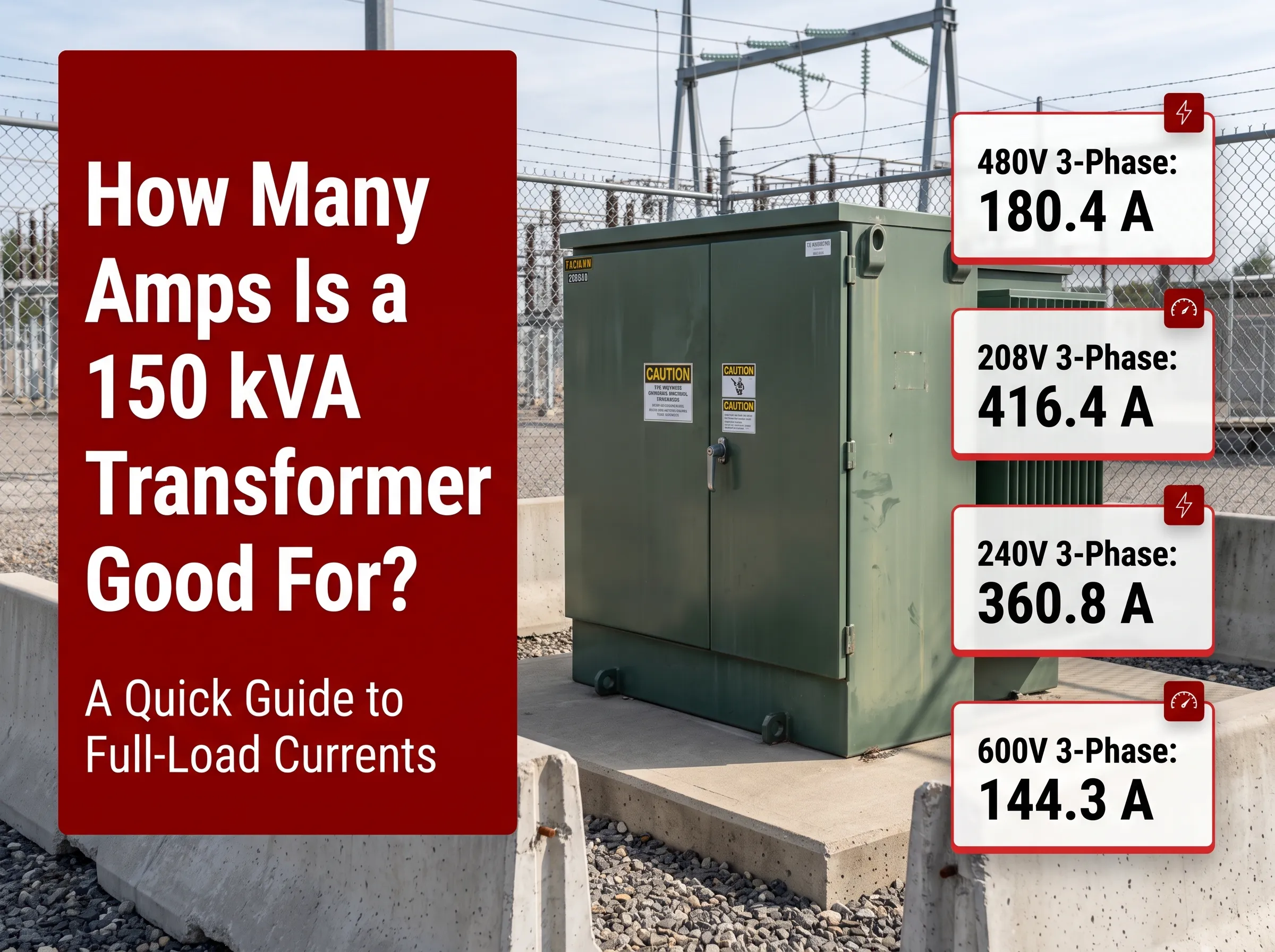
The 150 kVA transformer has a full-load amperage of around 180 amps per phase for a three-phase voltage of 480V or roughly 416 amps when the voltage is 208V. This number will, of course, vary depending on the voltage chosen for the transformer and whether the transformer is of the single-phase or three-phase type, since kVA refers to the apparent power in a given transformer and does not change, whereas the current will be determined by the transformer voltage. This guide provides full-load amps at all common voltages; explains in detail the transition between 480V and 208Y/120V; specifies the maximum load of a transformer with a rating of 150 kVA; discusses breaker size calculations; and how to choose between different types of transformers(metric/imperial).
What are the amperages for a 150 kVA transformer? A 150kVA three-phase transformer gives a full-load amperage of 416.4A @ 208V, 360.8A @ 240V, 180.4A @ 480V, and 144.3A @ 600V. The calculations for these amps are done using the equation I = kVA × 1,000 ÷ (1.732 × line voltage). A single-phase transformer of the same rating gives an ampacity of 1,250A at 120V, 625A at 240V, and 312.5A at 480V which is calculated using the equation I = kVA × 1,000 ÷ voltage.
150 kVA Transformer Amps at Different Voltages
The following table serves as a quick reference point for most users. The values submitted correspond to the currents rated under full load conditions of the three-phase 150 kVA transformer (the results have been rounded to one decimal place):
208 V three-phase: 416.4 A
240 V three-phase: 360.8 A
400 V three-phase: 216.5 A
415 V three-phase: 208.7 A
480 V three-phase: 180.4 A
600 V three-phase: 144.3 A
4,160 V three-phase: 20.8 A
11,000 V three-phase: 7.9 A
12,470 V three-phase: 6.9 A
13,800 V three-phase: 6.3 A
It can be noted how current goes down as voltage increases. If a 150 kVA load is drawn at 13.8 kV, around 6 A per line would be sufficient, while this value would be much higher – more than 400 A – for the same power at 208 V. That explains the main reason why utilities provide electricity at medium voltage and reduce it close to the place of utilization.
150 kVA Transformer at 208V
Under conditions of the 208 V three-phase circuit, the full-load current can be calculated as 150,000 ÷ (1.732 × 208) = 416.4 A. This figure stands in line with the most commonly used secondary voltage for 150 kVA installments throughout North America.
150 kVA Transformer at 240V
Under conditions of the 240 V three-phase circuit, the full-load current can be calculated as 150,000 ÷ (1.732 × 240) = 360.8 A. Voltage of 240 V three-phase is less commonly used for new buildings. However, a number of older sites make use of this voltage as a delta system with the “high leg”.
150 kVA Transformer at 480V
Under conditions of the 480 V three-phase circuit, the full-load current can be calculated as 150,000 ÷ (1.732 × 480) = 180.4 A. Voltage of 480 V is regarded as a common voltage supplied throughout North America.
150 kVA Transformer at 600V
Under conditions of the 600 V three-phase circuit, the full-load current can be calculated as 150,000 ÷ (1.732 × 600) = 144.3 A. Similar voltage systems lie in widespread use in Canada, especially at industrial plants.
Single-phase Current vs Three-phase Current
Single-phase transformers do not apply the 1.732 factor. Hence, at the same voltage the current level is significantly higher for single-phase machines. For instance, a single-phase transformer rated for 120 V would produce 1,250 A current, while the machine operating at 240 V would yield 625 A, the same machine at 277 V would read at 541.5 A. The power level of 150 kVA is a common measure for three-phase transformers, but such values are rarely encountered in single-phase models. The closest value of 167 kVA exists in this segment.
How Many Amperes are Backed by a Transformer Rated 150KVA 480V to 208Y/120V?
The 150kVA transformer with ratings of 480V to 208Y/120V is rated among the most widely used transformers in North America. The transformer takes in voltage rating of 480V from the building’s power distribution and downtrains the voltage to 208Y/120V for general usage. This transformer features two types of amperes ratings on
both sides.
The primary current at 480V – 180.4 amperes
The primary current is calculated as follows, 150,000 divided by (1.732 multiplied by 480), which comes out to be 180.4 amperes. This indicates that the transformer draws 180.4 amperes from the 480V feeder when fully loaded, which is known to set the amperes ratings of the primary conductors and primary overcurrent device. Most of the transformers operate on delta system of connection; therefore, no neutral is available on the 480V transformer.
Secondary current at 208V – 416.4 amperes
The secondary current is calculated as follows: 150,000 divided by (1.732 multiplied by 208), which shows that secondary current is equal to 416.4 amperes. It should be noticed that the drop in voltage ratio is equal to 480 divided by 208, which comes down to 2.31. At the same time, one will notice that current is increased as the same ratio from 180.4 amperes to 416.4 amperes. The input power remains equal to the output power without taking any minor losses into account.
What does 208Y120 mean in power supply?
The letter “Y” in 208Y/120 means that the secondary windings of the transformer work in Y configuration with the neutral point. The configuration makes it possible to derive at least two voltage levels from the transformer:
1. 208 between any pair of phases used for three phase motors, rooftop units and some other appliances.
2. 120 V between any phase and neutral used in standard lights and plug.
The two voltages are related as follows 120 multiplied by √3 = 208. The neutral point can often be grounded at the transformer hence creating a separate derived system.
Can the transformer provide both 208 and 120 loads at the same time?
Yes, and at many buildings in North America the transformer provides both voltage levels at once. But this is the place where many people get it wrong. The transformer voltage of 120 is NOT 150,000 divided by 120 = 1,250. In this case one should take into account the three phase configuration of the transformer allowing carrying the equal capacity, or 50 kVA per phase. One phase of the transformer can bear the full current of 416.4, no matter whether the current is directed toward the 120 power loads or toward 208 power loads.
Thus, the effective limit is on the level of 416 amperes not 1,250. If all 120 loads are run on one phase, this phase will use its full capacity even though the rest of the two phases are loaded lightly. The ability to distribute the single phase loads between the three phases of the transformer helps fully utilize the capacity of the transformer.
For the broader formula behind all of these calculations, and for current values at other kVA ratings, see ShineGrand’s transformer calculation table, which covers sizes from small dry-type units up to large distribution transformers.
How to Calculate the Full-Load Amps of a 150 kVA Transformer
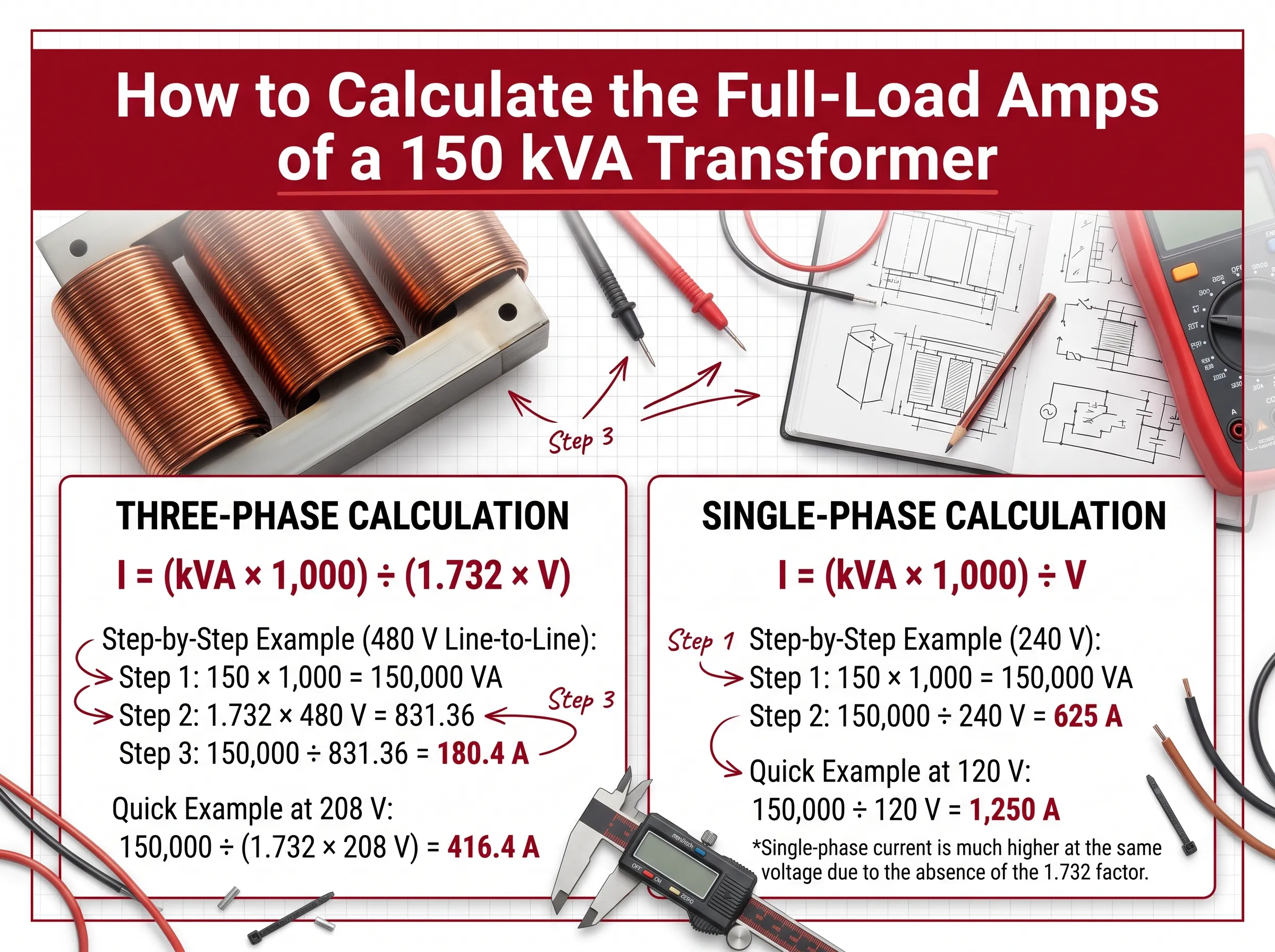
There are only two easy formulas you need to remember in order to determine the current from any nameplate or quote with ease.
In order to determine the current for three-phase transformers it is necessary to use the voltage from line to line:
Current (A) = kVA × 1,000 ÷ (1.732 × line-to-line voltage)
For single-phase transformers:
Current (A) = kVA × 1,000 ÷ voltage
Let’s see how this is done.
For three phase transformer, 150 kVA rating at 480 volts:
1.Converting kVA to VA: 150 × 1,000 = 150,000 VA
2.Voltage x √3: 1.732 × 480 = 831.4
3.Now, we can do the calculations: 150,000 ÷ 831.4 = 180.4 A
In the case of single-phase transformer, 150 kVA rating at 240 volts:
1.Converting kVA to VA: 150,000 VA
2.Calculating the current: 150,000 ÷ 240 = 625 A
Be careful not to make two silly mistakes: first, do not use phase-to-neutral voltage (e.g., 120 volts or 277 volts) in the three-phase formula, second, it is crucial to remember the factor 1.732; otherwise, the amount of the three-phase current will be approximately 73% higher than the actual value.
What Is the Maximum Load of a 150 kVA Transformer?
It is one thing to have knowledge about amps. To know how much load one could connect to an electrical device is, however, a different question which depends on several factors that kVA does not cover.
kVA vs kW
A transformer is measured in kVA and this is because it has to carry current irrespective of if that current is useful. Generally speaking, you have a “kW” power consumed by your load and the two are connected via the power factor:
If the power factor is 1.0 (as in the case with resistive heating), 150 kVA would equal 150 kW.
If the power factor is 0.95 (as it is the case with modern electronics), 150 kVA would equal 142.5 kW.
If the power factor is 0.9, it would mean that kVA equals 135 kW.
If the power factor is 0.8, especially while dealing with motors, kVA would equal 120 kW.
That is the reason why whenever suppliers tell you that a transformer has 150 kVA of capacity of “150 kW,” this statement is true only when power factor equals one.
Continuous load and temperature
The continuous rating of kVA is defined by conditions and parameters of the nameplate, like temperature, altitude, etc. Under these conditions, the transformer is capable of carrying the rated load which is sometimes quoted as if it should equal 80 % of its rated load – however – this is not true in general.
However, it is temperature that imposes limitations on loading.
Transformers are usually sold with temperature rise ratings of 150 °C, 115 °C or 80 °C meaning that a lower rise transformer will work our cooler.
Liquid insulation is usually rated for 65 °C average winding increase.
Hot ambient conditions, high altitude, lack of ventilation and harmonics lower the load transformers can take.
IEEE C57.91 and IEEE C57.96 these guidebooks offer information about loading limitations.
Harmonics
Harmonic demands form computer and LED drivers create unreliable power due to the distortion of currents and lead to heating of the transformer windings above the level they should. If your loads make up a considerable share of the transformer rated capacity, you will need to use a K-rated transformer, like K-4 or K-13.
Motor starting
When a large motor starts, it can consume up to six times its running amperage. Motor commencing gives rise to voltage dip on the 150kVA transformer that could impact the power consumption.
What Breaker Size Is Required for a 150 kVA Transformer?
The values for the transformer’s full-load current and breaker rating differ. National Electric Code Section 450.3 and the conductor protection guidelines from Article 240 give rise to the computation of fuse or breaker needed for transformer protection.
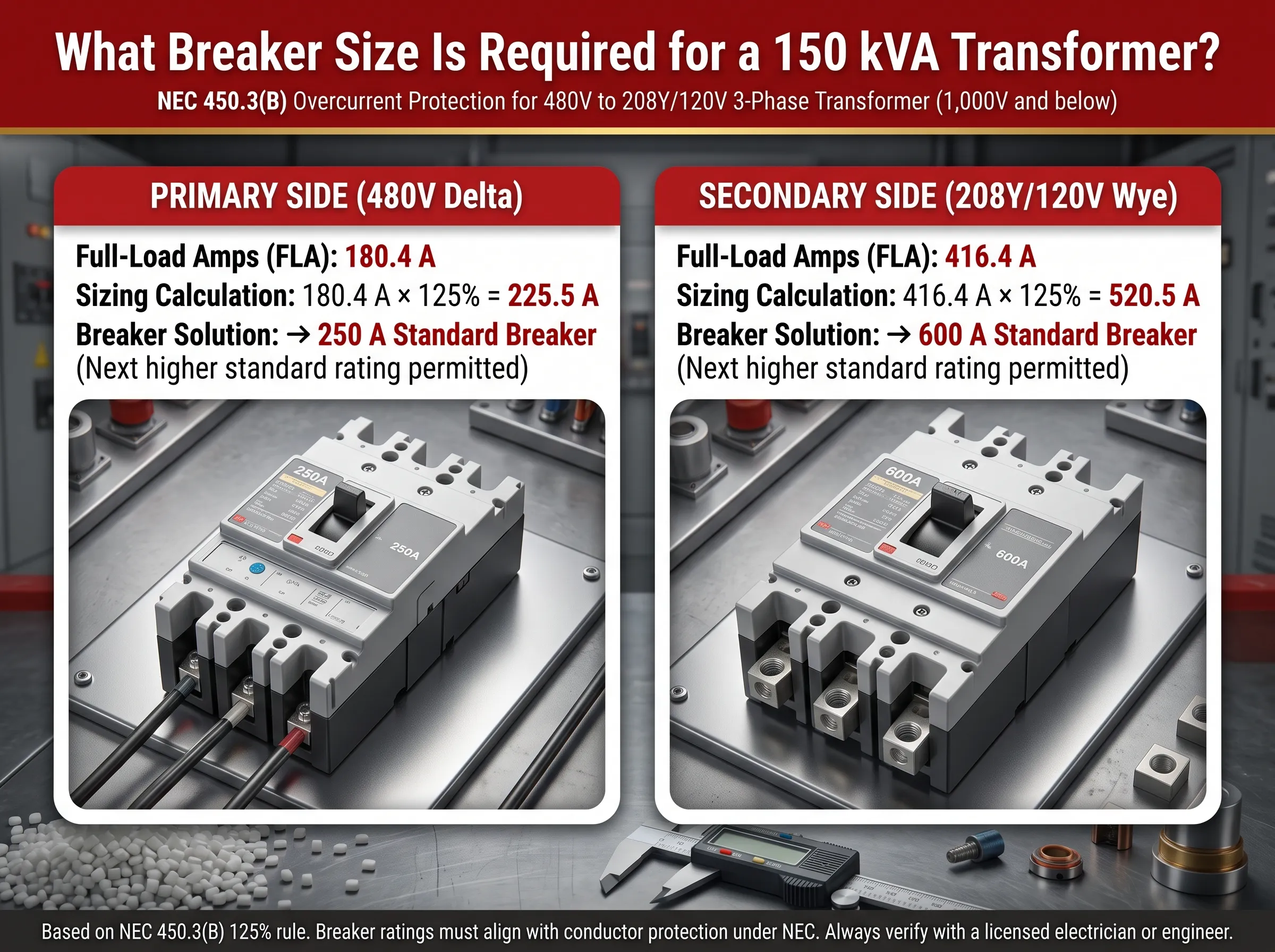
Section 450.3(B) of the NEC allows for the following two approaches when dealing with transformers of ratings of 1000 V and below:
1. Provision of primary only protection within 125% of primary full-load current; if this amount does not correspond to a compatible rating, the immediate higher standard size may be accepted.
2. Provision of primary protection of up to 250% of primary current and ensuring that secondary protection does not exceed 125% of the secondary current.
To illustrate this principle using a 150 kVA 480 V to 208Y/120 V transformer:
1. First, determine the primary current: 180.4 A * 1.25 = 225.5 A which means that the next standard (250 A) may be accepted per the 125% rule.
2. The secondary current is determined as follows: 416.4 A * 1.25 = 520.5 A and thus 600 A is a common standard.
The numbers above are just examples and final decision should be made in view of ampacity of wires, their tap rules, the rating of panel board, the 80%/100% of the breaker, the local code version, and inrush current issues. The energization of a transformer creates a magnetizing inrush current reaching up to 8-12 times greater than usual so a properly operating device should not trip.
The NEC 450.14 calls for a disconnect means to be fitted and positioned in sight or lockable when not. If you consider fused vs unfused type of disconnect, ShineGrand’s guide to fusible vs non-fusible disconnects explains the trade-offs.
Available fault current
A different number needs to be evaluated when sizing the secondary panel: the fault current that may be produced by a transformer. This is the secondary current divided by the impedance of the transformer. For example, a transformer with a 150 kVA rating and 208 V supply voltage and 4% impedance will produce 416.4 A / 0.04 = 10,400 A assuming an infinite supply. On the other hand, a transformer with low impedance produces higher fault current.
Is a 150 kVA Transformer Big Enough for Your Application?
A 150-kVA unit is right in the middle of the common three-phase units available, including:
Small to mid-sized businesses such as retail, restaurants, and offices.
Light industrial facilities with machinery, lighting, and compressors.
Dedicated supplies that make use of that power, like a single production line or computer room.
Schools, clinics, and multiple-tenancy commercial spaces served from the 480 V system.
Small utility power consumers, agricultural sites, telecom installations, and EV charging stations that rely on a pad-mounted transformer.
By comparing the standard sizes around, you can make an informed decision about whether a 150 kVA would be the right choice for you. Here are the full-load currents for a 480 V and a 208 V system:
75 kVA: 90.2 A at 480 V, 208.2 A at 208 V
112.5 kVA: 135.3 A at 480 V, 312.3 A at 208 V
150 kVA: 180.4 A at 480 V, 416.4 A at 208 V
225 kVA: 270.6 A at 480 V, 624.5 A at 208 V
300 kVA: 360.8 A at 480 V, 832.7 A at 208 V
You can make a calculation of your expected load in kVA and add in a cushion for increase, then purchase the next size up from that. However, if your load is already close to 150 kVA before taking into account any future increase, you will want to go with the 225 kVA unit.
Dry-Type Vs. Oil-Filled Vs. Pad-Mounted 150 kVA Transformers
When you are looking for a 150 kVA transformer, you will encounter very different devices under the same name. They are used in different conditions and voltages, and do overlap rather than compete.
Dry-Type 150 kVA Transformers
Dry-type transformers use solid insulation with air, which means that there is no liquid. These are regular solutions for all low-voltage installations, including almost all 480 V to 208Y/120 V jobs. Usually, these transformers are mounted on the floor in ventilation enclosures in electric rooms. In the USA, the efficiency of these transformers is regulated through the Department of Energy requirements.
Oil-Filled (Liquid-Filled) 150 kVA Transformers
Oil-filled transformers use mineral oil or non-flammable ester for insulation and cooling. They are more compact and more efficient for this rating, handle overloads easily, and are usually used outdoors when the primary is medium voltage, such like 4.16 kV, 12.47 kV or 13.8 kV. They can be pole-mounted and platform-mounted.
Pad-Mounted 150 kVA Transformers
Pad-mounted means a type of installation, but not insulation: the transformer is installed in a special steel structure on a concrete pad that is virtually impossible to open. The maximum number of distribution transformers of this type are liquid-filled. This is the most popular way of providing underground utilities to commercial facilities, campuses, and solar or EV charging points. The three-phase transformer of 150 kVA typically has a medium-voltage primary and produces standard secondary voltage of 208Y/120 V or 480Y/277 V. For example, at the primary voltage of 12.47 kV, it only takes 6.9 in the high-voltage circuit while delivering 180.4 A or 416.4 A at 208Y/120 V.
ShineGrand’s three-phase pad-mounted transformer series covers this application, starting at 150 kVA and scaling up to 6,300 kVA with primary voltages up to 35 kV, and secondary options such as 208Y/120 V and 480Y/277 V. The series is built to IEEE C57.12.34 and IEC 60076, with DOE 2016 efficiency compliance for the US market.
How to Choose the Right 150 kVA Transformer
Whether it’s for an electrical transformer, an essential piece of machinery with regard to power transmission, this piece does state one critical detail that you simply should be obliged to know about, which is that the better your specification is given to your supplier to receive the quotes from them, the better your quotes will be received from them. When providing the specification, be certain that you account for:
Primary and secondary voltages, when defining them don’t forget about neutral: ex.: from 12470 to 480Y/277 or from 480 to 208Y/120.
Single or three phases.
What is frequency of operation: is it 50 Hz or 60 Hz?
How is winding connection and which is vector group applied? (Dyn 11 according to IEC or delta-wye with lag of 30 degrees according to ANSI).
What is its impedance.
Which is the cooling method applied and how much will the temperature rise be (150 C? 115 C for dry types or ONAN with temperature rise of 65 for liquid types).
Is there a need for taps (2×2,5% on primary).
What is installation place of the transformer: indoor outdoor, what altitude, what environmental conditions apply.
What is the construction for pad-mounted transformers? Will they be loop-fed/delivered directly to the point?
Will the transformer meet all necessary standards and/or norms?
Will it be made of copper or aluminum wire?
What are the number and lead time?
If there is a need for 150 kVA transformer, email the specifications needed for the transformer and the engineering department will contact you to help with your task. In order to have confirmation of the configuration of the transformers, it is necessary to have the specifications beforehand.
Frequently Asked Questions About 150 kVA Transformers
How many amps is a 150 kVA transformer at 480V?
A three-phase 150 kVA transformer at 480 V has a full-load current of about 180.4 A per phase. A single-phase 150 kVA transformer at 480 V carries 312.5 A.
How many amps is a 150 kVA transformer at 208V?
A three-phase 150 kVA transformer at 208 V delivers about 416.4 A per phase. That is the current available on each phase conductor of a 208Y/120 V secondary, shared between the 208 V and 120 V loads connected to that phase.
How many amps is a 150 kVA single-phase transformer?
Divide 150,000 by the voltage: 1,250 A at 120 V, 625 A at 240 V, 541.5 A at 277 V and 312.5 A at 480 V. In North America the standard single-phase rating near this size is 167 kVA, so check catalog availability.
How many kW is a 150 kVA transformer?
It depends on the power factor of the load. At unity power factor it is 150 kW; at 0.9 it is 135 kW; at 0.8, typical of motor-heavy loads, it is 120 kW.
Can a 150 kVA transformer run at full load continuously?
Yes, according to manufacturers. The kVA rating means the transformer is rated continuously at the specified ambient temperature, altitude and cooling class. Higher ambient temperature, loads with high harmonic distortion, poor ventilation or altitude reduce safe accepted continuous load. The common “80% rule” applies to many circuit breakers used for continuous load and not transformer.
Is a 150 kVA 3-phase transformer additive or subtractive?
The terms additive polarity and subtractive polarity apply to single-phase transformers. In the case of three-phase transformers, it is necessary to refer to angular displacement or vector group. As defined by ANSI/IEEE, a delta-wye transformer will have a standard 30° phase shift whereby the low-voltage side lags behind the high-voltage side of the transformer. On the other hand, IEC would denote the same connection by the notations Dyn11 or Dyn1.
Must a 150 kVA transformer have a disconnect?
NEC 450.14 requires that transformers, except for Class 2 and Class 3 transformers, in the US should have a disconnecting device, which is required to be either visible or remotely locatable. The primary overcurrent device generally acts as the disconnect in such cases. Local codes and utility regulations may create additional requirements, so it is essential to check with the authorities in charge.
How much does a 150 kVA transformer cost?
There is no uniform charge for something because its pricing is determined by its type and specific details. It could be dry type or liquid filled, primary and secondary voltages, use of copper or aluminum in windings, availability of efficiency grade, heat production, types of casing and additions, required certifications, number of units, shipping destination. The quotation is influenced too by raw material prices like copper and electrical steel. The best option in such situations is to send each supplier the same detailed specification.
References
- NFPA 70 — National Electrical Code. Sections 450.3 and 450.14 on transformer overcurrent protection and disconnecting means, and Article 240 on conductor protection.
- IEEE C57.12.00 and C57.12.34. General requirements for liquid-immersed distribution transformers and requirements for pad-mounted three-phase distribution transformers.
- IEEE C57.91 and C57.96. Loading guides for liquid-immersed and dry-type transformers.
- US Department of Energy — Distribution Transformers. Energy conservation standards for liquid-immersed and dry-type distribution transformers.
- IEC 60076 — Power transformers. International standard series for transformer ratings, connections and tests.
- Wikipedia — Distribution transformer. General background on distribution transformer types and applications.
Need a 150 kVA Transformer for Your Project?
The step that comes first is determining transformer amps of 150 kVA at your voltage level; after that comes the step that requires you to find a transformer that matches the kVA, voltage and type of protection specific for your site. If you are going to have a medium voltage service installed, think of your voltage, phase, conditions of use and regulations requirements and write about that to ShineGrand. Contact ShineGrand for a quotation or technical support.