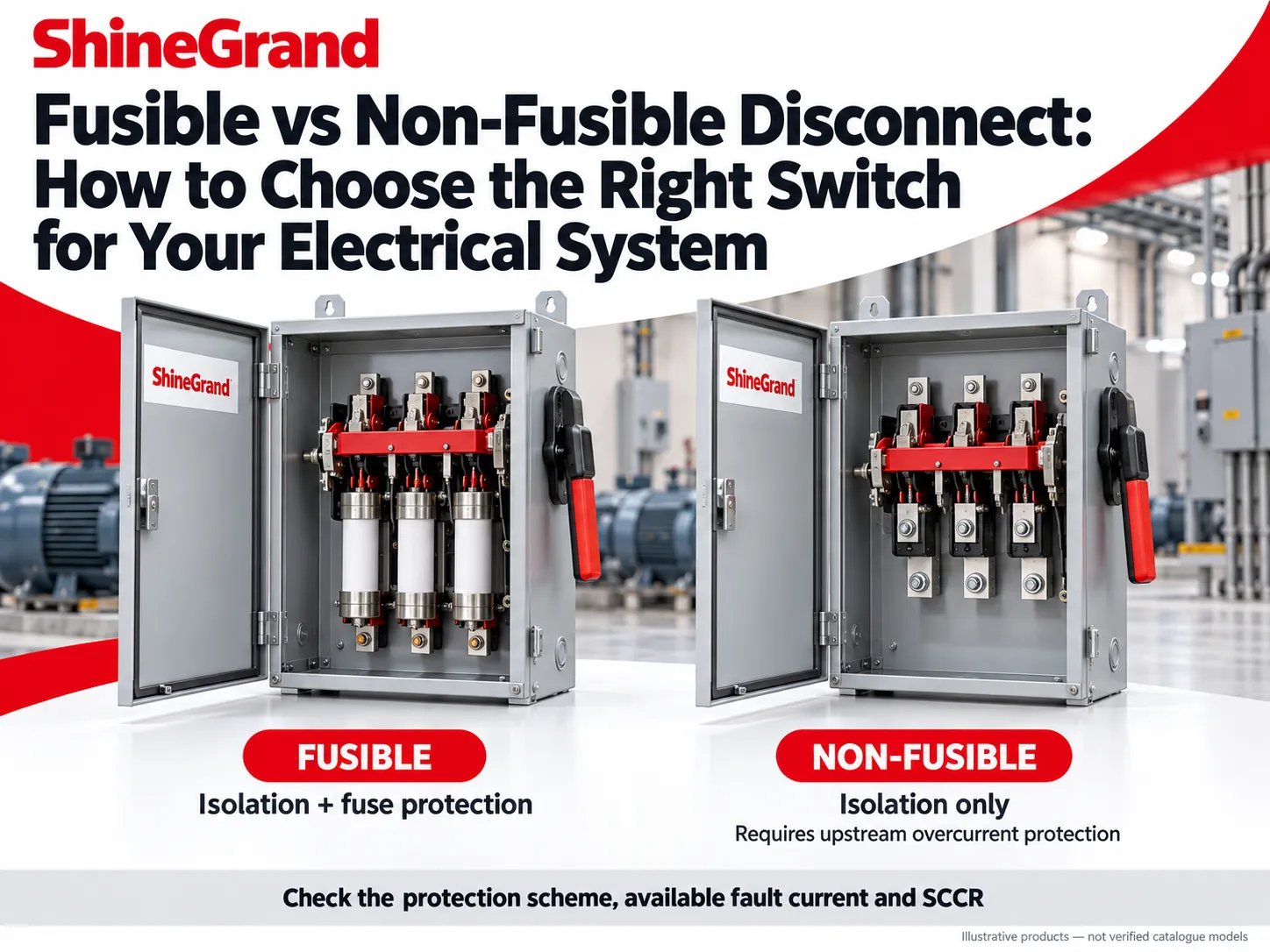
Choosing the right disconnect switch may be a minor choice until the complications it creates become apparent in a fault study, inspection failure, or an SCCR that is insufficient for the fault current. The difference between fusible and non-fusible disconnect is not simply about the device itself but rather about the role that the disruptor plays in the entire protection scheme. This guide is useful for engineers, panel builders, and purchasing teams who need to make the right decision quickly.
While both types of devices isolate equipment safely for maintenance, they differ from each other not by the fact that one differs from the other, but by the way this simple difference affects what happens next, including the strategy regarding faults, assembly safety rating, compliance with Codes in motor and feeder circuits, and costs involved.
In a nutshell, a fusible switch is a switch combined with fuses, while a non-fusible switch is a switch without fuses. A fusible switch allows for isolation of the circuit and for the provision of overcurrent protection, while a non-fusible one isolates the circuit but does not provide overcurrent protection. One must choose the fusible switch when overcurrent protection is required, or else can use the non-fusible switch when protection is present. Always check the rating of the device with regard to fault currents available at its terminals.
What a Fusible Disconnect Is
A fusible disconnect is a switch that has fuse holders included. When the switch is turned off, both the load and internal fuses are isolated. And thus, the fusible disconnect can not only ensure safety through isolation but also protect the circuit from overcurrent. Thanks to the limited fuses, a fusible disconnect can also decrease the let-through energy. Some fuse classes like Class J or Class R would possess specific characteristics in terms of separating and limiting current. Hence, installation of a fuse is essential in the process of designing the switch.
What a Non-Fusible Disconnect Is
A non-fusible disconnect is a switch which lacks both fuses and any overcurrent protection. Its only purpose is to ensure that equipment can be disconnected for service. Because it has no protection, it can only be used in places where there is already an appropriate upstream protective device, such as fuses or a circuit breaker. In practice, a non-fusible disconnect is most often used at the location of the equipment, such as the switch next to a motor, meaning that there is no need for actual protection at the equipment but a simple means of disconnection.
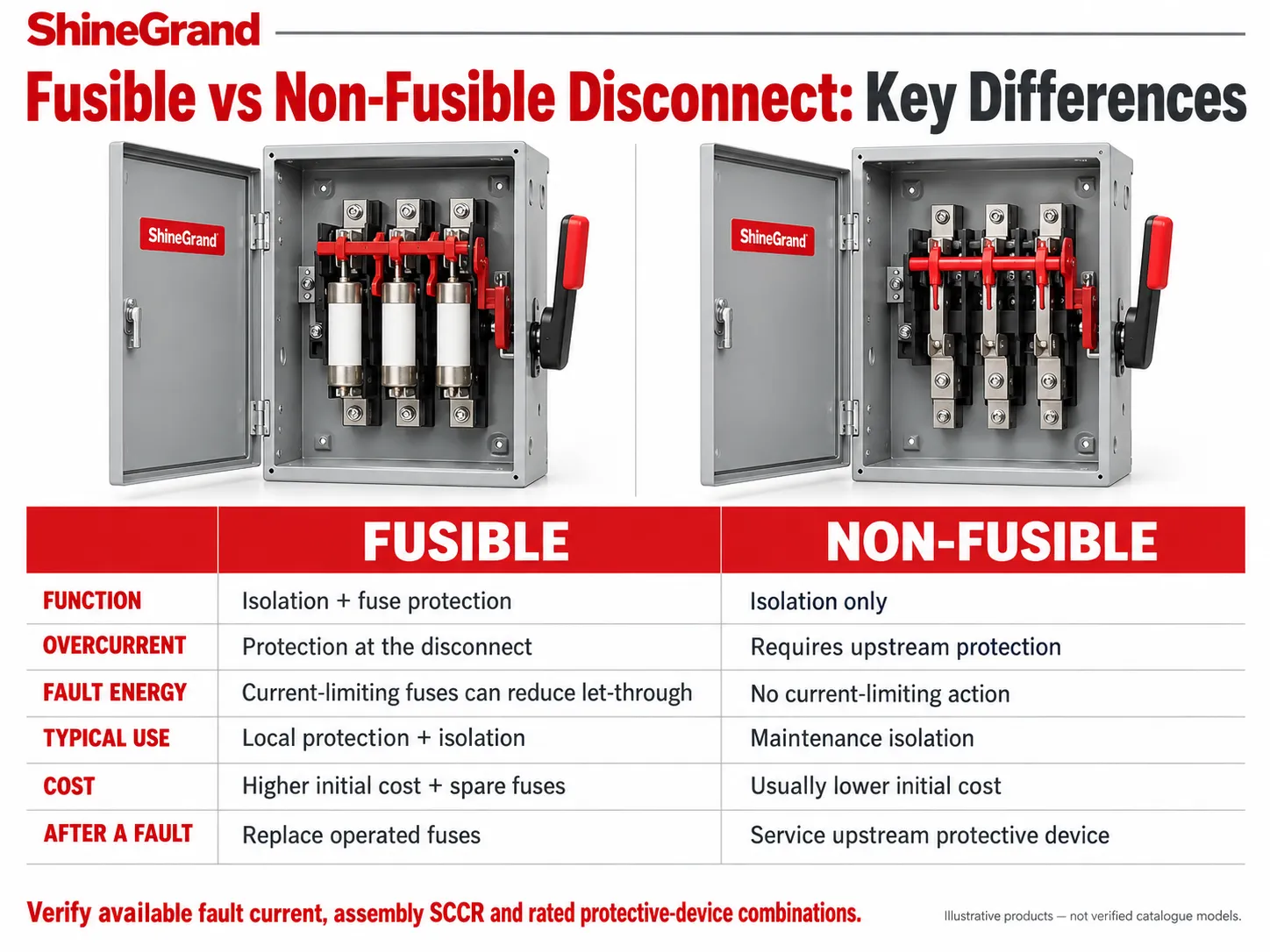
Fusible vs Non-Fusible Disconnect: Key Differences
The practical characteristics distinguishing fusible and non-fusible disconnects are as follows.
Overcurrent protection: With fuses, a fusible disconnect includes overcurrent protection; a non-fusible disconnect provides no overcurrent protection.
Function: The role of fusible disconnects is to provide isolation and protection, while a non-fusible disconnect is an isolation device only.
Contribution to a short circuit: The fusible disconnect equipped with current limiting fuses can decrease the let-through energy and allow fulfilling SCCR requirements. Non-fusible does not do any energy-limiting.
Cost: Non-fusible disconnect is cheaper than fusible disconnect.
Common application: Fusible disconnect is used as a protected disconnect or as a branch protection, while the non-fusible disconnect is implemented only as maintenance disconnect.
Reset after the trip: To reset a fusible trip, it is necessary to replace the blown fuses, which means keeping some at hand.
Think in Systems: Upstream Protection, AFC, and SCCR
Choosing it in isolation is the error that creates the incorrect disconnect. The proper approach is to examine the complete circuit. The very first question is always what protects the circuit. If a properly sized overcurrent protection device has been installed upstream and safeguards the conductor and equipment until this point in time, then a non-fusible disconnect might suffice in this case. In the event that there is no upstream protection available at this location, a fusible disconnect or breaker should be installed.
The second question contains the available fault current at the terminals of the disconnect, based on the short-circuit analysis. Each disconnect and assembly has its short-circuit current rating (SCCR) which must be above the fault current at this location, according to codes. Fusible disconnects have their specific advantage, as their fuses are capable of limiting the energy passing through the circuit, increasing the effective SCCR of all the equipment downstream. Non-fusible disconnects do not offer such assistance: they must simply meet the requirements for the fault current available at the chosen location, while any upstream device is designed to clear the fault.
As far as motor circuits are concerned, NEC Article 430 obtains its own sense. The motor branch circuit does most of the work because the tasks of short-circuit and ground-fault protection are assigned to the branch circuit device, overload protection to the starter, and disconnecting means with the motor itself. A motor often uses a non-fusible disconnect in cases where the upstream branch circuit protective device has already been installed and provides adequate protection.
Framework
Apply the following sequence to resolve the decision as to which type of disconnect switch, fusible or non-fusible, may be used in any specific circuit.
Is there any overcurrent protection upstream already installed at the site, which is deemed appropriate for this circuit? If so, also non-fusible disconnect switch may be used as a local isolation device, if not, the installation of some means of protection is needed here, and the choice should fall on fusible (or circuit breaker).
What is the fault current and what is the required SCCR of this installation? If current-limiting fuses are needed to ensure the proper SCCR, the device in question should be fusible.
Does this installation involve motors or falls under the regulations of Article 430? Decide whether the device works as a branch circuit protection device (fusible) or serves the purpose of just disconnecting the motor (non-fusible) in the system.
Does the design stipulate selective coordination? Make sure that the settings of the fuses or the upstream breaker are correctly chosen to ensure that only the device closest to the fault is activated in case of trouble.
What are involved operational considerations? Don’t forget to account for reliability of the fuse supply and repair that happens and the time to reset the upstream circuit breaker in case of non-fusible device application.
Go through these five points, and the answer is always evident enough, as well.
Common Selection Mistakes to Avoid
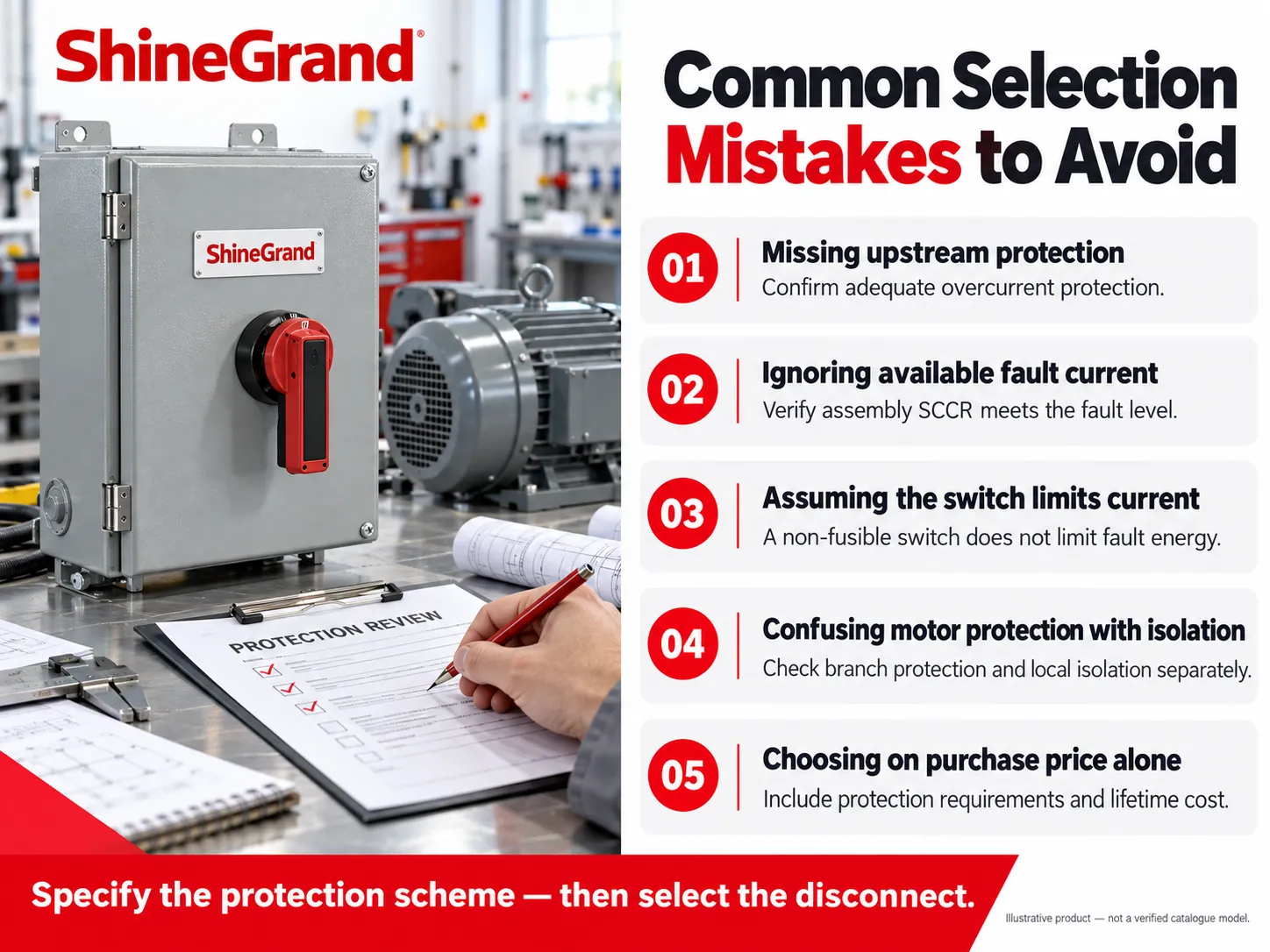
There are some mistakes that come into play repeatedly in the confusion of the fusible disconnect over the non-fusible disconnect. The worst mistake of all is placing a non-fusible disconnect into a circuit that has no proper upstream protection, because this leaves the circuit isolated from the load but incapable of breaking short-circuits and overloads. Another frequent mistake happens because of overlooking the fault current data and getting a device with an SCCR that is much lower than the AFC at its terminals, which leads to not just the rejection of the equipment but also, even worse, can result in catastrophic failure when an accident happens. Sometimes, however, a designer may wrongly assume that the use of a non-fusible disconnect means that the operator will be able to control an electrical current, which is not true, as it is only the fuses that may do this. In motor circuits, the problem of which kind of device gives the branch-circuit protection and which one is merely the at-motors disconnect occurs too. Finally, each time the choice is based on the price of the disconnect only, the designer forgets about the fact that a non-fusible switch is more economical when having the price in mind, but if protection is needed the price is of no relevance whatsoever.
Transformer and Distribution Applications
At different stages of a transformer and distribution process, different types can also be seen. For example, when it comes to the load side of the distribution transformer that supplies power to a panel, if the circuit breakers in the panel offer adequate protection to the feeders, then a non-fusable disconnecting device can be used in the process of isolating it from the equipment, while if more protection is needed at the disconnect device itself instead of the circuit breakers, a device with fuse is used. Same process applies to pad-mounted transformers. Always make sure that upstream protection is confirmed, calculate AFC in comparison to SCCR, and choose accordingly.
Frequently Asked Questions
What is the difference between a fusible and non-fusible disconnect?
A fusible disconnect consists of fuses that serve as both the isolation of the electric circuit and the device that protects the electrical circuit from overload and short circuits. A non-fusible disconnect explains itself as a switch only, meaning it can isolate an electric circuit but provide no protection and instead depend on an upstream installation of an overcurrent protection device. Choosing between such devices relies solely on the need for protection in that particular location and the necessity of using current-limiting fuses in order to meet the requirements of the SCCR.
When should I use a non-fusible disconnect?
Employ a non-fusible disconnect when upstream overcurrent protection is already installed, and only local isolation means are needed, such as a maintenance disconnect visible from the motor or equipment on the roof. Using this method is easier and cheaper, but it cannot be the only device in a circuit with no upstream protection.
Does a disconnect switch need overcurrent protection?
Some sort of overcurrent protection is required in the circuit but it doesn’t mean the disconnect needs to offer it. If there is already a protective device upstream, it is alright to use a non-fusible disconnect for isolation purposes. But if protection is important here, it is better to opt for a fusible disconnect or circuit breaker. However, no matter what is chosen, the device must come with a rating for the possible fault current at its terminals.
How does a fusible disconnect affect SCCR?
Fused disconnect switches incorporate current limiting devices, which help in lowering the let through energy from a fault, allowing for an increased short-circuit current rating of downstream devices. In systems with high fault current, this method becomes a simple way of achieving the overall SCCR, which cannot be achieved with a standard non-fused switch on its own.
Is a fusible or non-fusible disconnect more expensive?
Fused disconnect switches incorporate current limiting devices, which help in lowering the let through energy from a fault, allowing for an increased short-circuit current rating of downstream devices. In systems with high fault current, this method becomes a simple way of achieving the overall SCCR, which cannot be achieved with a standard non-fused switch on its own.
References
- NFPA 70 — National Electrical Code, Articles 240, 404, and 430. Requirements for overcurrent protection, switches, and motor circuits.
- UL 98 — Enclosed and Dead-Front Switches. The listing standard for fusible and non-fusible disconnect switches.
- UL 508A — Industrial Control Panels (SCCR). Reference for short-circuit current rating of assemblies.
- IEC 60947-3 — Switches, Disconnectors and Fuse-Combination Units. The international standard for switches and fuse-combination units.
- Electrical Engineering Portal. Neutral educational resource on disconnect selection, SCCR, and coordination.
Choose the Right Disconnect With ShineGrand Electric
The fusible vs non-fusible disconnect decision is a system decision, and it is easiest when your transformer, switching, and protection components come from one dependable source. ShineGrand Electric Co., Ltd. designs and manufactures power and distribution transformers together with the switching and protection components used around them, including disconnect switches, high-voltage fuses, and surge arresters, backed by transformers such as the 6-10KV Oil-Immersed Distribution Transformer and the Three Phase Pad Mounted Transformer Series. To match the right disconnect and protection to your system, explore our disconnect switch range and full transformer product range, or contact the ShineGrand team for engineering support.