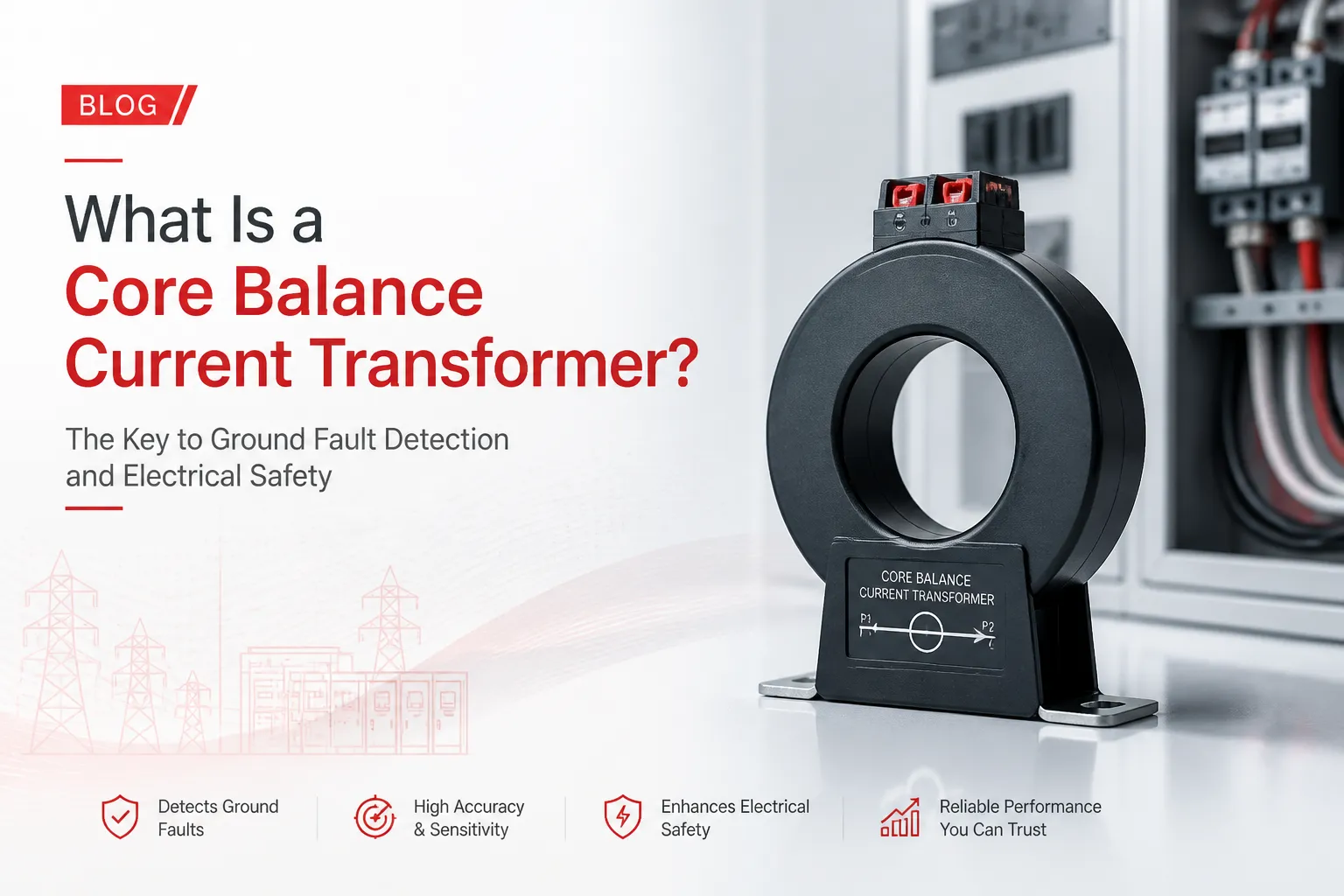
Current transformers (CTs) are an essential part of electrical systems, facilitating safe measurement and monitoring of high currents. Among the specialized CT types, the core balance current transformer (CBCT) plays a critical role in identifying ground faults to ensure safety. This guide covers everything about CBCTs, including their operation, applications, comparison to other CT types, leading manufacturers, pricing, and common buyer FAQs.
Core Balance Current Transformer: Definition & Working Principle
A core balance current transformer, also known as a zero-sequence CT or neutral CT, is a specialized current transformer designed to detect any imbalance in three-phase electrical systems. Unlike standard CTs that measure phase currents individually, CBCTs encompass all three-phase conductors and the neutral wire within a single toroidal core.
How It Works: In a balanced three-phase system, the vector sum of phase currents equates to zero, resulting in no magnetic flux in the CBCT core and no output current. In cases of ground faults, where a phase conductor makes contact with the earth, the current balance is disturbed, creating a net magnetic flux. This flux induces a current in the CBCT’s secondary winding, which activates a protective relay to isolate the faulty circuit.
Key Types of Current Transformers: CBCT vs. Other Varieties
Various types of current transformers are available, each designed for specific applications. Below, we compare CBCT with other popular CT variants:
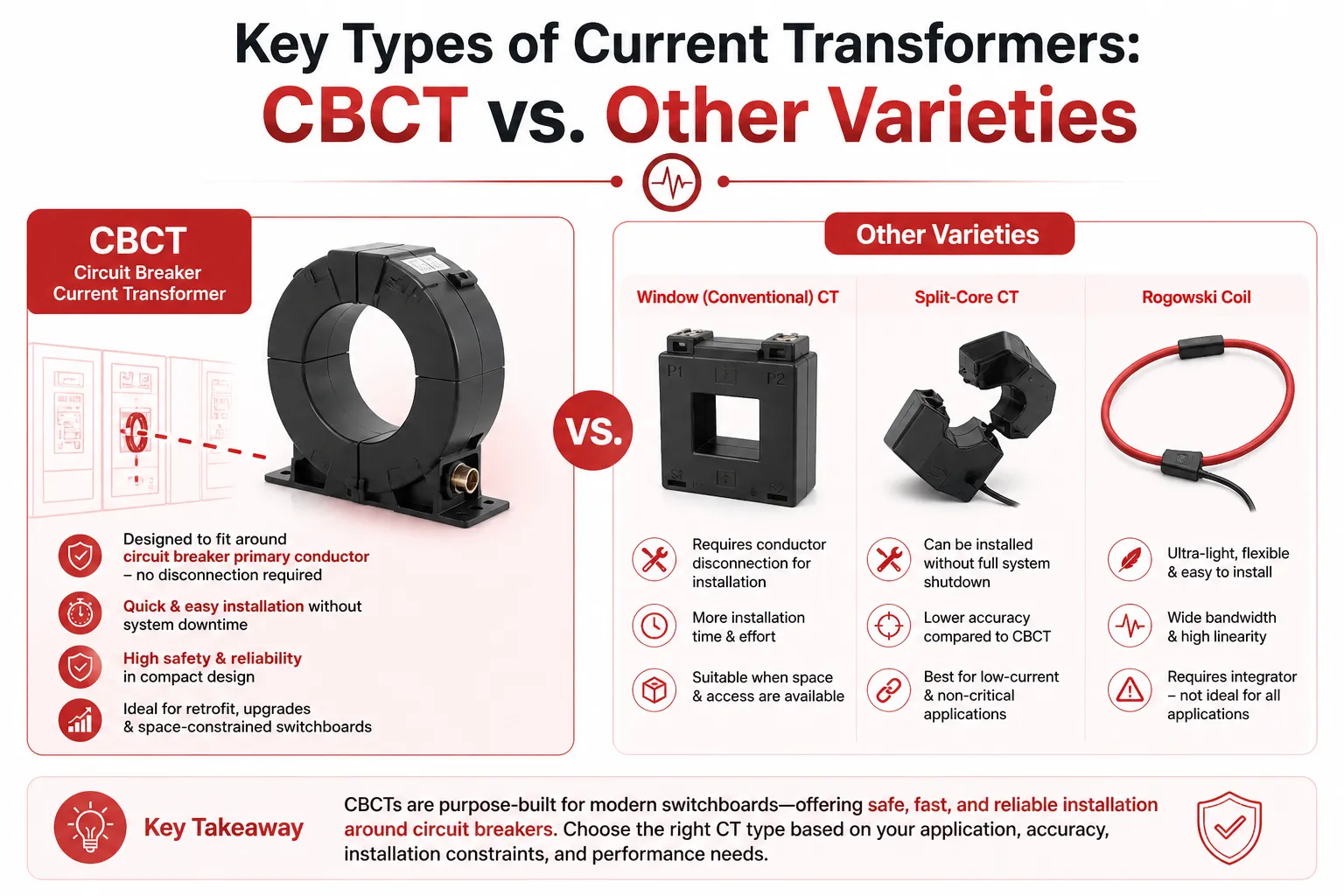
1. Core Balance Current Transformer (CBCT)
- Main Purpose: Ground fault detection in three-phase systems.
- Configuration: Toroidal core encompassing all phase conductors.
- Output: Activates ground fault relays upon detecting current imbalance.
- Typical Applications: Low-voltage distribution networks, industrial motor control centers (MCCs), residential panelboards.
2. Split Core Current Transformer
Split core CTs have a hinged design that allows them to be clamped around existing conductors without disrupting power, making them ideal for retrofit applications.
Main Purpose: Measurement of individual phase currents for energy monitoring and load management.
Typical Applications: Building automation systems, solar energy installations, power quality analysis.
3. Inrush Current Transformer
Inrush CTs are capable of handling high initial currents caused by motor startups or transformer energization, ensuring accurate measurement during transient events without saturation.
Main Purpose: Protection of equipment from excessive inrush currents.
Typical Applications: Industrial motor control, transformer protection systems, large HVAC systems.
4. DC Current Transformer
DC CTs measure direct currents using Hall-effect sensors, differentiating them from standard CTs that operate with alternating current.
Main Purpose: Monitoring DC currents in renewable energy systems, including batteries and solar inverters.
Typical Applications: Electric vehicle charging stations, DC circuits in renewable energy setups.
Current Transformer Comparison Table
| CT Type | Primary Function | Key Design Feature | Typical Applications | Price Range (100A Rating) |
|---|---|---|---|---|
| Core Balance CT | Ground fault detection | Toroidal core encircling all phases | LV distribution, industrial MCCs | $50–$200 |
| Split Core CT | Current measurement/monitoring | Hinged, clamp-on design | Building automation, solar systems | $30–$150 |
| Inrush CT | Transient current protection | Low-saturation core material | Motor control, transformer protection | $100–$300 |
| DC CT | DC current measurement | Hall-effect sensor technology | Renewable energy, EV charging | $80–$250 |
Core Balance Current Transformer: Applications & Benefits
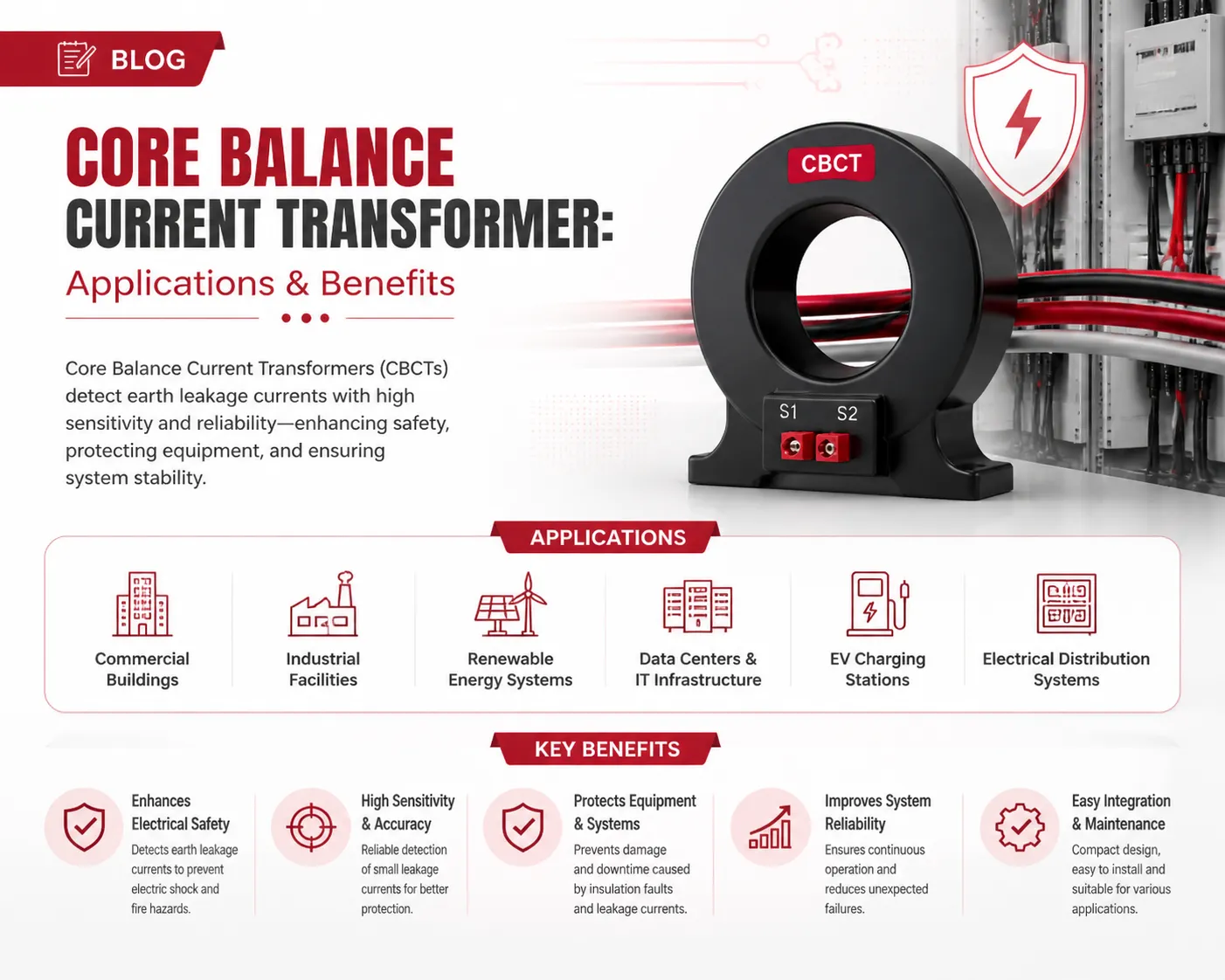
CBCTs play a vital role in ensuring electrical safety in three-phase systems, offering numerous advantages:
- Ground Fault Detection: Identifies ground fault currents as low as 0.5A, preventing equipment damage and electrical fires.
- Selective Coordination: When paired with protective relays, isolates the faulted circuit while minimizing downtime across the network.
- Space-Saving Design: Reduces installation size and costs compared to multiple standard CTs.
- High Sensitivity: Excellent for low-voltage systems where conventional overcurrent devices may not detect minor faults.
Typical Applications:
- Low-voltage residential and commercial panelboards.
- Industrial motor control centers (MCCs) and switchgear.
- Renewable energy systems like wind farms and solar parks to protect inverter circuits.
- Railway electrification systems for detecting faults in overhead lines.
Leading Current Transformer Manufacturers & Pricing
When selecting a CBCT or other types of CTs, prioritize products from reliable manufacturers with certifications like IEC 61869 or ANSI C57.13. Below are some renowned suppliers:
1. ABB
ABB specializes in CTs for both low and medium voltage applications, with CBCTs featuring robust designs and precise measurements.
Price Range: $80–$300 for CBCTs (100–1000A rating).
2. Siemens
Siemens offers CTs designed to integrate seamlessly with their protective relay systems, ensuring industrial automation and distribution applications.
Price Range: $60–$250 for CBCTs.
3. Schneider Electric
Schneider Electric provides compact CBCTs suitable for residential and commercial installations and are compatible with their relay systems.
Price Range: $50–$200 for CBCTs.
4. Crompton Greaves (CG Power)
CG Power provides cost-effective CBCT solutions for utility and industrial applications without compromising quality.
Price Range: $40–$180 for CBCTs.
FAQ: Common Questions About Current Transformers
What is the purpose of a current transformer?
A current transformer steps down high primary currents to a lower, measurable secondary current (usually 5A or 1A), allowing for monitoring, protection, and accurate measurements while providing operational safety.
What is the use of CT and PT?
CTs measure electrical current, whereas potential transformers (PTs, or voltage transformers) measure voltage. Both devices are vital for energy metering, power quality analysis, and protection systems in electrical networks.
Why is the CT ratio either 1 or 5?
CT secondary currents are standardized to 1A or 5A for compatibility with measurement instruments and relays. 5A is common for industrial applications, whereas 1A minimizes power losses in long-distance secondary wiring.
Why is CT used in substations?
Substations use CTs to:
- Monitor current for performance tracking and billing.
- Provide inputs to relays to detect and isolate faults.
- Provide isolation between high-voltage systems and low-voltage control circuits to ensure safety.
What is the difference between a current transformer and a potential transformer?
| Feature | Current Transformer (CT) | Potential Transformer (PT) |
|---|---|---|
| Primary Quantity | Current | Voltage |
| Connection | Series with primary circuit | Parallel with primary circuit |
| Secondary Output | 5A or 1A | 110V or 120V |
| Core Design | Toroidal or bar-type | Shell-type or core-type |
How to select the right core balance current transformer?
Consider the following when selecting a CBCT:
- System Voltage: Select a CBCT rated for your system (e.g., 400V for low-voltage systems).
- Current Rating: Ensure the CBCT matches the maximum primary current in your system.
- Sensitivity: Pick a CBCT with a minimum pickup current aligned to your ground fault protection needs.
- Certifications: Look for products with IEC 61869 or ANSI C57.13 compliance.
Core balance current transformers are critical for detecting ground faults and ensuring electrical safety in three-phase systems, complementing standard current transformers that measure individual phase currents. Their unique toroidal design allows them to detect even small current imbalances, triggering protective relays to prevent fires and equipment damage. When selecting a CBCT, consider factors like system voltage, sensitivity, and manufacturer reputation, with top suppliers like ABB, Siemens, and Schneider Electric offering reliable, certified products. By understanding the different types of CTs and their applications, you can design a safe, efficient electrical system that meets your monitoring and protection needs.