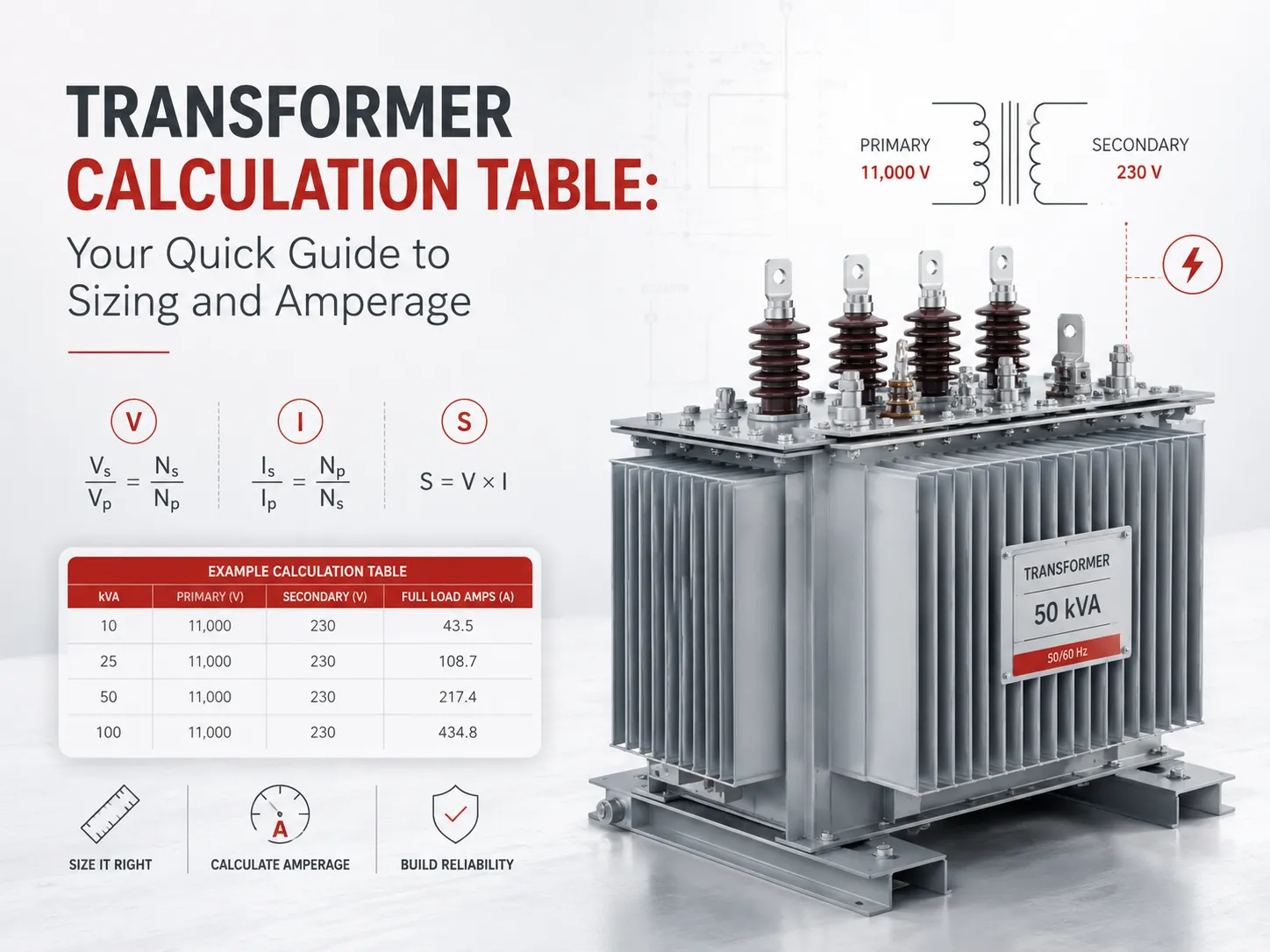
Whether you’re specifying a transformer for a new project or troubleshooting an existing installation, a transformer calculation table is the fastest way to get the critical numbers right. Getting the sizing wrong means either paying for unused capacity or, far worse, pushing a unit into overheating and premature failure. This guide gives you the essential formulas, a practical calculation table you can bookmark, and answers to the most common sizing questions electricians and engineers ask every day.
The Core Transformer Calculation Formulas
Every transformer calculation starts with the relationship between power (kVA), voltage, and current. The formula differs depending on whether the transformer is single-phase or three-phase.
Single-Phase Transformer:
Full Load Current (Amps) = (kVA × 1000) / Voltage
Three-Phase Transformer:
Full Load Current (Amps) = (kVA × 1000) / (Voltage × √3) ≈ (kVA × 1000) / (Voltage × 1.732)
These formulas give the rated current on the primary or secondary side, depending on which voltage you plug in. For example, to find the secondary current of a 30 kVA, 480V primary to 208V secondary three-phase isolation transformer, you would use the secondary voltage in the formula.
How to Calculate What Size Transformer You Need
There are three phases to sizing a new transformer, which includes; adding together loads, applying the safety margin, and choosing the next standard size.
- Add up all of the electrical devices the transformer feeds by reviewing their electrical ratings, either in watts (W) or volt-amperes (VA). In the case of electric motors, you’ll need to consider how much inrush current they have by using their locked-rotor current value or multiplying by a factor (generally between 125% and 150%) based on the running load of the largest motor on the circuit.
- Use Only 80% of Maximum Transformer Capacity . A transformer should only be loaded continuously at no greater than 80% of its rated capacity. To calculate the minimum amount of transformer nameplate kVA you need, divide your connected load (kVA) by .8, which will give you the minimum nameplate kVA required by your application. For a more detailed explanation of the reasons for the 80% rule safety margin; we have a separate section in our guide that breaks down how long it will take to replace a transformer based on the 80% rule and the effect of continuous overload.
- Choose the next available standard kVA size. For instance; Standard Single Phase kVA Sizes: 10, 15, 25, 37.5, 50, 75, 100. Standard Three Phase kVA Sizes: 15, 30, 45, 75, 112.5, 150, 225, 300 and greater. If you calculated your minimum kVA requirement at 43 then you would generally use a 50 kVA unit rather than a 45 kVA unit.
Quick Reference Transformer Calculation Table
The table below shows the full-load current for various popular sizes of transformers at the voltages used for most installations in North America.
| Transformer kVA | Single-Phase 120V (Amps) | Single-Phase 240V (Amps) | Three-Phase 208V (Amps) | Three-Phase 480V (Amps) |
|---|---|---|---|---|
| 10 | 83.3 | 41.7 | 27.8 | 12.0 |
| 15 | 125 | 62.5 | 41.6 | 18.0 |
| 25 | 208 | 104 | 69.4 | 30.1 |
| 30 | 250 | 125 | 83.3 | 36.1 |
| 45 | 375 | 187.5 | 125 | 54.1 |
| 50 | 417 | 208 | 139 | 60.1 |
| 75 | 625 | 312.5 | 208 | 90.2 |
| 100 | 833 | 417 | 278 | 120 |
| 150 | — | — | 416 | 180 |
| 225 | — | — | 624 | 271 |
| 300 | — | — | 833 | 361 |
It’s rare to see a single-phase voltage greater than 100 kVA for commercial distribution lines; however three-phase voltages can be used at larger service facilities such as factories. Be sure to check your regional voltage supply: 208-volt single-phase power is typically found in small businesses with a three-phase motor; while up to 480-volt three-phase power would be supplied in any size facility from a factory.
Worked Example: Sizing a Transformer for a Workshop
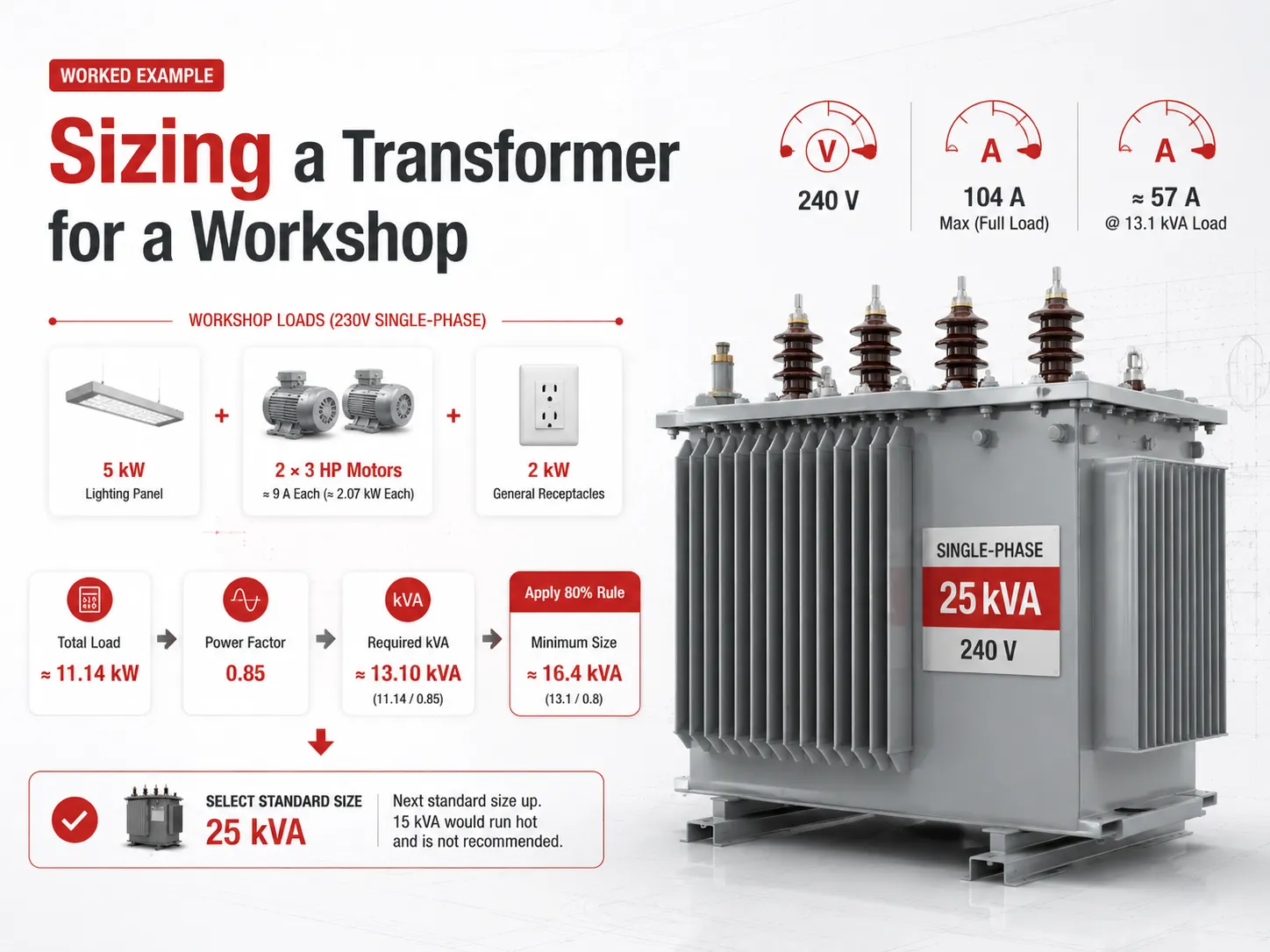
Let’s suppose you’re installing the following loads in a small commercial space; a 5 kW lighting panel, two single-phase 3 HP motors (approximately drawing 9 A) from 230 vrms, and general receptacles of a power requirement of 2 kW. All loads will be connected to 230V single-phase power supply.
- The final total amount of wattage is equal to 5 plus 2 multiplied by 2.07 watts (where 9 amps multiplied by 230 volts is approximately 2.07 watts) plus two. This equals approximately 11.14 Watts. If we assume a power factor of 85%, then the final total amount of kilo volt-amperes is: 11.14 Watts divided by 0.85 equals approximately 13.10 kilo volt-amperes.
- Apply 80% rule: Minimum transformer size = 13.1 kVA / 0.8 = 16.4 kVA.
- Choose your standard for ratings : The next size of single-phase transformer to the standard rating of 16.4 kVA is a 25 kVA transformer. A 15 kVA transformer would not allow it to work correctly and will cause it to produce excess heat.
The transformer, which is 240 volts and has a 25 kva rating, will handle up to 104 amps of current at the secondary side and will provide approximately 57 amps of output to run the load (13.1 kVA) inside of your business with a little space available for future use.
Frequently Asked Questions
What is the formula to calculate transformer?
The basic formula to calculate the full-load current of a transformer depends on the phase configuration. For single-phase: Amps = (kVA × 1000) / Volts. For three-phase: Amps = (kVA × 1000) / (Volts × 1.732). You can also rearrange these to solve for kVA when you know the voltage and current: kVA = (Volts × Amps) / 1000 (single-phase) or kVA = (Volts × Amps × 1.732) / 1000 (three-phase).
How do I calculate what size transformer I need?
To calculate the transformer size you need, first total the kVA of all connected loads (watts divided by power factor if the load is given in watts). Then divide that total by 0.8 to apply the 80% continuous load safety margin. The result is your minimum nameplate kVA. Finally, round up to the next available standard kVA rating. Always include a provision for future load growth if the installation is likely to expand.
What is the 80% rule for transformers?
The 80% rule states that a transformer should not be continuously loaded beyond 80% of its rated kVA capacity. For instance, a 100 kVA transformer should carry no more than 80 kVA of continuous load. This margin protects the winding insulation from excessive heat, extends service life, and gives the transformer the thermal headroom to handle short-term overloads such as motor starts without tripping or sustaining damage.
What amperage is a 480V 30 kVA transformer rated for?
A 30 kVA, 480V three-phase transformer has a rated full-load secondary current of approximately 36.1 amps (using the formula 30,000 / (480 × 1.732) = 36.1 A). If the same unit were a single-phase 480V transformer, the current would be 62.5 A. Always check the nameplate for the exact value, as the actual number may vary slightly with the design impedance and temperature rise rating.
A reliable transformer calculation table takes the guesswork out of sizing and load checks. Whether you’re looking up the full-load amps for a 480V 30 kVA unit or determining the minimum kVA for a new installation, the formulas and table above give you a foundation you can trust. Pair these calculations with the 80% rule, and you’ll end up with a transformer that runs cool, delivers stable voltage, and serves your operation for decades. Bookmark this page, and you’ll never have to retrace the math when a nameplate fades or a project lands on your desk with a tight deadline.