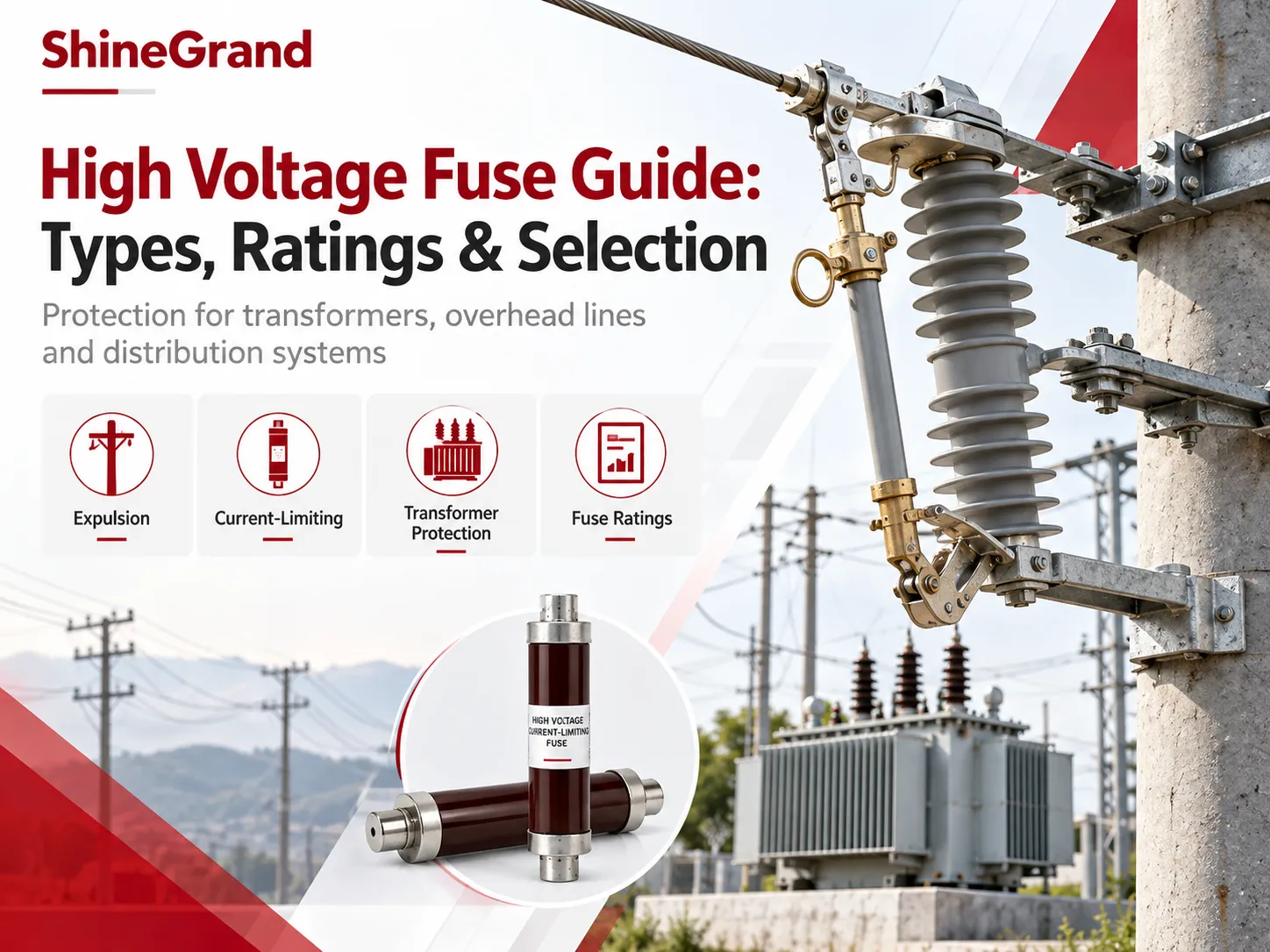
High voltage fuse are among the most economical elements of a distribution system yet one of the most important. Choose correctly, and the failure of a transformer is cleared in no time, the recloser upstream is not affected, and a lineman changes just one fuse element of the next day. Choose incorrectly, and repeated nuisance blown fuses await every time the transformer is activated, or even worse, a fuse unable to interrupt the current at that point of the circuit is used. The publication provides information on how high-power fuses operate, how different types vary, what every marking stands for, how to determine the appropriate fuse size without following an intuitive approach and how the most popular manufacturers’ fuses compare.
What is high-voltage fuse? High voltage fuse are protective devices of voltage rating above 1 kV AC (in reality, usually from 3.6 to 40.5 kV). High-voltage fuses are in operation either when the heated element of the fuse melts and opens the circuit or the arc is successfully extinguished. There are two typical types of high-voltage fuses; namely expulsion fuses which rely upon the internal gases to blow out an arc when the current reaches zero and current-limiting fuses which reduce the current in advance.
How a High Voltage Fuse Works
High voltage fuses have two functions. The first function is the tracking function, in which a metal conductor usually made of either silver, tin or a copper alloy is shaped in such a way that it melts at a predetermined current and a predetermined time. The influence of an overload is long enough for it to take several minutes for the fuse to melt; in the case of a bolted fault the element to melt in milliseconds. This proves the time-current characteristic (TCC) function is the most essential document in selecting a fuse.
The second function is interruption. This differs high voltage fuses from those used over
household voltages. At 400 V for example, the gap formed by a melted fuse will be able to ensure the interruption of a circuit. However, when voltages reach 11 kV or 33 kV, the system will simply re-strike the gap and create an arc. Hence, high voltage fuses use special arc-quenching mechanisms that differentiate one family of high voltage fuses from another:
Expulsion fuses rely on the arc burn in a tube, lined with a gas-evolving material (traditional horn fibre or borate in power fuses). Heat produced leads to the increase of the amount of gas that the system releases from the fuse tube and due to this heating of arc gas results in the loss of heat of the high voltage arcs.
Current limiting fuses consist of a notched conductor embedded in the silica sand. In this case, when the fuse melts it produces a series of short arcs. The silica sand absorbs the energy of the arcs produced. Thus, a fuse creates an arc voltage much larger than the voltage of the system, which leads to the decrease of the current before it reaches its peak value.
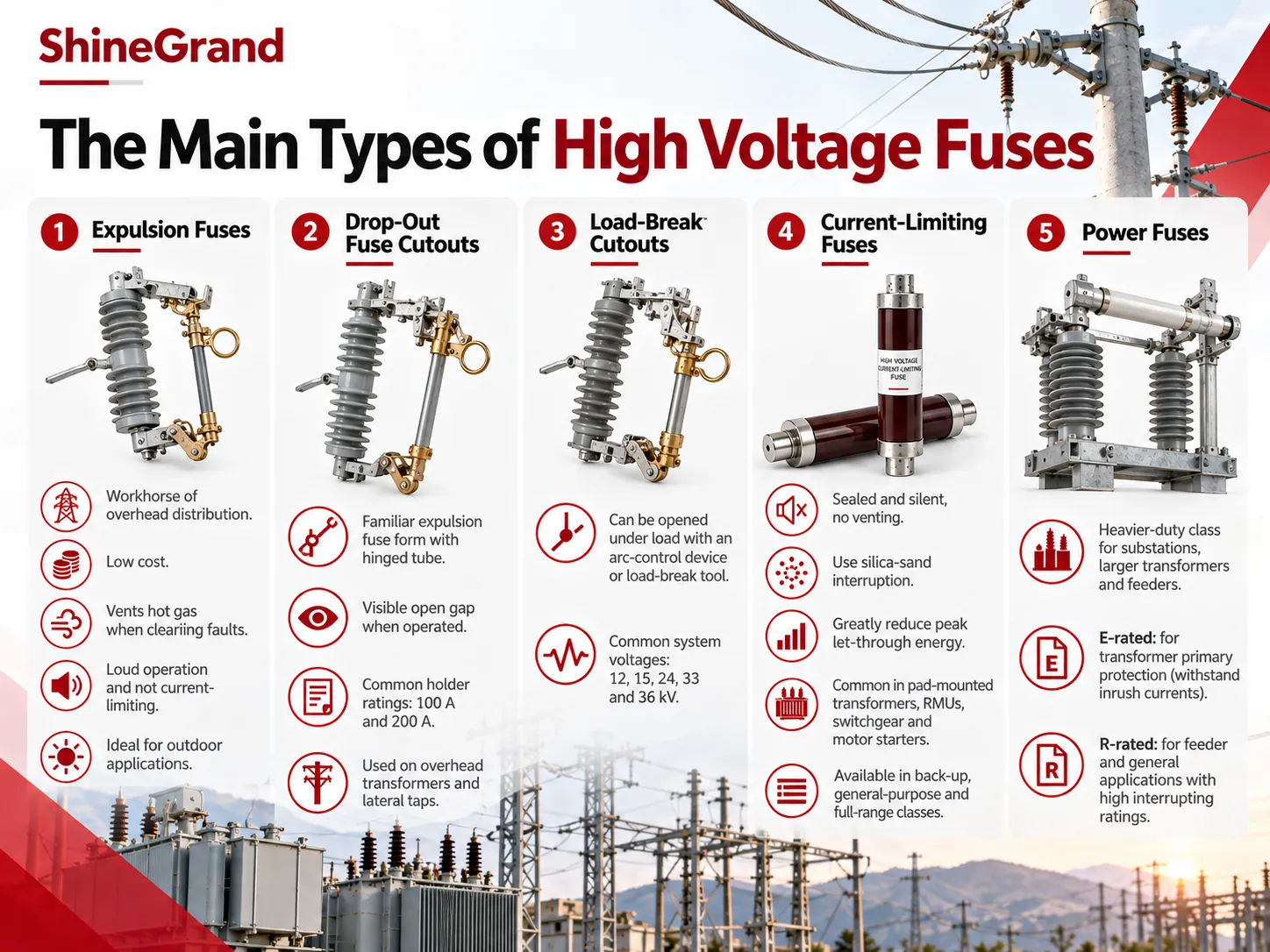
The Main Types of High Voltage Fuses
Since catalogs employ different terminology, it is crucial to classify the products according to their use, not brand terminology.
Ventilated fuses
Ventilated fuses can be defined as the mainstay of overhead distribution systems because they are cheap, the replaceable fuse link costs very little, and their operation is straightforward. Among the disadvantages of this kind of fuse one should mention that it emits hot gases and produces a loud sound during operation, and it does not limit the peak short circuit current, nor does it provide an isolation above and below the tube. Therefore, this type of fuse is the most appropriate for mounted installations and outdoor substations but not for installations indoors or in closed switchgear.
Drop-out fuse cutouts
The dropout cutout is the most well-known kind of ventilated fuse. This type of fuse relies on the porcelain or polymer insulator that holds the hinged tube with the fuse. The mechanism works as follows: as soon as the fuse wire melts, the latch opens, and the tube turns down, thus creating an opening that crews can see from a distance on the road. ShineGrand’s SGFCO124 drop-out fuse cutout is an example of this construction for 12 kV systems in 100 A and 200 A holder ratings.
Load-break cutouts
A standard cutout must not be operated under load conditions since opening the fuse would produce an arc. A load-break cutout is the cutout that has some form of arc chute or has load break tool attached in order to allow line workers to open the unit while electric current continues flowing through it and thus prevents the necessity to operate an upstream circuit breaker. One of the devices produced by ShineGrand is a load break fuse cutout covers 12, 15, 24, 33 and 36 kV systems.
Current-limiting fuses
Current-limiting fuses are completely enclosed in a box and as such it does not produce any noise and has no vents; that’s why it can be used together with pad mounted transformers, ring main units, switchgears and motor starters. The main value of the device is the great reduction of the let-through energy (I²t) and the peak current, which protects equipment that could fail due to a complete fault. The IEC 60282-1 standard had specified three classes for the current-limiting fuses, and the class is more meaningful than clients think:
Back-up (partial-range) fuses are capable of interrupts functioning only between the minimum breaking current and maximum rating. These devices are used for high fault currents and often require support of another device like the expulsion fuse or a switch with the striker trip in order to operate for low overcurrent conditions.
The general-purpose fuses are usually able to interrupt any current that melts the element in about an hour time, but they do not work for every case of low overload.
The full-range fuses interrupt some kind of current that melts the element regardless of how low the overload is.
Power fuses
Power fuses
Power fuses belong to heavier duty type which are used at substations and large transformers and feeders. This type includes such designs as boric acid expulsion devices with increase in interrupt ratings and decrease in vents compared to the distribution cutouts as well as thus large current-limiting devices. In South America, there are two types of fuses E-rated and R-rated based on the IEEE C37 standard: E-rated fuses are used for those circuit breakers and feeders where normal operations are expected and R-rated devices are the backup fuses used for motor starters in conjunction with contactors and overload relays.
Expulsion versus Current Limiting: A Comparison Guide
Making the decision between using a current-limiting high voltage fuse or an expulsion high voltage fuse can be summarized in few straightforward questions that people might consider when making this choice:
Interrupting method: Expulsion technology takes advantage of natural zero current; whereas current limiting fuses are designed in such a way as to decrease the amount of current before it attains its peak value.
Let-through peak current: For expulsion fuses, the entire potential peak is passed; while for current-limiting fuses only part of the peak is let through.
Noise and venting: Expulsion fuses are noisy and emit gases (and sometimes flames); whereas current-limiting fuses do not produce any sound and are hermetic.
Installation: Expulsion fuses can be mounted outdoors; whereas current limiting fuses can be mounted indoors only.
Replacement cost: All that is needed in case of an expulsion fuse is to replace the link; while for a current-limiting fuse one needs to replace the entire fuse.
Low-overcurrent behavior: Expulsion fuses can trip small overloads satisfactorily; back-up current-limiting fuses cannot accomplish that by themselves.
Applications: While expulsion fuses are perfect for overhead transformers, branch taps and open substations, current limiting fuses can be used in pad-mounted transformers, RMUs, switchgear, and circuits with high short-circuit values.
An Overview of High Voltage Fuse Ratings
More numbers appear on a fuse’s nameplate or datasheet than many buyers check. Here are those numbers from the most important to the least:
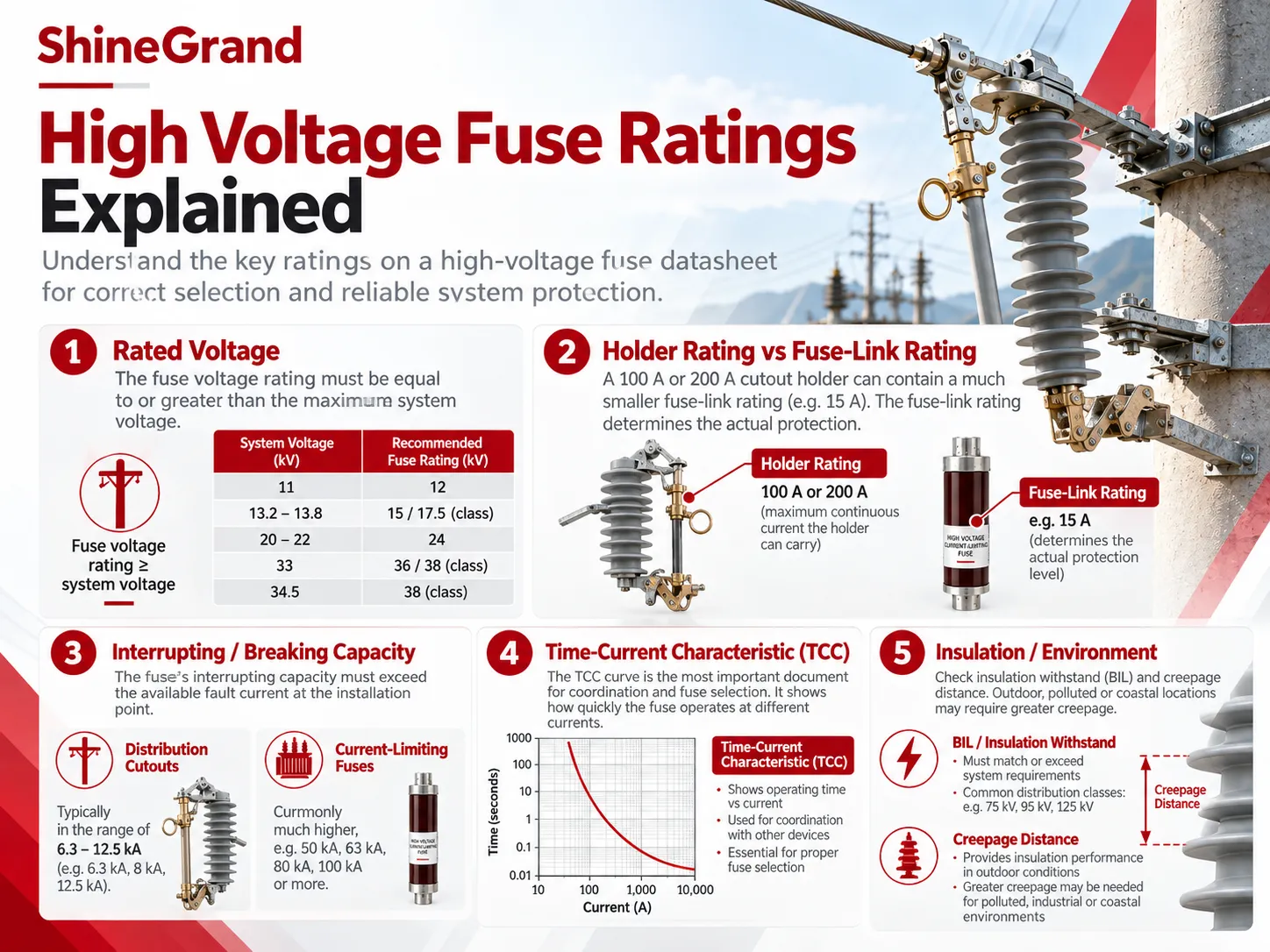
Voltage rating
This voltage rating indicates the maximum voltage the fuse can work against. It should be high enough to be at least as much as the highest system voltage. In addition, for ungrounded or resonant-grounded systems, it is important to check whether the fuse must withstand the complete voltage between lines for that fuse. Typical voltage ratings correlate to common systems:
12 kV rated fuses used in 11 kV systems (according to IEC) or 15 kV class (according to IEEE).
15 kV class and 17.5 kV rated fuses used in a 13.2- 13.8 kV system.
24 kV rated fuses used in 20 – 22 kV systems.
36 kV or 38 kV rated fuses used in 33 kV system.
38 kV class fuses used in 34.5 kV system.
Rated continuous current and fuse-link rating
The most common terminology confusion comes from the cutouts. The holder rating (like 100 A or 200 A) refers to the maximum continuous current that can be carried by the cutout body, contacts, and tube, while the link rating (like 10K, 25T, or 3H) describes what makes it blow. For instance, it means that if a cutout shows 100 A and uses a link of 15K, it protects the line at the value of 15 A.
The interrupting/breaking capacity
Interrupting (breaking) capacity
Rated interrupting current is the maximum current that could be interrupted by this fuse safely. It has to be more than the available fault current at the installation point. In fact, in the growing network, this value will keep rising over years due to the new low-impedance transformers and sources added to this network. This value for distribution cutouts varies from several kA up to about 10 kA. For example, ShineGrand’s 33kV ceramic fuse cutout, for instance, is rated 100 A with a 6.3 kA breaking capacity. Current-limiting fuses commonly reach 40 to 63 kA or more.
Time-current characteristic (TCC)
K links are fast links having speed 6-8.
T links are slow links with 10-13 speed. They can handle inrush current better and can be coordinated with downstream devices.
H links are high surge links of small rating (1, 2, 3, 5, or 8 A). They are designed to protect small transformers, preventing fuse burning during the inrush and lightning.
BIL and creepage distance
For outdoor cutouts, the basic impulse insulation level (BIL) and the creepage distance of the insulators are as important as the fuse itself. For example, in 15 kV cutouts which have 95 kV or 110 kV of BIL and 36 – 38 kV cutouts with 150 – 170 kV BIL, the creepage distance has to be selected according to the pollution degree of the site by using the creepage values given in the IEC TS 60815 standard.
How to Select a High Voltage Fuse for Transformer Protection
Fuse selection usually begins with the most straightforward method of multiplying the transformer’s rated current by a fixed number, for example 1.5 or 2, and then the best answer is picked. While this method will provide a good estimate, it is merely the starting point in the process of making the right fuse selection. The matter is that the selected fuse should meet a number of requirements simultaneously, which are ignored when using this method. The process of finding the correct answer is rather complicated and consists of the following six steps:
①.The current in the transformer should be calculated first. The formula for a three-phase transformer is as follows: I = kVA/(√3*kV). For instance, a 500 kVA transformer operating at a voltage of 11 kV delivers the current of approximately 26 A at the primary side, whereas the current delivered at 33 kV operating voltage is equal to approximately 8.7 A. As for single-phase transformers, the kVA value should be divided by the either line-to-neutral or line-to-line voltage.
②.The following step implies allowance for the possibility of overloads over a longer time period. Distribution transformers seldom work under load conditions up to their limits and deliver significant overload currents after outages. As a result, the minimum melting curve of the fuse should lie above all possible values.
③.The inrush points should be taken into consideration afterwards. The process of energizing the transformer requires the magnetizing inrush current, and it is commonly accepted that the fuse should not melt if the current does not exceed about 12-25 times of its rated current for some time period.
④.In addition, it is necessary to protect from the probability of damage to the transformer. The total clearing curve of the fuse should lie under the withstand curve of the transformer as a result of which all secondary faults are cleared. Besides, the interruption capacity has to be confirmed by calculating the maximum fault current.
⑤.Coordination with the upstream and downstream devices should also be made so that failures are cleared before the main switch operates.
Most manufacturers and utility companies provide tables where all these suggestions are grouped and presented together for each rated transformer. If the transformer is of an unusual type, one has to use the tables carefully to ensure they are correct. For the transformer side of this calculation, ShineGrand’s guide on what an electric pole transformer is covers the ratings and connections you will need.
Fuse type by application
This following table is a starting point for identifying fuse types for any electrical application, but the final decision is based on previous steps.
Small single-phase overhead transformers (5 to 25 kVA): a dropout cutout with a K- or H-link device
Larger overhead transformers or lateral taps: a dropout cutout with the K- or T-links, mainly using T-links when there is a requirement for coordination with other fuses
Devices requiring crew access under load: a load breaker cutout
Onsite transformers: a bayonet expulsion fuse backed up by a current-limiting fuse
Ring main units and compact substations: a current-limiting fuse with a trip mechanism
Indoor transformer supply installations in a metal environment: a current-limiting fuse of the E type or IEC general type
Medium voltage motor starter installations: a back-up current-limiting fuse of the R type combined with a contactor
Capacitor banks: a fuse dedicated to capacitors depending on the fault energy
Substation transformers with low MVA: an inverter type или a current-limiting fuse
Leading High Voltage Fuse Brands and Their Product Lines
The few manufacturers have long been in configurations that have ensured them almost complete authority within the field of high voltage fuse, and their literature is some of the best free engineering reference material available. When it comes to specifications, companies named below have proven themselves to be leading examples, which are mentioned most frequently.
- S&C Electric: The SM-4 and SM-5 power fuses are boric-acid types widely used for substation transformers and feeder protection. Application data applied by the company in question as well as TCC curves can be considered standard reference for North American utilities.
- Eaton Bussmann series: Both E-rated medium voltage current-limiting fuse line for transformers, feeders and switchgear complying with ANSI/IEEE standards as well as R-rated motor fuses are produced by this manufacturer.
- Hubbell CHANCE: Type C cutouts are considered to be long-time selection of overhead distribution featuring porcelain and polymer materials.
- Mersen: This manufacturer is known for producing a range of E-rated general-purpose medium voltage fuses and a great number of IEC and ANSI fuses.
- ABB: This manufacturer is providing its customers with IEC-style backup fuses able to comply with RMU standards.
IEC and IEEE Standards for High-Voltage Fuses
Determining which standard is responsible depends on the location of the system and the fuse type purchased. Knowing which standard to apply in the specification can help prevent issues with type-test later.
IEC 60282-1 specifies current-limiting fuses, which include back-up, common, and full-range types.
IEC 60282-2 is about expulsion fuses, which include distribution drop-out cutouts and fuse links for the latter.
IEEE C37.40 identifies conditions and definitions for high voltage fuses, distribution switches, and accessories.
IEEE C37.41 states tests to be performed on fuses and cutouts.
IEEE C37.42 specifies the details for expulsion-type distribution class fuses, cutouts, and fuse links, including the characteristics for K and T links.
IEEE C37.47 declares specifications for distribution-class current-limiting fuses.
IEEE C37.48 is an application, operation, and maintenance guide for engineers in search of fuse products, making it very practical.
One easy way to check the usability of the datasheet and the standard the supplier showed is to verify if the standard and the fuse type match. The expulsion cutout should reference IEC 60282-2 or IEEE C37.42, while the current-limiting fuse should refer to IEC 60282-1 or IEEE C37.47 or C37.46. If there is no matching standard, the user should never assume that the product is a bad product but it means that the user could ask for the type test report.
Common High Voltage Fuse Problems in the Field
Most of the complaints made by operator regarding fuse comes with a list that points back to the decision related to its selection or installation:
A nuisance blowing occurring due to the energization means that the link is under sized or having too quick reaction to the current. In this situation, T link or next size can be utilized to solve the issue.
Summer heating and failure due to cutting in implies that the disconnecting device was not sized correctly.
Failure of the cut-out tube implies that it has not been able to fall, which can be due to jammed mechanism due to corrosion or bad alignment.
Tube or holder damage that happened in process of use means that the device suffered damage greater than its ability to interrupt.
Insulator flashover in polluted or coastal areas means insufficient creepage distance for this location.
Failure of the back up current limiting device in case of low overload means that there was no other device used in combination with it.
What to Compare When Sourcing High Voltage Fuses
In comparing quotations, unit price of a cutout/link doesn’t provide much information. You should check the suppliers for the following confirmations:
The standard to which the product has been tested and whether test reports exist;
The rated voltage, BIL, and holder current rating;
What is the rated interrupting current and the voltage to be used;
Published TCC curves for desired link types and sizes;
Insulating material and creepage distance in mm;
The compatibility of existing fuse links with the holders to avoid keeping two systems;
The package offered, marking, and the time to deliver certain quantities.
To get an accurate quote in a short period, provide the suppliers the following with the RFQ:
The system voltage as well as its earthing;
kVA transformer ratings with connection type;
A model of the existing cutout or fuse in use;
Information regarding required holder current and type of size of fuse link;
Fault current at the installation point;
Standard of IEC/ANSI;
Environment characteristics like altitude/pollution/coastal exposure;
The quantity and the delivery country.
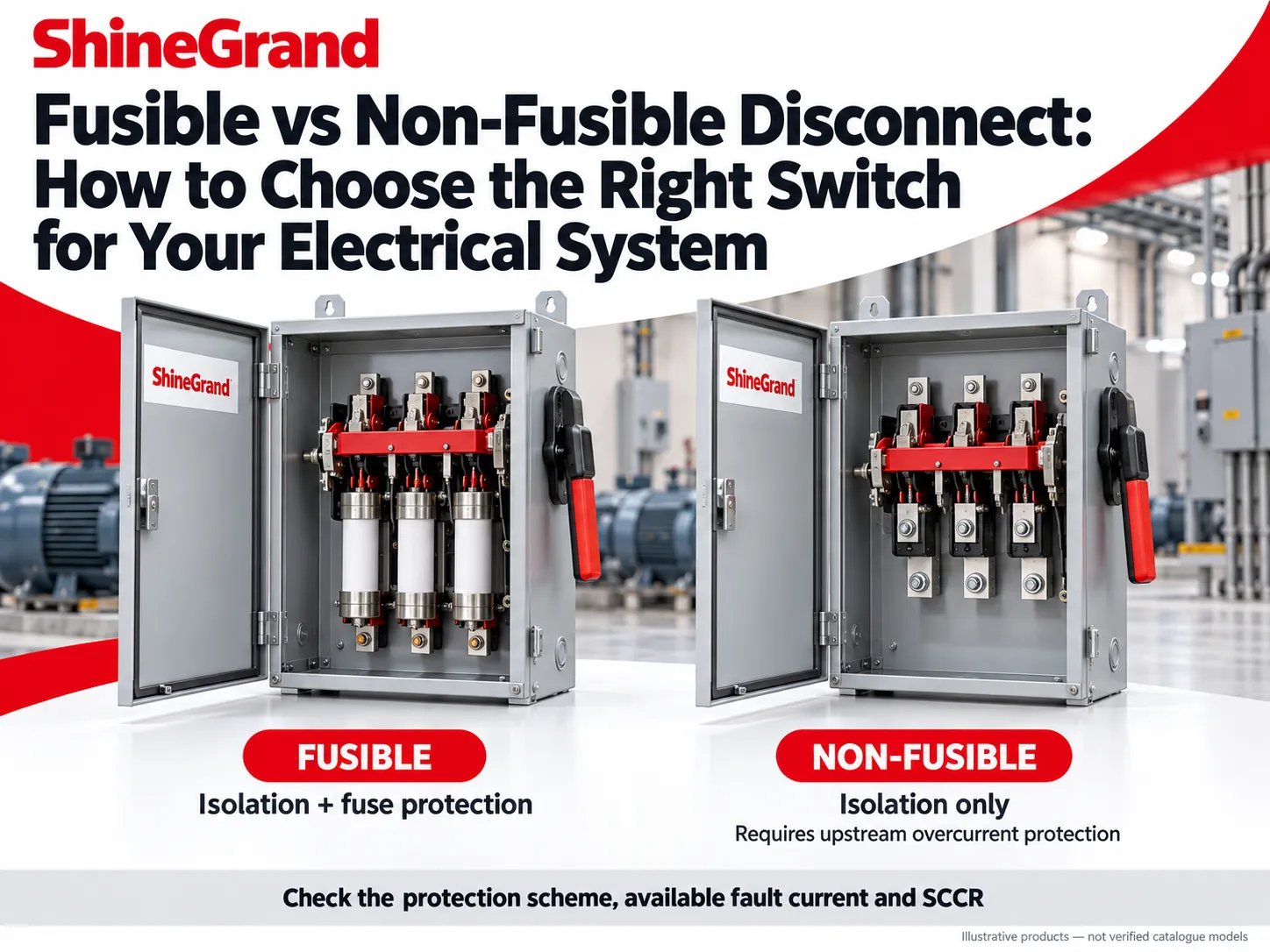
The same discipline applies to selecting the switching device used for the fuse. When considering the use of fused or unfused isolation for transformers/motor feeder, ShineGrand’s comparison of fusible vs non-fusible disconnects walks through the trade-offs.
ShineGrand High Voltage Fuse Solutions
ShineGrand Electric manufactures expulsion-type fuse cutouts for overhead distribution, the part of the market where most transformer protection is installed. The current range includes:
- SGFCO124 drop-out fuse cutout: 12 kV, available with 100 A and 200 A holders, for overhead distribution transformers and lateral taps.
- 33kV ceramic fuse cutout: 33 kV systems, 100 A, 6.3 kA breaking capacity, porcelain insulator.
- Load break fuse cutout: 12, 15, 24, 33 and 36 kV ratings for lines where operators need to switch under load.
Because ShineGrand also builds the transformers these fuses protect, including pole-mounted single-phase transformers and 6 to 10 kV oil-immersed distribution transformers, the team can help match cutouts and link sizes to transformer ratings as part of one supply. ShineGrand does not claim its cutouts are direct drop-in replacements for any particular brand’s model; if you are replacing installed equipment, send the existing model and dimensions so compatibility can be checked first. You can browse the full fuse product range, or pair fuses with surge arresters and disconnect switches for a complete pole-top protection package.
Frequently Asked Questions
What are high voltage fuses?
High voltage fuses are those overcurrent protective devices rated over 1,000 V AC and actually used on medium voltage distribution systems that work in a range of 3.6 kV to 40.5 kV. They consist of a special calibrated element that melts when current exceeds a certain threshold value and an arc-extinguishing media (either gas expulsion or silica sand). These fuses help to disconnect fault currents safely with the voltage being above normal values. High voltage fuses are used for transformers, wires, capacitor banks and engines.
What happens if you use a higher voltage fuse?
With the use of expulsion power fuses, having a rated voltage higher than the system voltage is usually acceptable and is acceptable since the rated voltage is always a maximum. Protection is determined by fuses’ current ratings and TCCs, which must be accurate. In the case of current-limiting fuses, on the contrary, the rated voltage could result in the development of an arc voltage resulting in the application of stress on the insulation of the system and surge arresters, and thus the manufacturers indicate a voltage minimum for the application. The most dangerous mistake is related to the use of a fuse with a rated voltage lower than the system voltage, which may not allow the fuse to operate correctly and prevent an explosion.
What is a H type fuse?
An H-type fuse is a high-surge fuse link that can be used in cut-outs in the medium voltage distribution. H-type fuses are available in small ratings like 1H, 2H, 3H, 5H, and 8H. It has a time-current characteristic that withstands inrush current of transformers, lightning strokes, and is also applicable to medium-sized distribution transformers, which is why it is often used for single-phase pole transformers. In low-voltage North American terminology “Class H” refers to an obsolete UL fuse class with a rating of 250 V or 600 V and an interrupting capacity of 10 kA.
What’s the highest amp fuse?
The maximum amperage fuses are low-voltage industrial versions: Class L fuses rated by UL have the capability of handling currents up to 6,000 A (600 V). Typically, medium voltage current-limiting fuses have current ratings in the hundreds of amps. When necessary, multiple fuses can be installed parallel in one enclosure thereby increasing the current ratings of the circuit. The maximum current allowed in distribution switches is determined by the ratings of the fuse holders, which typically accommodate fuses with ratings of 100 or 200 A. In transformer applications, fuses used are usually rated at significantly lower currents than either of these thresholds.
What is the difference between K and T fuse links?
Both types are expulsion fuse links used for cutouts and operate using common expulsion technology. K links are fast and have speed ratio 6 to 8 for melting times between 0.1 seconds and melting currents of 300 or 600 seconds. T links are slow and have a speed ratio of 10 to 13, which allows them to withstand inrush currents and short overloads.
Can a high voltage fuse be reset?
It’s a no. When the element has melted, the fuse link or cartridge will be replaced. In a drop-out cutout, the holder and tube are reused with the new inexpensive link as the only thing changed. A current-limiting fuse is completely replaced by its cartridge.
If a fuse has blown repeatedly, one must find out its cause before replacing any fuse.
Why do drop-out cutouts use expulsion fuses instead of current-limiting fuses?
Expulsion fuses are inexpensive, easily replaced from the ground via a hot stick, effectively clear low current surges, and provide a visible indication on operation. Noise and venting are non-issues for overhead lines. Current-limiting fuses are used in overhead systems primarily when the fault current is larger than the cut-out’s interrupting rating and is commonly used as an additional back-up fuse.
How often should high voltage fuses be inspected?
There is no one period that is universally deemed the appropriate time for inspection; however, in practice most utilities inspect the overhead cut outs during normal line patrols, and after severe storms, and check the enclosed fuses during switchgear maintenance. Inspect for cracked and contaminated insulation materials, corroded hinges and connections, tubes that are missing or partially missing, and any proof of tracking. Detailed maintenance information can be found in IEEE C37.48.
References
- IEC 60282-1 — High-voltage fuses, Part 1: Current-limiting fuses. International standard defining current-limiting fuse classes, ratings and tests.
- IEC 60282-2 — High-voltage fuses, Part 2: Expulsion fuses. International standard for expulsion fuses and distribution cutouts.
- IEEE C37.40, C37.41, C37.42 and C37.48. North American standards for high voltage fuse definitions, design tests, distribution cutouts and fuse links, and application guidance.
- IEEE C57.109 — Guide for Liquid-Immersed Transformers Through-Fault-Current Duration. The transformer damage curves used in fuse coordination.
- Electrical Engineering Portal (EEP). Technical articles on medium voltage fuse selection and coordination.
- Wikipedia — Fuse (electrical). General background on fuse construction and high voltage fuse types.
Get the Right Fuse for Your Network
The best high voltage fuse is the one whose ratings and curve fit the transformer and the system it protects, not the one with the lowest price per piece. If you are specifying cutouts for a new distribution project or replacing installed units, send ShineGrand your system voltage, transformer ratings and available fault current, and the engineering team will recommend suitable cutouts and fuse links. Contact ShineGrand for a quotation or technical support.