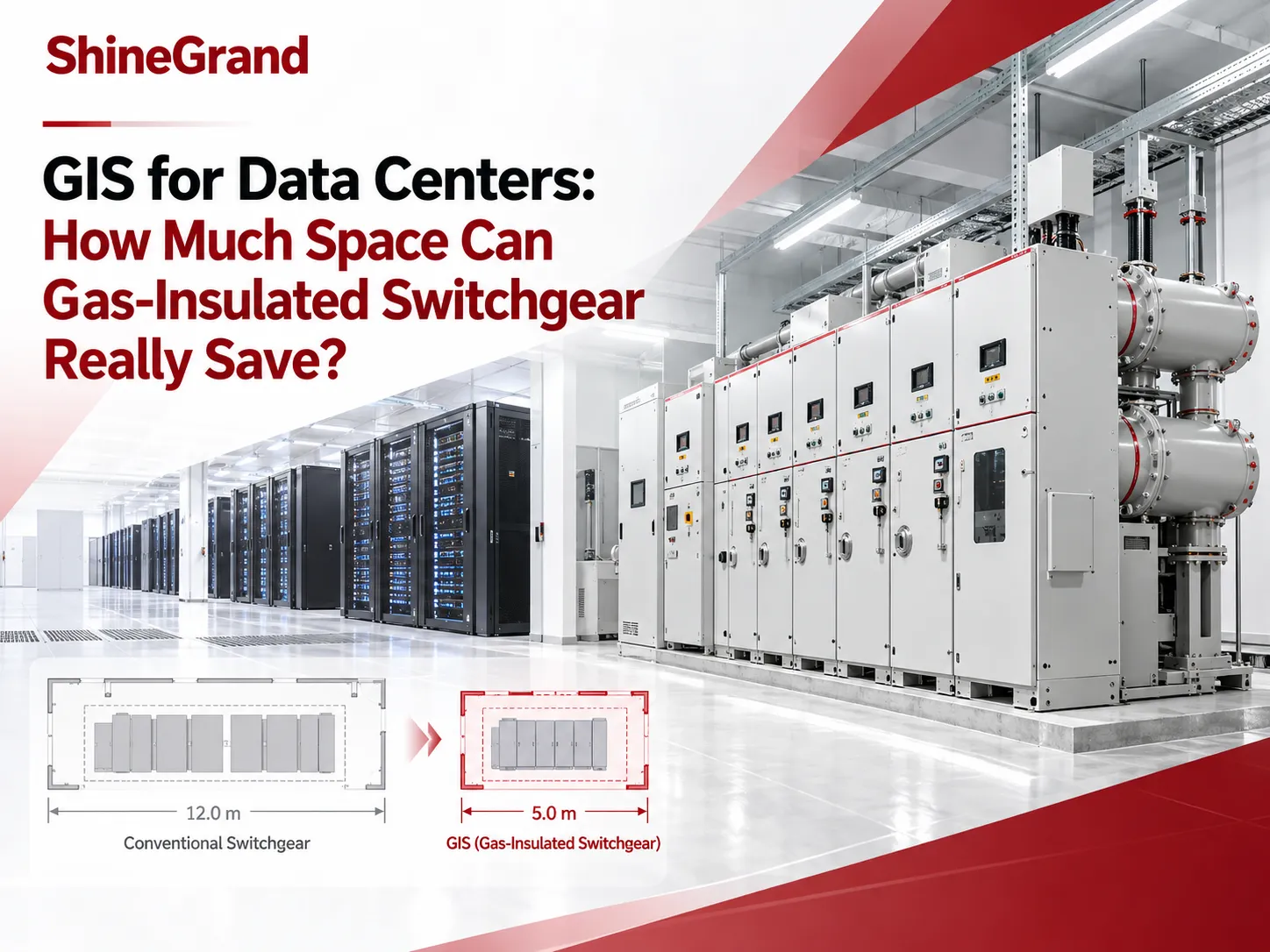
Data centers have white and gray spaces, where the former is where the money comes in, but the latter is necessary for operations. Both types of space are vital. However, with increasing rack densities, operators are finding a need for more gray space. That is why they are looking at GIS gas-insulated switchgear as a way to win space back. The vendors’ value proposition is sound: their equipment consumes less space by up to 90%. The engineering reality is that GIS can be less efficient at different voltages.
This document attempts to provide a procurement-based view on the benefits of GIS space saving in data centers. It analyzes why the numbers provided in the sources differ, goes through the calculations necessary to come up with the conclusions, assesses the offerings of major vendors like ABB, Siemens, Schneider Electric, Eaton, etc., and provides a framework for making decisions on GIS.
The amount of space saved by GIS is contingent on the voltage level and comparison standard used. According to Eaton’s own AIS vs. GIS report at voltages of 5-15 kV, the space used by GIS and metal clad protections is comparable, since North American metal clad systems are able to stack 2 circuit-breakers in one compartment. On the other hand, GIS line ups compared to single-tier IEC-style air insulated switches yield savings of 35-50% once openings are considered. Between 27 and 40.5 kV, the advantage becomes cumulative: according to Eaton, the space reduction may reach 60%, while the reduction in area may be even larger. Finally, at transmission voltages, GIS substation requires a small fraction of the footprint of outdoor air insulated yard as a whole.
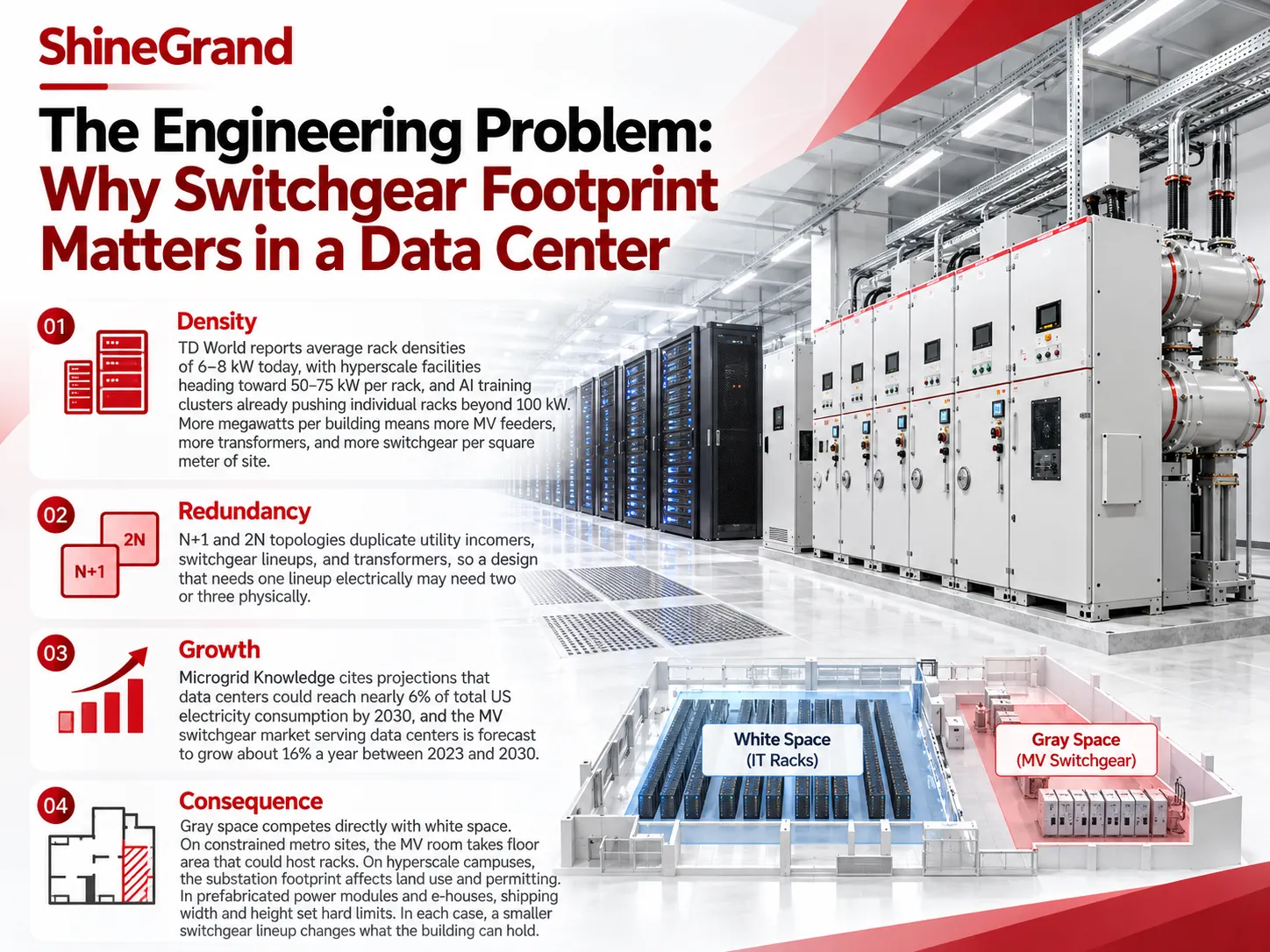
The Engineering Problem: Why Switchgear Footprint Matters in a Data Center
Simultaneously, three forces are putting pressure on electrical rooms. The first force is density. TD World reports that average rack densities are currently between 6-8 kW and that hyperscale facilities are aimed at achieving 50-75 kW per rack as the AI training clusters have already pushed some racks to over 100 kW each. More kW per building leads to more MV feeders, transformers and switchgear per site.
The second force is redundancy. The N+1 and the 2N topologies require more equipment downstream. The same design that requires 1 lineup may require 2 or 3 physically. The third force is growth. According to Microgrid Knowledge, data centers are projected to consume as much as 6% of total electricity in the US by 2030 and MV switchgear that serves data centers will grow by 16% per annum from 2023 to 2030.
As a result, gray space is competing directly with white space. In metro areas where the space is restricted, the MV room occupies valuable floor space. In hyperscale campuses, the size of the substation has an impact on land use and permitting. In case of prefabricated power modules and e-houses, shipping height and width restrict the possible units.
Why GIS Is Smaller: The Physics in Plain Terms
The improvement of space utilization in gas-insulated switchgear is due to a number of design features, so knowing them will enable the user to corroborate vendor statements.
Strong dielectric material. SF6 has approximately 2.5-3 times dielectric strength of air at the same pressure and GIS contain SF6 gas under pressure in sealed grounded metal containers which enables to keep the live parts closer.
No withdrawable truck. Most MV GIS employ fixed vacuum circuit breakers with a three position disconnect switch and grounding switch in gas section and there is no need for racking mechanism or deep front aisle.
Front access and wall mounting. Many GIS devices don’t need the aisle for rear access, so the back maintenance aisle is not needed.
Plug-in cable heads. Special plug-in bushings are used instead of heavy cable connections.
Non contamination. Since live parts are protected against dust, humidity and altitude influence, it is unnecessary to provide a margin of safety against contamination.
The Data: How Much Space GIS Actually Saves
Why the Published Numbers Disagree
If you look for GIS space savings figures, you can find anything from “similar footprint” to “90% smaller.” So both may be right since they measure different things. In fact, some GIS manufacturers claim that their savings exceed 50% even at a 15 kV rating, while Eaton’s white paper indicates that, at 5 and 15 kV, metalclad and GIS switchgear have a similar footprint. The reason behind this is the baseline. In the United States and Canada, at 5 kV and 15 kV, metalclad switchgear made according to IEEE C37.20.2 can accommodate wires of two circuit breakers in one section, effectively halving the required amount of sections. In contrast, IEC style withdrawable AIS normally accommodates one circuit breaker per panel, which makes GIS appear much more efficient in comparison.
There are also two traps that distort the comparisons. First, is measuring panels instead of rooms. In fact, the use of GIS often allows freeing space in some parts of the room, for instance, eliminating the rear aisle and shortening the front aisle, making it possible to save more space than when comparing GI and metalclad switchgear with rooms as a reference. Second, is the construction of geometry in the SF6 catalogue or switching to SF6-free plant structures.
12-15 kV Class
In comparison to two-high North American metal-clad switchgear, there isn’t much savings in space at this level, while the price difference is significant: as per Eaton, GIS can be from two to two and a half times more expensive at 5 and 15 kV. When compared to single-tier withdrawable IEC-type AIS, GIS saves about 35-40% in costs at panel level and 40-50% at room level. At this voltage level, the case for GIS relies on either its sealed reliability or its very low maintenance, or on a very small room contrary to space alone.e.
24-40.5 kV Class (27, 33, 34.5, and 38 kV)
This is how GIS has gained recognition. Clearance heights increase rapidly with the voltage, while a number of GIS equipment at 36-40.5 kV width about 600 mm. Eaton’s white paper mentions that footprint reduction was accomplished to 60% at 27 and 38 kV, stating that the usage of GIS pays off with lower maintenance costs and any savings in construction. Room level savings around 60-75% can be achieved when comparing to large IEC-style 40.5 kV withdrawable cabinets.
High-Voltage Campus Substations (69-230 kV)
At transmission voltages, outdoor AIS yards require extensive air clearances between phases and between phases and earth, increasing the size of the yard. Sales brochures often assert that GIS substations take up roughly one-tenth the acreage of an identical AIS yard. For a company with a hyperscale campus establishing its own substation, the disparity can be seen in land acquisition, permitting, security fencing, and proximity of the substation to the data halls.
A Worked Example: One 20-Panel MV Lineup, Built Two Ways
The numbers given below are merely for representation purposes. The dimensions mentioned here correspond to standard catalogue dimensions and do not relate to any particular product; therefore, you can repeat the calculation of the areas with the diagrams given to you based on the electrical installation in question. Each row is represented using twenty panels in a single row with a space of 1.0 m at either side of the withdrawal installation room. The depth of the room is equal to the length of the operating aisle + the width of the panel + the space behind the panel.
For example, the 12kV withdrawable AIS has panels with dimensions of 800mm width by 1,500 mm depth behind the installation. So the row is equal to 16.0 + 2.0 = 18.0 m, while the depth equals (2.0 + 1.5 + 0.8) = 4.3 m. Thus, the total area of the room required will be approximately 77.4 m².
For instance, 12kV GIS with panels sized at 600 mm by 1,200 mm when mounted on the wall give 14.0 m by 2.9 m (1.5 m of operating aisle length, 1.2 m panel size, 0.2 m of clearance); here, we get the room area of about 40.6 m², which is approximately 47% lesser.
In case of 40.5 kV withdrawable AIS presenting panels of size of 1,400 mm by 2,800 mm it is also possible to calculate the dimensions of the room. The AIS itself will give 30.0 m by 6.3 m (2.5 m for truck withdrawal, 2.8 m panel’s size, 1.0 m for clearance); therefore, the room area will be around 189.0 m².
Finally, 40.5 kV GIS with the panels sized at 600 mm by 1,700 mm give dimensions of 14.0 m by 3.7 m (1.8 m for the clearance before the panel, 1.7 m for the panel, and 0.2 m for the clearance after the panel); therefore, here we have the area of 51.8 m², which is around 73% lesser.
Two conclusions can be drawn from the above. The conclusion made regarding 40.5 kV is larger than that of Eaton who claims an upper limit of 60%. Indeed, the IEC standard 40.5 kV withdrawable panels turned out to be bigger than North American 38 kV metal clad, proving the idea of different baselines. Still, if there is another version of 12 kV of the North American metal-clad, the gap would be eliminated completely. In case you wish to estimate the benefits from our analysis, multiply the value of the area of the room saved in square meters by your cost per square meter of finished grey space or by the potential revenue an area can earn while going white.
What the Brochures Leave Out
Height. Compared to AIS, GIS panels are typically shorter in height, which makes them ideal for e-houses and shop-built skids.
Weight and floor loading. With mass constriction on a small area in GIS technology, slab loading and any raised-floor structure should be verified.
Cable entry. For cable entry from below, there should be a trench, cellar, or raised floor that should also provide sufficient bending radius for cables. Otherwise, it will occupy some space.
Pressure relief. Arc venting ducts or absorbers will impact both height and design of the room.
Extension. It is important to regard future additional equipment, since some GIS families are extendable only at the ends.
No-SF6 variants. Drawings should depict the exact gas variant that customer would buy, rather than SF6 type.
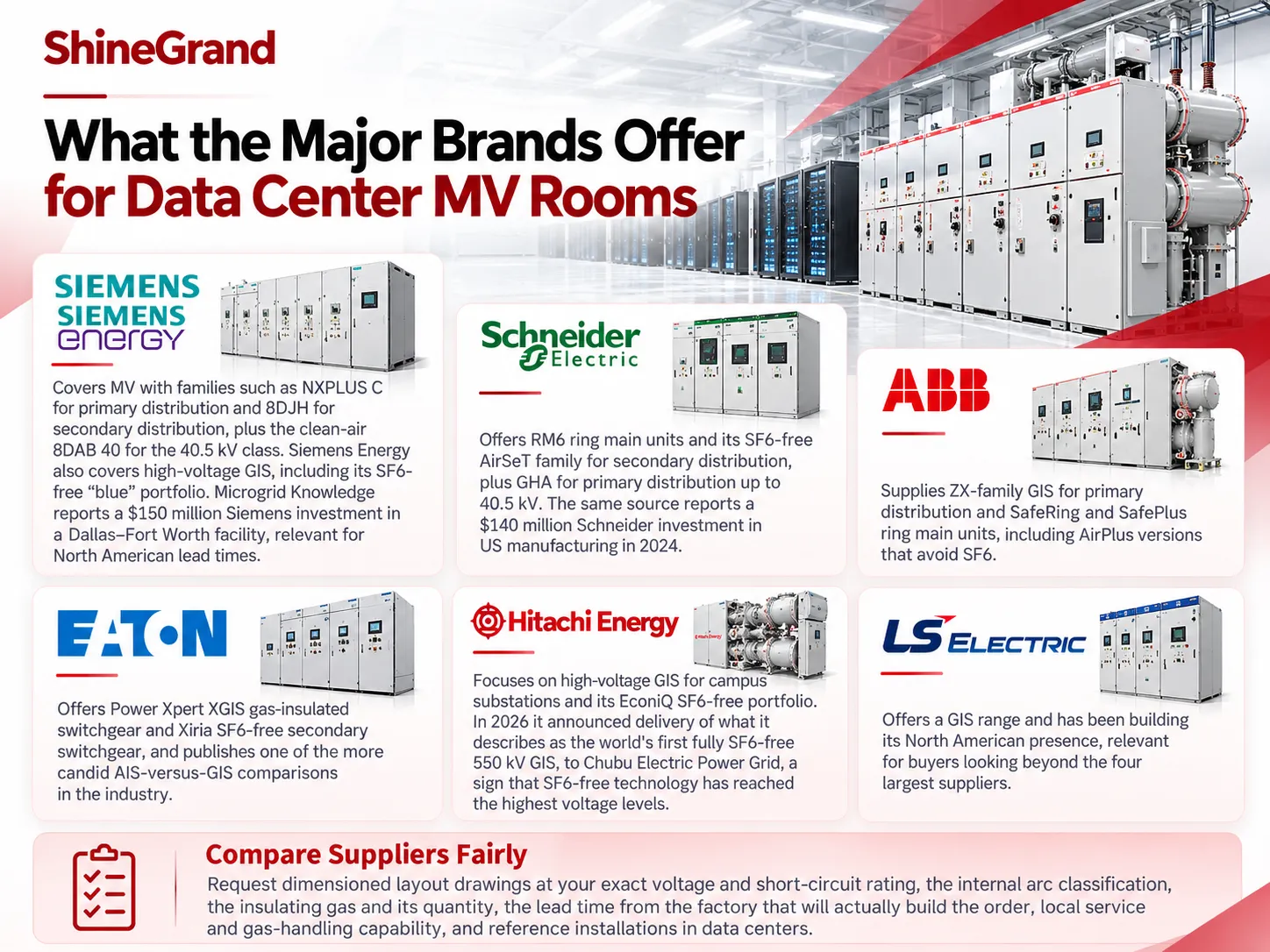
What the Major Brands Offer for Data Center MV Rooms
Instead of a ranking, here is what each major supplier brings to GIS for data centers, organized around the questions buyers are trying to answer.
- Siemens and Siemens Energy. Siemens provides products of medium voltage with series like NXPLUS C for primary distribution and 8DJH for secondary distribution, and the 8DAB 40 with clean air for the 40.5 kV class. Siemens Energy supplies products in high voltage GIS including its eco-friendly “blue” portfolio for campus substation concepts. Microgrid Knowledge states that Siemens has invested $150 million to a facility in Dallas-Fort Worth significantly influencing lead times in North America.
- Schneider Electric. Schneider sells RM6 ring main units and its AirSet family, which doesn’t use SF6 gas for secondary distribution purposes, as well as GHA to meet primary distribution needs up to voltage levels of 40.5 kV. As reported by the same source, Schneider is investing $140 million to manufacture products in the US.
- ABB. ABB supplies ZX-family GIS for primary distribution and SafeRing and SafePlus ring main units, including AirPlus versions that avoid SF6.
- Eaton. Eaton offers Power Xpert XGIS gas-insulated switchgear and Xiria SF6-free secondary switchgear, and publishes one of the more candid AIS-versus-GIS comparisons in the industry.
- Hitachi Energy. Hitachi Energy has an emphasis on high-voltage gas-insulated substation technology and the EconiQ line of products that are free of SF6. In 2026, the company revealed that it has supplied the world’s first SF6-free technology at 550 kV GIS to Chubu Electric Power Grid.
- LS Electric. LS Electric offers a GIS range and has been building its North American presence, which is relevant for buyers looking beyond the four largest suppliers.
In order to ensure a fair compare of suppliers, it is important to ask the suppliers to provide dimensioned layout drawings with the specific voltage and short-circuit ratings, internal arc classification, type and quantity of insulating gas, lead time from the manufacturing facility which will actually build the order, local support and gas handling capabilities, as well as the reference installations at data centers.
Real-World Deployment Patterns
There is scarce information released regarding the data center switchgear project information. Instead of sharing the case studies based on publications, the author has shared four common deployment patterns followed by market data.
Hyperscale campi with separate substations. Increasingly, hyperscale campuses get served on their own at 115-230 kV and build substations for their use. GIS technology allowed placing this substations in a compact facility close to the load and optimizing the space utilization and lengths of high-voltage connections.
Metro colocation where the MV room is either located in the basement or on the upper floor. In case with limited area available and the need of making the floors useful, the gas-insulated switchgear (20-35 kV) saves space within MV room.
Pre-manufactured power modules and e-houses. Compact GIS technology enables the MV lineup to fit into a container which simplifies and speeds the process of installation when the additional power needs to be provided.
More than it is true for 13.8 kV in North America where AIS technology is still used. At 15 kV and lower, compact EXT metal-clad switchgear is more familiar and affordable in comparison to GIS equipment, therefore many operators apply rational logic and continue using AIS at those voltages.
Market data supports this point of view. Microgrid Knowledge reports AIS technology being six times more employed in comparison to GIS technology despite increasing popularity of the latter technology in limited space and cases when reliability is crucial.
GIS vs AIS for Data Centers: A Decision Framework
The distinction between GIS and AIS does not depend on technology, but on tradeoffs like cost, availability of space, maintenance and risk. The situation with which technology to use can keep changing with voltage.
In case of high voltage (24 kV and higher, especially 34.5 kV and 38 kV),
GIS will usually be a better option in situations where:
– the space is scarce, there are expensive pieces of land, prime locations or real estate on which space for GIS installations is built.
– the installation will take place in an e-house, container or another small premises.
– the environment is harsh (dust, humidity, coastal or high altitude).
– the maintenance and repair should be minimal.
However, if the voltage is 15 kV and below, AIS would be a better option in the cases when:
– there is enough space.
– budget is the primary constraint.
– the repair and maintenance of the equipment will be done by the personnel of the company themselves.
– local regulations and practices prefer certain types of electrical equipment.
If need be, a quick evaluation of the cost-efficiency between the use of GIS and AIS is possible. To do so, multiply the number of square meters saved by the cost of square meters of the building space plus some money saved on maintenance and compare this value with the costs of GIS installation.
Which Voltage Is Common in Data Centers?
- North America: utility service and internal distribution commonly at 12.47, 13.2, or 13.8 kV; campus distribution increasingly at 34.5 kV; large campuses taking service at 69, 115, 138, or 230 kV.
- IEC markets: distribution at 10/11 kV, 20/22 kV, or 33/35 kV, with campus substations at 66, 110, or 132 kV.
- The trend: as campuses grow, distribution moves up to the 34.5 kV class to cut current and cable quantities, which is exactly the range where the GIS space advantage is largest.
Configuration Choices That Affect Reliability and Space
- Main differences between primary and secondary GIS. With primary distribution GIS, circuit breaker panels are used for the incoming current; secondary GIS and ring main units act as distributors to transformers of lower costs and sizes.
Arrangement of busbars. Data centers can have redundancy thanks to either employing different independent single busbar line-ups or using double-busbar GIS. The second variant allows saving space, while the first ensures physical separation.
Classification of internal arc. IAC should be determined according to IEC 62271-200 (i.e., AFLR), or arc resistance according to IEEE C37.20.7 in North America. The white paper published by Eaton emphasizes that GIS is resistant to arcing by strict design.
Standards applied. IEC 62271-200 defines MV metal enclosed switchgear for power levels below 52 kV. IEC 62271-203 is about GIS for power levels above 52 kV. IEEE C37.20.9 refers to MV switchgear with gas insulation.
Monitoring of GIS. Regulation of gas density, measure of temperature and peripheral discharge should be linked to the system of electricity monitoring.
Connections. There are standardized plug-in bushings that can help to perform connections quickly.
SF6 or SF6-Free?
Although SF6 is very effective in insulating and quenching arcs, it has been reported to contribute towards global warming more than 23,000 times that of carbon dioxide over a century. As a result of this regulation, the market is swiftly moving towards switchgear that doesn’t use SF6-based systems, starting in the EU with Regulation (EU) 2024/573. The regulation indicates that by 2026, switchgear producing electricity at a voltage lower than 24 kV must not use SF6. The breaking voltages higher than 24 kV can only rely on SF6 until 2030 when it will be banned. This Directive also includes rules about two other levels of voltage including those higher than 52 kV and above that for all voltages, up to the highest level of 145 kV and up-to 50 kA – requiring all companies to use switchgear without SF6 after 2032.
Another very important detail is that in regulations they mention not only SF6, but also the use of other fluorinated gases just like SF6. The fact that the design using any other fluorinated gas than SF6 may still be banned under the law makes it risky to use any fluorinated gas in the power plants being currently designed. Therefore, the safest solution for usage in the switchgears for medium voltage is to use gases without fluorine like clean air with vacuum breaking. Before acquiring any component including switchgear equipment, make sure that it is compliant with the already-mentioned Directive.
A Procurement Checklist for Data Center GIS
The following sequence is recommended for the development of the GIS specification for data centers:
1. Check the utility distribution voltage and short-circuit rating as per utility and system study.
2. Decide upon the redundancy design (N+1, 2N) and whether separate lineups or double bus bar is required.
3. Map out complete room layout for GIS and AIS including walkways, cable entry, and pressure release openings.
4. Include insulating medium specifications including all local regulations regarding SF6 or F-gases.
5. Include details regarding internal arc classification or arc resistant type.
6. Verify floor load-bearing capacity, ceiling heights, and cable tray/cellar requirements.
7. Request dimensioned drawings of the exact gas type being procured.
8. Compare factory lead times for building the order.
9. Verify local service and gas handling capabilities, including spare parts availability.
10. Ensure coordination of switchgear with transformer, cables, and protection into a single power chain.
Frequently Asked Questions
How much space does GIS save compared with AIS?
The result varies from what voltage and which baseline is adopted. In between 5-15 kV, the footprint of GIS and two-high North American metal-clad line-ups is comparable to that of a single-tier IEC-style AIS and results in a saving of around 35-50% of room area. Reduction claims of 27-40.5 kV often reach even 60% and even higher room savings are reported. At the level of high voltage transmission GIS substations occupy only a fraction of the land of an outdoor AIS yard.
Why is GIS used in data centers?
Gas-insulated switchgear is employed in data centers to minimize land use in buildings, to accommodate MV equipment within a modular design, and to obtain low-maintenance, sealed devices with excellent arc performance. The increase in power density and change in topology result in an upsurge in the amount of switchgear needed by each site, thus, elevating the significance of its compactness.
Is GIS better than AIS for data centers?
Not in all situations. GIS is generally preferred above 24 kV, in buildings with space constraints, and in prefabricated units. At 15 kV and below, AIS metallic switchgear tends to be less expensive, of the same dimensions, and easier to keep in good working order. The proper conclusion can be drawn after analyzing entire room layouts and total ownership costs.
What voltage GIS is commonly used in data centers?
As per North America, MV GIS is used typically in the voltage range of 34.5-38 kV; although some examples of its use at 13.8 kV exist. High-voltage GIS is used commonly at voltages ranging between 69 and 230 kV for campus substations. When it comes to the IEC markets, the voltage ranges used for MV applications are 10-11 kV, 20-22 kV, and 33-35 kV and for substations, voltages are 66-146 kV.
Does all GIS use SF6?
No. SF6 has been the conventional dielectric gas but now SF6-free GIS is offered by leading manufacturers at both medium voltage and mostly high voltage employing technologies utilizing pure air, various gas blends or solid insulations combined with vacuum switches.
What is SF6-free GIS?
SF6-free GIS refers to gas-insulated switchgear that makes use of gas other than SF6 that is clean or dry air with vacuum interrupters, or gas mixtures instead of SF6. The aim of the system is to maintain the reliability and compactness of GIS while not employing the SF6 gas that has a high potential for global warming. Some of the designs are somewhat larger than SF6 counterparts at the same MV ratings.
Which companies manufacture GIS for data centers?
Major suppliers remain Siemens and Siemens Energy as well as Schneider Electric, ABB, Eaton, Hitachi Energy and LS Electric as well as some other local producers. Suitability relies on the value of voltage required, gas type, lead time and local service availability.
Is SF6 switchgear banned in Europe?
Though the use of SF6 switchgear is not totally prohibited, any new switchgear that uses fluorinated gases will be phased out according to EU Regulation (EU) 2024/573: 2026 for MV switchgear up to 24 kV, 2030 for MV switchgear up to 52 kV, 2028 for HV switchgear up to 145 kV and 50 kA, and 2032 for higher switchgear ratings, with only limited exceptions.
References
- Regulation (EU) 2024/573 on fluorinated greenhouse gases. The EU F-gas regulation, including the switchgear phase-out schedule.
- Eaton — AIS vs GIS White Paper (WP022006EN). Footprint and cost comparison by voltage class.
- Microgrid Knowledge — The US Move Toward Gas-Insulated MV Switchgear. Market data on GIS adoption, data centers, and SF6-free trends.
- TD World — Switchgear for Data Centers. Rack density trends and data center switchgear demand.
- MarketsandMarkets — Gas Insulated Switchgear Industry and SF6-Free GIS. Market perspective on the SF6-free transition.
- IEC 62271-200 and IEC 62271-203. International standards for MV metal-enclosed switchgear and high-voltage GIS.
- IEEE C37.20.9 and IEEE C37.20.7. North American standards for gas-insulated MV switchgear and arc-resistant switchgear.
- Andeli — GIS Space Saving in Data Center MV Rooms. Additional industry perspective on GIS in data center MV rooms.
Where This Leaves Your Project
To answer honestly about the savings that GIS (gas-insulated switchgear) provides in a data center, the truthful answer is “it depends on voltage and baseline” and the teams that get the answer right look at actual layouts, have real drawings and calculate total costs. ShineGrand is a transformer manufacturing company and not a switchgear company, which is why this guide does not promote certain vendors themselves. But every GIS lineup sits in a power chain with transformers on both sides of it. Indoor MV rooms often pair GIS with fire-safe dry-type units such as the 20-35kV Epoxy Dry-Type Transformer; campus distribution uses units like the Three Phase Pad Mounted Transformer Series; and campus substations rely on high-voltage units such as the 110-132kV Oil-Immersed Distribution Transformer. If you are planning the transformers around your switchgear, explore the transformer product range or contact the ShineGrand team.