All overhead power lines are one long antenna for trouble spots. Lightning strikes nearby; a breaker opens somewhere upstream; a capacitor bank switches in; and for a few millionths of a second, the line voltage jumps by several multiples of normal. Most equipment on the distribution network cannot take it, at least not several times. That is where the surge arrester comes into play. This guide will explain clearly what a surge arrester is, its operation, its difference from a “lightning arrester,” the main types, and how to choose the right arrester for a 10 kV, 11 kV, or 17 kV distribution system without getting lost in the datasheet.
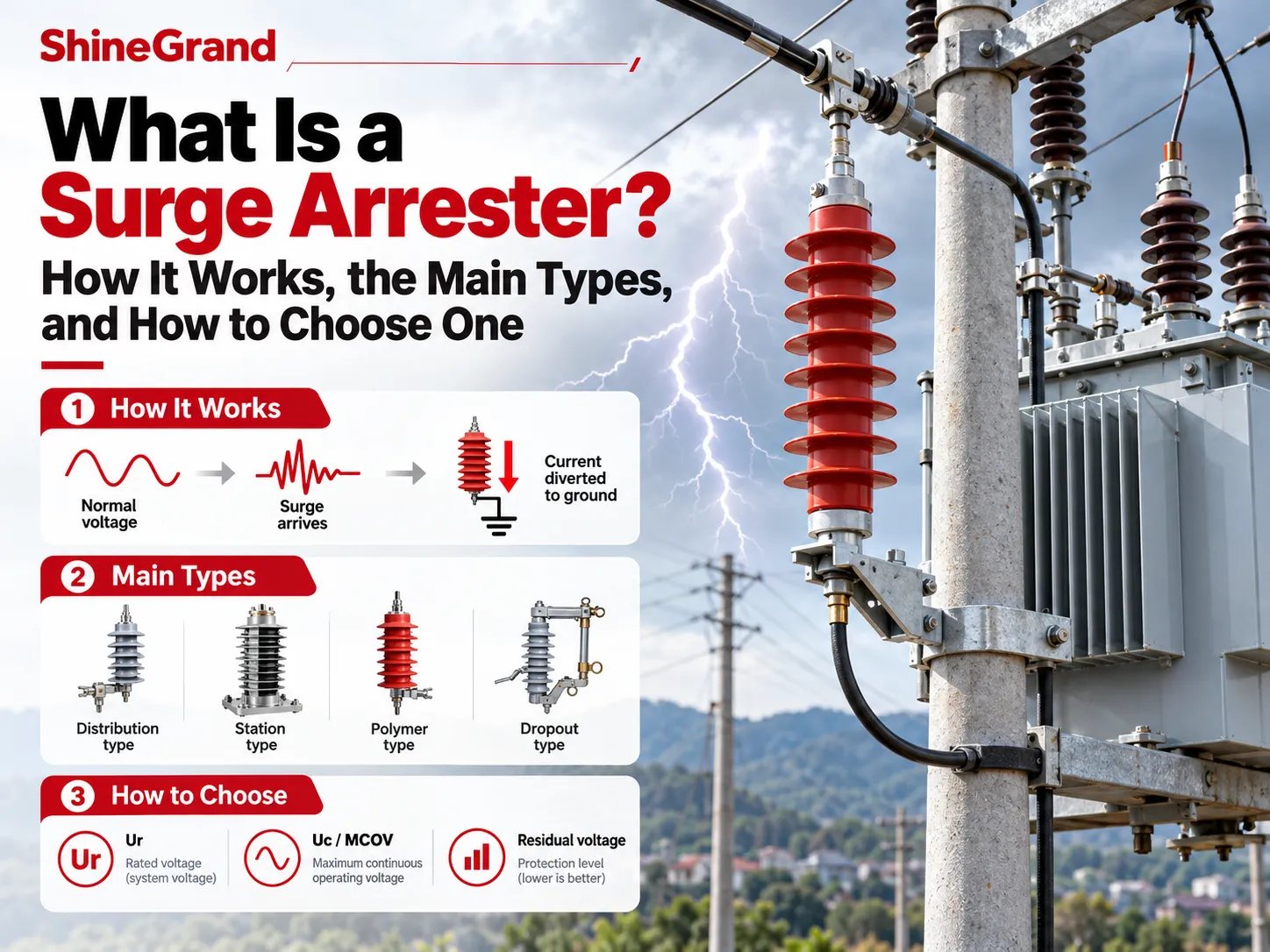
What is a surge arrester? A surge arrester is a protective device connected between a power line and ground that limits short, high-voltage spikes caused by lightning or switching operations. At normal voltage it behaves almost like an open circuit and passes only a tiny leakage current. When a surge arrives, its metal-oxide (zinc oxide) core becomes highly conductive in a fraction of a microsecond, diverts the surge current to ground and holds the voltage at a level the protected equipment can withstand. When the surge has passed, it returns to its insulating state. Surge arresters are used to protect transformers, switchgear, cables and overhead lines from 3 kV distribution systems up to the highest transmission voltages.
How Does Surge Arrester Work?
Surge arresters can be viewed as pressure releases for safe voltage. In normal working environments, they work like pressure releases. When the voltage increases to a certain level, they discharge electrical pressures.
In a surge arrester, the device consists of a set of rotating discs made out of zinc oxide. Zinc oxide has a specific unique physical property. The material has variable resistance, depending on the level of voltage in use. When the voltage increases slightly above the optimal limit, its resistance drops.
An explanation of what happens, step by step, during a lightning surge consists of the following actions:
- The surge happens in a conductor moving at the speed of light.
- As soon as the voltage level reaches the level that allows for conduction to occur in the surge arrester, the zinc oxide discs change from working as an insulator to acting as a conductor.
- While the device is in charge of conducting the surge, it will discharge the current into the ground with amperage that can be several thousands of amps.
- The surge voltage comes back to normal, and the discs go back to work having full resistance.
The older types of surge arresters were made using silicon carbide substances with the help of air gaps. However, silicon carbide blocks have high leakage and hence lose a lot of current, when there is a normal voltage level. It is mainly due to the fact that zinc oxide has low leakage also as high resistance.
Surge Arrester vs Lightning Arrester: Are They the Same?
One of the most common questions in this field, where net sources often provide contradictory answers, requires precise definitions. In the medium or high voltage power system, a lightning arrester, lightning surge arrester, and surge arrester refer to essentially the same piece of equipment: a metal-oxide arrester that is located between the line and the ground.
The difference is mostly historical. The first devices were designed only for lightning, and that is why they were called lightning arresters. Modern zinc oxide units can also manage switching surges and temporary overvoltages, and hence regulatory body started to utilize a more general name “surge arrester”. Both guidelines IEC 60099-4 and IEEE C62.11 use the term surge arrester. However, many manufacturers, utility companies, and customers keep calling it lightning arresters, and thus the market considers both names as synonyms. You will find ShineGrand’s own 17 kV lightning surge arrester is the same metal-oxide technology as the products labeled simply “surge arrester”.
The also potential sources of confusion are two truly different devices:
- Lightning rod (air terminal) is a device mounted on top of a house providing a lightning strike with a safe path towards the ground. It protects the building from direct strikes and does not limit voltage on the power line.
Surge protective device (SPD) is the low voltage equivalent of an arrester and is used in the distribution boards, PV inverters, and equipment panel working on voltage below 1000 V. SPDs have different standards (IEC 61643 series, UL 1449) and cannot be confused with medium voltage arresters.
Typical protection scheme would use all these three devices: lightning rod on the top of the building, lightning arrester on medium voltage side of the transformer and SPDs on low voltage side.
What Causes Surges to Occur?
It is important to understand the cause of surges because this will provide insight into ratings.
Lightning surges are both the fastest and highest type of surge. When lighting strikes, it produces a surge lasting a microsecond that can produce hundreds of kilovolts of pressure in an unprotected line.
Switching surges are produced by the electric grid itself. When a long line or a cable is energized, capacitor banks are switched, or some other operation occurs, it could create a surge. Although switching surges take longer, they are still more powerful over time.
Temporary over-voltages are not actually surges, but are instances when a voltage remains for a few seconds or longer. In case a phase short-circuits, a voltage surge is produced in the healthy phases without any possibility of being stopped or regulated.
The Main Types of Surge Arresters
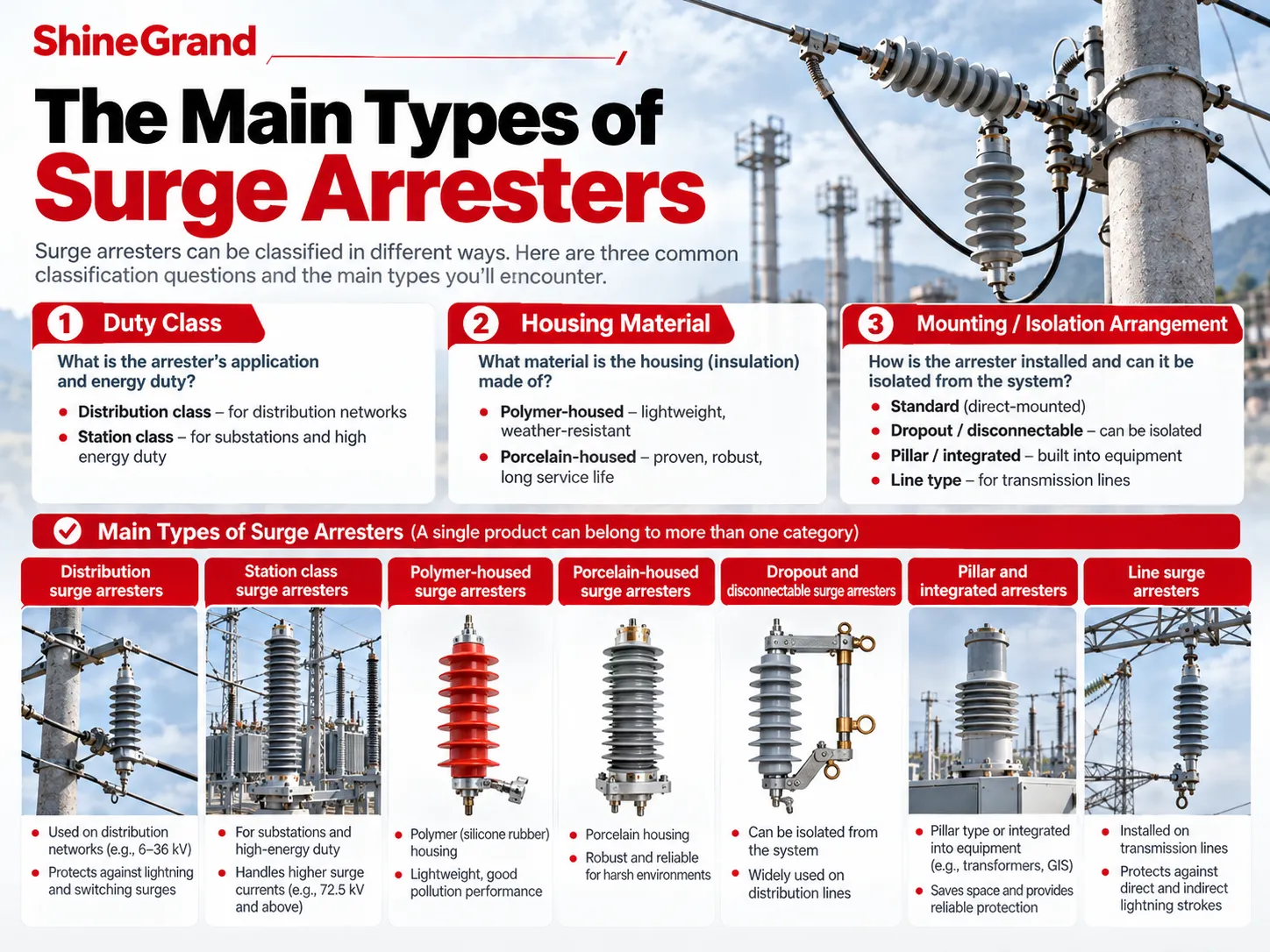
List of catalogs contains various kinds of surge arresters. However, these designations are not the same type of classification which sometimes causes problems for buyers trying to get confused when comparing the things they should not be compared. There are actually three different questions that arise:
- What kind of duty is it? The distribution class or station class describe how much energy and current the arrester was designed to handle.
What is the outer casing made of? The list of polymers or porcelain describes the outer covering of the arrester.
How it is fixed or isolated? Dropout, disconnect, pillar lines surge arresters indicate the mechanical configuration.
That is why one product can be a bunch of things at once: a distribution class polymer casing dropout surge arrester. With this in mind let us focus on the types of surge arresters you will encounter.
Distribution Surge Arresters
Distribution class surge arresters are the most common type of surge arresters in the world. They are installed on poles, transformer tanks, at the cable ends, and in pad mounted equipment. They are rarely used in electrical systems of less than 3 kV or more than 36 kV and have nominal discharge currents of either 5 or 10 kA in IEC terminology. The international system IEEE puts these arresters in heavy duty, medium and light duty types according to install conditions. They are compact, cost-effective, relatively cheap to produce and have found their broad application in practice.They have superior power and discharge current ratings (normally 10 kA or 20 kA nominal according to IEC), good pressure relief characteristics and more strict protection levels. According to the current edition of IEC 60099-4, surge arresters are divided into station class (SH, SM, SL) and distribution class (DH, DM, DL) where letters H, M, L refer to the duty type (high, medium and low respectively). ShineGrand’s station surge arrester range covers this substation category.
Polymer-housed surge arresters
Polymer surge arresters have their zinc oxide blocks sealed in silicone rubber body which is molded directly on the core or on a fiberglass support. Purely practical aspects make it the distribution standard:
– Low weight usually being of a fraction of that of porcelain making pole installation easier and cheaper.
– Failure is safer – if an arrester fails in a heavy fault situation then polymer body will split and vent instead of shattering into dangerous pieces.
– Very good pollution performance since silicone rubber is hydrophobic meaning no water film is forming during rain and thus no leakage or flashover takes place due to contaminants like dust and salt (industrial pollution included);
– Well-made designs do not have any internal air space thus moisture ingress problem is excluded which registered many failures for traditional arresters.
– Resistance to any blows and damages while in transportation mode.
The YH5W-10 10 kV polymer surge arrester is a typical example of this construction for 10 kV distribution networks.
Porcelain-housed surge arresters
The porcelain housing has been used for many years and though there are different types of housing materials available at present porcelain is still in use even for some types of high voltage station arresters. It has an extensive operational history and proves to be excellent in terms of mechanical strength for high columns of arresters. Its disadvantages are high mass, fragility and risk of sudden failure which is why almost all new power distribution systems use polymer.
Dropout and disconnectable surge arresters
Distribution arresters feature a small device called a grounding lead disconnect device located at the bottom terminals of the devices. If the arrester stops functioning properly the disconnect device will disconnect the grounding lead which makes it unnecessary for the faulty device to keep the line overloaded and gives a visible signal for the crews working on the line that the arrester must be replaced.
The disconnectable arrester is even more advanced since the arrester itself is mounted in a hinged cutout base allowing its replacement with a hot stick likewise a dropout fuse cutout. In other words, line arresters can be easily checked or replaced while any operation is performed. ShineGrand’s HY5WS-17/50DL dropout surge arrester is built for this kind of 10 kV distribution use. Designs vary between manufacturers, so check the mounting and operating method on the specific product.
Pillar and integrated arresters
There are some arresters that perform the function of insulators and supporting structures at the same time which brings about advantage of saving space in confined areas. For instance, a 17 kV pillar surge arrester is an example of such multifunctional design.
Line surge arresters
Line surge arresters are used for protecting transmission and sub-transmission lines, as a rule, they are placed above insulator strings of transmission towers in order to save the line from flashover and outage due to lightning. There are two types of such arresters – gapless and ones with external series gaps which comply with the requirements of IEC 60099-8 standards.
Understanding a Surge Arrester Nameplate
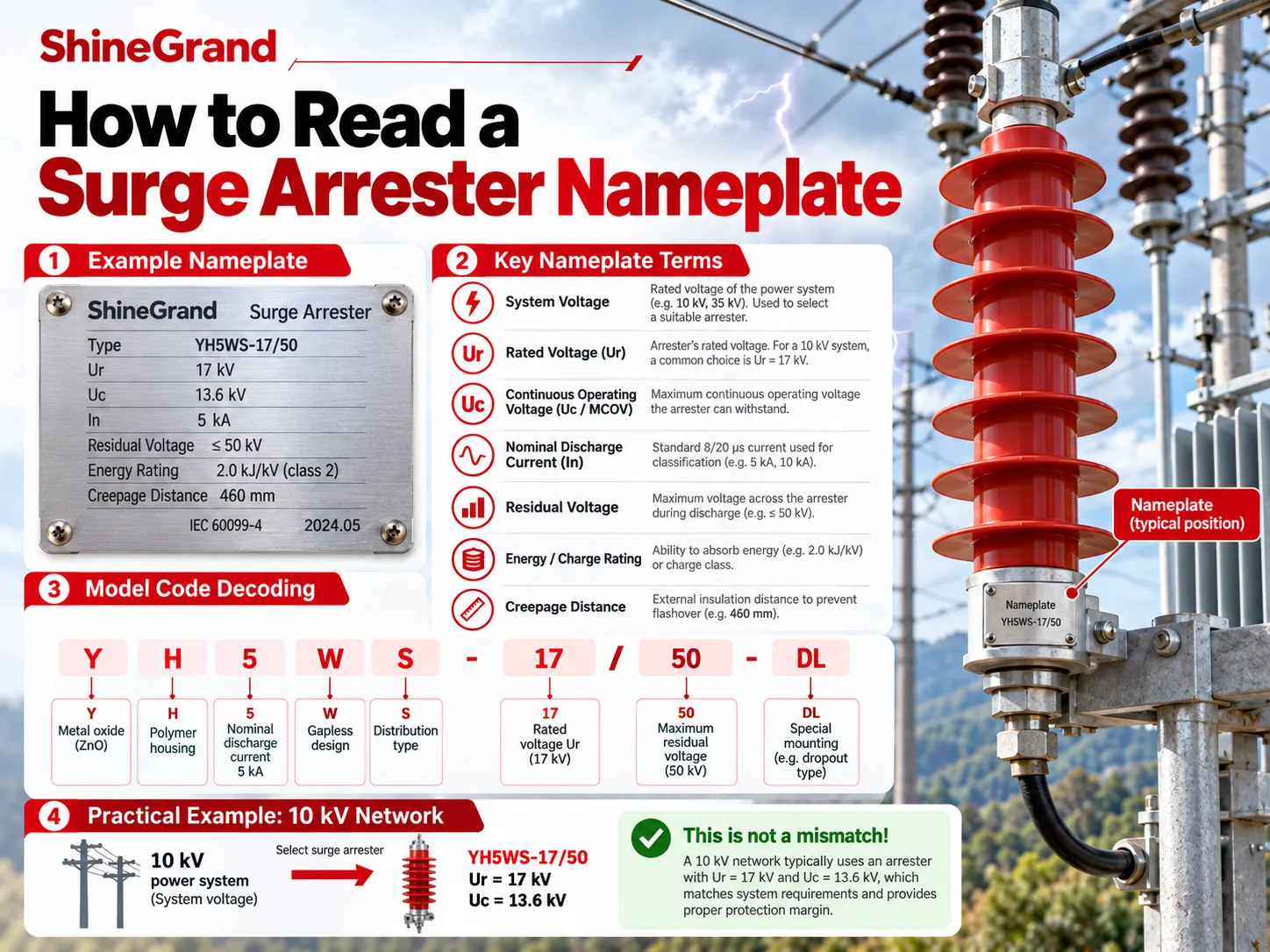
A nameplate on an arrester can appear complicated with all of the different voltages listed. Here are three common electrifying voltages contained in datasheets: system voltage, rated voltage and continuous operating voltage. Some people get confused by these three specifications because they are not the same and mixing them up can lead to an error in specification.
The term system voltage means the nominal voltage of the system and is expressed in kV such as 10 kV or 11 kV. It tells about the system but has nothing to do with the arrester.
Rated voltage (Ur) is explained by IEC 60099-4 and represents the maximum voltage that the arrester can maintain after absorbing energy for 10 seconds. The figure tells about an arrester ability to tackle overvoltages. An equivalent term used in IEEE terminology is called duty-cycle voltage rating.
The continuous operating voltage (Uc or MCOV in IEEE) is used to refer to the maximum voltage that can constantly pass through an arrester. This is the only figure that can be used to do the business every hour.
Nominal discharge current (In) is the lightning current used to specify an arrester.
Residual voltage is the voltage supplied to an arrester during its operation.
Energy or charge rating tells about the amount of energy that the arrester may accept.
Creepage distance is the housing length along the surface that shows the quality of an arrester operation in polluted conditions.
For better understanding consider the real-life example. The YH5WS-17/50 arrester by ShineGrand is called to be used for 10 kV systems and has rated voltage Ur = 17 kV and Uc = 13.6 kV. Here we see that one should not mix the two numbers and when a foot fault occurs, the arrester can pass along a very high but still safe voltage even though the grid voltage is that high.
The name plate itself is written in accordance with the common Chinese policy, that is why a minimal knowledge in the nomenclature allows the customers to understand it immediately.
Y indicates that zinc oxide has been used.
H indicates that the arrester has polymer coating.
5 shows that the nominal discharge current is equal to 5 kA.
W indicates that it is a gapless arrester.
S shows that it is a distribution type of arrester. The other letters are Z, meaning, that the device is for station application and R indicating protection of capacitors.
17 indicates the rated voltage of Ur in kV.
50 indicates the residual voltage that has been produced during the operation of an arrester.
The extra letters stand for the type of attachement of the device.
Surge Arrester Selection: Why MCOV Matters More Than the Nameplate Voltage
Remember this idea from the guide: you do not choose an arrester from its rated voltage to the system voltage. You ensure that its continuous operating voltage (Uc or MCOV) and temporary overvoltage strength fit the way the system is grounded, and then you check that its residual voltage gives enough protection margin for the equipment. So primary application considerations oriented manufacturers’ choosing guidelines based on MCOV, system grounding, energy capability and protective level.
That is how it works in reality presented in five easy steps.
- Steady-state system voltage. What is the maximum voltage of the power-line system, not the nominal one? An 11 kV network generally has a 12 kV maximum system voltage; likewise, this applies to a 10 kV network.
- Determine the manner in which the power system is grounded. Under solidly or effectively grounded conditions, a ground fault on one phase raises the healthy phases only modestly and only for a brief time until the ground fault clears. Grounded or resonant-grounded systems sustain voltage across the non-faulted phases up to nearly line-to-line voltage and remain there for a long period.
- Set the continuous operating voltage. A line-to-line voltage of Uc must on a system grounded effectively exceed a certain margin of the maximum phase-to-ground voltage. On the other hand, if an ungrounded or resonant-grounded system has long fault durations, it is necessary for Uc to be at least as great as the maximum line-to-line voltage. This is why a 10 kV ungrounded network uses an arrester rated Ur 17 kV/Uc 13.6 kV, while an effectively grounded network at a similar voltage can be rated far lower.
- Check against the temporary overvoltage curve. Compare the expected TOV level and duration against the manufacturer’s TOV withstand curve. If the arrester cannot withstand the TOV, it will fail from overheating, regardless of its good performance against lightning.
- Check the protection margin. Measure the residual voltage left by the arrester with respect to the level of insulation (BIL) of the conductor.
There is a trade-off hidden in these five steps. The high-rated surge arrester provides better security against TOVs than a low-rated one, and thus the residual voltage is higher; so protection is less tight. Good selection means picking the lowest rating that still will survive the TOV conditions of the system, not just the highest rating available.
Choosing a surge arrester for an 11 kV or 10 kV system
Since the networks of 11 kV and 10 kV can be extremely popular, below is how the universal prescriptions usually work. Always compare with the real study of the system and the data from the producers.
On the effectively-earthed 11-kV networks with quick disappearance of ground faults, the arrester used should have Uc parameters equal to around 7-9 kV.
For 10-kV and 11-kV networks without earthing or with resonant earthing, the value of Uc is usually taken to be about 12-13.6 kV, which means using arresters with nominal values approximately equal to 15-17 kV.In the coastal, desert or industrial areas, please, use the polymer enclosure with the increased creepage losses, for instance, ShineGrand’s 11 kV anti-pollution surge arrester with the creepage distance of 372 mm.
- If there are a lot of lightnings or long overhead line feeding transformers, it is better to use the 10 kA rather than the 5 kA nominal discharge current.
Surge Arrester for Transformer Protection
The primary purpose of the majority of distribution surge arresters is transformer protection since transformers are one of the most costly components in the line and are one of the slowest parts to replace. A surge arrester for a distribution transformer can perform its function properly only if two conditions are satisfied: the protection level of the arrester is securely below the insulation level of the transformer and the arrester is located at sufficient short distance for its protection to reach the windings.
Understanding insulation coordination
Every transformer has its basic impulse insulation level (BIL), which is the impulse voltage its insulation can withstand. A distribution transformer of a working voltage of 12 kV has a BIL of 75 kV and a transformer of 15 kV usually has a BIL of 95 kV. In simple terms, insulation coordination means that there is no surge voltage applied to the transformers higher than the BIL.
Examples may help to understand better this principle. For instance, an arrester having current limiting voltage of around 45-50 kV would leave a good margin for transformers with 75 kV and 95 kV BIL, respectively. The industry guides such as IEEE C62.22 suggest having 20% margin for lightning protection, but in practice, designers consider much more margin to be safe.
Why is the distance important?
Surge phenomena develop so quickly that even a short length of connection wire creates a significant voltage drop. The longer the connection length, the voltage drop is proven to be even more significant. Following the above, we can derive some practical recommendations.
It is necessary to mount the arrester as close to the transformer bushing as possible, preferably on the transformer tank or to the same crossarm.
It is recommended to keep the connection path short and straight, avoiding loops and sharp bends.
It is recommended to make a common, low-resistance grounding one while connecting the arrester ground and transformer tank with the neutral or system ground.
It is preferable to mount the arrester on the line side of the fuse cutout whenever possible to avoid blowing fuses. Since every utility has its own practices, it is better to consult with specialists on the matter.
Where Surge Arresters Are Used
The same basic concept may be met in utterly different areas. Overhead distribution line arrestors: arrestors at the transformer site, but also at the power cable risers and on distribution class polymer devices.
Pole-mounted transformers: there is one on each of the phases of the high voltage line, either on the tank or on the cross arm next to the bushings.
Riser poles: these have arrestors on either riser pole or non-cable riser where the voltage may double when entering an underground cable.
Substation: at the terminals of the substation and on incoming lines there are specific substation arrestors.
Solar/wind farms: there should also be arrestors on the medium voltage collector line and for the step-up transformer.
Environmental conditions: in this case, polymeric arrestors extended creepage rating.
Industrial plants: arrestors protecting rotating machines, generators, and dry-type transformers.
Leading Surge Arrester Manufacturers
A handful of manufacturers lead the way in arrester innovation and development and offer great guides on how to select suitable devices. These resources can help you learn how to train yourself in this industry or to create specifications.
- Siemens Energy offers medium voltage arresters such as the 3EK distribution family and the 3EJ high-energy family, along with high voltage station arresters such as the 3EL and 3EQ series used in substations and on transmission lines.
- Eaton, through its Cooper Power series, supplies UltraSIL polymer-housed distribution arresters up to 36 kV and a separate station class range. Its literature is a good reference on MCOV, TOV and housing choices.
- Hubbell Power Systems (CHANCE / Ohio Brass) makes normal duty, heavy duty, riser pole and under-oil distribution arresters plus substation and line arresters, with detailed application guides covering grounding and energy selection.
- GE Vernova produces TRANQUELL polymer and porcelain arresters for distribution and station applications, with application guidance that covers both IEEE and IEC classifications.
This narrow list of global brands is widely used by customers in the role of reference designs, while in reality, zinc oxide technology and IEC and IEEE standards are also used by other companies. This is an acceptable approach for many projects, especially in the rest of the world when customers should go for reliable products offered by manufacturers that produce devices for the same technology at lower prices.
Industry Trends Worth Knowing
A number of recent changes are influencing how utilities look for arresters these days:
Polymer has taken the place of porcelain in distribution while gapless designs using zinc oxide have become prevalent.
Purchasers are beginning to require arresters as part of insulation coordination for their expensive devices instead of just providing protection against lightning.
Grid advancement, network extension and association of solar energy sources have increased the quantity of new medium voltage connection points, thus resulting in the need for surge protection to be provided to all of them.
As it has been indicated by Grand View Research and other market research firms, this fact is considered to be one of the drivers of growth for the arrester market.
It is also required to switch to the newer classification IEC 60099-4 (SH/SM/SL, DH/DM/DL) and charge-based ratings meaning that it is sometimes necessary to rework previous specifications.
ShineGrand Surge Arrester Range
ShineGrand Electric manufactures metal oxide surge arresters for medium voltage distribution and substation applications, and builds the transformers, fuse cutouts and disconnect switches that usually sit alongside them. The current arrester range includes:
- YH5W-10 polymer surge arrester for standard 10 kV distribution networks.
- YH5WS-17/50 17 kV lightning surge arrester, Ur 17 kV, Uc 13.6 kV, silicone rubber housing, for 10 kV class overhead lines.
- 11 kV anti-pollution surge arrester with extended creepage for polluted, humid and coastal sites.
- Station surge arrester for substation equipment protection.
- HY5WS-17/50DL dropout surge arrester for distribution lines where easy removal and replacement matter.
- 17 kV pillar surge arrester combining arrester and support functions.
For a complete pole-top or substation package, arresters can be supplied together with pole-mounted transformers, drop-out fuse cutouts and disconnect switches. Browse the full surge arrester range to compare models.
Frequently Asked Questions
What is a surge arrester?
A surge arrester is a device that links a power line and the ground. Its purpose is to protect electrical equipment against high voltage impulses, which appears either from lightning strikes or switching on the electrical network. It has a core made of zinc oxide that serves as an insulator at nominal voltage. When the voltage spike occurs, the core becomes a conductor, thus allowing the electrical surge to flow directly to the ground while limiting the voltage. After that, the device resumes its normal operation automatically.
What is the difference between a surge arrester and a lightning arrester?
There is generally no real difference in medium and high-voltage power systems. “Lightning arresters” is the original name from the time the devices were developed mostly for lightning action; now we use the term “surge arresters,” the name used since metal oxide devices can also deal with switching surges. However, the terms refer to one and the same metal-oxide device. Neither of these devices refers to a lightning rod placed on a roof or a low-voltage surge protective device situated in a distribution board.
How does a polymer surge arrester work?
A polymer surge arrester operates in the same way as a metal-oxide surge arrester. The major distinction between the two is manifested in their housing. While in metal-oxide surge arresters, metal oxide blocks are encased in porcelain, in polymer surge arresters they are sealed in silicone rubber. Hence, polymer surge arresters are lighter, safer in case of failure, more resistant to dirt, and impermeable to moisture penetration.
What is the difference between distribution and station class surge arresters?
Arresters of the distribution class are used for distribution lines and pole transformers; they are small and cost-effective and can cope with moderate surge energy. Station class arresters are used for substation equipment and can manage higher discharge currents and energy absorptions, and they are also better in terms of pressure relief and ability to protect equipment from surges. The station design is more expensive, and it is normally used in the cases when the equipment protected is more valuable or the surges are stronger.
How do you select a surge arrester for an 11kV system?
Begin with determining the peak operating voltage, which can be 12 kV for a system operating on 11kV. There is usually a use of a lightning arrester with a rated voltage capacity of about 7 to 9 kV on an effectively grounded system. However, in cases of ungrounded or resonant grounded systems that suffer from the prolonged effect of ground faults, the rated voltage capacity of a lightning arrestor has to be above 12 kV (in most situations, ranging between 15 and 17 kV). Finally, it is advisable to check the strength against the temporary overvoltage, energy rating, creepage on-site, and margin against the equipment BIL rating.
What does MCOV mean on a surge arrester?
MCOV is expressed in maximum continuous operational voltage. The maximum supplied power is defined above which the apparatus continues to function without heating up or deteriorating. In IEC standards, this is denoted as Uc. The MCOV should be greater than the greatest voltage expected to emerge on the line during operation taking into account the effect of the grounding technique being used.
Where should a surge arrester be installed on a transformer?
The ground must be connected as closely as possible to the transformer high-voltage bushings, preferably on the tank or on the same crossarm, through the shortest and straightest leads possible. The ground of the arrester should be directly connected to the tank and system ground of the transformer. Long leads in the system increase the inductance and can cause problems in terms of protection of the transformer.
How long does a surge arrester last?
A high-quality metal oxide varistor that has been correctly rated for its network can have a long life; in fact, many are expected to last for about 25 to 30 years or even longer. Their life is limited by many instances of excessive surges, continuous application of excess voltage, moisture infiltration, and pollution. The operation of a disconnector, damage to its casing or large leakage current when measured serve as the signs of metal oxide varistor replacement.
References
- IEC 60099-4 — Surge arresters, Part 4: Metal-oxide surge arresters without gaps for a.c. systems. Defines Ur, Uc, discharge classes and test requirements.
- IEC 60099-5 — Surge arresters, Part 5: Selection and application recommendations. Guidance on choosing arresters for different systems.
- IEEE C62.11 — Standard for Metal-Oxide Surge Arresters for AC Power Circuits. North American arrester ratings and tests, including MCOV.
- IEEE C62.22 — Guide for the Application of Metal-Oxide Surge Arresters for AC Systems. Insulation coordination and protective margins.
- Electrical Engineering Portal (EEP). Technical articles on surge arrester selection and installation.
- Wikipedia — Surge arrester. General background on arrester history and technology.
Protect Your Transformers Before the Next Storm Season
An arrester is the least expensive piece of equipment you will install on a distribution line and the most useful. Proper selection of an arrester requires asking a number of straightforward questions about your system: its peak voltage, grounding attributes, exposure to environmental conditions and equipment to be protected. Provide this information to the engineers at ShineGrand and they will help you choose the right type of arresters and select suitable transformers, fuse cutouts and switches. Contact ShineGrand for a quotation or technical advice.