One December night in Minnesota’s suburbs, a crack rang out through a residential neighborhood – then another loud noise came from the transformer on a pole at the end of the street just shortly thereafter, followed by darkness, 16 Houses lost power in less than a minute! Almost immediately after, both groups of homeowners (who were now in complete darkness) had two questions to ask – “How long is this going to last?” and “How long does it take to replace the power supply?” A utility company arrived within three and a half hours (to assess the situation, install a new transformer, and restore power). However, that time varies dependent on several different reasons that all homeowners/property managers should know.
The Silent Workhorse Outside Your Home
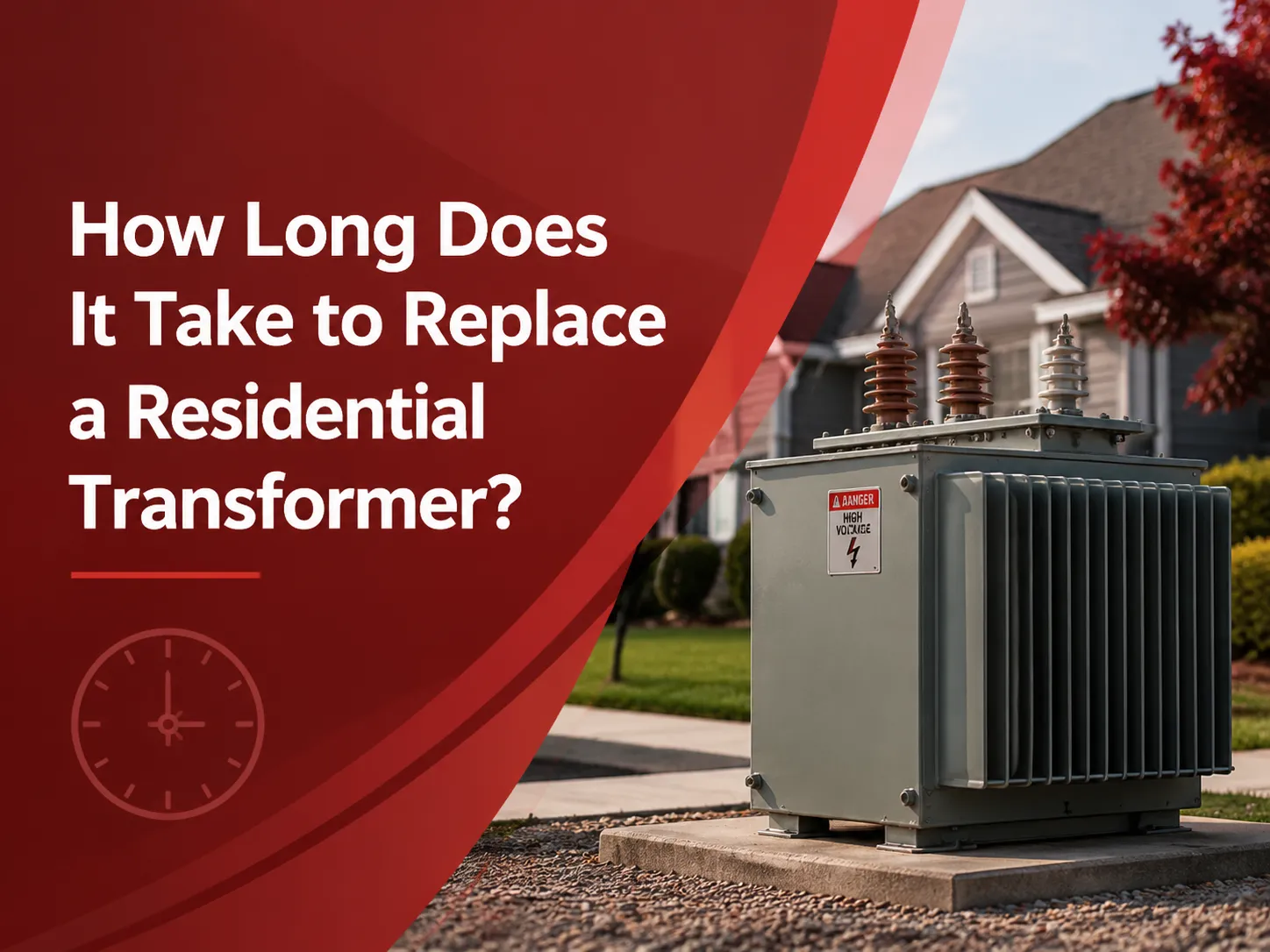
On a utility pole, a residential transformer is the gray cylinder, or if it’s a green metal box on a concrete pad in your yard, it is the residential transformer. A residential transformer converts medium-voltage power that travels down the distribution lines (typically 7,200-14,400 volts) into 120/240-volt split-phase power that can safely supply power to your home’s service panel. If there were no transformers and therefore no way to step down the voltage, all of the appliances and lights in your home would be destroyed from voltage levels that are roughly sixty times greater than what your appliances and lights are capable of handling. While these transformers are typically very reliable and will run for decades without the need for any type of maintenance, upon burnout, which can be caused by lightning strikes, overloads, internal insulation breakdown, incidental physical damage, or other means, all of the homes served by that transformer experience an immediate and total loss of power. For a deeper look at how these units compare to their larger commercial cousins, our overview of transformer sizing and the 80% loading rule provides context on how any transformer, residential or otherwise, should be loaded to maximize its service life.
The Replacement Process: Step by Step, Hour by Hour
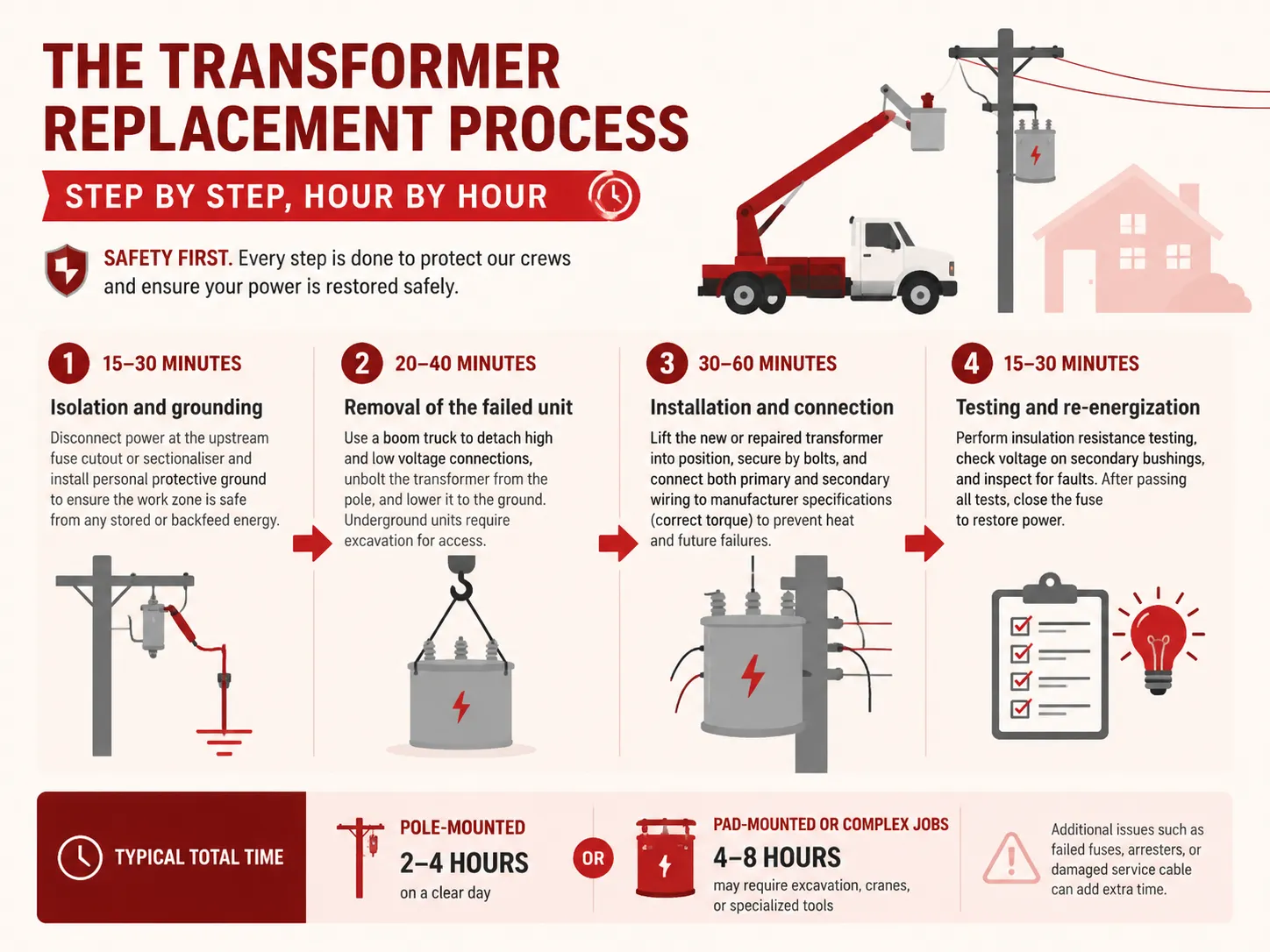
A utility crew has a very specific order to changing out the transformer on a residential property every time they come out to do it. Safety is the first priority for them, but here is the normal order of operations along with the approximate amount of time it will take to complete each step.
- Isolation and grounding (15–30 minutes): The team will disconnect off the current connected through the upstream fuse cutout or sectionaliser which will remove the circuit from service and install personal protective ground that protects from any charged energy stored in the circuit until the crew can do the work in the work zone. This process must be done in order to ensure there is not an accidental feed back into the work zone from the existing installation and for crews not just to exchange the equipment or boxes the moment they arrive on site.
- Removal of the failed unit (20–40 minutes): A crew uses a boom truck to detach both the high voltage and low voltage from the overhead transformer, unbolt it from the pole and lower it to the ground. An underground pad mounted transformer will need to have a yard excavated for access and the time it takes to do this will delay the removal of the underground transformer.
- Installation and connection (30–60 minutes): The new or repaired transformer will be lifted into position, secured by bolts, and electrically connected (via both the primary and secondary) using the manufacturer’s specifications for torque on any electrical connections. If not done properly, electrical connections may generate heat and fail again, leading to another failure of the transformer or other pieces of equipment.
- Testing and re-energization (15–30 minutes): The crew performs insulation resistance testing, checks for voltage at the transformer’s secondary bushings, and checks for obvious faults on the secondary side prior to closing the fuse. After passing all tests, power can be restored by closing the fuse.
Typically the time it takes for crews to replace a pole-mounted or pad-mounted device and restore power will range from 2 to 4 hours for pole-mounted devices on a clear day and/or 4 to 8 hours for pad-mounted devices or pole-mounted devices that require cranes or other specialized tools, whether the replacement is already on the truck or not. If there are any additional failures, such as broken fuses cutouts, broken arresters, or damaged secondary service cable, then time can also be increased due to the need for additional repair work.
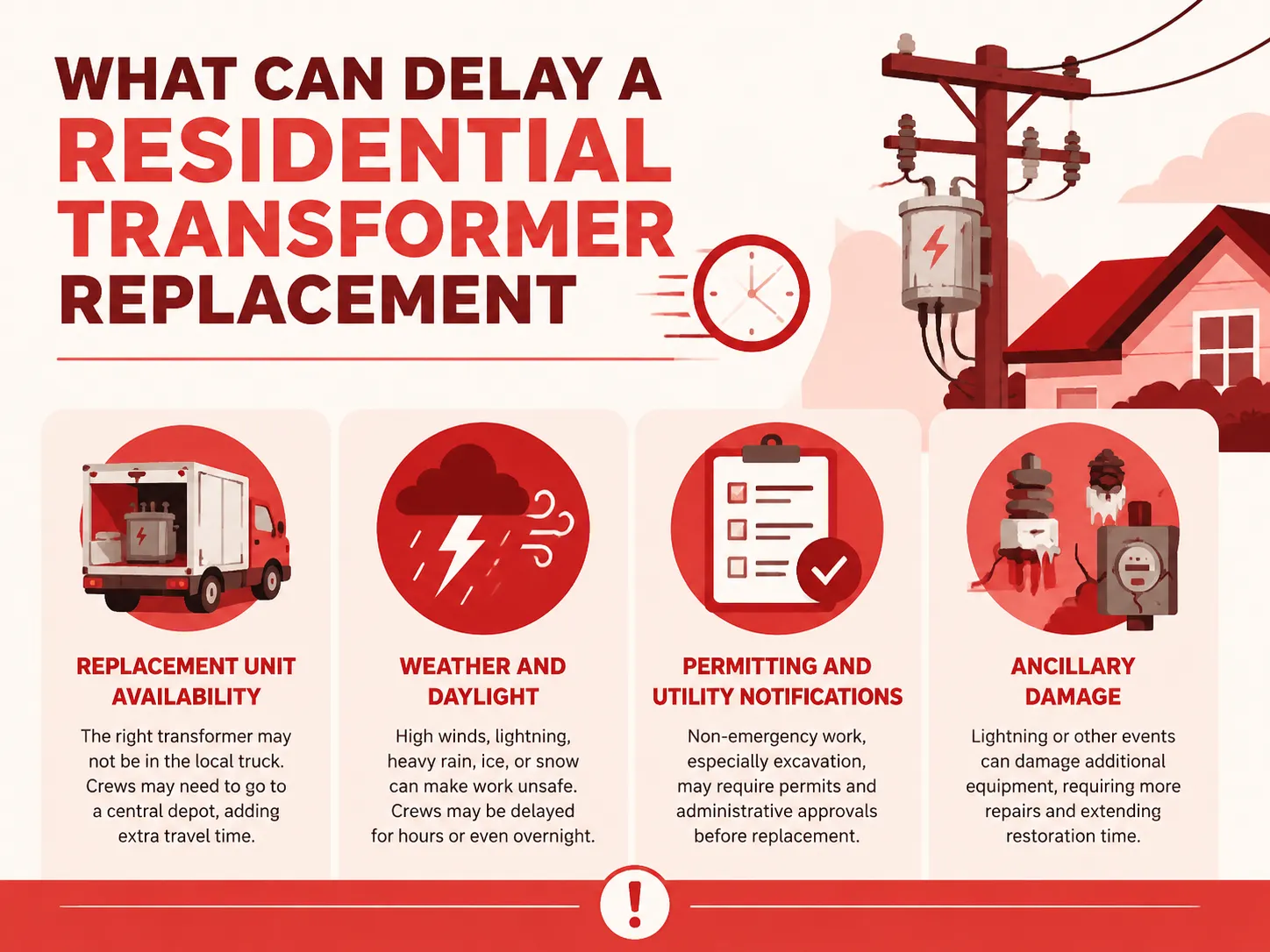
What Can Delay a Residential Transformer Replacement
Several real-world variables can push the timeline far beyond the baseline:
- Replacement unit availability: Utility warehouses and service trucks contain standard residential transformers. Some neighborhoods have a different kVA rating or specific voltage configuration than what is typically in stock. In this case, the crew will have to go to the central depot to get the transformer, which could take an extra hour or so in addition to the time spent driving to the neighborhood.
- Weather and daylight: When it comes to wind, bucket trucks are not able to operate safely at over 35 miles per hour or during any lightning storm. Heavy rain, ice or a significant amount of snow will prolong the amount of time necessary to make all the steps associated with reaching a pole or making watertight connections. For example, if a storm occurs, there could be one crew available that must first restore the greatest number of customers. Unfortunately for the small housing outage, they will most likely, have to wait a number of hours or even overnight for their power.
- Permitting and utility notifications: If a closed pad-mounted enclosure or cable system requires excavation, a street-opening permit may need to be obtained from the local municipality. Emergency repairs usually do not require this permit; however, replacement of non-emergency equipment may be subject to administrative approval prior to replacement being permitted.
- Ancillary damage: An electrical transformer can be damaged or destroyed by a lightning strike, as well as indirectly damaged by other nearby electrical equipment. In this case, the lightning strike damaged not just the electrical transformer but also caused the fuse holder to melt, the nearby insulator to crack and the meter socket on the side of the house to be damaged. It may take only a short time to replace the transformer, however, it could take up to a full 24 hour day to identify all of the secondary electrical damages and repair them.
Costs and Responsibility: Who Pays for the New Transformer?
Typically, a utility company is responsible for the installation and ongoing upkeep of a transformer that serves a residential customer’s home. As a homeowner, you will not receive a monthly bill for this transformer; all costs associated with the transformer will be included in your standard monthly electric rate. For example, utility companies pay between $800-$3000 (depending on the kVA rating and whether the windings are made from copper or aluminum) just for the unit itself; they incur similar costs for labor and equipment. A transformer can be purchased for $1500-$5000 (depending on the kVA rating and how it is configured). The only situation where homeowners could potentially pay for their own residential transformer is if they have their transformer located beyond the utility’s point of demarcation, which is most frequently seen along rural properties with a long private service. In these cases, the utility company must clearly define ownership and maintenance responsibilities in its service agreement with the homeowner.
The Different Shapes of Residential Transformers
In residential settings, you will come across two styles of transformer that are recognized by their installation options. One style, the pole mount transformer, generally has a capacity to serve up to 12 homes depending on the size of the transformer (10 kVA — 167 kVA) and is made with porcelain insulators (or bushings) and is filled with oil; cooled naturally by oil and air (ONAN). The pad mount transformer, which usually has a capacity between 25 kVA — 500 kVA, is an enclosed unit that sits on top of concrete pads and is generally used in subdivisions where the underground distribution system (from the point of supplying) is preferred due to its aesthetics or reliability than having above-ground distribution. Generally speaking, both types of transformers are single-phase, although smaller apartment buildings or clusters of townhouses may have a three-phase pad mount transformer feeding them. Both of these residential transformers have an estimated lifespan of 25-30 years; most of them exceed that timeframe for up to 40 years or longer if operated within their thermal limits and protected from moisture intrusion or ingress.
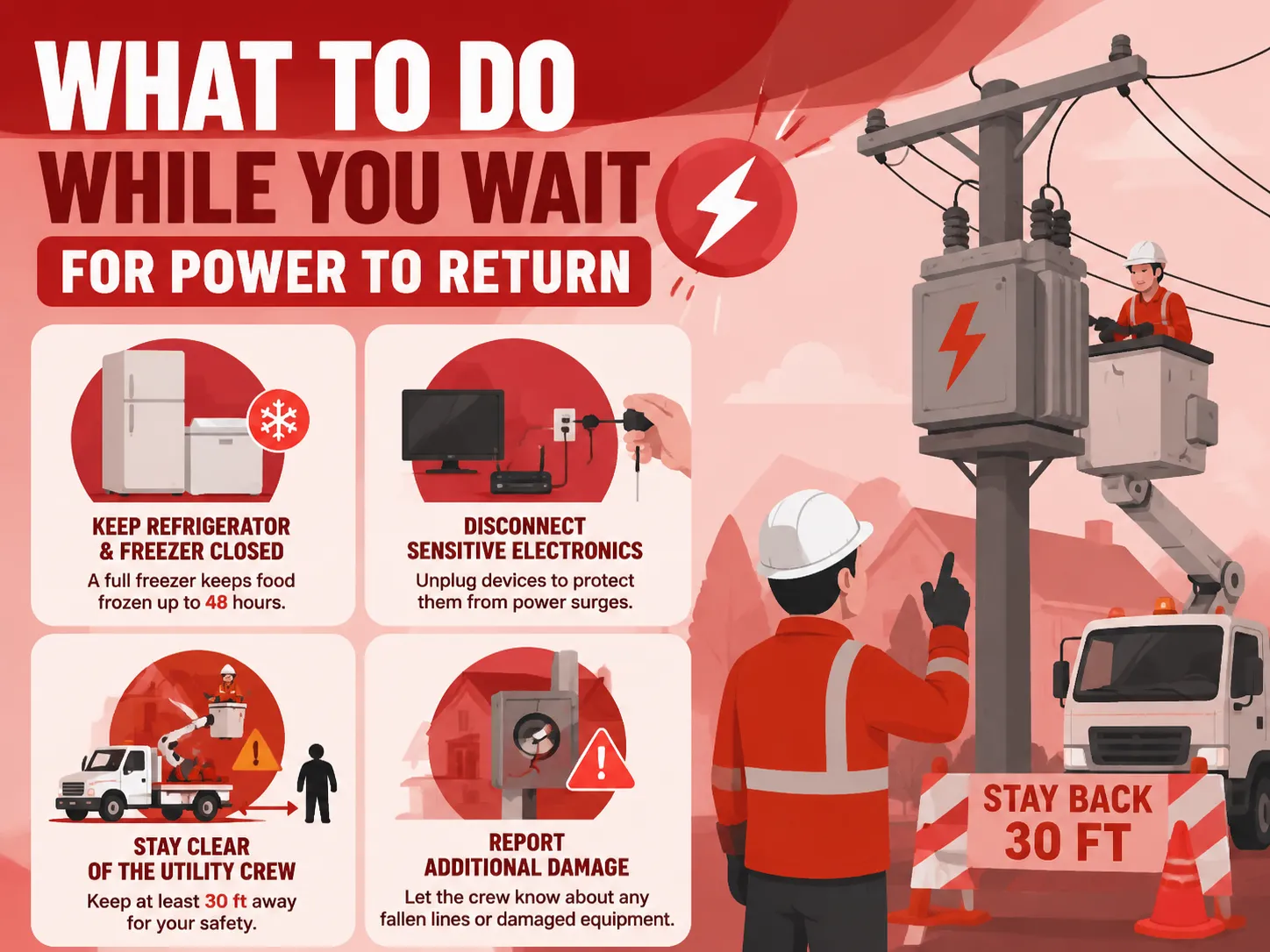
What to Do While You Wait for Power to Return
The utility will be notified of an outage through their SCADA system or customer calls. After the utility company is made aware of the outage, homeowners can’t expedite replacing transformers. But take some simple precautions while you wait for your power supply:
- Keep the refrigerator and freezer closed. An entirely full freezer will keep items frozen for around 48 hours; a partially full freezer will hold food frozen for approximately 24. If you were to open your freezer frequently, the time would decrease even more.
- Disconnect sensitive electronics. There may be a short surge in voltage when electrical power is reinstated, but by unplugging your computer, TV, and smart home device until the voltage settles at normal levels, you can protect them from possible damage.
- Stay clear of the utility crew. A closed bucket truck will create dangerous working conditions for others working in or near them. A minimum distance of 30 ft ensures that a crew working in the area will not be interfered with, or have their exposure to high-voltage equipment limited.
- Report additional damage. Let the crew know if you see any fallen service masts or broken meter boxes after changing out the transformer, as the secondary side of the transformer may need to be de-energized for safety before they leave.
Frequently Asked Questions
What is a residential transformer?
A residential transformer is a distribution transformer that reduces the utility’s medium voltage — usually between 2,400 and 14,400 volts — to the 120/240 volts used inside a home. It is the gray cylinder on a power pole or the green box on a concrete pad in a neighborhood.
How much does a residential transformer cost?
The hardware cost of a typical single-phase residential transformer ranges from $800 to $3,000 for a pole-mounted unit and $1,500 to $5,000 for a pad-mounted unit, depending on the kVA rating and winding material. Homeowners do not pay this cost directly; it is covered by the utility.
What type of transformer is used in residential areas?
Almost all transformers serving single-family homes are single-phase, oil-filled distribution transformers, either pole-mounted or pad-mounted, with kVA ratings between 10 and 167. They are designed for a 120/240V split-phase secondary output.
Do residential homes have transformers?
Homes do not have their own individual transformers in most cases. A single residential transformer typically serves several homes. In rural areas with long distances between houses, a dedicated transformer may serve only one property. The transformer is owned and maintained by the utility, not by the homeowner.
The length of a residential transformer replacement is determined as much by preparation and safety protocol as by the physical swap itself. A straightforward pole-mounted changeout on a clear day wraps up in a few hours. A complex pad-mounted job, complicated by weather, parts availability, or storm damage, can take a full working day or longer. Understanding the process not only answers the pressing “how long” question when the lights go out, but also highlights the engineering effort and safety discipline that stand behind every minute of that outage. When the replacement unit is a well-built, properly tested transformer — such as those manufactured by companies like ShineGrand Electric for utility partners — the restored power is something you can rely on for decades to come.