Each time electricity travels from a generating station to your home, it goes through several processes of electronic equipment that increase and decrease its voltage value. The device that is responsible for increasing the voltage value is called a step up transformer, and its role is so important that there can be no power supply system without it. What exactly does the step up transformer do and why is the increase of the voltage value important? This article gives the fundamental information regarding the operation and application of step up transformers.
Simply speaking, the step up transformer is the device that raises the voltage level of electricity from its input to its output. The device takes low voltage electricity and produces high voltage electricity out of it. The importance of its function lies in the fact that if it were not for such devices, electricity could not be transmitted over long distances.
To sum up, a step up transformer makes the voltage level higher from the primary winding to the secondary winding because it has more turns of wires on the secondary side. As the voltage increases, the current decreases proportionally, which is exactly what makes it possible to transmit electricity over long distances with minimum losses because lower current leads to lower losses in the power lines. The step up transformers are installed at electric stations and renewable energy installations in order to convert the electricity to the high-voltage transport level as it works on electromagnetic induction concept, like all transformer devices, but the only difference is that its installation is aimed at increase of voltage value.
What is Step up Transformer?
A step up transformer is defined as a type of transformer that is used to step up AC voltage from the primary side to the secondary side. Transformers are static devices that consist of two coils, referred to as the winding and both of these coils are wrapped around a common magnetic material. What makes a transformer a step up type of transformer is the turn ratio of the winding wherein the secondary winding is having more turns than the primary winding. This difference in the number of turns of the winding helps in increasing the voltage.
It should also be noted here that the role of the transformer to be step up or step down depends not on its construction but on its application. This means that both of them are essentially operating on the same principle. Step up transformers are made in such a manner that energy enters the winding with fewer turns and exits with more turns and hence resulting in an increase in voltage.
What does a step up transformer do?
The most important operation of a step up transformer is to increase the voltage. However, besides the increase in voltage, it also leads to the decrease in current. Since a transformer does not lose power, apart from negligible internal losses, the product of voltage and current is approximately same on both the primary side and secondary side. Hence when the voltage was increased, the current will also be decreased in the same manner.Electricity is produced at power stations at a relatively low voltage. Prior to being transmitted across a country, a transformer must increase the voltage significantly, often to hundreds or even thousands of volts. The following part will elaborate on how the decline of the current makes electricity easy to transmit.
How Does a Step Up Transformer Work?
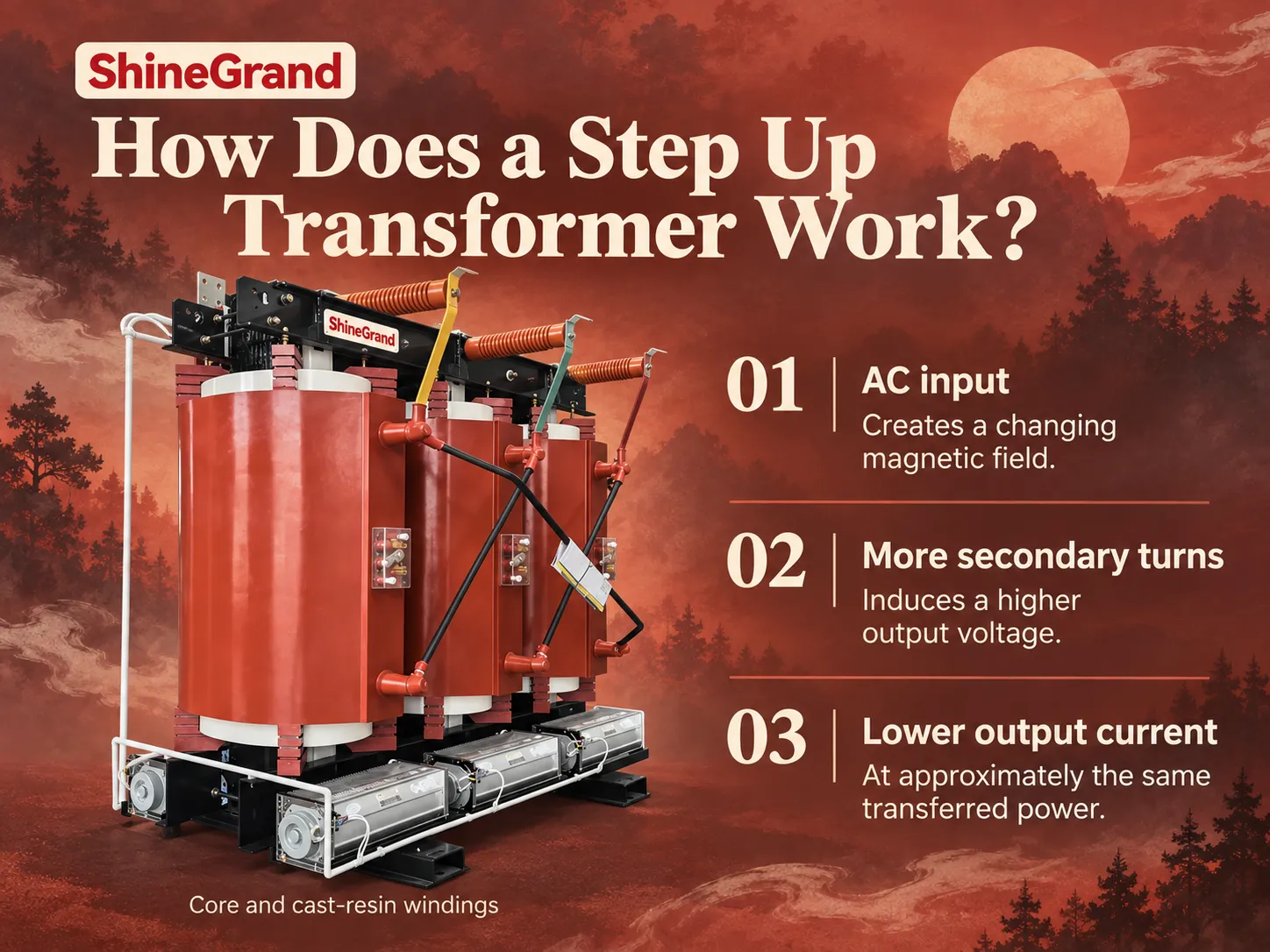
A step up transformer works on the principle of electromagnetic induction, specifically mutual induction between two coils. When alternating current flows through the primary winding, it creates a constantly changing magnetic field in the core. That changing field passes through the secondary winding and induces a voltage in it. Because the secondary has more turns than the primary, the induced voltage is higher than the input voltage.
The relationship is governed by the turns ratio. The ratio of secondary voltage to primary voltage equals the ratio of secondary turns to primary turns. If the secondary winding has ten times as many turns as the primary, the output voltage will be about ten times the input, and the output current will be about one tenth of the input. This simple, elegant relationship, with no moving parts involved, is what lets a step up transformer multiply voltage so reliably.
Why Increase the Voltage? Efficient Power Transmission
The reason for stepping voltage up comes down to reducing energy loss in power lines. As electricity travels through a conductor, some energy is lost as heat because of the wire’s resistance, and that loss increases with the square of the current flowing through it. In other words, halving the current cuts the line losses to a quarter. Since a step up transformer lowers the current as it raises the voltage, it dramatically reduces these resistive losses over long transmission distances.
This is why power is generated at low voltage, stepped up to a very high voltage for transmission across the grid, and then stepped back down near its destination for safe use. Without the ability to step voltage up, sending electricity efficiently over any real distance would be impossible, and power plants would have to sit right next to the homes and factories they serve. The step up transformer is, quite literally, what made the long-distance electrical grid practical.
Step Up vs Step Down Transformer
The natural counterpart to a step up transformer is the step down transformer, which does exactly the opposite. Where a step up unit raises voltage and lowers current using more turns on the secondary, a step down unit lowers voltage and raises current using fewer turns on the secondary. Both rely on the same principle of electromagnetic induction and differ only in their winding arrangement and how they are connected.
In the grid, the two work together as a team. A step up transformer raises the generated voltage for efficient transmission, and step down transformers at substations and along distribution lines then reduce it in stages to the safe, usable levels needed by industry, businesses, and homes. One cannot serve the system without the other.
Step Up Transformer Components
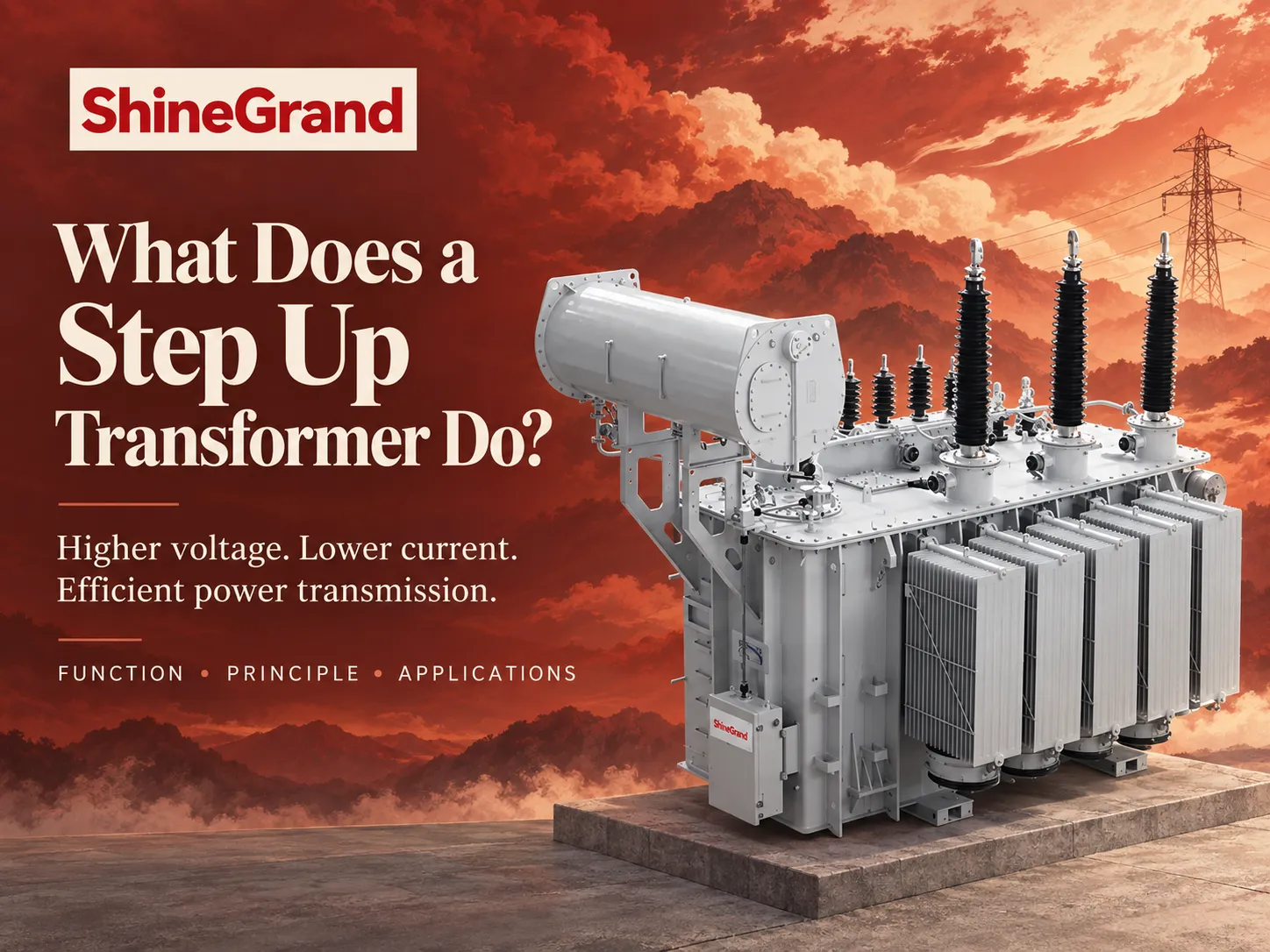
Although the designs differ according to their sizes and uses, the step up transformer is made of essential components just as any other type of power transformer. The incoming electric power is captured via the lower voltage primary winding, while the secondary winding produces electric power having a higher voltage since it has more turns. The two windings are wound around a laminated magnetic core that helps deliver a magnetic flux. The bigger units have the windings and the core inside a tank that is filled with insulating oil that serves to insulate as well as cool the transformer. However, the smaller indoor units may be using dry-type constructors with no oil and having insulated casing.
Applications of Step Up Transformers
The step up transformer appears wherever voltage needs to be raised, and its applications span the entire power system and beyond.
- Power generation plants. Conventional plants running on coal, gas, hydro, or nuclear energy generate at low voltage and use a generator step-up transformer to raise it to transmission levels before sending it out across the grid.
Renewable energy. Wind farms and solar plants produce electricity at relatively low voltages, and step up transformers raise that output so it can be fed efficiently into the grid, often across long distances from remote sites.
Transmission substations. Step up transformers at the start of the transmission network lift voltage to the high levels used for long-distance power transfer.
Industrial and specialized equipment. Certain industrial processes and high-voltage equipment, including some medical imaging systems, rely on step up transformers to reach the voltages they require.
In all of these, the equipment that carries the load must be robust and reliable. ShineGrand Electric manufactures power and distribution transformers used across generation, transmission, and distribution, including high-voltage oil-immersed units such as the 110-132kV Oil-Immersed Distribution Transformer for substation and transmission-class duty. For medium-voltage networks there are options like the 6-10KV Oil-Immersed Distribution Transformer, and for indoor or fire-sensitive sites the 20-35kV Epoxy Dry-Type Transformer, giving system designers reliable equipment for both step up and step down roles.
Different Categories of Step Up Transformers
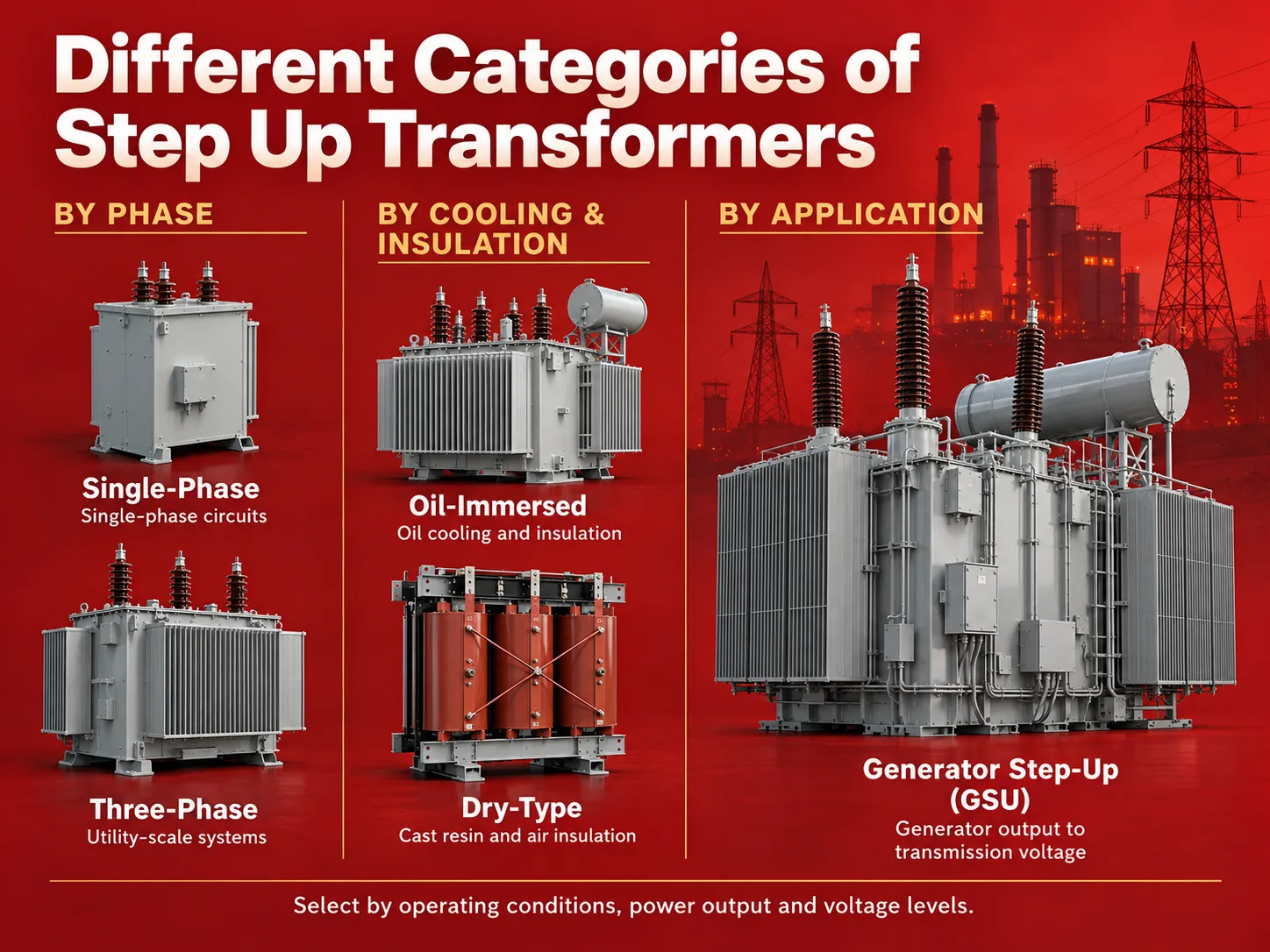
Step up transformers come in various designs for various ranges and applications. The types can either be single-phase or three-phase, whereby three-phase types are the most common in the utility scale electricity production and distribution applications. There are other classifications based on designs and cooling/insulation methods. There are two categories of transformers: oil-immersed transformers that utilize liquid insulating oil in order to cool and insulate the high-voltage transformers and dry-type transformers in which cast-resin and air insulation are used. One of the most notable types of step-up transformer is the generator step-up transformer (GSU) that is meant to convert the output of the generator into the voltage level for transmission. There are instances in which the system will require delta-wye configuration in terms of grounding and harmonics mitigation. Different projects require the appropriate type of step-up transformer based on operating conditions, power output and voltage levels.
A Specific instance: From Generator to Grid
By giving cases we will understand the importance of the step-up transformer. In many cases, the electricity is being produced at the level of tens of kilovolts in a power plant. This voltage level is not enough to ensure transmission over long distances. Using step-up transformer, the voltage can be raised to the level that can reach hundreds of kilovolts. As a result, the electricity can travel further with low parameters of the current and losses. Upon nearing the supply location, step-down transformers are used again in order to reduce electricity voltage to the necessary level for the supply.
Benefits and Important Factors
The advantages offered by this transformer are closely related to the working principle of the transformer. The transformer increases the voltage and reduces the current, thus allowing optimal power transfer over large distances and the development of large power generation facilities and renewable energy installations. In addition, as a static device, a quality transformer is very reliable and can be operated for many years.
The factors that should be considered when selecting a transformer are the required input and output voltages, the required power rating (in kVA and MVA), winding configuration, as well as whether the oil-immersed or dry transformer is preferable in a certain environment. Good cooling, insulating, and protection systems are of utmost importance, because the transmission transformer deals with very high levels of voltage. Just like with any transformer, quality equipment from a trusted manufacturer is the key to long-term trouble-free operation of the device.
Frequently Asked Questions
What does a step-up transformer do in layman’s language?
Step up transformers increase the voltage when electricity goes in and it also reduces the current at the same time. Due to the higher voltage and lesser current, electricity can be sent over long distances easily without suffering from the losses that occur during power transmission.
How does a step-up transformer increase voltage?
More number of turns are presented in the secondary circuit as compared to the primary circuit. When the alternating current produces a magnetic field in the primary circuit, this helps in inducing some amount of voltage in the secondary circuit owing to the availability of more turns in this circuit. The increase in voltage is equal to the turns ratio.
What is the major distinction between a step-up and a step-down transformer?
The step up transformer increases the voltage and reduces the current by having more turns in the secondary circuit, while on the flip side, the step-down transformer does the opposite by reducing the voltage and increasing the current. Both of these transformers act on the very same principle of operation.
Where are the applications of step-up transformers found?
Step up transformers are used in power generating stations, solar panels, wind farms, and other high voltage electronic instruments. The kind of step-up transformer that is found in power generating stations is referred to as a generator step-up transformer.
References
- IEC 60076 — Power Transformers. The international standard series defining the performance, insulation, and testing requirements for power transformers.
- IEEE C57.12.00 — General Requirements for Liquid-Immersed Distribution, Power, and Regulating Transformers. Reference standard for the ratings and construction of power transformers.
- U.S. Energy Information Administration — Electricity Transmission. Background on why electricity is transmitted at high voltage to reduce losses over distance.
- Electrical Engineering Portal. Neutral educational resource on transformer operation, types, and power systems.
- Transformer — Wikipedia. General reference on transformer construction, the turns ratio, and step up and step down operation.
Reliable Transformers From ShineGrand Electric
From raising generated power for transmission to delivering it safely at the point of use, dependable transformers are the backbone of every electrical network. ShineGrand Electric Co., Ltd. designs and manufactures a complete range of power and distribution transformers, in both oil-immersed and dry-type designs, along with high-voltage fuses, surge arresters, and disconnect switches. Whether you are equipping a generation site, a renewable energy project, a transmission substation, or a distribution network, explore our full transformer product range or contact the ShineGrand team for expert guidance tailored to your project.