Transformer testing is a critical aspect of electrical power distribution. This process converts voltages from one level to another and distributes the power through safe electrical cables into the electrical receptacles for end user consumption. In addition to transformer testing for commercial applications, you will also find many instances where it is beneficial to test your transformer in the home for troubleshooting issues. This guide provides transformer testing methodology, including how to test transformers, troubleshooting tips, and common buyer and technician questions regarding transformer testing.
Safety First
Before starting any transformer testing process, you must put safety first to avoid electric shock or damaging your equipment.
- Disconnect Power: Always turn off power to the transformer and lock out the power source before performing any testing on a transformer in an off-line manner.
- Insulated Tools: Use rubber gloves and insulated screwdrivers and multimeters rated for more than 1,000 V, mileage, or CAT I or CAT II ratings when working on a transformer in a high voltage condition.
- Discharge Capacitors: If a transformer has capacitors built in, use a discharge rod to safely discharge stored energy before you test.
- Follow the Manufacturer’s Instructions: The manufacturer’s manual will provide a guide for testing your transformer and indicate the voltage to use when testing your transformer.
Basic Transformer Testing Procedures (No Power)
Offline transformers can be tested for open circuits, short circuits, or winding integrity using simple tools such as an ohmmeter or multimeter. These types of tests are a great method for quick and inexpensive repairs and troubleshooting.
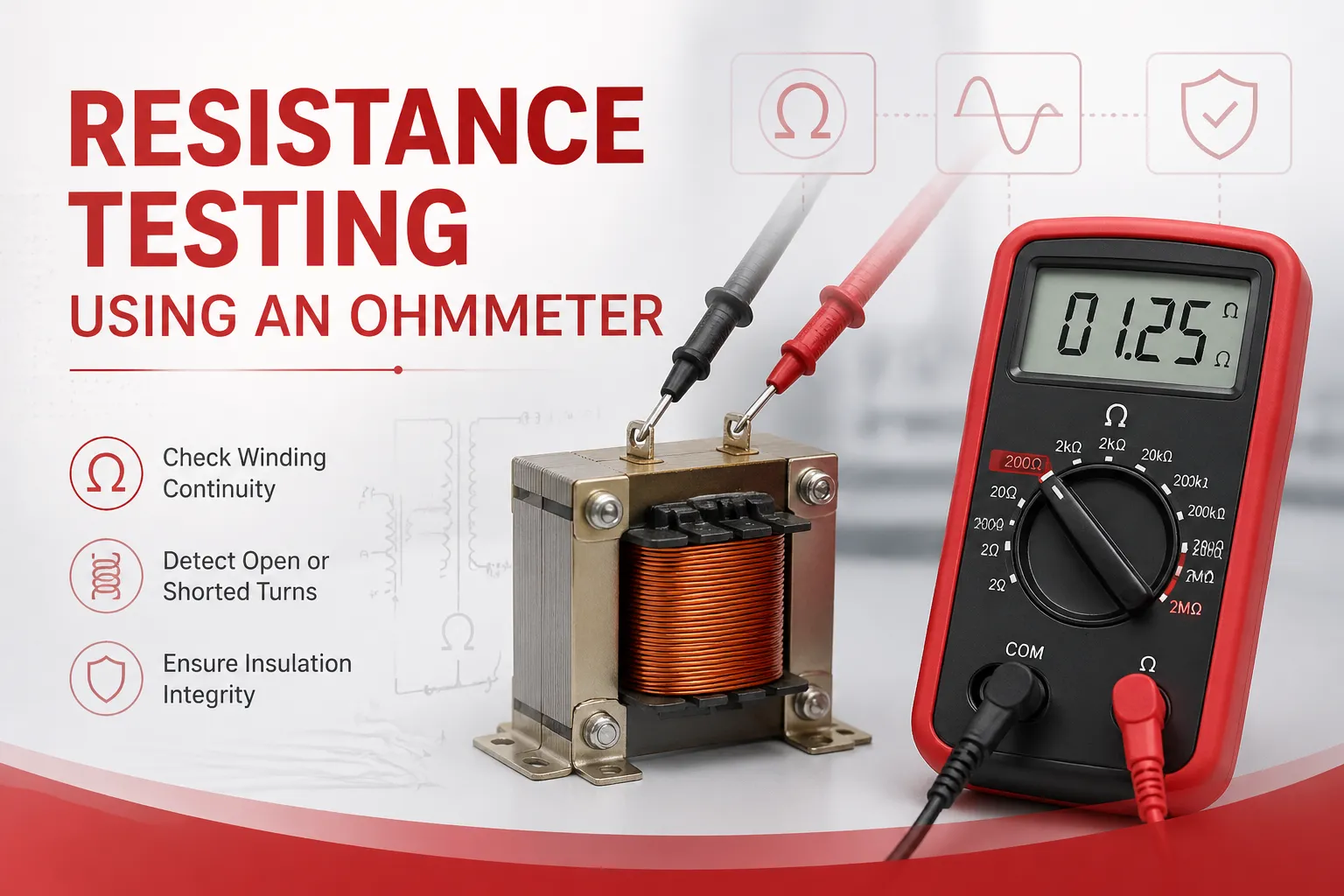
Resistance Testing using an Ohmmeter
This test will allow you to verify transformer winding continuity as well as determine whether there are any open or shorted turns within the windings of the transformer.
- On your ohmmeter, set the resistance scale to the lowest range (e.g., 200Ω).
- Place your probes to the two primary winding terminals. A good transformer will typically have a low resistance measurement, anywhere from approximately 1Ω to 100Ω depending on the size of the transformer.
- Perform this test again for the secondary winding. If either winding reads as infinite resistance, then the winding is open and the transformer is defective.
- Test for shorts between windings and the core: Place one of the probes on a winding’s terminal and the other probe on the metal core. If you find infinite resistance, there are no shorts. If you find low resistance, there is some damage to the insulation.
Battery Testing for Magnetic Continuity
This simple test is performed to determine if the core and windings of a transformer are capable of generating a magnetic field in cases where you do not have a multimeter to use for measuring magnetic continuity.
- Apply 9 volts from a battery to the primary winding terminals for 1–2 seconds.
- Remove the battery from the primary winding terminals and listen for the faint sound of a “click” from the transformer. The “click” signifies that the core’s magnetic field has collapsed and therefore the winding(s) are intact.
- If there are multiple secondaries on the same transformer, repeat this procedure for each of the secondaries to verify that they are also intact.
Visual Inspection
Many types of transformer failures can be easily identified visually:
- Burned or discolored insulating material on a winding indicates overheating.
- For oil-filled transformers, oil leaks may lead to a breakdown in insulation.
- Check the connections of your transformer for any sign of corrosion and/or any loose wiring that might possibly cause a voltage drop.
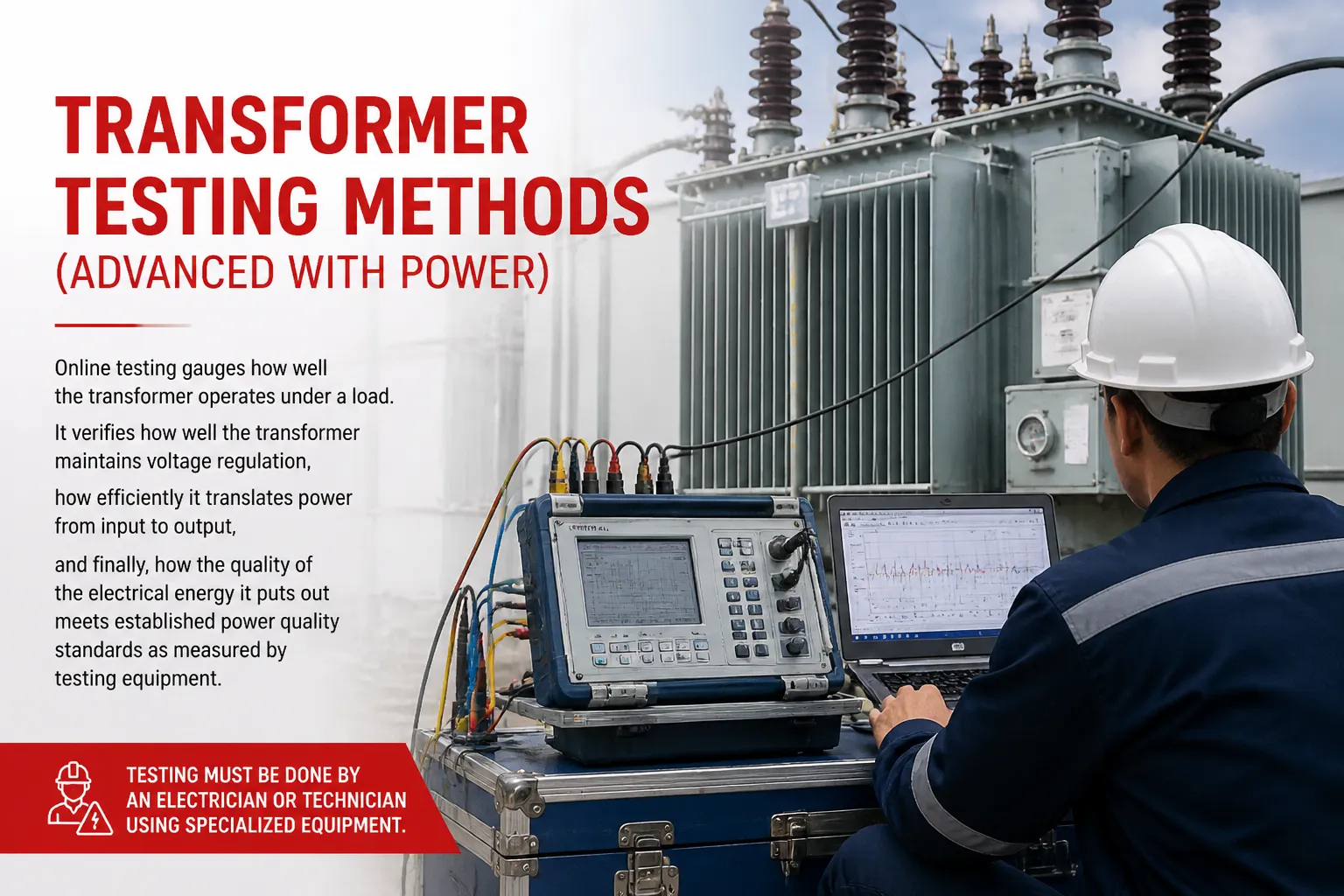
Transformer Testing Methods (Advanced with Power)
Online testing gauges how well the transformer operates under a load. It verifies how well the transformer maintains voltage regulation, how efficiently it translates power from input to output, and finally, how the quality of the electrical energy it puts out meets established power quality standards as measured by testing equipment. Testing must be done by an electrician or technician using specialized equipment.
Voltage Output Test with a Multimeter
Check to see if the transformer is stepping up and/or stepping down voltages properly.
- Connect to an appropriate power source. For example: 110 volts for a residential transformer, or 480 volts for an industrial transformer.
- Use AC voltage mode on your multimeter to check the secondary side output after connecting the source to the Primary Winding of the Transformer. Your reading should be ±5% of the rated output of the transformer (e.g., 24 volts for doorbell transformers).
- Testing should be completed while connected to a load. For example, testing with a light bulb or motor connected and checking secondary output after connecting the load. If you observe a voltage drop greater than 10%, you may have an issue with a winding/core fault.
Turns Ratio Test
The turns ratio of a transformer will determine the accuracy of the transformer’s ability to convert voltage and also help identify if there are any shorted turns in the transformer windings.
- Use a turns ratio tester or multimeter with Turns Ratio Test capability.
- Connect the tester to the primary and secondary windings of the transformer. The tester will apply a low voltage to the Primary Winding and measure the Secondary Voltage.
- Compare the measured ratio of turns (primary voltage ÷ secondary voltage) to the Manufacturer’s Specification. If the deviation is greater than 2%, then an issue may exist with the transformer.
Insulation Resistance Testing (Megger Testing)
This test measures the electrical resistance between transformer windings and the transformer core. It is very important for high-voltage transformers such as Oil-Filled Transformers.
- Disconnect the transformer from all sources of incoming power and discharge the capacitors.
- Connect a megohmmeter (megger) to one of the winding terminals and the transformer core.
- Apply a high voltage (1,000 volts for low voltage transformers; 10,000 volts for medium voltage transformers) for 60 seconds and note the resistance that’s displayed.
- If the displayed resistance is below 100 Megaohms (100 MΩ), there is an insulation issue, and repair or replacement will be necessary.
Transformer Testing Types (i.e., Dry-Type versus Oil-Filled)
Different transformers require different methods for testing due to their unique designs and applications:
Testing Dry-Type Transformers
Dry-type transformers utilize solid insulation (such as epoxy resin) and are typically located indoors—most commonly found in places like data centers and hospitals.
- Typical Testing Types: Insulation Resistance Test, Voltage Output Test, and Resistance Test.
- Key Issues to Look Out For: Insulation on the windings can become damaged by dust accumulation, which may lead to overheating. Perform a megger test annually to check the integrity of the insulation.
- Top Manufacturers: ABB, Siemens, Eaton.
Testing Oil-Filled Transformers
Oil-filled transformers use mineral oil for insulation and cooling. They are most commonly found in electrical substations and industrial facilities.
- Typical Testing Methods: All dry-type tests plus oil analysis tests (to measure the presence of moisture, acidity, and dissolved gases).
- Key Issues to Look Out For: Perform oil dielectric strength tests annually to ensure that the oil can adequately handle the electrical stress it will encounter. Look for any signs of insulation system failure due to arcing or other internal faults.
- Top Manufacturers: Schneider Electric, TBEA, WEG.
Transformer Testing Tools & Methods by Scenario
| Scenario | Tools Used | Recommended Testing Method |
|---|---|---|
| 24V Doorbell Transformer Testing | Multimeter | Output Test and Resistance Test |
| 480V Industrial Transformer Testing | Megger, Turns Ratio Tester | Insulation Resistance Test and Turns Ratio Test |
| Troubleshooting D/C Power to a Transformer | Ohmmeter, Battery | Resistance Test and Battery Continuity Test |
| Verify Dry-Type Transformers | Multimeter, Turns Ratio Tester | Output Test and Turns Ratio Test |
FAQ: Common Questions About Transformer Testing
How can I tell if my transformer is bad?
Signs of a bad transformer include:
- No voltage output from the secondary winding.
- Burnt or discolored windings.
- Loud humming or buzzing noises.
- Overheating of the transformer case.
- Circuit breakers connected to the transformer trip frequently.
What are the different transformer testing methods?
Common transformer tests include:
- Resistance Test: Checks for open or shorted windings.
- Voltage Output Test: Verifies accuracy of voltage conversion.
- Turns Ratio Test: Checks for shorted turns and ratio errors.
- Insulation Resistance Test: Checks the integrity of the insulation system.
- Oil Analysis: Detects internal faults for oil-filled transformers.
How to test a 110V transformer?
To test a 110V transformer:
- Perform a resistance test on the primary and secondary windings to check for continuity.
- Connect the primary winding to a 110V power source.
- Use a multimeter to measure the secondary voltage, which should match the rated output within ±5% (e.g., 12V or 24V).
- Test under load by connecting a rated device to the secondary and remeasure the voltage.
How to troubleshoot a faulty transformer?
Follow these steps:
- Verify that there is power to the primary winding.
- Check resistance of the primary and secondary windings for broken or shorted turns.
- Test voltage output under load using a multimeter.
- Inspect the transformer for visible damage, such as burnt windings or oil leaks.
- If still faulty, consider repair or replacement.
Can I test a transformer without a multimeter?
Yes, you can use alternative methods such as:
- Using a 9V battery to check winding continuity. Connect the battery to the primary winding for 1–2 seconds, then disconnect. A faint “click” indicates intact windings.
- Using a light bulb tester. Connect a bulb to the secondary winding and energize the primary winding. If the bulb lights up, the transformer is functioning.
You can check transformers using basic safety practices, non-electrical tools such as multimeters, and advanced diagnostic tools for high-voltage transformers. Whether you are testing a 24V doorbell transformer or a 480V industrial dry-type transformer, both offline and online tests are critical for identifying faults and ensuring safe and efficient operation. For complex tests like insulation resistance measurement or oil analysis, hiring trained professionals is strongly recommended to ensure safety and accuracy.