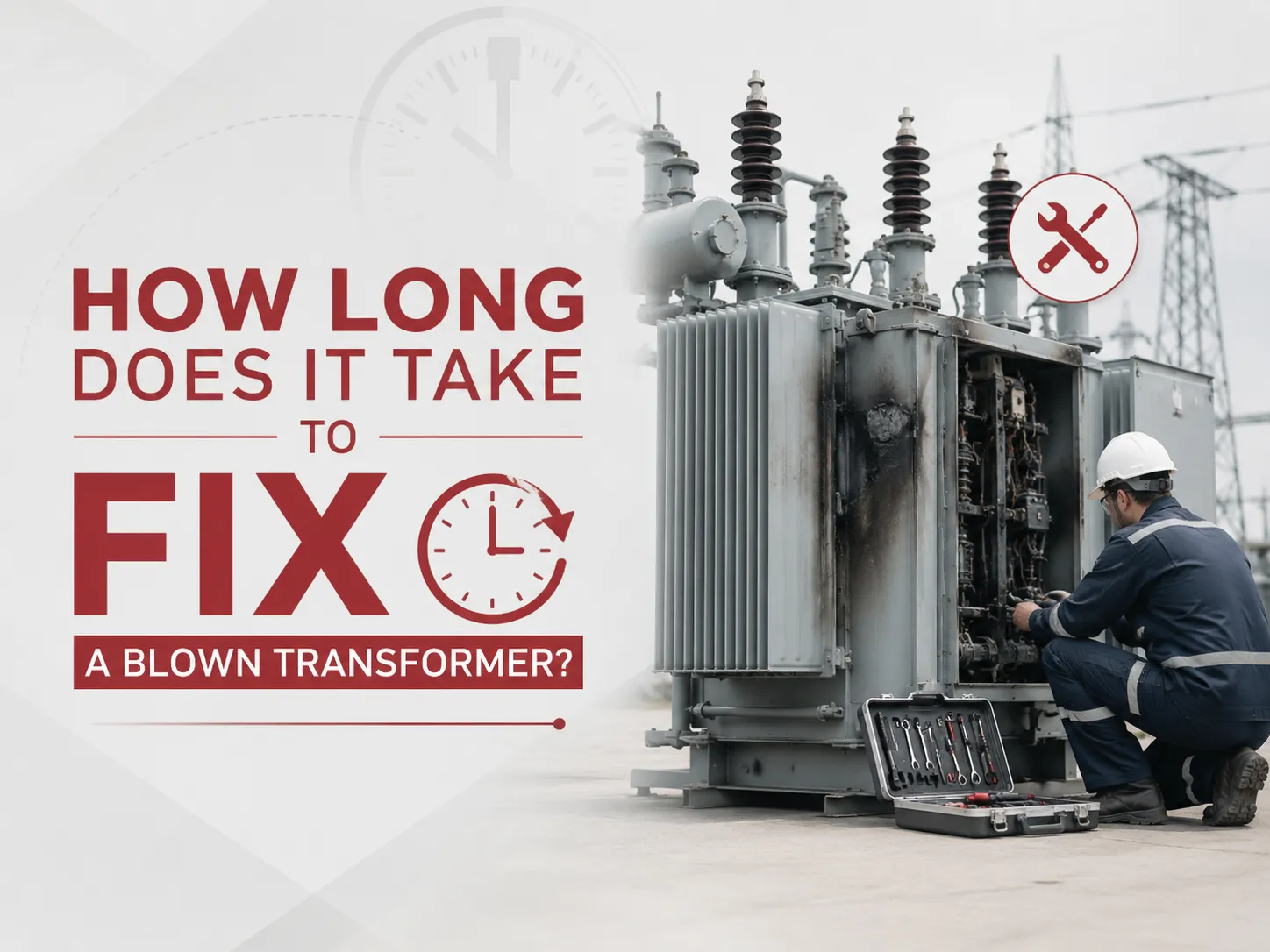
The first reaction to a blown transformer in your neighbourhood or facility is the classic: how long will it take to fix a blown transformer? A blown transformer is generally assessed very quickly. Usually, a pole-mounted transformer will be repaired within 2 to 4 hours. However, depending on the size of the transformer and its use in a commercial or industrial setting, fixing a blown transformer can take anywhere from 8 hours to several days. The primary thing to keep in mind is the crew performing either minor or extensive repairs and most of the time replacing rather than fixing a blown transformer.
Fix Versus Replace: What Happens When a Transformer Blows
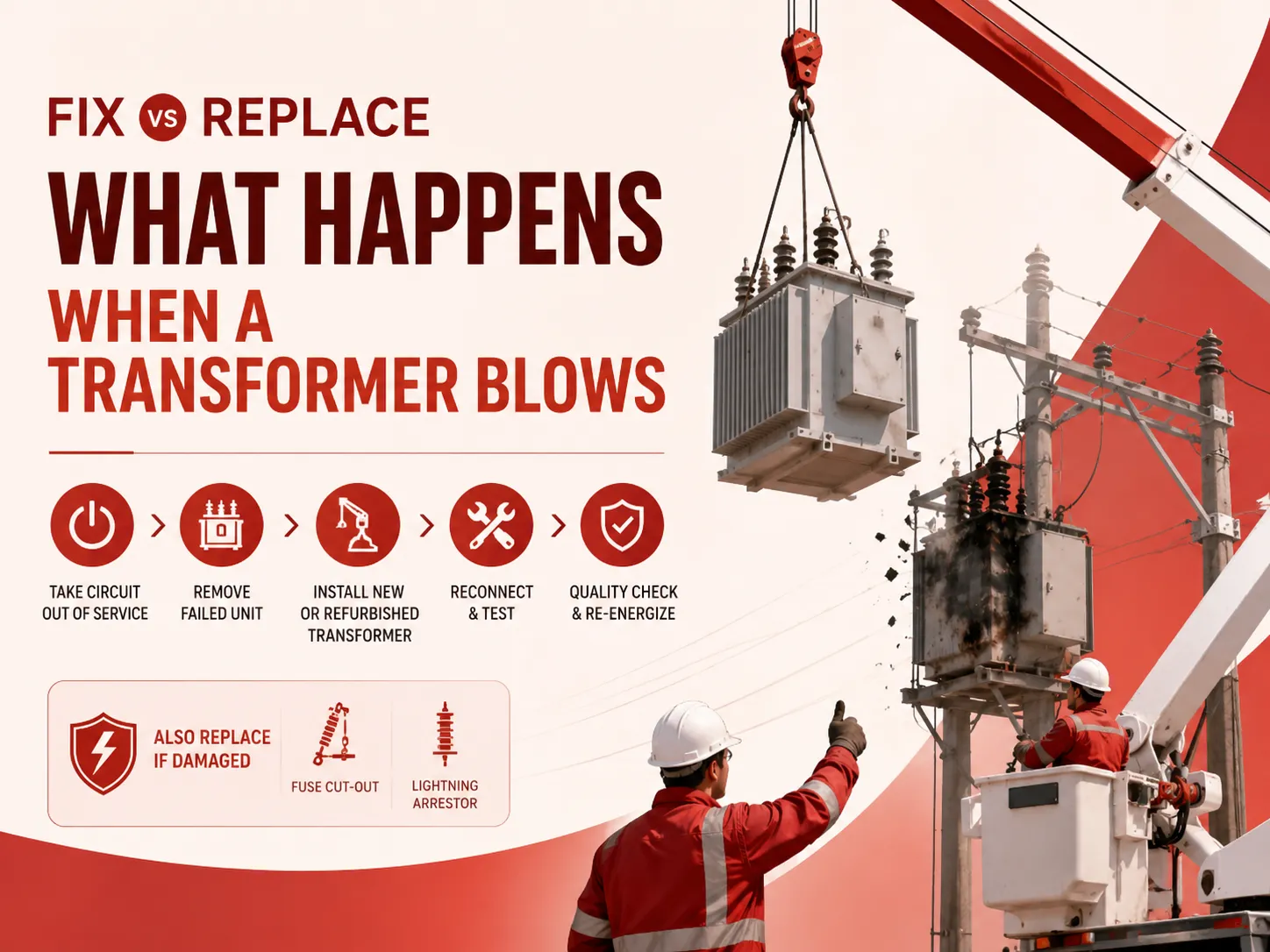
When a power transformer needs repairs, it is rare for field personnel to perform their repairs in a timely manner like you would fix a dripping faucet. In a large majority of blown transformers with either failed internal winding insulation or catastrophic failure due to degradation of the dielectric oil causing a short circuit, utility crews will invariably take the failed transformer out of service and install a new or refurbished replacement. The replacement procedure involves taking the circuit out of service, removing the defective device, hoisting the new device into place through the use of a bucket truck or crane, reconnecting the primary and secondary cables, and performing insulation testing as well as quality testing before re-energizing. If the blown transformer resulted in an associated cut-out mechanism being damaged, the fuse cut-out and lightning arrestor will be replaced during the same maintenance interval.
To understand the underlying causes of transformer failure and to view some warning indications prior to an actual utility service interruption, see our article on why transformers blow.
Repair Timelines by Transformer Type and Location
How long you’ll wait depends primarily on the size and type of the failed transformer, as well as site accessibility. Below is a breakdown of typical repair windows for the most common scenarios.
| Transformer Type | Typical Repair/Replacement Window | Critical Variables |
|---|---|---|
| Residential pole‑mounted (10–100 kVA) | 2–4 hours | Bucket truck access, availability of a standard replacement unit on the truck |
| Residential pad‑mounted (25–167 kVA) | 3–6 hours | Excavation if cables are damaged, confined space entry |
| Commercial dry‑type (50–500 kVA) | 4–8 hours for swap; 1–3 days if a custom unit must be ordered | Crane access, match of voltage taps and impedance with existing system |
| Industrial oil‑filled (500+ kVA) | 8 hours to 3 days | Concrete pad curing time if replaced, oil processing, extensive testing |
For those who specifically wonder about the equipment you see on roadside poles, our explanation of what a pole‑mounted transformer is called gives you the terminology and the typical ratings you’ll encounter.
Things That Can Delay the Repair Timeline
There are many practical issues that can complicate and dramatically extend a repair timeline even when you have a replacement transformer ready.
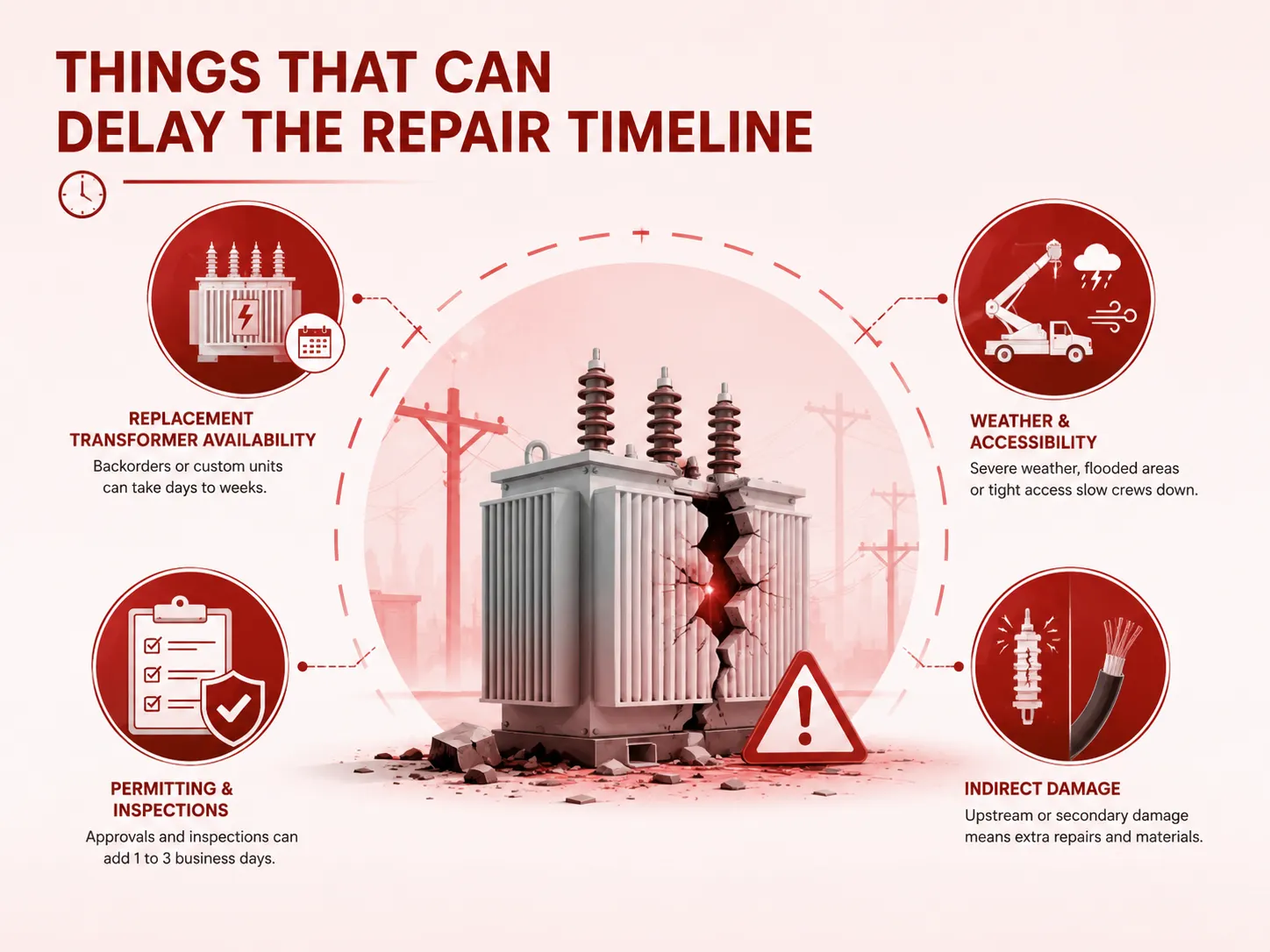
Replacement Transformer Availability: Standard distribution transformers are maintained as part of inventory at most utility warehouses, while specialty step-up transformers and/or transformers with specific impedance requirements will take 2 to 10 business days; a custom winding transformer may take many additional weeks to be available for pickup or delivery. Understanding the difference in the types of transformers is critical because the difference in length of time to replace or to have to wait for back-ordered transformers is significant. For further information about where to find step-up transformers look at our article titled what is a step-up transformer.
Weather & Accessibility: Crews cannot operate bucket trucks in high winds or lightning. If flooded vaults, icy roads or tight urban alleys will add time to crewmembers for those situations. If personnel require entering an underground dry-type transformer vault they must make additional safety checks to assure a safe atmosphere and temperature prior to entry.
Permitting & Inspections: For commercial or industrial installations local building departments or utility regulators may require an inspection conducted by the utility company to obtain sign-off before re-energizing the circuit when they complete their repair work. Administrative steps may take 1 to 3 business days when an incident report has been filed in conjunction with the outage and repair incident.
Indirect Damage: When a transformer fails violently, it can cause damage including breaking upstream fuse holders, breaking insulators, or breaking the secondary service cable to a building. Additional repairs can add time and require new materials.
How an Isolation Transformer or Autotransformer Changes the Fix
Not all transformers are created equal, and the electrical topology of the failed unit directly affects repair complexity. An isolation transformer — one that physically separates the primary and secondary windings — is commonly found in hospitals, data centers, and sensitive industrial equipment. Repairing or replacing an isolation transformer requires absolute phase matching and verification of the ground‑reference scheme, adding several hours of testing compared to a standard distribution unit. If you’re unsure about the distinction, our comparison of autotransformer vs isolation transformer explains it in clear terms.
Autotransformers share a portion of the windings between primary and secondary sides of the transformer. Therefore, as compared to an isolation transformer, the size and cost are minimal for applications requiring only voltage adjustments. The non-isolated condition of the autotransformer allows faults to affect the winding less than would occur with an isolation transformer; thus, diagnostic procedures after a fault prior to energization are more cautious compared to using an isolation transformer, although the physical change of the transformers generally takes less time due to the lower weight and size of the autotransformer.
Frequently Asked Questions
How long will the power be out if a transformer fails?
For a residential customer due to a blown transformer, utility crews typically replace the blown unit within 2 to 4 hours. When a transformer fails under heavy storm conditions affecting thousands of customers, it usually takes 12 to 24 hours for that transformer outage to be restored due to the fact that crews will focus on restoring electricity to hospitals, emergency services, and other areas with large numbers of customers affected. If the transformer powering a commercial or industrial facility fails, it could take an entire business day or longer to restore power to that facility if there is not an appropriate replacement transformer readily available.
Can I repair a blown transformer by myself?
NO — do not attempt this as a do-it-yourself project. A blown distribution transformer contains exposed medium voltage conductors (typically 7,200 volts or more), heavy equipment that weighs many hundreds or thousands of pounds, and the potential for arc flash explosions. Only licensed utility technicians, equipped with specialized tools, personal protective equipment (PPE), and have been trained as line workers, should attempt to do this work. In addition, if you are replacing a small interior dry type transformer you will need to have your qualified electrician verify that the electric circuit in the transformer has been de-energized and that all connections have been properly torqued.
What is the 80% rule for transformer loading?
The 80% rule provides that a transformer should not be continuously loaded over 80% of nameplate KVA rating. Therefore, if a transformer has a 100 KVA nameplate, it should supply no more than 80 KVA of continuous loading. This allows for a margin of capacity which limits the heating effects upon the insulation, minimizes the aging of the insulation, and significantly limits the ability of a transformer to fail prematurely. Keeping within this guideline is by far one of the best methods of avoiding having to answer “how long to repair a blown transformer.”
How long will it take to repair a transformer?
Most repairs to residential transformers (which will generally involve replacing the transformer) can be completed within 2 to 4 hours after the crew has arrived. Typically, a commercial dry-type transformer swap may take anywhere from 4 to 8 hours. An industrial transformer rated at 500 kVA or above could take from 8 to 24 hours of actual work over a one to three-day period, particularly if there is a need to pour and cure a new concrete pad. However, whenever the estimate for time exceeds one day’s time frame, the reason for the extended estimate is almost always due to lead time required to obtain the proper replacement transformer, not from the labor to complete the work.
When a transformer fails, the timeline to restore power is driven by a handful of tangible factors: the kVA rating, the type of cooling and insulation, site accessibility, and whether a compatible replacement is sitting on a shelf or must be fabricated. A residential pole‑mounted unit might be swapped in an afternoon; a large step‑up or isolation transformer for a factory could take days. Knowing the difference between a quick swap and a lengthy replacement project helps you plan your contingency power strategy. Whether you manage a home, a business, or an industrial facility, pairing the right transformer with a disciplined maintenance routine — and respecting the 80% load limit — keeps the lights on and avoids the scramble that follows a catastrophic blowout.