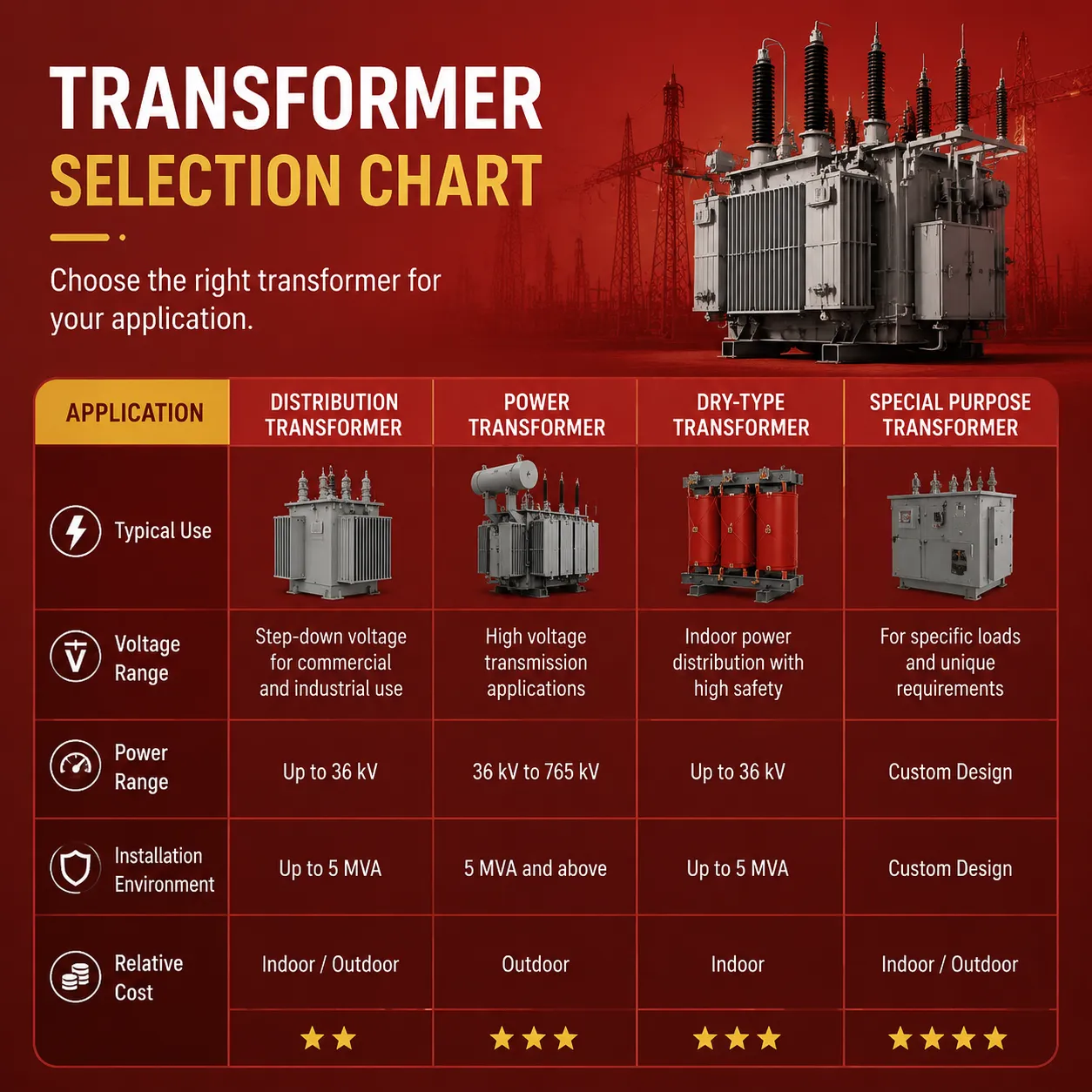
When an engineer at a plant needed to substitute a faulty 750 kVA transformer, he encountered a myriad of options, comprising an oil-filled or a dry-type transformer, copper or aluminium winding, male or high effective transformer, a NEMA 1 or a NEMA 3R enclosure. The planner was fitted with a transformer in the year of installation and that was all the information he had about this unit. The wrong decision could lead to the heating of the device during summer months in Texas, triggering malfunction due to high voltage levels available or not allowing the plant to achieve the desired energy-efficiency objectives. He would need a Transformer Selection Chart to denote the right type of device rather than a catalog page.
The Four Fundamental Transformer Types and Where They Belong
When it comes to selecting transformers, the process always begins with the application. There are four main classes of transformers: by the way they are cooled and their location in the power system. Each class of transformers is suited for different applications correct selection is very important, as it cannot be undone or corrected after installation of the transformer. The table below offers the crucial information on the environment of installation and load type.
| Transformer Type | Cooling Medium | Typical kVA Range | Best Installation Environment | Key Selection Drivers |
|---|---|---|---|---|
| Oil-Filled Distribution (Pad-Mounted or Pole-Mounted) | Mineral oil, natural ester, or synthetic ester | 10 kVA – 5,000 kVA | Outdoor — residential subdivisions, commercial campuses, industrial yards | Lowest first cost per kVA; excellent overload capability; requires oil containment and fire-safety clearance |
| Dry-Type (VPI — Vacuum Pressure Impregnated) | Air, natural convection or forced-air | 15 kVA – 1,000 kVA | Indoor — electrical rooms, mechanical penthouses, clean environments | Zero oil = zero containment and minimum fire risk; lower weight than oil-filled; higher operating temperature |
| Dry-Type (Cast-Coil) | Air, epoxy-encapsulated windings | 100 kVA – 10,000+ kVA | Indoor and outdoor — hospitals, data centres, subways, harsh environments | Superior moisture and chemical resistance; highest fire safety; higher first cost, lower maintenance |
| Power Transformer (Substation Class) | Mineral oil, natural ester, or synthetic ester | 5,000 kVA – 100,000+ kVA | Outdoor — utility substations, large industrial plants, generation switchyards | Custom-engineered for the specific voltage, impedance, and loss requirements; long lead times; highest capital cost |
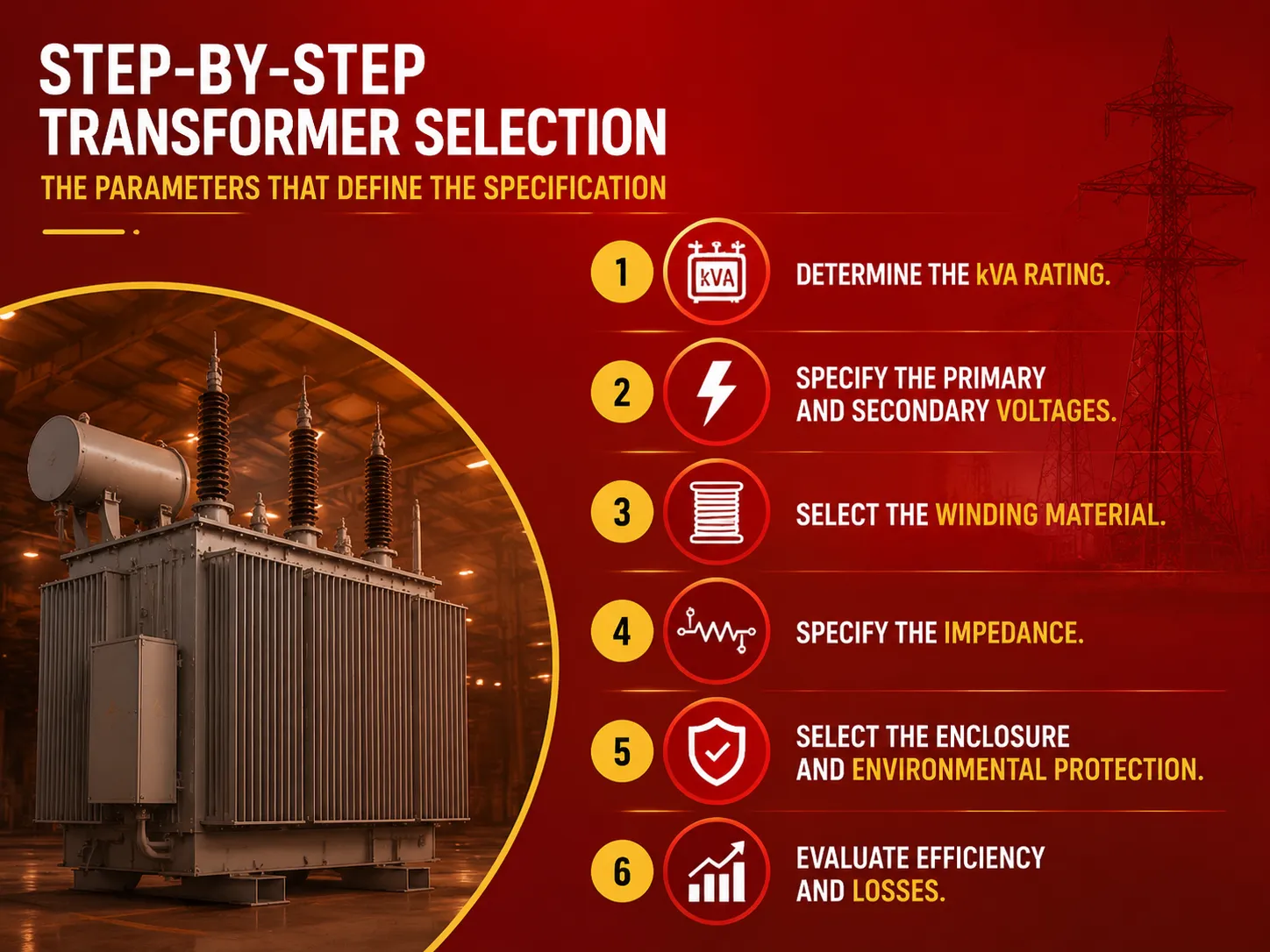
Transformer Selection: The Parameters That Define the Specification
After choosing the kind of transformer required, the specification must be established according to the electrical characteristics of the load and the source. The next steps describe the selection of the transformer following the ways in which an engineer, a contractor, or a purchaser would do it.
Determine the kVA rating. It is important that the kVA rating of the transformer is equal to or above the determined load. For a new installation, adhere to the NEC Article 220 load calculation rules and ensure that all equipment in use is considered, including forecasts of demand and the addition of more equipment. You must also follow the 80 percent rule, which states that the continuous load should not exceed 80 percent of the transformer’s kVA rating. For instance, if the calculated load is 400 kVA, then a 500 kVA transformer needs to be purchased so that enough thermal headroom is available.For help with the specific calculation, our transformer calculation table provides full-load current values for all common kVA ratings.
Specify the primary and secondary voltages. The primary voltage should equal the voltage supplied at the connection point. The voltage in the secondary must be equal to the voltage used by the equipment being serviced. Common combinations of the above are 13.8 kV / 480 V, 20 kV / 400 V, and 34.5 kV / 240 V. The voltage ratio also helps determine the turns ratio from which the secondary voltage under the load is derived.
Select the winding material. Copper windings offer a better conductivity, a more compact form factor, and generally a longer lifetime than other windings. While aluminum windings lower the first cost by 15–25%, they lead to a larger but less efficient product. Basically, the buyer’s decision is determined by his or her priorities: lowest initial investment (aluminum) or the lowest total cost of ownership (copper). To have an idea of the broader economic context of transformer purchasing, take a look at our guide regarding how to get the best transformer quotation, which describes in detail what a high-quality transformer quote should contain.
Specify the impedance. The impedance, which is defined as a percentage of the base kVA, plays an important role in the regulation of voltage under load and the provision of short circuit currents. The impedance of a typical distribution transformer lies between 4% and 6%. A lower impedance gives better voltage regulation but permits greater fault currents. A higher impedance enables controlling fault current but experiences higher voltage drop during load. Therefore, the impedance needs to be matched with overcurrent protection and other transformers working in parallel with it.
Select the enclosure and environmental protection. For a dry-type unit situated inside, the NEMA 1 or IP20 protection standard is acceptable. The protection criteria for a pad-mounted unit outside is met with a NEMA 3R or IP54 classification. In case of installation in coastal areas or any other corroding environment, the protective casing must be made from stainless steel (304 or 316L) or be coated appropriately. This enclosure is also important in determining airflow as it influences whether an indoor unit is ventilated sufficiently and whether the outdoor unit is able to dispose of rain and snow without blocking the cooling grids.
Evaluate efficiency and losses. The transformer’s purchase price is incurred only once. The loss cost, though, must be incurred every hour for the lifetime of 25-35 years of the energised transformer. When determining the total cost of ownership, one often realises that a high-efficiency transformer, which costs more but operates with lower losses, is the best choice. This is especially true in locations where the cost of electricity is high.For a detailed look at the cast-coil construction that offers the highest efficiency in the dry-type category, our overview of dry-type transformer types including cast resin and VPI covers the technology distinctions.
How ShineGrand Supports the Transformer Selection Process
ShineGrand Electric manufactures transformers across the full spectrum — oil-filled distribution, dry-type (VPI and cast-coil), and power transformers — with the engineering support to guide a buyer through the selection process. Our product range includes three-phase pad mounted transformers from 75 kVA to 5,000 kVA, SCB series epoxy cast-coil dry-type transformers from 6–10 kV, and 20–35 kV cast-coil dry-type transformers for industrial and renewable energy applications. For projects where energy cost is a significant factor, our SCBH series amorphous alloy core transformers reduce no-load losses by up to 70% compared with conventional silicon steel cores. Every ShineGrand transformer is factory-tested to the applicable IEC or IEEE standard, and the routine test report is provided with every unit. For a buyer who needs a transformer that matches the application, the environment, and the budget — and who needs the documentation to prove it — ShineGrand provides the product range and the engineering support to make the selection with confidence.
Frequently Asked Questions
What is the 80% rule for transformers?
The 80% rule implies that a transformer should not be operated continuously with a load greater than 80% of the rated kVA. This helps in providing thermal headroom for load additions, harmonic current, and variations in ambient temperature. A transformer operating for a longer period with a load greater than 80% will be hotter than the one working under this rule and consequently will age faster causing a reduction in its service life.
How do I choose the right transformer?
Choosing the appropriate transformer entails pairing it to the application: start by determining the type — whether oil-filled or dry — that would best fit the environment and the fire safety specifications. Next, calculate the kVA rating following standards based on the anticipated load. Then, get the voltages, materials used for the winding, impedance, and the type of enclosure. Finally, determine the total cost of owning the unit, which is the purchase cost plus the expected losses during its lifespan.
What are the 4 types of transformers?
Four basic types of transformers used in the electric power distribution system include oil-filled transformers (mounted on poles and using oil for outdoor functioning), dry-type transformers (used indoors and where environmental conditions are moderate), dry-type cast coil transformers (used both indoors and outdoors, particularly in case fire safety and moisture resistance requirements must be followed), and power transformers (used in substations and systems operating on high voltages and having MVA rating).
How to choose the right current transformer?
In order to select the correct current transformer (CT) for an installation, it is necessary to match its primary current rating to the maximum continuous current in the circuit. Then it is important to choose the appropriate accuracy class for the task (protection or metering). The burden (the sum of impedance for all the connected wiring and equipment) must also be considered. Finally, the rated short-time thermal current of the CT must be greater than the possible short-circuit current available at the installation site.
References
- Eaton — Transformer Selection and Application Guide. Manufacturer of oil-filled, dry-type, and power transformers with published selection tables and application guidance.
- Schneider Electric — Transformer Specification and Selection Tools. Manufacturer of dry-type and cast-coil transformers with online selection and sizing resources.
- Siemens Energy — Power and Distribution Transformer Portfolio. Global manufacturer of transformers across all voltage classes and applications.
- U.S. Department of Energy — Transformer Efficiency Standards and Selection Guidelines. Regulatory standards and technical guidance for transformer efficiency and selection in the United States.
A transformer selection chart is not a catalogue page. It is a decision framework that starts with the application and the environment, moves through the electrical parameters — kVA, voltage, impedance, winding material — and ends with the total cost of ownership calculation that separates the economical choice from the merely cheap one. The engineer who selects the correct transformer is the one who understands that the purchase price is paid once and the losses are paid every day for 30 years, that a copper winding costs more than aluminium but returns the difference in efficiency and service life, and that a transformer specified without regard for its environment — a standard enclosure in a coastal installation, a dry-type unit in a damp basement — will fail long before its design life. ShineGrand Electric supplies transformers that are built to the specification that the application demands, with the test documentation and the engineering support that turn a selection decision into a reliable, long-term installation.