A factory in the Philippines received a machine from Germany and found out from the nameplate that it required 230 volts of electricity at a frequency of 50 Hz. However, upon checking the factory supply, it was found that it only delivered 208 volts (which is a normal voltage level for that area) – a measurement that was 22 volts less than what was necessary for the machine to function correctly. The factory did not want to spend more money installing around a large transformer, so they decided to use a buck boost transformer – that is a small, inexpensive piece of equipment that increased the factory supply voltage from 208 volts to 230 volts, which made it possible for the German machine to function properly. The term “buck boost transformer” refers to the device that provides a small adjustment in an existing voltage of the electrical system, but still without the costliness of any of the large power or distribution transformers. Anyone working in the industry and involved in the equipment installation, maintenance or specifications must know the buck boost transformer, its differences from other transformers, and its proper usage in the system.
What a Buck Boost Transformer Does
A buck boost transformer refers to a type of transformer that is either single-phase or three-phase. Its connection is done in a unique manner that allows a minor alteration of either addition or subtraction of an incoming voltage in the range of 5% – 20%. The process differs from a transformer that acts in a normal transformer. Those kinds of transformers bring down the primary voltage into a secondary one completely different from the first primary voltage. For example, the voltage can be brought down from 13.8kV down to either 240 or 480 V. A buck boost transformer takes the same voltage levels which are slightly near to the required voltage level that has to be obtained. The buck boost works through connection of the above-winded transformer in such a way that the output voltage is a combination of the incoming voltage. It should be noted that the transformer procedures are achieved through its two-winding bodies for its bucking or boosting function. Resources from manufacturers such as Eaton and Schneider Electric provide detailed connection diagrams and application guidance for buck boost configurations.
“Buck boost” describes a process, not a specific kind of transformers. Any transformer can be used as a buck-boost transformer depending on which terminals are connected. Hence, it is one of the most widely-used devices in the electrical industry, solving a particular problem at a very low cost.
How a Buck Boost Transformer Differs from a Regular Transformer
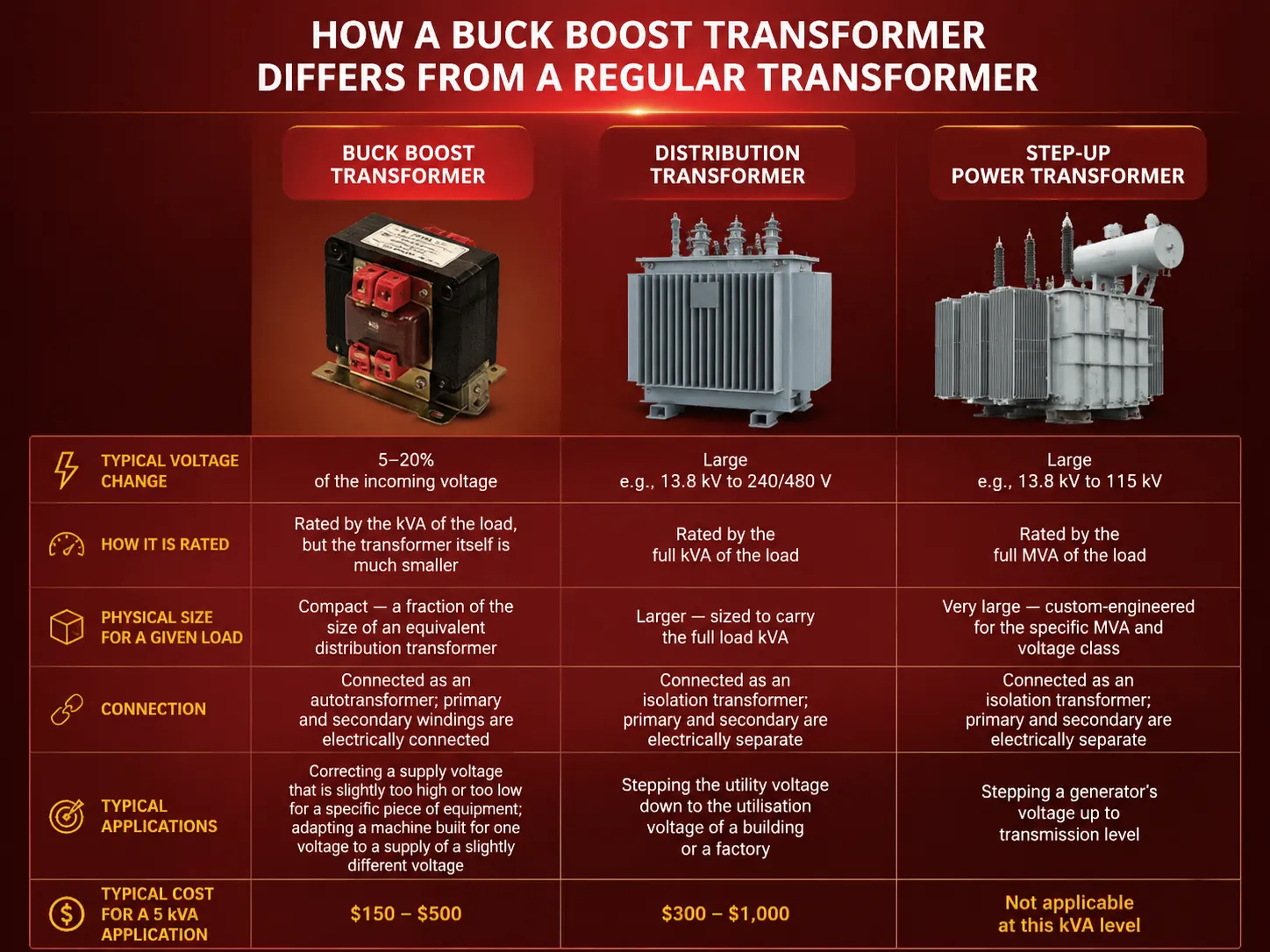
The table below captures the essential differences between a buck boost transformer, a conventional distribution transformer, and a step-up power transformer. The differences are not in the internal construction — all three are electromagnetic devices with a core and windings — but in how they are rated, how they are connected, and the magnitude of the voltage change they produce.
| Characteristic | Buck Boost Transformer | Distribution Transformer | Step-Up Power Transformer |
|---|---|---|---|
| Typical voltage change | 5–20% of the incoming voltage | Large — e.g., 13.8 kV to 240/480 V | Large — e.g., 13.8 kV to 115 kV |
| How it is rated | Rated by the kVA of the load it serves, but the transformer itself is much smaller than a distribution transformer of the same load kVA because it only processes the voltage difference, not the full load power | Rated by the full kVA of the load | Rated by the full MVA of the load |
| Physical size for a given load | Compact — a fraction of the size of an equivalent distribution transformer | Larger — sized to carry the full load kVA | Very large — custom-engineered for the specific MVA and voltage class |
| Connection | Connected as an autotransformer; primary and secondary windings are electrically connected in series with the load | Connected as an isolation transformer; primary and secondary are electrically separate | Connected as an isolation transformer; primary and secondary are electrically separate |
| Typical applications | Correcting a supply voltage that is slightly too high or too low for a specific piece of equipment; adapting a machine built for one voltage to a supply of a slightly different voltage | Stepping the utility voltage down to the utilisation voltage of a building or a factory | Stepping a generator’s voltage up to transmission level |
| Typical cost for a 5 kVA application | $150–$500 | $300–$1,000 | Not applicable at this kVA level |
Where Buck Boost Transformers Are Used
The buck boost transformer serves mainly the purpose of adjusting a supply voltage that is nearby the equipment’s operating voltage, such that both voltages are close to being equal but are not precisely the same. Uses in real life are manifold, especially in the setting of industrial and commercial businesses where equipment is purchased from different countries and the voltage supplied is incompatible with the nameplate voltage of the equipment.
Adapting imported equipment. The device designed for a European 230-volt supply has been installed in an establishment using a North American 208-volt supply. A step-down transformer is used to convert the 208 volts to the desirable 230 volts. This conversion allows the machine to function properly, thus avoiding the need for an expensive isolation transformer.
Correcting for voltage drop in a long feeder. A motor, or any equipment, positioned at the end of a lengthy wire may receive a voltage quite a bit lower than the nominal supply voltage as a result of the resistance offered by the wire itself. An elevation transformer at the end of the wire compensates for this drop in voltage and restores its value back to the required level.
Operating a 240-volt motor on a 208-volt system. Most industrial motors are designed for use at 230 or 240 volts. When used on a 208 volt system, they can draw more current than normal and run hotter, thus reducing their lifetime. A boost transformer converts the 208 volts into 240 volts so that the motor works at its rated voltage.
Compensating for a consistently high or low utility supply. In certain regions, the electricity supply voltage constantly remains near its limits. Using a buck transformer will reduce excessive voltage levels; on the other hand, a boost transformer can increase low voltage level to the proper level.
How a Buck Boost Transformer Is Sized and Selected
In order to choose the appropriate buck boost transformer, it is necessary to match the transformer’s kVA rating to the intended load and to select the correct primary and secondary voltage taps for the required voltage change. The method is systematic and involves the use of the national tables for transformer selection that are made available by all leading transformer manufacturers.
Determine the load voltage and the supply voltage. The main distinction between the two systems lies in how much voltage correction is involved. For instance, if a supply voltage of 208 volts is provided, but the load needs a voltage of 230 volts, the required voltage boost will be 22 volts.
Determine the load current or kVA. The buck-boost transformer needs to be rated for the load current on the secondary. This is because the buck-boost transformer operates as an autotransformer, and as a result, it only processes power due to voltage difference and not the full load. As a result, it is possible for the buck-boost transformer to be much smaller than an isolation transformer of the same kVA capacity.
Select the transformer from the manufacturer’s catalogue. The tables provided by the manufacturer contain information regarding different configurations of transformers and their advantages. They indicate different input voltages, output voltage rates, and primary voltages of transformers that can be suited to certain configurations. The tables also clarify whether a specific configuration can be used in single-phase or three-phase systems.
Wire the transformer according to the connection diagram. The diagram of the wiring can be found on the nameplate of the transformer and the instruction manual for installation purposes. This diagram provides information on how to connect the primary side and the secondary side for getting the correct boost and buck actions. It is important to wire the transformer properly because wrong wiring can cause the voltage to change in reverse direction and can cause damage to the transformer or the load.
What Does a Buck Boost Transformer Cost?
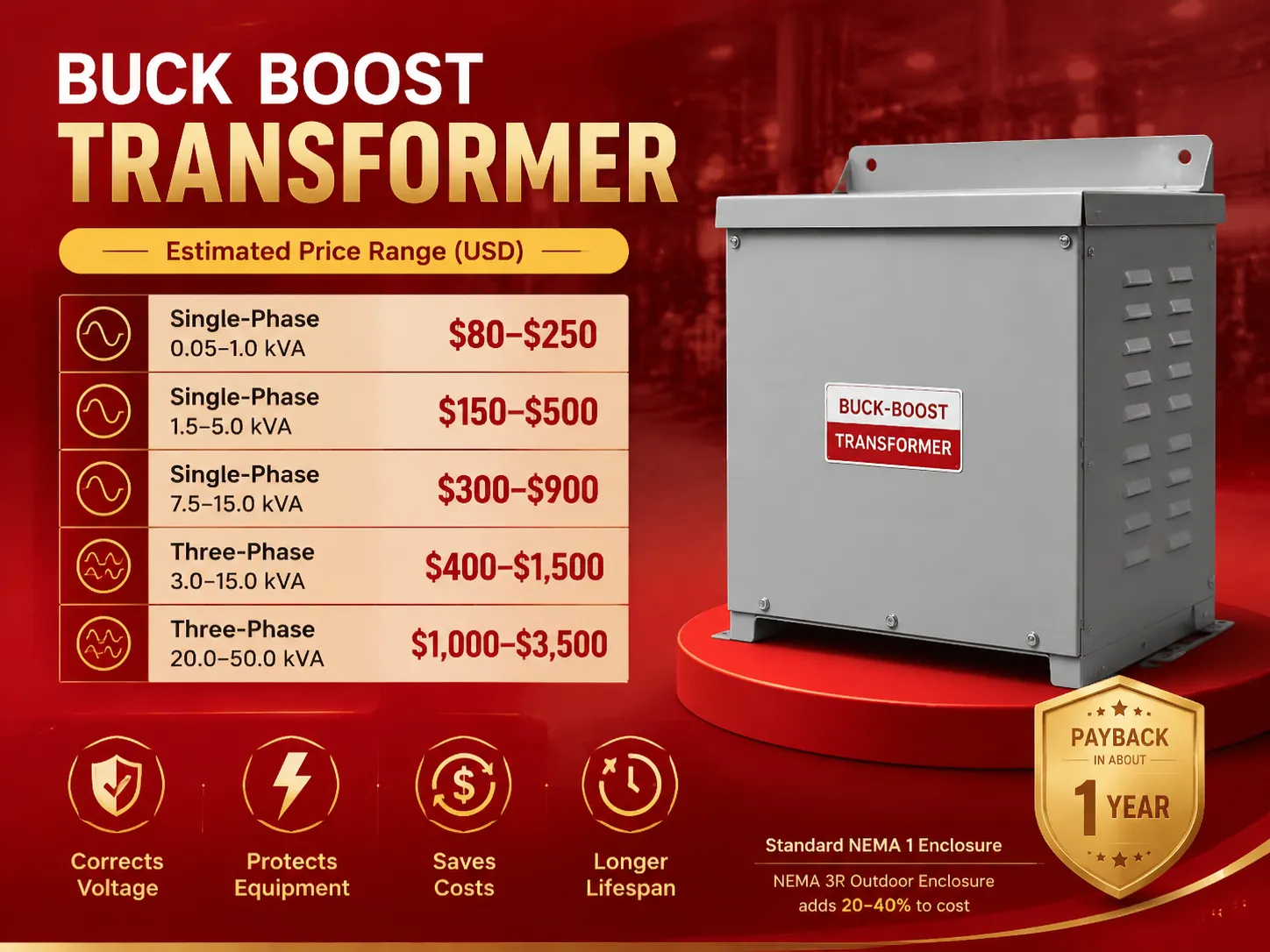
The price of a buck-boost transformer is contingent upon the kVA rating, phase counting and type of enclosure used. The information below gives estimated price ranges for usual single-phase or three-phase models using the information from the experienced manufacturers that supplied the price in the middle of 2025.
| Configuration | Typical kVA Range | Approximate Price Range (USD) |
|---|---|---|
| Single-Phase, 0.05–1.0 kVA | 0.05–1.0 kVA | $80–$250 |
| Single-Phase, 1.5–5.0 kVA | 1.5–5.0 kVA | $150–$500 |
| Single-Phase, 7.5–15.0 kVA | 7.5–15.0 kVA | $300–$900 |
| Three-Phase, 3.0–15.0 kVA | 3.0–15.0 kVA | $400–$1,500 |
| Three-Phase, 20.0–50.0 kVA | 20.0–50.0 kVA | $1,000–$3,500 |
The prices quoted are for standard indoor enclosures with NEMA 1 classification. The NEMA 3R outdoor enclosure raises the cost by 20-40%. A buck boost transformer usually pays for itself within the first year. It helps avoid installing a bigger isolation transformer as well as increases the life of devices operating at the proper voltage. ShineGrand Electric offers buck boost transformer at the required voltages and kVA configurations used in industry and commerce with connection diagrams and installation instruction sheets that make their use easier.For a broader look at the transformer types available, our guide on dry-type transformer types including cast resin and VPI covers the full spectrum of low-voltage transformer technologies.
Frequently Asked Questions
What is the difference between a buck-boost transformer and a regular transformer?
An ordinary transformer, which can be a distribution or an isolation transformer, is fitted so that the primary and secondary windings are electrically isolated, and it transmits the full power of the load from one voltage to another. A buck-boost transformer is used as an autotransformer, with the primary and secondary windings electrically joined in series with the load. It only handles the power that corresponds to the difference between the voltages achieved, which makes it lighter and cheaper than an ordinary transformer with the same kVA capacity.
What is the difference between a step up transformer and a buck-boost transformer?
The main function of a step-up transformer is to transform high voltage, for example, from 13.8 kV to 115 kV, so it should be designed to accommodate the load capacity. On the other hand, a buck lift transformer transforms voltage changes of only a small percentage, e.g. 5-20%, and can only be applied to lower loads due to its autotransformer design. In other words, step-up transformers are highly developed specialized devices for power generation and transmission, while buck lift transformers are comparatively simple devices.
What is the point of a buck-boost converter?
The buck-boost converter is one of the devices that is classified under the category of electronic gadgets. Specifically, it is a kind of DC-to-DC converter device that produces a regulated DC output which can be either greater or smaller than the value of the DC input voltage. The buck-boost converter depends on the use of the switching semiconductors, an inductor, and a capacitor for accomplishing the voltage transformation. The buck-boost converter should not be confused with the buck boost transformer device, which is a DC transformer. Although buck-boost is a term that can be used both in the context of AC transformers and the field of the DC electronics devices, the devices and their uses and how they work are drastically different from each other.
How much does a buck-boost transformer cost?
The price range for a buck-boost transformer varies from around $80 for a minor single-phase device of capacity 0.05 kVA to roughly $3,500 for a 50 kVA three-phase transformer of higher capacity. A common single-phase transformer with a capacity of 1.5-5.0 kVA would cost approximately $150 to $500 depending on the requirements. This price is quite low compared to that of a full isolation transformer of similar capacity.
References
Eaton — Buck Boost Transformer Selection and Application Guide. Manufacturer of buck boost transformers with detailed selection tables, wiring diagrams, and application guidance for single-phase and three-phase configurations.
Schneider Electric — Buck Boost Transformers and Voltage Correction. Manufacturer of buck boost and dry-type transformers with technical documentation and sizing tools.
Acme Electric — Buck Boost Transformer Technical Resources. Specialist manufacturer of dry-type transformers, including buck boost configurations, with published selection guides and connection diagrams.
Jefferson Electric — Buck Boost Transformer Application Notes. Manufacturer of dry-type transformers with educational resources on buck boost theory, selection, and installation.
A buck boost transformer is the economical, compact solution to a specific and common electrical problem: a supply voltage that is close to, but not exactly matching, the voltage that a piece of equipment requires. It makes a small correction — a boost of 5–20% or a buck of a similar magnitude — using a transformer that is physically much smaller and less expensive than a full-capacity isolation transformer because it only processes the power associated with the voltage difference, not the full load power. For the facility manager dealing with imported equipment, the plant engineer correcting for voltage drop on a long feeder, or the electrical contractor adapting a motor to the local supply, a buck boost transformer is the right tool — simple to select, straightforward to wire, and economical to purchase. ShineGrand Electric manufactures buck boost transformers in the standard configurations that these applications demand, with the connection diagrams, the installation instructions, and the test documentation that support a reliable, long-term installation.