In Southeast Asia, when a local power company was in search of a 60 MVA, 115 kV transformer for a substation, the buying department found four potential manufacturers. One was a world-known company with a delivery time of 16 months. One was a local supplier with faulty documentation. One had an offer 30% lower than the market price and was unable to a similar unit in use for over five years. The winner was a specialized supplier that had complete certification according to IEC standards and competitive delivery time. The choice was not made just according to price or brand. The decision was based on having evidence that the transformer would be delivered on time and work properly for decades in harsh tropical conditions. Finding a reliable transformer for the high-voltage electrical installations. This is a complex process that involves checking manufacturers against electrical and locality parameters and confirming that the reliability of the manufacturer is confirmed by tests and references.
What Defines a High-Voltage Substation Transformer
A high-voltage substation transformer is mainly utilized as a power transformer that functions at transmission level voltage, which tends to be higher than 69 kV. The purpose that these transformers serve is to link the transmission grid to the sub-transmission and distribution networks. Whereas a distribution transformer is manufactured and sold at a given standard rating, a substation transformer is custom made. In that vein, its transformer impedance, the ratio of its voltages, its class of cooling, the configuration of the tap changer and the insulation coordination make up the components of the transformer that are engineered to satisfy the stipulated needs of a given substation. An individual transformer is massive, weighing over 200 tons, requiring a solid base as well as oil containment and costing millions to put it in place. The failure of this transformation means that its unreliability is outweighed and invariably makes it unreliable.
Where Reliable Substation Transformers Are Found: The Global Manufacturer Landscape
Due to significant engineering capabilities, testing facilities, and manufacturing capabilities necessary to produce 230 kV transformers, the high-voltage substation transformers market is limited to a handful of manufacturers across the globe. The categories below outline the sources of reliable and quality equipment, including typical manufacturers in each class.
| Manufacturer Tier | Characteristics | Representative Manufacturers | Typical Lead Time |
|---|---|---|---|
| Global Tier-One | Full in-house capability from core steel processing to final test; extensive type-test libraries; global service networks; premium pricing | Hitachi Energy (ABB), Siemens Energy, GE Vernova | 12–20 months |
| Global Tier-Two / Regional Leaders | Strong domestic and regional installed base; IEC-compliant manufacturing; competitive pricing; shorter lead times than tier-one | Toshiba, Hyundai Electric, TBEA, CG Power | 10–16 months |
| Focused Export-Oriented Manufacturers | IEC-certified manufacturing with transparent test documentation; responsive engineering support; competitive pricing with shorter lead times; direct factory relationship | ShineGrand Electric and similar focused manufacturers | 8–14 months |
A first-rate manufacturer possesses 100 years of engineering experience, a worldwide network of contacts, and a service team capable of providing assistance to a defective transformer anywhere in the world. A specialized manufacturer is able to establish a direct relationship with an engineer, express the desire to offer customized solutions, and provide the products at a competitive price and delivery time thanks to a more efficient operating model. Both types of manufacturer can build a reliable transformer. The only difference between them is the variety of test methods, the number of countries the manufacturer has served, and the model of procurement.
How to Verify Reliability Before You Place an Order
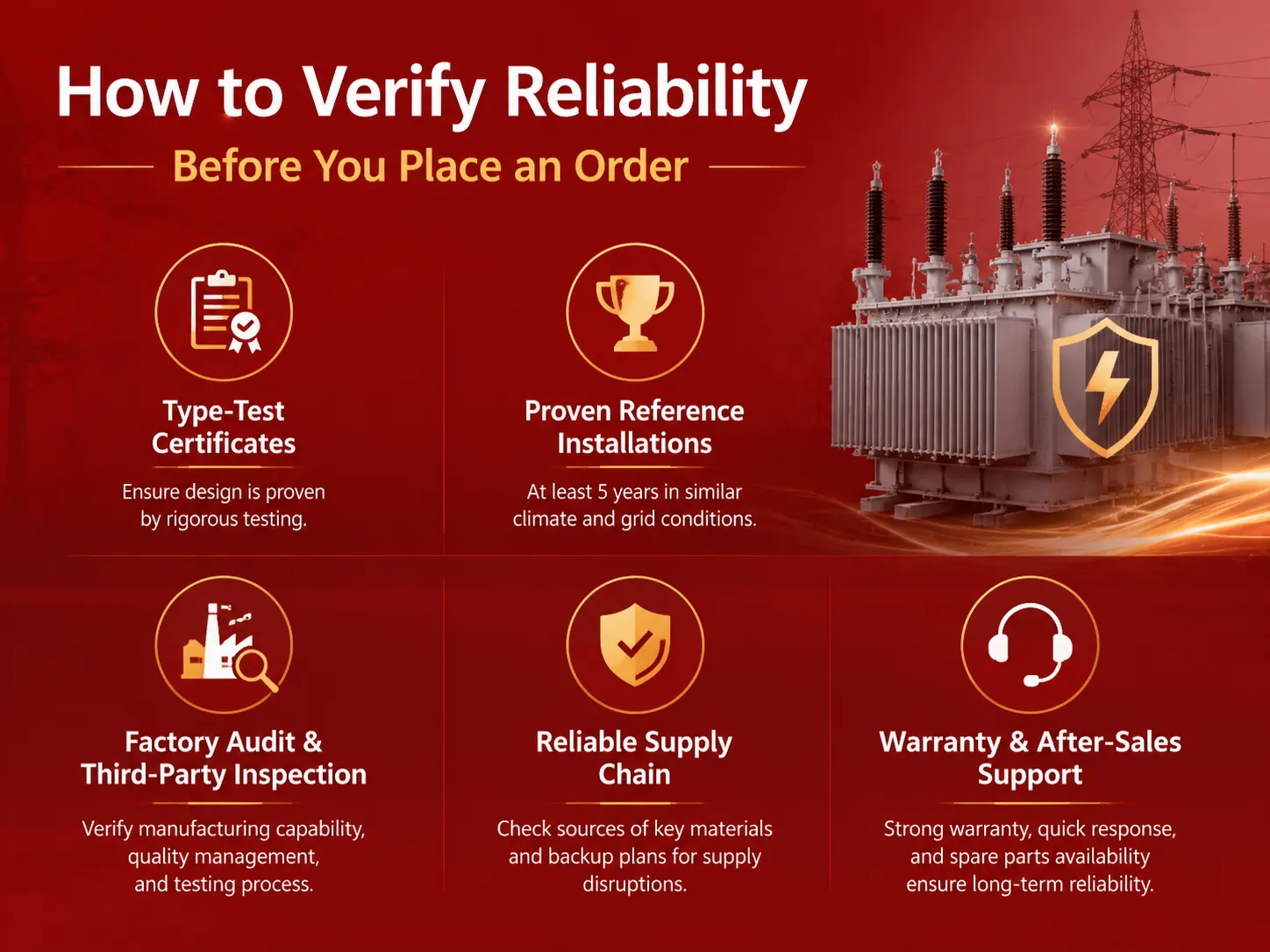
A trustworthy substation transformer does not come from a name but from its proof of reliability. The following verification procedures should be followed before placing a purchase order regardless of the supplier being assessed.
- Request the type-test certificates for a unit of the same voltage class and a similar MVA rating. Type-testing in general allows for certification of the manufacturer’s design through tests such as a temperature rise test, lightning impulse test, and short circuit breaking test. Failure to provide a certificate for similar units states that the manufacturer expects the user to blindly accept a design that has not been tested.
- Request reference installations that have been in service for at least five years in a climate and grid environment similar to your own. Having seen a transformer run reliably in a temperate European substation for 10 years is a good indicator. A transformer that has operated equally well for the same period in a tropical environment, in a lightning-prone or earthquake-prone area, would be even better for customers based in a similar area. Ask for the details of the operator of the installation, and not just for the name of the project.
- Audit the factory or commission a third-party inspection. A tour of a factory shows us both the state of the manufacturing machines, as well as how well the production floor is set up. In case a visit cannot be made, an outside company can conduct pre-qualification checks and evaluate manufacturing abilities, quality management procedures, and testing services.
- Verify the supply chain for critical materials. The performance and durability of a transformer depend on the core steel, winding conductor and insulating pressboard, as well as the bushings. Make sure you ask the manufacturer from where these materials have been sourced and whether it could call upon other suppliers in instances of disruption to the materials supply. A manufacturer that relies on one source for an important component can be considered to have a vulnerable supply chain.
- Review the warranty and the after-sales support commitment. The standard is an assurance of material and craftsmanship for a span of one year from commissioning. A warranty with appropriate response time in regard to technical support combined with maintenance of ready spare parts allows to guarantee that the producer will take their responsibility for the machine for an extended period of time.
What to Expect for Price and Total Cost of Ownership
The MVA rating, voltage class, impedance, type of winding material, cooling class, and tap changer configuration are the main components that determine the price of a substation transformer. Typically, a 30 MVA transformer rated for 115 kV, outfitted with a tap changer and copper windings will cost about $400,000 to $900,000. Conversely, a more powerful 100 MVA transformer rated for 230 kV may cost from $1.5 to $3.5 million. It should be noted that the capital expenditure associated with the purchase of a transformer in such amount is just one element of the total ownership costs. The total cost of ownership includes losses (core no-load losses as well as winding load losses) incurred by the customers for the 30-year lifespan of the transformer, thus costing them more than the initial purchase price. Hence, a more expensive transformer type could be even more cost-effective. The company ShineGrand Electric offers guarantees on losses with each quotation so that every buyer can estimate their total cost of ownership effectively in order to make a better comparison of their options.
How ShineGrand Supports High-Voltage Substation Transformer Procurement
ShineGrand Electric is a manufacturer of power transformers designed for substation uses at voltages of up to 132 kV. The range of products includes oil-immersed power transformers customized to special voltage, impedance, and environmental requirements in every case. Our Engineering Department cooperates with utility companies, EPC contractors, and industries in order to prepare specifications matching such parameters as primary and secondary voltages, vector group and impedance, cooling class, tap changer design, as well as environmental conditions that can be expected at the site of installation. Each transformer produced by ShineGrand is tested at the factory in strict compliance with the standards provided by IEC 60076, and a report detailing the results of such tests is provided with every product.Our product range includes 35 kV high-performance oil-type power transformers and 110-132 kV oil-immersed distribution transformers, with the engineering capability to extend to higher voltage classes for specific project requirements. For buyers who need a reliable substation transformer with transparent test documentation, competitive lead times, and a direct engineering relationship, ShineGrand provides a focused, responsive alternative to the global tier-one brands.
Frequently Asked Questions
What is the typical lead time for a high-voltage substation transformer?
The delivery time for a high-voltage substation transformer generally varies from 8 to 20 months according to the vendor, voltage class, MVA rating, and specifications needed. Leading global manufacturers can expect lead times of around 12 to 20 months. Dedicated manufacturers with direct access to factories may often achieve deliveries within a shorter time frame of 8 to 14 months. The lead time should be clarified during the quotation phase and should cover the factory acceptance test, shipment, and installation.
How do I evaluate whether a manufacturer is truly reliable?
When evaluating a transformer manufacturer, you should seek type-test certificates for equipment with the same voltage class and MVA, interview references who have used the manufacturer’s equipment for a minimum of five years in a similar environment, audit the factory or arrange for a third-party inspection, and check the warranty terms and after-sales support system. Any manufacturer who makes this information available is more trustworthy than one who does not.
What is the difference between a power transformer and a distribution transformer?
Power transformers operate at transmission voltages (generally 69 kV and above) and link transmission networks to sub-transmission systems or to distribution networks. They are custom-designed machines with a power rating usually greater than 20 MVA. Distribution transformers work at medium voltages (frequently between 2.4 kV and 34.5 kV) and reduce the voltage to the level used in homes and businesses. The power transformers are less compact and less costly than distribution transformers.
Can a single manufacturer supply both the transformer and the associated substation equipment?
Yes, some manufacturers and suppliers can provide a package that includes the power transformer, the disconnect switches, the surge arresters, the instrument transformers (CTs and VTs), and the protection and control equipment. ShineGrand Electric’s product range includes not only power transformers but also outdoor disconnect switches, fuse cutouts, and surge arresters — the ancillary equipment that a substation transformer requires for protection and connection. Procuring these components from a single manufacturer simplifies logistics, ensures compatibility, and provides a single point of responsibility for the electrical package.
References
- Hitachi Energy — Power Transformers for Substation Applications. Global manufacturer of high-voltage power transformers with extensive type-test libraries and a worldwide service network.
- Siemens Energy — Transmission Products and Power Transformers. Manufacturer of power transformers for generation, transmission, and industrial applications up to the highest voltage classes.
- GE Vernova — Grid Solutions and Power Transformers. Manufacturer of large power transformers for utility and industrial substation applications.
- U.S. Department of Energy — Large Power Transformers and the U.S. Electric Grid. Report on the global supply chain for large power transformers and the characteristics of reliable manufacturers.
Finding reliable high-voltage substation transformers is a process of verification, not a brand-selection exercise. The most recognised name in the industry can produce a transformer that fails if it is specified incorrectly, tested inadequately, or installed without regard for the site conditions. The focused manufacturer who provides complete type-test documentation, a verifiable reference list, and a transparent factory test report can deliver a transformer that operates reliably for decades. The difference lies in the evidence — the type-test certificates, the reference calls, the factory audit, and the supply-chain transparency — that the buyer demands before the order is placed. ShineGrand Electric welcomes that scrutiny, with the documentation, the testing, and the engineering support that turn a transformer purchase from a leap of faith into a verifiable, long-term investment.