The proprietor of a small manufacturing company in Laguna required a 500 kVA dry-type transformer for a new processing line and got quotations from three vendors having a difference of almost 40%. The lowest quotation was from a local dealer who was supplying a used machine with a warranty of six months. The highest quotation was from a multinational company’s approved distributor who was quoting a delivery time of 12 weeks with five-year warranty. The medium quotation was from a producer of transformers with an attractive offer as they promised the delivery of an acknowledged machine within five weeks and gave all test reports. It makes it clear that the question is how much a transformer costs in the Philippines cannot be answered straight away as the price depends upon a number of factors like kVA ratio, class of voltages, the kind of cooling technology used, winding material, necessary certificates, and documents. This guide gives examples of prices in the Philippines for different types of transformers and explains what is taken into account when fixing the price.
Transformer Costs by Type and Size in the Philippine Market
In the Philippines, the electrical system utilizes a nominal frequency of 60 Hz and utilizes distribution voltages, like 13.8 kV, 20 kV, and 34.5 kV when referring to the primary side and 240/460V and 400/230V when referring to the secondary side. In general, the different varieties of transformers that the country uses range from lesser single-phase pole-mounted types intended for home uses to bigger three-phase types that work in industrial venues. The table given below gives approximate prices of the best-selling varieties according to mid-2025 data from Philippine electrical companies and manufacturers. The prices provided are even in both Philippine Pesos and US Dollars and include ex-works or delivered pricing of brand new units meeting IEC standards.
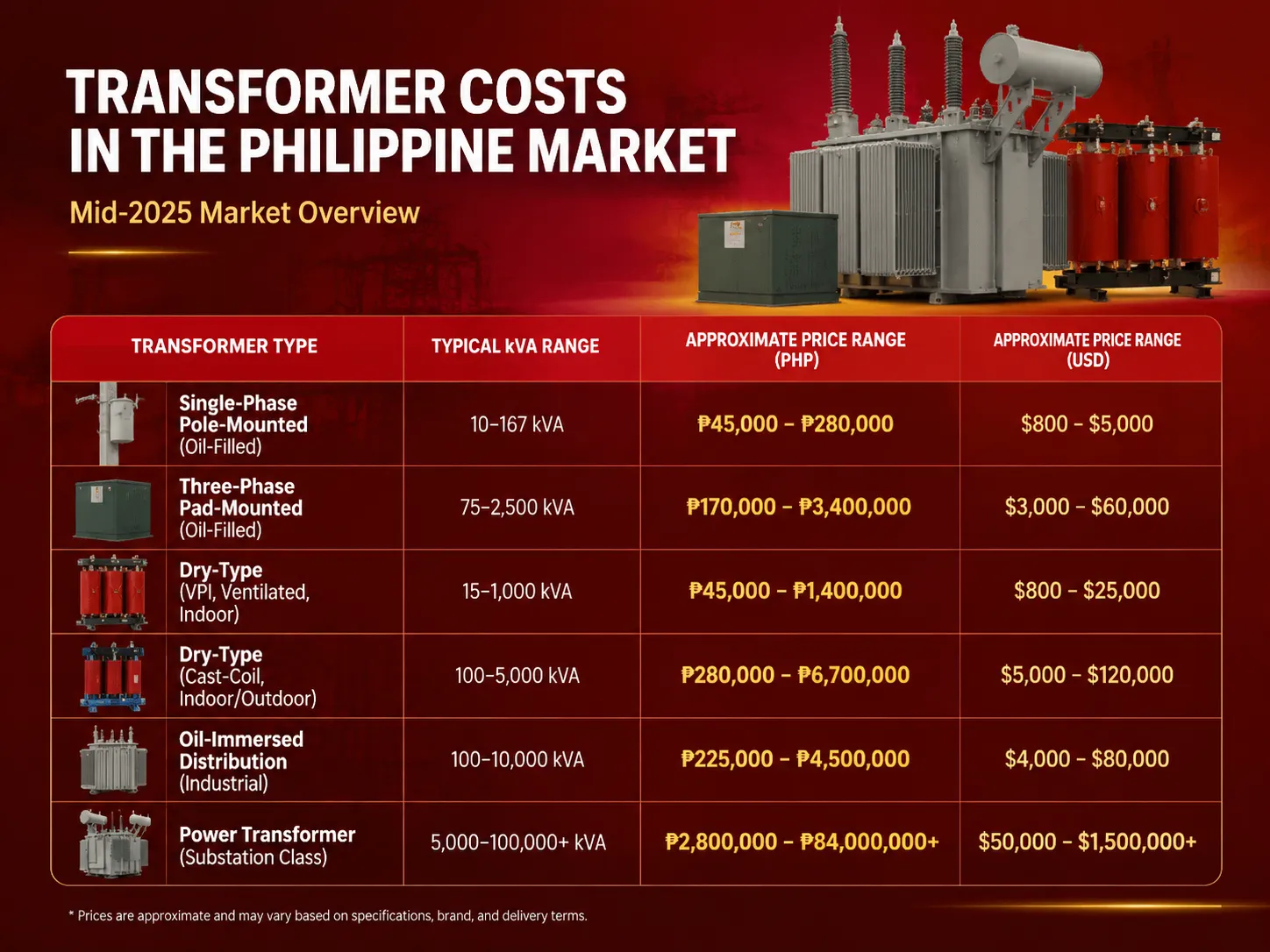
| Transformer Type | Typical kVA Range | Approximate Price Range (PHP) | Approximate Price Range (USD) |
|---|---|---|---|
| Single‑Phase Pole‑Mounted (Oil‑Filled) | 10–167 kVA | ₱45,000 – ₱280,000 | $800 – $5,000 |
| Three‑Phase Pad‑Mounted (Oil‑Filled) | 75–2,500 kVA | ₱170,000 – ₱3,400,000 | $3,000 – $60,000 |
| Dry‑Type (VPI, Ventilated, Indoor) | 15–1,000 kVA | ₱45,000 – ₱1,400,000 | $800 – $25,000 |
| Dry‑Type (Cast‑Coil, Indoor/Outdoor) | 100–5,000 kVA | ₱280,000 – ₱6,700,000 | $5,000 – $120,000 |
| Oil‑Immersed Distribution (Industrial) | 100–10,000 kVA | ₱225,000 – ₱4,500,000 | $4,000 – $80,000 |
| Power Transformer (Substation Class) | 5,000–100,000+ kVA | ₱2,800,000 – ₱84,000,000+ | $50,000 – $1,500,000+ |
The price list provided earlier does not represent any lethal figures. The actual cost of the particular transformer depends on the kVA rating, primary and secondary voltage, impedance, type of the winding material (copper or aluminium), efficiency level, as well as special specifications required for the transformer. For example, it can be a stainless steel enclosure for coastal installations, higher voltage for thunderstorm-prone area, or a special specification for painting in aggressive environment. The equipment which comply with Philippine Electrical Code and local utility regulation will surely cost more because of its compliance with the applicable regulations.For help with the technical specification before requesting a quote, our guide on how to get the best transformer quotation explains what a complete, comparable quotation should contain.
What Drives the Price of a Transformer in the Philippines
The cost of two transformers that are rated at 500 kVA can significantly vary from each other. The reasons for such price variability are similar to those in any IEC-compliant market all over the world, with some factors specific to the Philippines that potential customers ought to take into account.
- kVA rating. The main cause of cost. The price increases nearly in a straight line with kVA increase until it reaches around 2500 kVA before increasing further as the design moves to a bigger frame size and more heavier core and coil assembly.
- Voltage class. Insulation, clearances, and bushings for 34.5 kV transformers are much more expensive than the same equipment for 13.8 kV transformers. Additionally, there is a direct correlation between the cost and the voltage.
- Winding material. Copper coils are pricier than their aluminum counterparts but they allow for more efficient designs, reduced losses, and longer operational life. In the Philippines, several utility companies and large industrial buyers prefer copper coils; small commercial buyers may choose aluminum in order to lower the project costs.
- Cooling technology. Usually, oil-filled transformers are less costly than dry-type transformers of the same KVA rating. Between dry types, the cast coil type is more costly than VPI because of the superior moisture and chemical resistance due to the epoxy encapsulation.For a deeper understanding of the cast‑coil construction and its advantages, our guide to dry‑type transformer types including cast resin and VPI explains the technology distinctions.
-
- Efficiency and losses. The manufacturing of transformers with reduced no-load losses (because of improved core steel, such as amorphous alloy) and reduced load losses (resulting from the use of larger conductor cross-section) is more expensive, but the cost difference is compensated with lower utility costs during the transformer’s lifetime of 20–30 years. In the Philippines, with one of the highest industrial electricity prices in Southeast Asia, the return on investment in high-efficiency transformers is particularly attractive.
- Import duties, freight, and logistics. Transformers that are imported from Europe, North America, or Northeast Asia will incur freight costs, custom duties, and VAT, which together would mean an increase of 15–30% in the ex-works price. Purchasing a unit from a supplier that has a distribution partner or sells directly in the Philippines for instance, ShineGrand Electric, who have both options.
- Certification and testing. A transformer that comes with all necessary documents such as routine test report, type test certificate and material trace documentation costs more than a transformer that comes with a simple declaration of conformity. In the case of a buyer who needs to satisfy a Meralco inspector, a plant’s insurance company or an ISO auditor, having the necessary documentation is a must.
Installation, Commissioning, and Additional Costs
The cost of the transformer is just one portion of the total cost of the project. In the Philippines, usually, installation and commissioning are carried out by a local electrical contractor, and the price varies depending on the size of the transformer, its location, and how complicated it is to be connected. The following table gives approximate ranges for the extra expenses which the buyer should take into account.
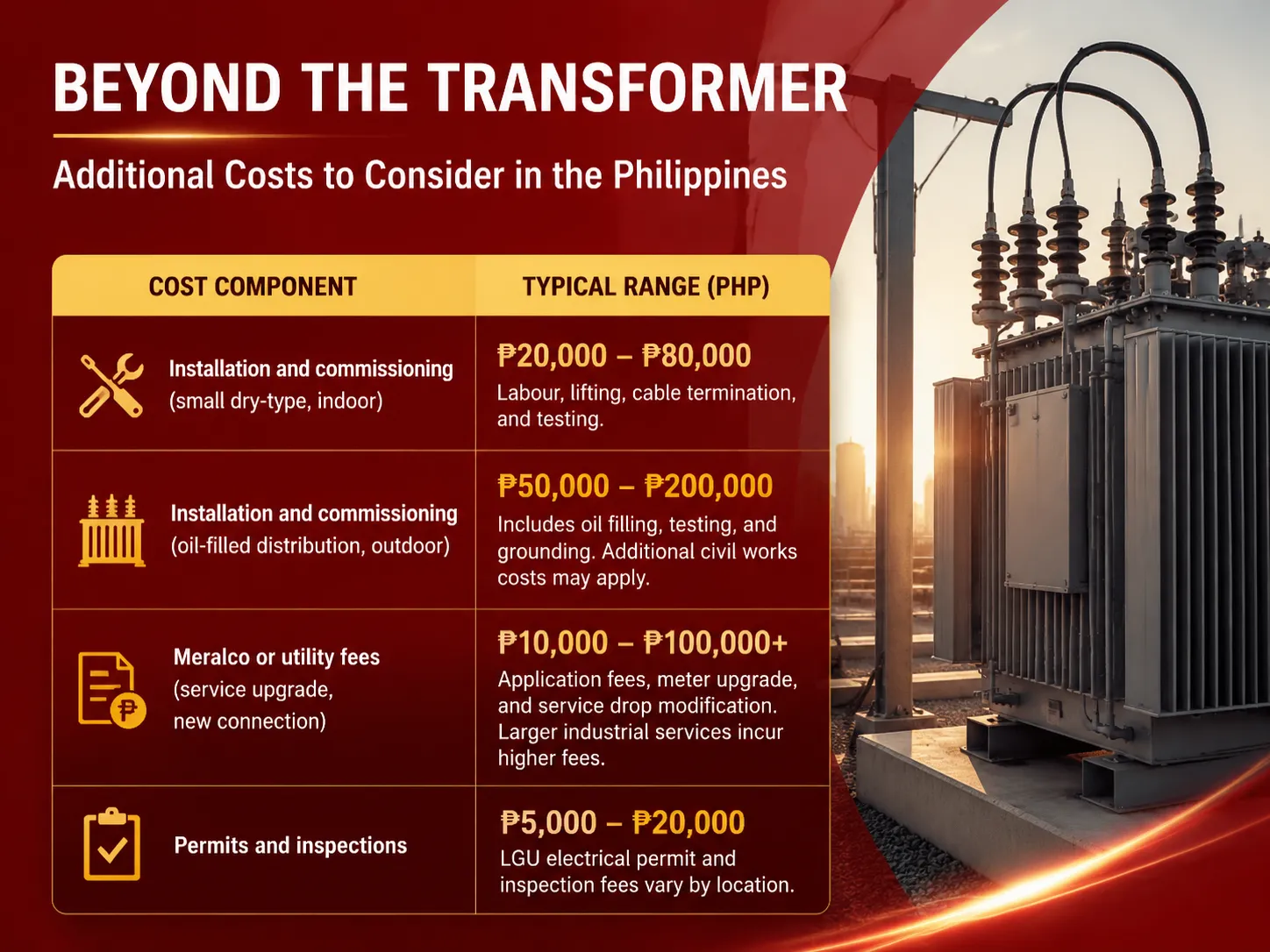
| Cost Component | Typical Range (PHP) | Notes |
|---|---|---|
| Installation and commissioning (small dry‑type, indoor) | ₱20,000 – ₱80,000 | Labour, lifting, cable termination, and testing. A simple panel‑adjacent installation is at the lower end; a unit requiring a crane or a new concrete pad is at the higher end. |
| Installation and commissioning (oil‑filled distribution, outdoor) | ₱50,000 – ₱200,000 | Includes oil filling, testing, and grounding. A pad‑mounted unit in a subdivision requires a concrete pad and safety fencing, which are additional civil works costs. |
| Meralco or utility fees (service upgrade, new connection) | ₱10,000 – ₱100,000+ | Application fees, meter upgrade, and service drop modification. Larger industrial services incur higher fees. Contact the local utility for a specific quotation. |
| Permits and inspections | ₱5,000 – ₱20,000 | Local government unit (LGU) electrical permit and inspection fees, which vary by city and municipality. |
Where to Buy a Transformer in the Philippines: Major Brands and Suppliers
The Philippines has a transformer market that consists of both international as well as local producers. Some of the major brands available in this region include:
- Global tier‑one manufacturers – ABB (Hitachi Energy), Siemens, and Schneider Electric – all have a direct presence along with a distribution network in the Philippines. They manufacture transformers which have been specified in big industries, utility substations and in projects which require brand name and a global service network to procure the transformer. Their pricing is on the higher end and it also takes longer to get custom specifications.
- Domestic Philippine manufacturers and assemblers – Manufacturers of transformers for distribution serve the needs of local utilities and industries. The prices are attractive, and the delivery time is usually shorter than for imports. However, they usually have a limited line of standard distribution ratings and voltages of products. If you are looking for specialised dry or cast coil transformers, the local manufacturer may be unable to provide the right equipment for the vacuum casting process or partial discharge test.
- Asian manufacturers with direct export channels — including ShineGrand Electric — provide a mid‑range alternative that combines IEC‑compliant manufacturing, complete test documentation, and competitive pricing with shorter lead times than the tier‑one global brands. ShineGrand’s product range includes SCB series epoxy cast‑coil dry‑type transformers from 6‑10 kV, 20‑35 kV cast‑coil dry‑type transformers for industrial and renewable energy applications, and SCBH series amorphous alloy core transformers that reduce no‑load losses by up to 70% — a significant advantage in the Philippine market where industrial electricity costs are high. Every ShineGrand transformer ships with its routine test report, including partial discharge measurement, and the engineering team works directly with Philippine buyers to match the unit’s voltage, impedance, and enclosure to the specific installation environment.
Do You Need a Voltage Converter or a Transformer in the Philippines?
This is a frequent misconception for homeowners and small businesses in the Philippines, where the electricity system runs on 220/240 volts at a frequency of 60 Hz. Anyone who imports electrical equipment from the USA, where the power supply is 120 volts with 60 Hz frequency, or from Japan, where it is 100 volts and 50/60 Hz frequency, will require a voltage converter to change 220 volts of the local supply into 120 or 100 volts depending on the country of origin. Just put, a voltage converter is a small plug-and-use device priced at several thousand PHP. It is not a distribution transformer. While the former is a ready-to-use device that can easily be used by consumers, the latter is a permanent electrical infrastructure that lowers the utility’s medium voltage to the construction level of a building or a factory. Two devices are fundamentally different from each other, although it is common to confuse them, thereby using information provided in this guide on the pricing of distribution transformers for the needs of voltage converters.
Frequently Asked Questions
How much do transformers cost?
The cost of a transformer ranges from less than ₱50,000 for a tiny single phase pole-mounted device to more than ₱80 million for a substantial power transformer situated in the station. The pricing depends on kVA, voltage, cooling technique, type of winding, efficiency, and certification. For example, a 500 kVA dry-type transformer used in a commercial structure will cost anywhere between ₱400,000 to ₱1,400,000, depending on its design (either VPI or cast-coil) and the winding type.
Is Transformers popular in the Philippines?
It is safe to assume that the issue is not related to electrical devices, rather, it relates to the franchise. Whenever anyone talks about transformers, they mean those power equipment, which is vital for the Filipino energy sector.
Since every house, factory, and residential subdivision in the country relies on transformers to reduce the voltage down to practical levels, they are not “popular”, as in consumer terms.
How much is a brand new transformer?
A new transformer can range from around ₱45,000 for a small single-phase pole transformer to a million pesos for a big industrial transformer. The price will depend on the kVA rating, voltage range, cooling method, and winding material. A new transformer from a licensed manufacturer will be more expensive than a refurbished or undocumented one, but the reliability in the long run, in addition to compliance with security rules and insurance standards, will make this investment worthwhile.
Do I need a voltage converter in the Philippines?
In situations where a 120-volt appliance is to be used in the Philippines, one would require a step-down voltage converter, which is a consumer gadget, not a distribution transformer. In order to connect an industry or building to the electricity grid, a distribution or power transformer, which is a piece of electrical equipment that is permanently installed, will be required.
How much does one transformer cost?
Depending on the kVA rating, voltage and cooling method, as well as the efficiency level, the cost of a transformer can range from below ₱50,000 to more than ₱80 million. To estimate the cost accurately, it is important to mention the parameters and ask the manufacturer or an authorized distributor for a detailed quotation about all the items included.
What are the 4 types of transformers?
The oil-filled distribution transformers which are commonly used are pole-mounted and pad-mounted transformers used in utility operations, as well as by residential houses. Apart from these transformers there are dry-type transformers, which are divided into 2 fundamental types namely: VPI and cast-coil dry-type transformers which are suitable for the indoor use and also used in the places where the fire safety is also concerned.In addition to these transformers there are power transformers capable of handling high voltage power supply, which are used undergone electricity transmission too.
References
- Meralco — Distribution Transformer Specifications and Service Requirements. The largest Philippine electric utility’s technical specifications for transformers connecting to its distribution network.
- Philippine Department of Energy — Electrical Equipment Standards and Efficiency Requirements. Regulatory standards for transformers sold and installed in the Philippines.
- IEC 60076 — Power Transformers. The international standard for transformer design, testing, and performance, adopted in the Philippine Electrical Code.
- Siemens Philippines — Distribution and Power Transformers. Global manufacturer with a local Philippine presence, providing a reference point for premium‑brand pricing.
The cost of a transformer in the Philippines is a function of what the transformer must do, the voltage it must handle, the environment it will operate in, and the documentation it must carry. A small pole‑mounted unit for a residential connection costs tens of thousands of pesos. A cast‑coil dry‑type unit for a semiconductor plant or a pharmaceutical factory costs millions. In every case, the right investment is the one that matches the transformer’s specification — its kVA, its impedance, its cooling class, its efficiency — to the real demands of the load, and that arrives with the test reports and the certifications that the local utility, the plant insurer, and the regulatory inspector will require. ShineGrand Electric supplies transformers across that full spectrum, with the transparent pricing, the documented quality, and the responsive engineering support that Philippine buyers need to make a confident, long‑term capital decision.